SOLAS is the International Maritime Organization’s convention setting minimum safety standards for the construction, equipment, and operation of merchant ships. For anyone loading containers today, the most urgent operational obligation is simple: the shipper must verify and submit the Verified Gross Mass, or VGM, before the terminal will load that container onto a vessel.
That single requirement, born from a 2016 amendment, trips up more shipments than almost any other SOLAS rule. The convention itself, formally the International Convention for the Safety of Life at Sea,-1974.aspx), dates to 1974 and has been amended repeatedly since. It sits alongside a family of related instruments, the IMSBC Code for bulk cargoes, the IMDG Code for dangerous goods, and the International Grain Code for grain shipments, all of which shippers and carriers need to know to move cargo without delay.
Here’s what matters immediately if you’re moving freight this week:
- Definition: SOLAS 1974, maintained by the IMO, sets baseline safety requirements for merchant vessels worldwide.
- VGM rule: Every packed container needs a verified gross mass on file before loading; no VGM generally means no loading.
- Governing codes: The IMSBC Code, IMDG Code, and International Grain Code fill in the operational details SOLAS references but doesn’t spell out in full.
- Who enforces it: Flag states, port state control, and terminal operators all have a hand in checking compliance.
Key Takeaways
SOLAS compliance succeeds when shippers treat VGM verification as a contractual, documented responsibility rather than a last-minute weighing task.
| Point | Details |
|---|---|
| SOLAS sets the baseline | The 1974 convention establishes minimum safety standards for merchant ship construction, equipment, and operation. |
| VGM is non-negotiable | Containers generally cannot be loaded without a verified gross mass submitted before the terminal cut-off. |
| Two methods, one liability | Shippers can weigh the packed container or sum package weights plus tare, but remain liable even if a third party submits the data. |
| Codes work together | The IMSBC Code, IMDG Code, and International Grain Code fill in commodity-specific rules that SOLAS references but doesn’t fully detail. |
| Worldwideexpress supports compliance | Worldwideexpress’s freight forwarding and customs brokerage services help integrate VGM checks into standard pre-carriage workflows. |
Table of Contents
- What Does SOLAS Cover, and Who Does It Apply To?
- How Has SOLAS Evolved Since 1914?
- Which SOLAS Chapters Actually Affect Cargo Operations?
- How Do You Comply With VGM Requirements?
- What Are the Stowage and Bulk Cargo Rules Under SOLAS?
- What Happens When SOLAS Rules Aren’t Followed?
- What Should a SOLAS Compliance Checklist Include?
- Where Worldwideexpress Fits Into Your Compliance Plan
- Sources
What Does SOLAS Cover, and Who Does It Apply To?
SOLAS applies to merchant ships engaged in international voyages, covering everything from hull construction and fire protection to life-saving equipment and cargo securing. It does not typically apply to warships, fishing vessels, or pleasure yachts, though individual flag states sometimes extend similar standards to those categories anyway. If you’re chartering, forwarding, or exporting cargo that moves by sea on a commercial vessel, SOLAS almost certainly touches some part of that shipment.
Two enforcement layers do the actual work. The flag state, the country where a vessel is registered, bears primary responsibility for certifying that ships under its flag meet SOLAS standards. Port state control then acts as a second check: inspectors at destination or transit ports can detain a vessel, delay cargo operations, or demand corrections if they find deficiencies. Ship masters retain real discretion here too. A master can refuse to load cargo that appears to threaten the vessel’s stability or the crew’s safety, regardless of what paperwork says.
SOLAS rarely operates alone. It works in tandem with several other IMO instruments, and knowing where each one picks up matters for day to day compliance:
- IMDG Code governs the classification, packing, and labeling of dangerous goods referenced under SOLAS Chapter VII.
- IMSBC Code sets requirements for solid bulk cargoes, particularly those that can shift or liquefy in transit.
- International Grain Code applies specifically to bulk grain shipments and their stability calculations.
- MARPOL handles pollution prevention, overlapping with SOLAS on fuel and emissions equipment.
- ISM Code governs the safety management systems that shipping companies must maintain fleet wide.
A cargo that seems straightforward, say, a container of machinery parts, might touch three or four of these instruments before it clears the terminal gate. Knowing which one applies to your specific commodity saves time you’d otherwise lose to a rejected booking.
How Has SOLAS Evolved Since 1914?
SOLAS traces back to the Titanic disaster, but the version shipping teams work with today bears little resemblance to that original 1914 text. Understanding the timeline helps explain why certain rules exist and why some feel newer than others.
- 1914: The first SOLAS convention emerges directly from the Titanic inquiry, focused mainly on lifeboats and radio watch requirements.
- 1960: A significant revision modernizes the convention and brings it under the newly formed IMO’s oversight.
- 1974: The current base convention is adopted, using a tacit acceptance procedure that makes future amendments faster to implement.
- 1988: Amendments introduce the Harmonized System of Survey and Certification, streamlining inspection schedules across flag states.
- 2014: The Maritime Safety Committee adopts amendments to regulation VI/2 requiring verified container weights.
- 2016: The VGM requirement takes effect on July 1, permanently changing shipper obligations for containerized cargo.
The change taking effect in mid-2016 matters more to today’s logistics managers than earlier amendments, because it shifted a specific, documented burden onto the shipper rather than the carrier or terminal. For the full consolidated text and every amendment since, the UN Treaty Series holds the official record, while the IMO maintains its own consolidated editions for practical reference.
Which SOLAS Chapters Actually Affect Cargo Operations?
SOLAS spans fourteen chapters, but three or four of them do almost all the work that touches day-to-day freight movement. Knowing which chapter governs which decision saves confusion when a terminal or carrier cites “SOLAS requirements” without specifying further.
Chapter VI, Carriage of Cargoes and Oil Fuels, is the one most shipping professionals will reference constantly. It requires shippers to provide accurate cargo information before loading, covers the VGM obligation, and sets rules for securing cargo so it doesn’t shift during a voyage. National guidance like the UK’s Annex A to MGN-699-M breaks Chapter VI’s regulation 2 (cargo information and VGM) and regulation 5 (packing and securing) into practical checklists that shippers can actually follow.
Chapter V, Safety of Navigation, governs voyage planning, meteorological services, and the carriage of navigational equipment. It rarely affects individual shipments directly, but it shapes how carriers schedule routes and respond to weather, which indirectly affects transit times and cargo condition on arrival.
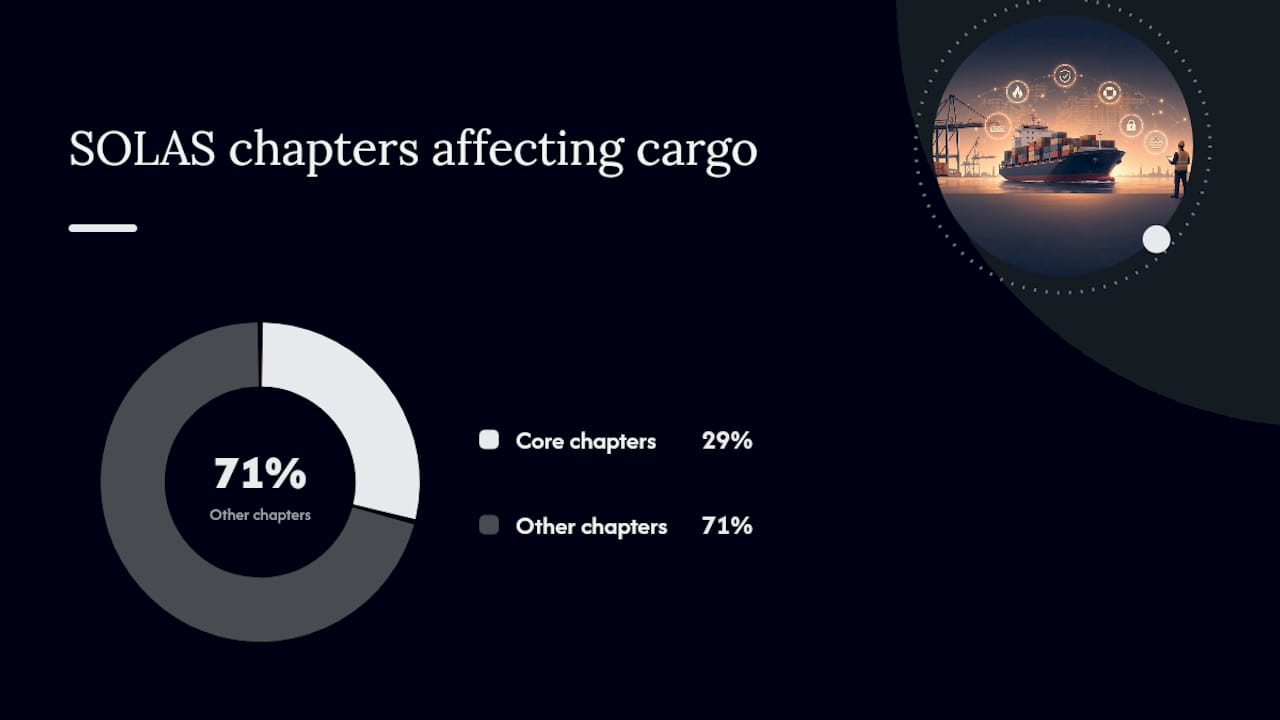
Chapter II-1 and Chapter III deal with ship construction, stability, and life-saving appliances. These matter to cargo operations mainly through stability calculations: a vessel’s loading plan has to account for how cargo weight and placement affect the ship’s center of gravity, which is exactly why inaccurate VGM data creates real safety risk, not just a paperwork problem.
Several operational obligations flow directly from these chapters:
- Shippers must supply advance cargo information, including the VGM, before the cargo can be loaded.
- Cargo has to be stowed and secured according to an approved Cargo Securing Manual specific to that vessel.
- Masters need access to accurate stability and loading manual data before finalizing a stowage plan.
- Documentation covering hazardous or bulk cargo characteristics must remain available on board throughout the voyage.
Where SOLAS references other codes rather than spelling out full technical detail, those codes carry legal weight of their own. The IMSBC Code, IMDG Code, and International Grain Code function almost as extensions of Chapter VI and Chapter VII, filling in commodity-specific requirements that a single convention chapter couldn’t reasonably cover on its own. Skipping one of those referenced codes because “SOLAS didn’t mention it directly” is a common and costly misreading of how the framework actually fits together.
How Do You Comply With VGM Requirements?
The VGM rule sounds simple on paper: verify the weight, submit it, load the container. In practice, it’s the single most common source of delay and dispute in containerized shipping today, mostly because the mechanics of “verify” and “submit” involve more coordination than most shippers expect.
Two approved methods exist, and choosing the wrong one for your operation causes most of the friction. Method 1 involves weighing the entire packed container on a certified scale after it’s sealed. Method 2 allows the shipper to weigh each package and pallet individually, then add the container’s tare weight, listed on the door of the container itself, to get the total. The IMO’s guidelines on gross mass verification confirm both methods carry equal legal standing, but Method 2 tends to suit shippers packing their own cargo with known component weights, while Method 1 works better for consolidated or third-party-packed containers where individual weights aren’t reliably known.
Timing is where most VGM failures actually happen. Terminals set their own cut-off times for receiving VGM data, often well before the physical cargo cut-off, and missing that window can bump a container off its booked vessel regardless of how accurate the weight turns out to be. The SOLAS Chapter VI text itself requires the shipper to ensure the VGM appears in the shipping document, signed by a person authorized by the shipper, and submitted far enough ahead that it can be used in the stowage plan.
A practical workflow for getting this right looks like this:
- Determine which verification method fits your packing process before the shipment is booked, not after.
- Confirm your scale has current calibration certification; uncalibrated equipment invalidates the entire VGM regardless of the number it produces.
- Assign a named, authorized signatory for the VGM declaration and document that authorization in writing.
- Submit the VGM through your carrier’s accepted format, EDI, port community system, or the specific web portal, well before the terminal’s stated cut-off.
- Reconcile the submitted VGM against your packing list before departure to catch data entry errors early.
Delegation adds another layer worth planning for. Maritime NZ’s guidance makes clear that shippers remain legally responsible for the VGM even when a freight forwarder or packing agent submits it on their behalf. If you’re authorizing a third party to handle submission, put that authorization in writing, keep an audit trail, and specify liability terms in your service contract rather than assuming it’s implied.
Pro Tip: Build VGM verification into your pre-carriage checklist as its own line item, not a subtask under “documentation.” Teams that treat it as an afterthought are the ones who discover a missed cut-off after the vessel has already sailed.
The failure modes are predictable: missed submissions, late data that arrives after cut-off, and inaccurate weights from uncalibrated scales or outdated tare figures. Each one carries a real cost. Terminals may re-weigh the container at the shipper’s expense, bump the booking to the next available vessel, or in some cases refuse the cargo outright until the discrepancy is resolved. Building a fallback agreement with your terminal, spelling out who pays for re-weighing and under what circumstances, closes a gap that otherwise turns into a dispute after the fact.
What Are the Stowage and Bulk Cargo Rules Under SOLAS?
Cargo securing isn’t optional guidance, it’s a documented requirement. SOLAS Chapter VI obligates vessels to carry an approved Cargo Securing Manual specific to that ship, detailing how different cargo types must be lashed, blocked, or braced for the voyage ahead. Packing and securing cargo outside that manual’s parameters is a compliance failure even if the cargo arrives intact.
Bulk and grain cargoes carry their own additional layer. The IMSBC Code applies to solid bulk cargoes, particularly ones prone to shifting or liquefaction, like certain mineral concentrates, and sets requirements for moisture content testing and stowage angles. The International Grain Code governs bulk grain specifically, requiring vessels to carry a Grain Stability Booklet approved by the flag state and, in many cases, a Document of Authorization confirming the ship can safely carry grain in its intended configuration.
A few operational practices follow directly from these requirements:
- Pre-loading documentation must confirm cargo moisture content and stability characteristics for IMSBC-covered bulk cargoes.
- Certain bulk cargoes require gas detection or oxygen monitoring during the voyage due to off-gassing risk.
- Grain Stability Booklets and Documents of Authorization need flag state approval and, often, translation if the vessel operates under a different flag than its trading region.
Skipping these steps doesn’t just risk a safety incident. It routinely results in cargo rejection at the load port before the vessel ever departs.
What Happens When SOLAS Rules Aren’t Followed?
Enforcement runs through three channels working together: flag state administrations certifying vessel compliance, port state control inspecting ships at call, and terminal operators applying their own booking and loading policies on top of the legal minimum. A container can be technically SOLAS-compliant and still get rejected by a terminal that has stricter internal cut-off rules.
The consequences tend to compound rather than stay isolated. A missing VGM commonly triggers a mandatory re-weigh at the shipper’s cost, which pushes the container past its vessel cut-off, which then triggers storage and demurrage charges while it waits for the next available sailing. Industry practitioners report these downstream costs often exceed the original weighing fee many times over, since a bumped booking can mean days of delay rather than hours.
Mitigating this starts with the contract, not the terminal counter. Specify in your service agreements who bears re-weighing costs if a third party submits an inaccurate VGM, confirm your cargo insurance covers delay-related exposure, and keep an escalation contact at your terminal for containers that arrive without complete documentation.
What Should a SOLAS Compliance Checklist Include?
A workable compliance process doesn’t need to be complicated, but it does need clear ownership at every step:
- Verify your scale’s calibration certificate is current before relying on it for any VGM submission.
- Write VGM responsibility explicitly into contracts with forwarders and packing agents, including who holds liability if the data is wrong.
- Standardize on accepted submission methods (EDI, port portal, or carrier-specific format) so nothing depends on manual re-entry.
- Set internal cut-off deadlines ahead of the terminal’s published cut-off to leave room for corrections.
- Maintain a signed authorization on file for anyone submitting VGM data on the shipper’s behalf.
- Use a templated VGM form and reconcile it against the packing list before final submission.
Shippers hold the legal responsibility for VGM accuracy even when someone else pushes the button on submission, so the paper trail matters as much as the number itself.
A Freight Operations View on Making This Work
In practice, most VGM failures aren’t about the rule itself, they’re about handoffs. A packer weighs cargo correctly, but the number never reaches the person authorized to sign the shipping document before the terminal’s cut-off. Building VGM verification into the same checklist as booking confirmation, rather than treating it as a separate documentation task, closes that gap. Worldwide Express’s freight forwarding and customs brokerage services exist partly to catch these handoff failures before they become bumped bookings.
Where Worldwideexpress Fits Into Your Compliance Plan
Reading SOLAS text and managing VGM handoffs across multiple forwarders and packers is a different job than actually moving cargo on schedule. Worldwideexpress works as the operational layer between the two: a single point of contact that handles freight forwarding alongside customs brokerage, so a missed authorization or a late VGM doesn’t fall through the cracks between three different vendors.
For businesses moving containers regularly, that means fewer bumped bookings and less time spent chasing down who was supposed to submit what. Worldwideexpress’s ocean freight forwarding team builds VGM verification into the standard pre-carriage workflow rather than leaving it to chance, and pairs that with cargo insurance options that cover the delay exposure a compliance gap can create. If your current process depends on manually tracking cut-off times across multiple terminals, request a freight quote from Worldwideexpress and see how a coordinated workflow compares to what you’re running now.
Sources
Recommended
- How to Optimize Logistics for Efficient Global Shipping – Worldwide Express, Inc.
- Shipping logistics explained: streamline your international trade – Worldwide Express, Inc.
- Work Life Balance Tips for Logistics Leaders – Worldwide Express, Inc.
- Improve Worker Safety in Logistics: Proven Protocols for 2026 – Worldwide Express, Inc.