TL;DR:
- Uniform customs procedures are standardized rules for crossing international borders, ensuring compliance and reducing delays. Digitization enhances procedural consistency by automating filings, shortening processing times, and lowering costs across borders. Effective internal processes and adherence to key frameworks enable businesses to navigate complex global trade smoothly and sustainably.
Uniform customs procedures are standardized rules and processes that govern how goods cross international borders, ensuring compliance, reducing delays, and creating predictable trade conditions for importers and exporters worldwide. The term “uniform customs procedures” describes what trade professionals formally call harmonized trade processes, a concept anchored in frameworks like the WTO Trade Facilitation Agreement (TFA), the EU’s Union Customs Code (UCC), and the ICC’s Uniform Customs and Practice for Documentary Credits (UCP 600). Businesses that adopt these standards gain a measurable edge: fewer shipment holds, lower compliance costs, and stronger relationships with customs authorities. This guide explains what those frameworks require, how digitization is reshaping compliance, and the practical steps your operation should take right now.
What are the main international standards shaping uniform customs procedures?
Three regulatory pillars define the global architecture for harmonized customs procedures. Understanding each one tells you exactly where your compliance obligations originate and where gaps are most likely to appear.
WTO Trade Facilitation Agreement (TFA)
The TFA, which entered into force in 2017, is the most significant multilateral customs reform in decades. It requires member countries to publish customs regulations online, establish enquiry points for trader queries, and accelerate release procedures for compliant shipments. Per WTO TFA acceleration mechanisms, firms must plan bonds and deposits carefully because shipment release does not equal final duty payment. That distinction catches many importers off guard and creates cash flow problems when duty determinations arrive weeks after goods have already moved.
EU Union Customs Code (UCC) and the 2026 reform push
The EU’s approach goes further than most jurisdictions. EU customs reform aims to eliminate national approaches that undermine uniform customs legislation application across member states. The reform introduces simplified procedures including self-assessment and centralized clearance for qualified operators, meaning a business registered in one EU country can clear goods on behalf of the entire bloc. Harmonization here arises from legal alignment and digital operational design working together, not from legal text alone.
ICC UCP 600 and Partner Government Agencies
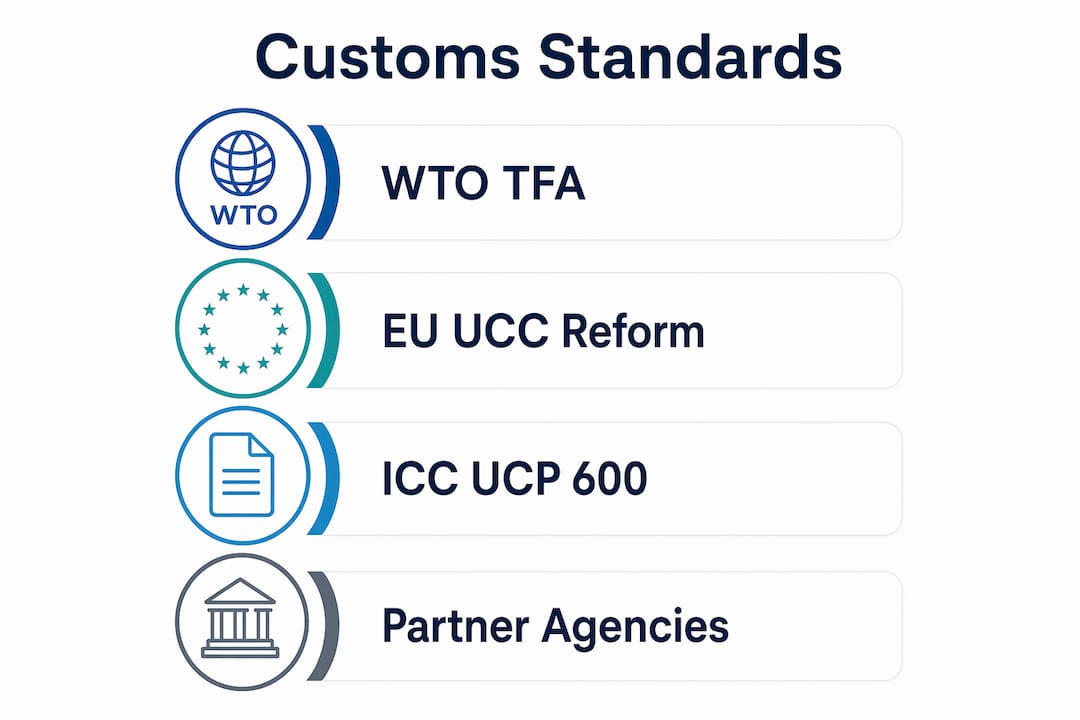
The ICC’s UCP 600 governs documentary credits in international trade finance, setting uniform rules for letters of credit that customs documentation must satisfy. Separately, U.S. Customs and Border Protection (CBP) frames customs compliance as a shared responsibility, requiring traders to understand the commodity requirements of Partner Government Agencies (PGAs) such as the FDA, USDA, and EPA. Ignoring PGA filings is one of the most common and costly compliance failures in U.S. import operations.
Key frameworks to track:
- WTO TFA: Enquiry points, advance rulings, and expedited release procedures
- EU UCC: Centralized clearance, self-assessment, and Authorized Economic Operator (AEO) status
- ICC UCP 600: Documentary credit rules governing trade finance documentation
- CBP and PGAs: Shared compliance responsibility across multiple federal agencies
- Singapore Customs: A model blending standardized trader obligations with risk-based audits and enforcement
How does digitization impact customs uniformity and compliance?
Customs automation is the single most powerful driver of procedural consistency across jurisdictions. When paper-based processes are replaced by electronic systems, the variability introduced by individual officers, regional offices, and paper filing errors drops sharply.

The UNCTAD-developed ASYCUDA (Automated System for Customs Data) platform illustrates this clearly. According to the ASYCUDA report 2025, Kazakhstan shortened transit declaration processing by 67% between 2017 and 2024 after adopting digital customs reforms. Iraq increased customs revenue by 128% between 2023 and 2024 through the same digital shift. These are not marginal improvements. They represent a fundamental change in how customs authorities manage throughput and accuracy.
Single electronic windows, where traders submit all import and export documentation through one portal rather than multiple agencies, are the most direct expression of standardized import procedures in practice. Countries operating mature single windows, including Singapore, South Korea, and the UAE, consistently report faster clearance times and lower compliance costs for traders.
- Audit your current filing platforms. Identify whether your team uses a single electronic window or submits separately to customs, PGAs, and freight forwarders.
- Integrate your ERP with customs software. Tools like SAP Global Trade Services, Descartes, or Amber Road connect product master data directly to customs declarations, reducing classification errors.
- Monitor jurisdiction-specific digital requirements. The EU’s Import Control System 2 (ICS2) and CBP’s Automated Commercial Environment (ACE) have distinct data requirements that must be mapped separately.
- Track digital adoption gaps in your supply chain. Suppliers in less-digitized markets may still submit paper documents, creating a weak link in an otherwise automated process.
Pro Tip: Record every query you submit to a customs enquiry point and save the official response. Per UNCTAD best practices, caching authoritative responses reduces risk when government guidance varies between officers or updates without notice.
The challenge is uneven adoption. While Singapore and the Netherlands operate near-fully digital customs environments, many developing markets still rely on hybrid paper and electronic systems. For exporters shipping to multiple destinations, this means maintaining parallel documentation workflows, which is precisely the kind of inconsistency that uniform customs procedures are designed to eliminate.
What practical steps should importers and exporters take internally?
Adopting consistent customs compliance workflows starts with internal process design, not external regulation. Most compliance failures trace back to mismatches between what a company’s product data says and what its customs filings declare.
Customs compliance best practices recommend mapping all workflows to three core audit domains: classification and commodity codes, origin claims, and valuation. Each domain carries distinct risk. Misclassification under the Harmonized System (HS) triggers duty underpayments or overpayments. Incorrect origin claims invalidate preferential tariff treatment under free trade agreements. Valuation errors, particularly undervaluation, attract penalties and audit scrutiny from CBP, HMRC, and equivalent authorities globally.
Controlled templates with change control are the operational backbone of this approach. When a product specification changes, a formal change control process updates the HS code, origin determination, and valuation method simultaneously. Without that linkage, product teams and customs teams operate in silos, and the filing diverges from reality.
- Build a customs classification register. Maintain a live document linking each SKU or product line to its HS code, country of origin, and customs value methodology.
- Establish a PGA checklist. For U.S. imports, map each commodity to its relevant PGA and confirm filing requirements before the shipment departs origin.
- Use enquiry points proactively. About 75% of WTO members have established enquiry points, but over 60% failed to respond effectively in a UNCTAD mystery client study. Centralized enquiry points operated directly by customs authorities provide the most reliable guidance.
- Coordinate with your customs broker on shared responsibility. CBP’s shared compliance model means the importer of record carries legal liability even when a broker files on their behalf.
- Review your customs clearance process at least annually. Regulatory changes, new trade agreements, and product line expansions all create classification and origin review triggers.
Pro Tip: Trade information portals linked with enquiry points improve guidance clarity and responsiveness. Bookmark the official customs portal for every country you trade with and check for regulatory updates quarterly.
The most overlooked step is documenting the rationale behind every customs decision. When an auditor asks why a product was classified under a specific HS code three years ago, a documented decision trail is the difference between a clean audit and a penalty assessment.
How do harmonized customs procedures facilitate smoother cross-border trade?
Harmonization removes the friction created when each country applies its own interpretation of shared international rules. The practical effect shows up in shipment release timing, duty predictability, and the administrative burden on logistics teams.
Authorized Economic Operator (AEO) programs, recognized under the WTO TFA and mirrored in the EU’s UCC, are the clearest example of harmonization delivering operational benefit. AEO-certified companies receive expedited customs clearance, reduced physical inspections, and priority processing at borders. The EU and several partner countries, including Japan, the U.S. (through the Customs-Trade Partnership Against Terrorism, C-TPAT), and Canada, maintain mutual recognition agreements that extend these benefits across jurisdictions.
The table below compares the operational experience of a standard importer versus an AEO-certified operator across key customs touchpoints.
| Customs touchpoint | Standard importer | AEO-certified operator |
|---|---|---|
| Physical inspection rate | Higher, risk-based selection | Significantly reduced |
| Customs release timing | Variable, subject to full review | Expedited, priority lane |
| Duty determination timing | May lag shipment release by weeks | More predictable, aligned processes |
| Multi-country recognition | Country-by-country filing | Mutual recognition in partner countries |
| Cash flow planning | Difficult due to timing gaps | Easier with predictable duty schedules |
The cash flow dimension deserves specific attention. WTO TFA mechanisms separate shipment release from final duty determination, meaning goods can move while the customs authority continues reviewing the declared value or classification. For high-volume importers, this creates a liability that sits off the balance sheet until the final assessment arrives. Firms that align internal controls with duty payment timing, including maintaining bonds or deposits as required, avoid the operational disruption that catches less-prepared traders.
Centralized customs decision-making, as seen in the EU’s push toward a single customs authority model, reduces the national practice disparities that create compliance inconsistency for businesses operating across multiple EU member states. A trader filing through the Netherlands should face the same substantive requirements as one filing through Germany. The EU reform initiative is designed to make that parity real, not just theoretical.
Key takeaways
Uniform customs procedures succeed when legal alignment, digital infrastructure, and internal process discipline operate together, not in isolation.
| Point | Details |
|---|---|
| Know your regulatory frameworks | WTO TFA, EU UCC, and ICC UCP 600 each impose distinct obligations that require separate compliance mapping. |
| Digitize and centralize filings | Platforms like ASYCUDA and single electronic windows cut clearance times and reduce filing errors significantly. |
| Map workflows to audit domains | Align classification, origin, and valuation processes to prevent mismatches between product data and customs declarations. |
| Use enquiry points strategically | Record official responses from customs enquiry points and cache them as authoritative compliance references. |
| Pursue AEO certification | AEO status delivers expedited clearance and mutual recognition benefits across multiple jurisdictions. |
Why customs uniformity is harder than it looks
The frameworks are clear. The execution is where things get complicated, and that gap is wider than most trade compliance guides acknowledge.
The most persistent problem is not ignorance of the rules. It is the assumption that once a company has filed correctly once, the process is set. Product lines change. Suppliers shift. Trade agreements expire or get renegotiated. A classification that was accurate in 2022 may be wrong in 2026 because the HS nomenclature updated or a new ruling changed the interpretation for your commodity.
The second problem is the PGA blind spot. Many importers focus entirely on CBP requirements and miss the FDA, USDA, or EPA filings that apply to their goods. CBP will hold a shipment pending PGA clearance, and that hold is entirely preventable with a proper pre-shipment checklist.
The third problem is treating customs brokers as a black box. A good broker is a compliance partner, not just a filing service. The importer of record carries legal liability regardless of who submits the paperwork. Building a working relationship with your broker, sharing product data proactively, and reviewing filings periodically is not optional for serious trade operations.
What actually works is treating customs compliance as a living process. Quarterly reviews, documented decision trails, and proactive use of advance rulings from customs authorities all reduce the risk of the surprise audit that derails an otherwise smooth operation. The companies that get this right do not just follow the rules. They build systems that make following the rules the path of least resistance.
— Ian
How Worldwideexpress supports your customs compliance
Worldwideexpress brings deep expertise in customs brokerage, freight forwarding, and multi-jurisdictional trade compliance to importers and exporters operating across complex global supply chains. Whether you are managing first-time import filings or scaling a high-volume cross-border operation, Worldwideexpress provides the documentation support, digital tracking tools, and customs knowledge to keep shipments moving without compliance surprises.
The Worldwideexpress team works across air, ocean, and ground freight, with specialists who understand the PGA requirements, HS classification nuances, and AEO program benefits that matter most to your business. For businesses ready to build a consistent, penalty-free customs operation, the customs broker guide from Worldwideexpress covers exactly how professional brokerage translates into smoother trade. You can also explore the compliance best practices resource for a framework built around the 2026 regulatory environment.
FAQ
What are uniform customs procedures?
Uniform customs procedures are standardized rules and processes that govern how goods are declared, assessed, and released at international borders. They draw from frameworks including the WTO TFA, EU UCC, and ICC UCP 600 to create consistent compliance conditions across jurisdictions.
How does the WTO Trade Facilitation Agreement affect importers?
The WTO TFA requires member countries to publish customs regulations, establish trader enquiry points, and offer expedited release for compliant shipments. Importers must plan for the gap between shipment release and final duty determination, which can affect cash flow and operational controls.
What is AEO certification and why does it matter?
Authorized Economic Operator (AEO) certification is a customs status granted to businesses that meet security and compliance standards, delivering expedited clearance and reduced inspection rates. Mutual recognition agreements between the EU, U.S. C-TPAT, and other programs extend these benefits across multiple countries.
Why do customs enquiry points matter for compliance?
Customs enquiry points provide official, authoritative guidance on trade regulations, but per UNCTAD research, over 60% of WTO member enquiry points failed to respond effectively in a mystery client study. Recording and caching official responses protects traders when guidance varies between officers.
What is the biggest internal risk for customs compliance?
The biggest internal risk is a mismatch between product data and customs filings, particularly in classification, origin, and valuation. Mapping workflows to these three audit domains and enforcing change controls when product specifications change prevents the most common and costly compliance failures.
Recommended
- Common customs forms: your guide to global trade success – Worldwide Express, Inc.
- Customs compliance best practices: stay penalty-free in 2026 – Worldwide Express, Inc.
- Complete Guide to the Customs Inspection Process – Worldwide Express, Inc.
- How to choose a customs broker for seamless 2026 trade – Worldwide Express, Inc.