Every month, U.S. Customs processes over 1 million air shipments, each requiring precise documentation and regulatory compliance. For import/export businesses, even minor documentation errors trigger delays averaging 48 to 72 hours, disrupting supply chains and increasing costs. This guide explains how to navigate airport customs clearance efficiently, reduce processing times, and avoid penalties that hurt your bottom line.
Table of Contents
- Understanding U.S. Airport Customs Clearance
- Documentation Essentials for Airport Customs Clearance
- Role of Customs Brokers and Freight Forwarders
- Common Misconceptions About Airport Customs Clearance
- Technology and Automation in U.S. Airport Customs Clearance
- Impact of Customs Clearance Delays on International Shipping
- Practical Strategies to Expedite Airport Customs Clearance
- Optimize Your Customs Clearance with Worldwide Express Solutions
- Airport Customs Clearance FAQ
Key Takeaways
| Point | Details |
|---|---|
| Customs brokers accelerate clearance | Licensed brokers reduce clearance times by approximately 25% through expertise and established CBP relationships. |
| Documentation accuracy prevents delays | Incomplete or incorrect paperwork causes delays averaging 48 to 72 hours, increasing costs and disrupting schedules. |
| Technology cuts processing times | Automated systems like ACE reduce processing errors and times by up to 40%, streamlining customs data submission. |
| Delays increase operational costs | Customs holds raise inventory costs, cause stockouts, and damage customer satisfaction ratings. |
| Compliance knowledge avoids penalties | Understanding clearance requirements helps businesses avoid legal penalties and shipment seizures. |
Understanding U.S. Airport Customs Clearance
U.S. Customs and Border Protection (CBP) operates the world’s most sophisticated customs clearance system at major air cargo hubs. When your shipment arrives at a U.S. airport, it enters a multi-step verification process designed to ensure compliance with federal regulations, tariff classification accuracy, and security protocols.
The customs clearance process involves several regulatory checkpoints. CBP officers review submitted documentation, verify declared values against commercial invoices, and assess duty obligations. For certain product categories, additional agencies like the FDA, USDA, or EPA conduct specialized inspections before releasing cargo.
The clearance flow typically follows these stages:
- Arrival notification: Carrier transmits manifest data to CBP electronically
- Documentation review: CBP examines commercial invoices, airway bills, and entry forms
- Risk assessment: Automated systems flag shipments requiring physical inspection
- Duty calculation: System determines applicable tariffs and fees
- Payment processing: Duties and fees cleared through ACE
- Release authorization: CBP grants permission for cargo delivery
Processing times vary based on shipment complexity, documentation quality, and inspection requirements. Businesses importing regulated goods or high-value shipments face longer review periods. Working with experienced customs attorney services becomes essential when navigating complex regulatory requirements or resolving compliance disputes.
Documentation Essentials for Airport Customs Clearance
Accurate documentation forms the foundation of efficient customs clearance. Missing or incorrect paperwork accounts for the majority of preventable delays at U.S. airports.
Every air shipment requires these core documents:
- Commercial invoice: Detailed description of goods, quantities, unit prices, and total value
- Air waybill: Contract between shipper and carrier serving as receipt and tracking document
- Entry summary (CBP Form 7501): Official customs declaration listing imported goods and calculated duties
- Packing list: Breakdown of contents by package, including weights and dimensions
- Certificate of origin: Documentation proving country of manufacture for tariff determination
- Import licenses or permits: Required for regulated products like food, pharmaceuticals, or textiles
Documentation errors create cascading problems. Incorrect Harmonized System (HS) codes result in improper duty calculations, triggering CBP audits. Missing certificates of origin prevent preferential trade agreement benefits. Vague product descriptions raise security concerns, forcing manual inspections.
These mistakes cause delays averaging 48 to 72 hours while importers scramble to provide corrected information. During this hold period, cargo sits in bonded warehouses accruing storage fees. Temperature-sensitive goods risk spoilage. Time-critical shipments miss delivery windows.
Pro Tip: Create document checklists specific to your product categories and review them with your customs broker before each shipment. This simple validation step catches errors before they reach CBP, preventing costly holds.
The import documentation guide provides comprehensive templates and requirements for different commodity types, helping you prepare complete submission packages.
Role of Customs Brokers and Freight Forwarders
Licensed customs brokers serve as your regulatory experts and CBP liaisons. These professionals hold federal licenses requiring extensive trade law knowledge and maintain bonds guaranteeing compliance with customs regulations.

Brokers navigate the regulatory maze on your behalf. They classify products using correct HS codes, calculate applicable duties under current trade agreements, and prepare compliant entry documentation. Their established relationships with CBP officers and familiarity with port-specific procedures enable faster issue resolution.
Businesses using brokers experience approximately 25% faster clearance times compared to self-filing importers. This efficiency stems from broker expertise in anticipating CBP questions, preparing complete documentation packages, and responding promptly to agency inquiries.
| Aspect | Self-Clearance | Broker-Assisted |
|---|---|---|
| Average clearance time | 3 to 5 days | 1 to 2 days |
| Documentation error rate | 15 to 20% | 2 to 5% |
| Penalty risk | High | Low |
| Regulatory knowledge required | Extensive | Minimal |
| Time investment | 8 to 12 hours per shipment | 1 to 2 hours review |
Freight forwarders complement brokers by coordinating the physical movement of goods. They arrange cargo space, consolidate shipments for cost efficiency, and manage carrier relationships. Many forwarders offer integrated services combining transportation and customs clearance under one provider.
The customs broker role extends beyond paperwork processing. Quality brokers provide strategic advice on tariff engineering, duty drawback programs, and compliance risk management that directly impact your profitability.
Pro Tip: Select brokers with specific experience in your industry and the airports you use most frequently. Port procedures vary, and local expertise accelerates clearance at your primary entry points.
Common Misconceptions About Airport Customs Clearance
Several persistent myths about customs clearance lead businesses to adopt inefficient strategies that increase costs and compliance risks.
Myth: Customs clearance is just bureaucratic delay with no real purpose
Reality: CBP protects public health, safety, and economic interests by verifying product safety, collecting proper duties, and preventing illegal imports. Each inspection serves specific regulatory objectives mandated by federal law. Understanding these purposes helps you prepare documentation that addresses CBP concerns proactively.
Myth: Customs brokers are an unnecessary expense that doesn’t meaningfully speed clearance
Reality: Brokers reduce clearance times by 25% on average and dramatically lower documentation error rates. The cost of one delayed shipment typically exceeds annual broker fees. For businesses making regular imports, broker services deliver positive return on investment through faster clearance, fewer penalties, and reduced staff time spent on customs matters.
Myth: Documentation requirements are straightforward and uniform across all products
Reality: Requirements vary significantly by commodity type, value, country of origin, and intended use. Food products need FDA prior notice. Textiles require country of origin declarations. Electronics containing batteries face DOT regulations. Each product category carries unique documentation obligations that change as regulations evolve.
These misconceptions create false confidence that leads to compliance failures. Businesses underestimating clearance complexity face preventable penalties, shipment holds, and in severe cases, cargo seizures. The financial and operational impact of these mistakes far exceeds the cost of proper clearance preparation.
Technology and Automation in U.S. Airport Customs Clearance
The Automated Commercial Environment (ACE) revolutionized customs processing by replacing paper-based systems with integrated electronic data exchange. ACE serves as CBP’s primary system for processing imports, tracking shipments, and managing trade compliance.
Automated customs clearance systems like ACE reduce customs data processing times and errors by up to 40% compared to manual filing methods. The system validates data in real time, flagging errors before submission rather than during CBP review. This immediate feedback prevents the submission of incomplete entries that would trigger delays.
ACE enables several efficiency improvements:
- Electronic document submission: Eliminates physical paperwork and courier delays
- Real-time status tracking: Provides visibility into clearance progress and inspection holds
- Automated risk assessment: Screens shipments using algorithms that identify high-risk cargo for inspection
- Integrated payment processing: Allows electronic duty payment without manual check processing
- Account management: Centralizes importer records and compliance history
Major importers integrate their enterprise systems directly with ACE through certified software providers. This integration automates data transfer from purchase orders and shipping documents into customs entries, eliminating manual data entry errors.
Smaller businesses access ACE benefits through their customs brokers, who submit entries electronically on their behalf. The system’s efficiency improvements apply regardless of whether you file directly or through an intermediary.
Technology Impact: Automated customs systems reduce processing times and errors by up to 40%, enabling same-day clearance for compliant shipments.
Adopting electronic filing through ACE or broker-operated systems represents the single most impactful technology investment for improving clearance speed and accuracy.
Impact of Customs Clearance Delays on International Shipping
Customs delays create immediate operational problems and long-term strategic challenges for import-dependent businesses. Understanding these impacts motivates investment in clearance optimization.
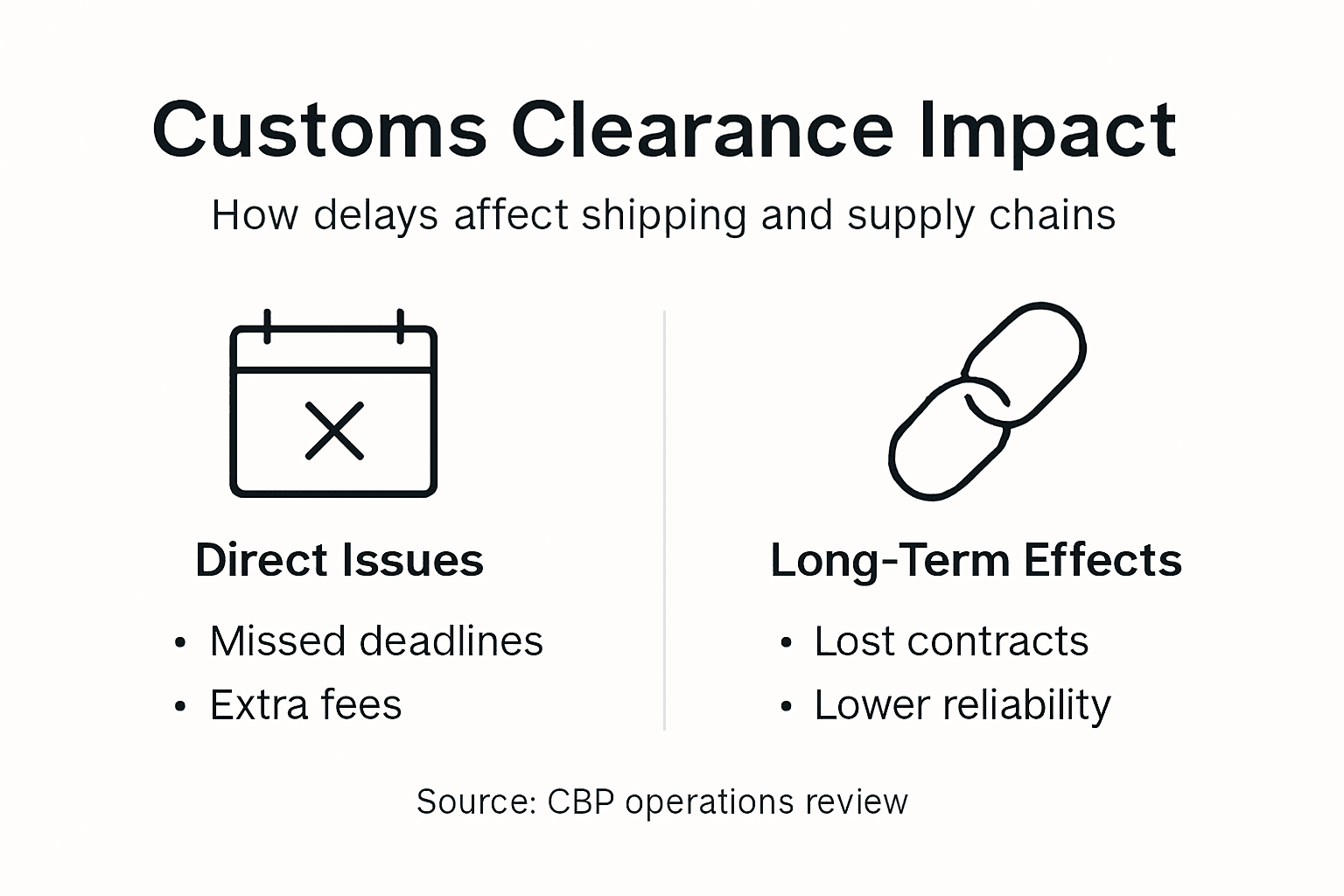
Documentation errors causing 48 to 72-hour delays force businesses into reactive crisis management. Inventory planners scramble to find alternative supplies. Customer service teams manage angry clients facing late deliveries. Finance departments absorb unexpected demurrage charges and expedited shipping costs for replacement orders.
The financial costs accumulate quickly:
- Demurrage fees: Cargo storage charges at airports ranging from $50 to $200 per day
- Penalty assessments: CBP fines for incorrect classifications or undervalued declarations starting at $1,000
- Lost sales: Revenue impact when stockouts prevent customer purchases
- Expedited shipping: Premium freight costs to recover schedule after delays
- Carrying costs: Interest on inventory capital tied up in customs holds
Beyond direct costs, delays damage supply chain reliability metrics. Manufacturing operations depending on just-in-time inventory face production stoppages. Retailers miss seasonal selling windows. Service providers disappoint customers with broken delivery promises.
Customer satisfaction suffers measurably when delays prevent on-time delivery. Research shows delivery reliability ranks among the top three factors influencing customer loyalty in B2B commerce. Repeated customs delays erode the competitive advantage you’ve built through product quality and pricing.
Supply chain disruptions from customs issues ripple through your organization, affecting inventory planning, cash flow management, and customer relationships. Avoiding customs delays through proactive clearance management protects these critical business functions.
Practical Strategies to Expedite Airport Customs Clearance
Implementing proven clearance strategies transforms customs from a bottleneck into a reliable supply chain component. These actionable steps reduce delays and improve compliance.
-
Partner with licensed customs brokers experienced in your commodities and entry airports: Broker expertise in your specific products and ports accelerates clearance through familiarity with common issues and inspector expectations.
-
Ensure complete, accurate documentation before submission: Review all entries against checklists covering required documents, correct HS codes, proper valuations, and complete product descriptions. Fixing errors before submission prevents delays.
-
Use ACE or broker systems for electronic filing: Electronic submission through approved systems provides immediate data validation, real-time status tracking, and faster processing than paper entries.
-
Monitor clearance status proactively and respond immediately to CBP inquiries: Check entry status daily and assign staff to respond to agency questions within hours, not days. Quick responses prevent holds from extending.
-
Maintain updated knowledge of regulatory changes affecting your products: Subscribe to CBP bulletins, attend trade webinars, and consult with brokers about rule changes impacting your commodities.
-
Implement pre-clearance document review with your broker: Establish a process where brokers validate documentation accuracy 24 to 48 hours before cargo arrival, allowing time to correct issues.
-
Develop backup plans for common delay scenarios: Create contingency protocols addressing typical problems like missing certificates, incorrect values, or inspection holds.
Pro Tip: Schedule quarterly compliance reviews with your broker to assess clearance performance metrics, identify recurring issues, and update procedures based on regulatory changes. This proactive approach prevents problems rather than reacting to them.
These strategies work together as a comprehensive clearance optimization system. The import process guide provides detailed implementation steps, while importer filing tips address specific documentation requirements. Understanding how to avoid customs penalties protects your business from compliance violations that trigger fines.
Businesses can also apply inventory management principles like minimizing shrinkage and losses to reduce exposure to customs delays through better demand forecasting and safety stock management.
Optimize Your Customs Clearance with Worldwide Express Solutions
Navigating airport customs clearance requires expertise, technology, and established relationships that most businesses lack internally. Worldwide Express delivers these capabilities through comprehensive customs brokerage and freight forwarding services designed for import/export operations.
Our U.S. customs brokerage services combine licensed broker expertise with advanced technology platforms that accelerate clearance and ensure compliance. We handle documentation preparation, CBP communication, and regulatory filings while you focus on core business operations. Our broker network operates at all major U.S. air cargo hubs, providing local expertise regardless of your entry points.
When you need integrated logistics solutions, our best freight forwarding services coordinate transportation and customs clearance under unified management. This integration eliminates coordination gaps that cause delays. Our guide on how to choose a freight forwarder helps you evaluate providers based on capabilities matching your specific shipping needs.
Airport Customs Clearance FAQ
What documents are absolutely required for U.S. airport customs clearance?
Every air shipment needs a commercial invoice, air waybill, entry summary form, packing list, and certificate of origin. Regulated products require additional permits or licenses specific to the commodity type.
How long does customs clearance usually take with and without a broker?
Self-clearance typically requires 3 to 5 days for straightforward shipments, while broker-assisted clearance averages 1 to 2 days. Brokers reduce processing time approximately 25% through expertise and established CBP relationships.
What penalties can I face for customs non-compliance at airports?
CBP assesses penalties starting at $1,000 for incorrect classifications or undervalued declarations. Serious violations result in cargo seizures, import privilege suspension, and potential criminal charges for intentional fraud.
How can ACE technology help my shipments clear customs faster?
ACE validates data in real time before submission, eliminating errors that cause delays. The system reduces processing times up to 40% through electronic filing, automated risk screening, and integrated payment processing.
Is it better to self-clear or hire a customs broker for small shipments?
Brokers benefit businesses of all sizes because even small shipments face the same regulatory requirements as large ones. Documentation errors on low-value shipments still trigger delays and penalties that exceed typical broker fees.
Recommended
- US Customs Form PDF: 30% Faster Processing via ACE Filing – Worldwide Express, Inc.
- Customs Clearance Is in Progress – What It Means for U.S. Importers – Worldwide Express, Inc.
- Power of Attorney for Customs Clearance: Streamline US Imports – Worldwide Express, Inc.
- Expedited International Shipping: Fast-Track Your Global Deliveries – Worldwide Express, Inc.
- SFO Limo & Black Car Service | San Francisco International Airport