TL;DR:
- Pennsylvania importers can be randomly selected for CBP audits regardless of compliance history. Proper recordkeeping, regular self-audits, and proactive disclosure reduce penalties and streamline audits. Partnering with logistics experts and maintaining strong internal controls enhances audit readiness and compliance culture.
Pennsylvania businesses engaged in international trade operate under a compliance reality that many underestimate: even compliant importers may be selected for a customs audit, with penalties that can reach into the millions. Whether your operation runs smoothly or not, U.S. Customs and Border Protection (CBP) can knock on your door at any time. This guide lays out exactly what triggers customs audits, how they unfold for Pennsylvania importers, and what practical steps businesses can take to stay audit-ready. With the right preparation, the process becomes far less daunting and far less costly.
Table of Contents
- Understanding customs audits in Pennsylvania
- Types of customs audits and why they happen
- Key compliance areas and common pitfalls
- How to prepare and what to do if audited
- Why proactive compliance is your best defense in Pennsylvania
- Partnering for customs success in Pennsylvania
- Frequently asked questions
Key Takeaways
| Point | Details |
|---|---|
| Audits affect all importers | Any international shipper in Pennsylvania may be audited, even if fully compliant. |
| Recordkeeping is critical | Keep all customs documents and entry records organized for at least five years to avoid issues. |
| Common triggers and pitfalls | High volume, anomalies, and misclassification are top audit triggers; proper HTS codes and documentation prevent penalties. |
| Proactive preparation pays off | Mock audits, voluntary disclosure, and internal controls reduce risk and show ‘reasonable care’ to CBP. |
| Expert help available | Customs brokerage and logistics services ensure businesses stay audit-ready and compliant year-round. |
Understanding customs audits in Pennsylvania
With the risks now clear, let’s define what a customs audit actually involves for Pennsylvania businesses. At its core, a customs audit is a formal review by CBP to verify that an importer has accurately declared goods, paid correct duties, and maintained proper records. It is not a sign of wrongdoing. It is a structured examination of trade compliance.
All Pennsylvania businesses importing goods fall under CBP’s nationwide audit program. The Philadelphia TRA office manages Trade Regulatory Audit (TRA) coverage for the region, operating under the same national program that governs importers in every other state. There are no Pennsylvania-specific audit rules, but local CBP contacts play a role in coordinating audit logistics, scheduling, and communication.
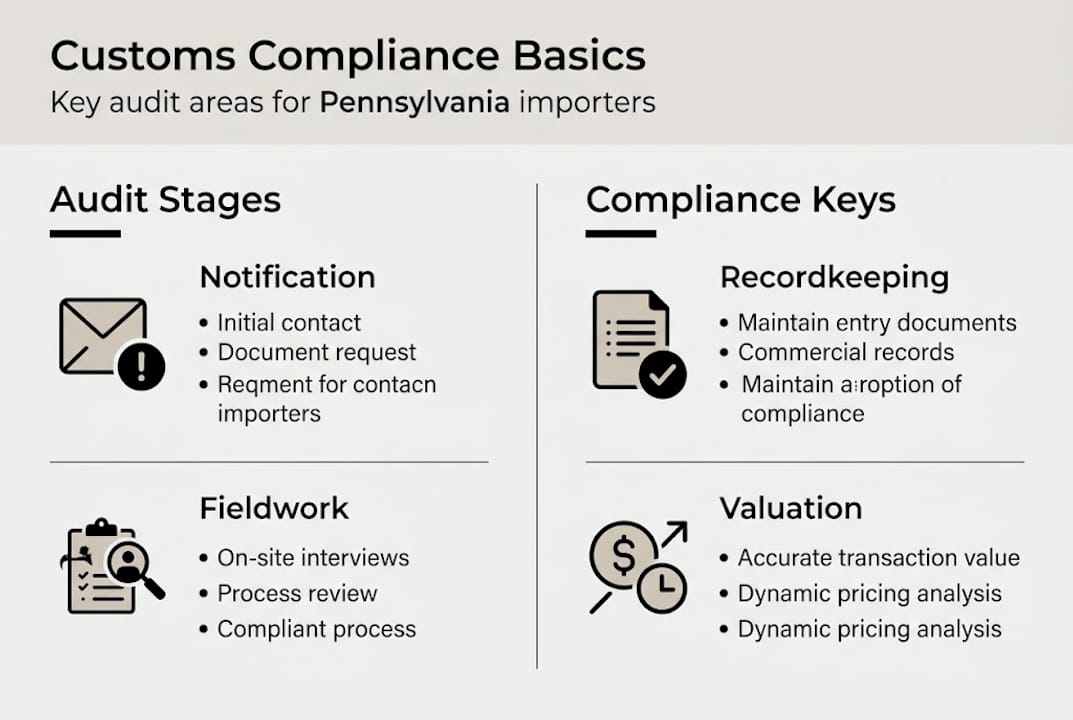
Audits follow a predictable structure, per CBP’s focused assessment process:
- Notification: CBP sends a written notice announcing the audit scope and timeline.
- Pre-survey: Auditors review publicly available data and prior entry records.
- Fieldwork: On-site visits and document reviews take place at company facilities.
- Reporting: CBP issues a final report detailing findings, including any compliance gaps.
Businesses must retain import records for a minimum of five years under 19 CFR §163. This includes commercial invoices, packing lists, bills of lading, and CBP entry summaries. Missing records are themselves a violation and can escalate an otherwise routine audit into a serious compliance event.
“Audits are not punitive by design. They are a mechanism for CBP to assess trade accuracy across the importer community. Being selected does not mean you are suspected of wrongdoing.”
Even a company with a near-perfect compliance history can be randomly selected. That is an uncomfortable but important truth. Handling customs audits proactively rather than reactively is the single most effective way to reduce exposure.
| Audit stage | What happens | Your responsibility |
|---|---|---|
| Notification | Written audit notice from CBP | Confirm receipt, assign a point of contact |
| Pre-survey | CBP reviews entry data | Gather records, flag any known issues |
| Fieldwork | On-site review and interviews | Provide access, answer questions accurately |
| Reporting | Findings issued in writing | Review, respond, and remediate as needed |
Types of customs audits and why they happen
Now that you know who runs customs audits in Pennsylvania, let’s explore why a business might be audited and the main types you could face. CBP uses three primary audit formats, each with a different scope and intensity.
Audit types include Focused Assessments, Quick Response Audits, and Risk Analysis and Survey Assessments (RASA). Here is how they compare:
| Audit type | Scope | Typical trigger |
|---|---|---|
| Focused Assessment | Full trade compliance review | Risk-based or random selection |
| Quick Response Audit | Targeted, issue-specific review | Specific anomaly or tip |
| RASA | Broad survey, lower intensity | New importer or low-risk monitoring |
For most mid-size Pennsylvania importers, the Focused Assessment is the most consequential. It examines the full scope of trade activity, from classification accuracy to valuation, origin marking, and record integrity.
Common audit triggers include:
- High import volume with irregular duty payment patterns
- Data anomalies flagged in the Automated Commercial Environment (ACE) system
- Prior compliance issues or unresolved penalties
- Misclassification patterns across multiple entries
- Random selection under CBP’s risk-stratified targeting model
The numbers are striking. CBP completed 348 audits in the first nine months of fiscal year 2025, uncovering $310 million in unpaid duties. That translates to an average of roughly $890,000 per audit finding. These are not niche cases. They represent real companies that believed they were operating within compliance parameters.

Pro Tip: A well-documented internal customs compliance tips program signals to CBP that your operation is structured and intentional. It will not make you immune to selection, but it does reduce the likelihood of being flagged under risk-based targeting.
Key compliance areas and common pitfalls
Knowing that audits can be triggered by a range of factors, it’s vital to understand exactly what compliance items auditors look for and where Pennsylvania importers most often get in trouble. Four areas consistently draw the most scrutiny.
Key compliance areas in every CBP audit include:
- HTS classification: Assigning the correct Harmonized Tariff Schedule code to every product. Even small errors can result in significant duty underpayments.
- Transaction value: Accurately declaring the price paid for goods, including assists (tools, molds, or designs provided free to a supplier), royalties, and related-party pricing adjustments.
- Country of origin marking: Ensuring goods are properly marked with country of origin. Transshipment schemes, where goods are routed through a third country to obscure Chinese or other origins, are under intense scrutiny in 2026.
- Recordkeeping: Maintaining complete, accessible records for the full five-year retention period.
Edge cases catch many Pennsylvania importers off guard. Undeclared assists, meaning materials or services provided to a foreign supplier that add value to the goods, must be included in the declared value. Related-party transactions between a U.S. importer and its overseas parent or affiliate require additional documentation to justify transaction value.
The consequences of getting this wrong can be severe. CERATIZIT USA paid $5.44 million in fines for origin misclassification on China imports processed through Pennsylvania. That is not a hypothetical. It is a documented case from this region.
“The most expensive compliance errors are rarely dramatic. They are systematic small errors repeated across hundreds or thousands of entries.”
Pro Tip: Run a mock audit every six to twelve months. Review a random sample of entry summaries and check classification, valuation, and marking against current tariff schedules. Pair this with PA freight forwarding tips and use expert review to catch what internal teams miss. Pair that process with easier customs documentation practices to keep records clean and audit-ready. Investing in protecting your cargo from compliance missteps is as important as protecting it physically.
How to prepare and what to do if audited
With common compliance risks illustrated, businesses need practical steps for bulletproofing their approach and minimizing audit impact. Preparation is not a one-time event. It is an ongoing practice.
Before an audit:
- Organize all import records by entry date and maintain digital backups for the full five-year retention period under 19 CFR §163.
- Conduct mock self-audits using CBP’s Focused Assessment checklists, available in the Trade Compliance Handbook.
- Establish internal controls, including a designated compliance officer and a written compliance manual.
- Review classification and valuation practices annually, especially when product lines change or new suppliers are added.
- Consider enrolling in the CTPAT Trade Compliance program, which offers routine Focused Assessment exemptions for qualifying companies.
During an audit:
- Designate a single point of contact to communicate with CBP auditors.
- Provide requested documents promptly and accurately. Delays raise red flags.
- Avoid volunteering information beyond what is specifically requested.
- Keep written notes of all auditor requests and your responses.
After an audit:
If errors are uncovered, voluntary disclosure can make a meaningful difference. Voluntary disclosure and strong compliance programs can reduce penalties by as much as 35%. CBP views proactive disclosure favorably, particularly when paired with a corrective action plan.
“Prior disclosure is one of the most underused tools in an importer’s arsenal. It signals good faith and often results in substantially reduced penalties.”
Pro Tip: Document every step of your reasonable care efforts, meaning the research and expert consultations you conduct before making classification or valuation decisions. CBP’s standard for penalty mitigation includes whether the importer exercised reasonable care. Good documentation of that process can be the difference between a warning and a seven-figure fine. Review audit penalty mitigation tips and familiarize yourself with Entry Summary 7501 requirements to shore up your recordkeeping.
Why proactive compliance is your best defense in Pennsylvania
Having covered concrete steps, let’s zoom out: what separates companies that glide through audits from those that scramble? The answer is rarely luck. It is culture.
Conventional wisdom holds that customs audits are rare events reserved for large corporations or known bad actors. That view is outdated. Mid-size Pennsylvania importers are increasingly showing up in CBP’s audit pipeline, often because their entry volumes have grown faster than their compliance infrastructure. Auditors assess systems, not just individual transactions. A company with clean paperwork but no documented procedures is a liability waiting to surface.
Proactive compliance changes the equation entirely. When CBP auditors arrive and find organized records, written policies, and evidence of regular self-review, the audit typically concludes faster and with fewer findings. The cost of building that infrastructure is a fraction of what a single penalty can impose.
Self-audits and internal compliance reviews are remarkably underused, particularly among importers who believe their brokers are handling everything. Brokers are essential partners, but they cannot see everything, and ultimate liability rests with the importer. The businesses that leverage customs compliance insights to build strong internal practices are the ones that weather audits without disruption.
Partnering for customs success in Pennsylvania
If your team is looking to build bulletproof compliance without going it alone, here’s where expert help comes in.
Navigating customs audits, classification requirements, and CBP recordkeeping rules is a significant undertaking for any Pennsylvania importer. Expert logistics partners can simplify the compliance process, help manage documentation, and communicate effectively with CBP on your behalf.
Worldwide Express offers customs brokerage in Pennsylvania and a full suite of logistics services for PA importers, designed to keep businesses audit-ready and operationally efficient. From classification support to documentation management, the team brings deep expertise across industries with complex import profiles. Discover how customs brokers help businesses like yours stay compliant, avoid costly penalties, and maintain smooth international shipping operations year-round.
Frequently asked questions
How do I know if my Pennsylvania business will be audited by CBP?
Audit triggers and random selection mean any importer can be reviewed. CBP considers import volume, data anomalies, and prior compliance issues, but random selection also plays a role regardless of your track record.
What records must I keep to prepare for a customs audit?
Maintain all shipping invoices, packing lists, and CBP Form 7501 for at least five years, per the five-year recordkeeping rule under 19 CFR §163. Incomplete or missing records can independently trigger penalties during an audit.
Can penalties be reduced if I disclose errors before an audit?
Yes. Voluntary disclosure reduces penalties by up to 35% and signals good faith to CBP. Proactive disclosure paired with a corrective action plan is the most effective approach when errors are discovered internally.
Is there a way to avoid a Focused Assessment audit?
Companies enrolled in the CTPAT Trade Compliance program are generally exempt from routine Focused Assessments. The program requires demonstrated compliance infrastructure but delivers meaningful protection against the most intensive audit type.
Recommended
- How to Handle Customs Audits for Smooth Compliance – Worldwide Express, Inc.
- Customs compliance best practices: stay penalty-free in 2026 – Worldwide Express, Inc.
- International cargo insurance in Pennsylvania: protect your shipments – Worldwide Express, Inc.
- How to Avoid Customs Penalties: A Step-by-Step Guide – Worldwide Express, Inc.