TL;DR:
- Proactive layered risk mitigation strategies prevent costly shipping disruptions and reputational damage.
- Technology like IoT, AI, and blockchain enable real-time monitoring and predictive risk management.
- Combining compliance, insurance, and financial hedges creates resilient global shipping operations.
Shipping disruptions are costly, but they are far from inevitable. When high-value shipments face damage, theft, or regulatory holds, the financial and reputational fallout can set operations back by months. Yet many logistics managers still treat risk as background noise rather than a strategic priority. The organizations pulling ahead in global trade are doing something different: they are building layered, proactive mitigation systems that catch problems before they become crises. This guide breaks down the strategies, technologies, and financial tools that make that possible.
Table of Contents
- Understanding modern shipping risks in global logistics
- Core strategies for mitigating shipping risk
- Leveraging technology for proactive shipping risk management
- Navigating financial and regulatory risk: Insurance and compliance best practices
- Advanced risk mitigation: Hedging and risk modeling for volatile markets
- Our take: The real difference with proactive risk mitigation
- Support your risk mitigation strategy with expert resources
- Frequently asked questions
Key Takeaways
| Point | Details |
|---|---|
| Identify core risks | Knowing the most common shipping threats helps you target the right mitigation strategies. |
| Layer mitigation tools | Effective strategies use multiple defenses including packaging, insurance, and partner vetting. |
| Embrace technology | AI, IoT, and blockchain speed up disruption response and pinpoint vulnerabilities. |
| Stay compliance-driven | Proactive customs compliance and insurance coverage protect against heavy fines and seizures. |
| Adapt to volatility | Advanced modeling and financial hedging guard against shocks in an unpredictable market. |
Understanding modern shipping risks in global logistics
To understand which strategies work, start by clarifying the core risks shaping today’s shipping landscape. The range is wider than most teams account for, and the consequences of underestimating any single category can be severe.
Major shipping risks include cargo damage, delays, compliance violations, and cyber threats, each with its own frequency and financial footprint. Macro forces are amplifying these categories. Geopolitical tension is rerouting established lanes. Regulatory volatility, particularly around tariff volatility challenges, is making compliance harder to predict. Extreme weather events are disrupting port operations at a scale that was rare a decade ago.
Top emerging risks for 2026 include:
- Cybersecurity breaches targeting freight management platforms
- Port congestion driven by geopolitical rerouting
- Sudden regulatory changes affecting tariff classifications
- Climate-related cargo damage from extreme weather
- Supplier insolvency disrupting multi-leg shipments
“The frequency and severity of shipping disruptions are rising in tandem, making reactive risk management a liability rather than a strategy.”
Without a structured framework, teams end up firefighting rather than preventing. The table below shows how common risks compare on frequency and operational impact, which helps prioritize where mitigation resources go first.
| Risk category | Frequency | Operational impact |
|---|---|---|
| Cargo damage | High | Moderate to severe |
| Customs delays | High | Moderate |
| Theft or piracy | Moderate | Severe |
| Cyber threats | Growing | Severe |
| Extreme weather | Moderate | High |
| Supplier failure | Low to moderate | Very high |
Focusing on reducing shipping costs without first addressing risk exposure is a common mistake. Cost savings evaporate quickly when a single unmitigated incident triggers cargo loss, regulatory penalties, or a shipment hold at the border. A structured mitigation framework is not optional. It is the foundation everything else builds on.
Core strategies for mitigating shipping risk
Now that the risks are clear, here is how leading logistics teams systematically lower their exposure. The most effective approaches are not isolated tactics. They work together as interlocking layers.
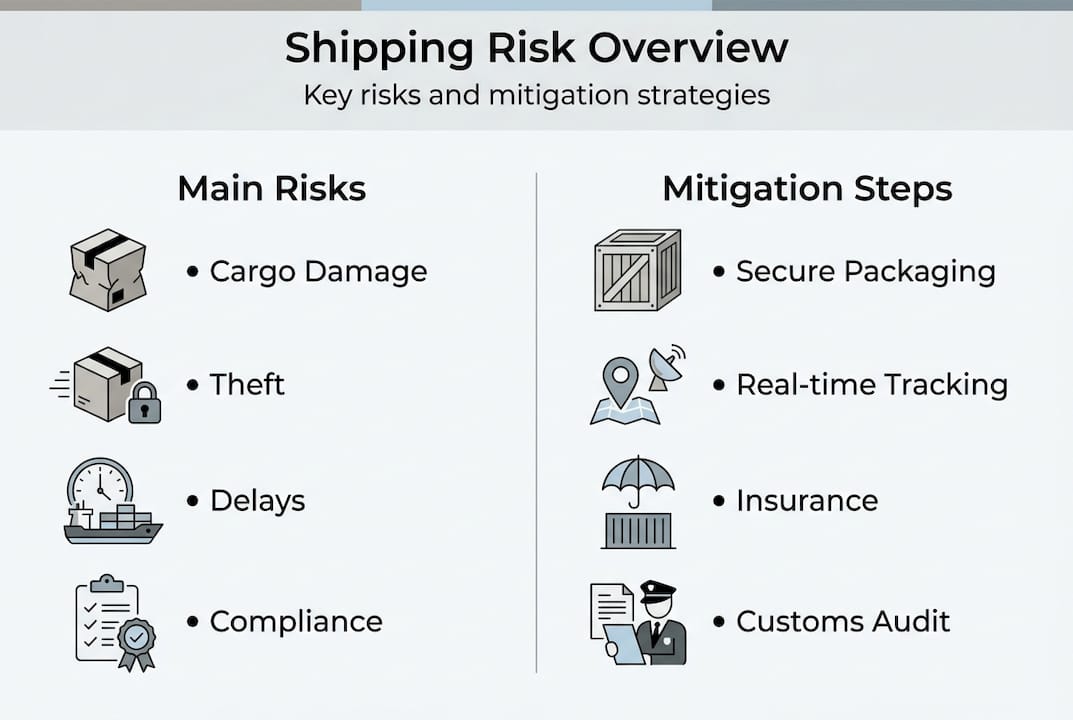
Key risk mitigation strategies include secure packaging, advanced tracking, insurance, strategic partnerships, and contingency planning, each targeting a specific threat category.
Five core strategies and what each guards against:
- Secure packaging: Prevents physical damage during transit, especially for fragile or high-value goods. Use double-walled containers, moisture barriers, and tamper-evident seals.
- Contingency planning: Establishes response protocols before disruptions occur. Includes alternate routing, backup carriers, and pre-approved emergency budgets.
- Vendor vetting: Reduces partner-related risk through due diligence, performance benchmarking, and regular audits of carriers and freight forwarders.
- Cargo insurance: Covers financial loss from damage, theft, or total loss. Understanding freight insurance essentials helps teams avoid the common gap of underinsuring high-value goods.
- Advanced tracking: Provides real-time visibility, enabling faster response when deviations occur.
The table below maps specific risks to the mitigation approach best suited to address them.
| Risk | Primary mitigation strategy |
|---|---|
| Physical damage | Secure packaging, insurance |
| Theft | Tracking, vendor vetting |
| Customs delays | Compliance audits, documentation |
| Carrier failure | Contingency planning, vendor vetting |
| Financial loss | Insurance, hedging |
Pro Tip: Third-party audits of carrier controls and packaging standards reveal gaps that internal reviews often miss. Schedule them at least annually, and more frequently for high-volume trade lanes. Optimizing global shipping becomes significantly more reliable when vendor performance is verified rather than assumed.
Leveraging technology for proactive shipping risk management
Beyond foundational strategies, digital innovation powers sharper, faster risk response for modern supply chains. The gap between teams using real-time data and those relying on manual tracking is widening fast.

Real-time IoT sensors on containers now alert teams to temperature deviations, unauthorized access, and route changes as they happen. This kind of cargo tracking technology compresses response windows from hours to minutes, which is critical when a shipment is carrying perishables or high-value electronics.
Machine learning is taking predictive capability further. An AI-driven risk model using LightGBM for cross-border risks achieves 92.5% prediction accuracy and reduces response time to 15 minutes, a remarkable leap over traditional rule-based systems. That kind of accuracy means teams can intervene before a disruption becomes a loss event.
Blockchain adds another dimension by ensuring data integrity across multi-party shipments. Tamper-proof records reduce fraud risk and make document verification faster at customs checkpoints.
Top tools adopted by leading shippers in 2026:
- IoT-enabled container sensors for real-time condition monitoring
- AI platforms with predictive disruption alerts
- Blockchain-based bill of lading and documentation systems
- Integrated TMS platforms with live carrier data feeds
- Automated customs pre-clearance tools
Pro Tip: Integrate your tracking data feeds directly into your TMS and risk dashboard. Siloed data is one of the biggest reasons response times lag. When all signals flow into one view, your team can act on patterns rather than react to individual alerts.
A mid-sized manufacturer shipping precision components across three continents cut its average incident response lag from four hours to under 20 minutes after deploying an AI-powered monitoring platform. The result was a measurable drop in cargo loss claims and a stronger negotiating position with insurance providers.
Navigating financial and regulatory risk: Insurance and compliance best practices
Financial and legal exposures also demand systematic attention to keep shipments and budgets on track. Regulatory penalties and uninsured losses are two of the most preventable cost drivers in international logistics, yet they remain common.
The consequences of compliance failures range from fines and cargo seizure to full import privileges being suspended. Customs compliance best practices are not bureaucratic overhead. They are active financial protection.
Proven compliance measures that reduce regulatory exposure:
- Regular internal audits of tariff classifications and valuation methods
- Broker performance reviews to catch documentation errors early
- Binding ruling requests for ambiguous product classifications
- Maintaining complete, organized records for every shipment
- Staff training on current import/export regulations
Proactive compliance, including binding rulings, audits, and broker oversight, demonstrates “reasonable care” to CBP and significantly limits penalty exposure.
On the insurance side, policy gaps are a persistent problem. Many shippers discover their coverage excludes specific damage types or geographic zones only after filing a claim. Reviewing freight insurance options before a loss event, not after, is what separates well-protected operations from exposed ones.
One importer avoided a six-figure penalty after a customs audit by producing a complete record of broker correspondence, classification rationale, and prior binding rulings. The documentation demonstrated reasonable care, and CBP reduced the proposed fine substantially. That outcome was not luck. It was the result of a compliance program built before the problem arose. Teams that want to consistently avoid customs penalties need systems that generate evidence of due diligence automatically.
Advanced risk mitigation: Hedging and risk modeling for volatile markets
As volatility rises, even proven tools must be extended by next-generation analytics and financial instruments. Freight markets in 2026 are not behaving like textbook models, and the strategies built for stable conditions are showing their limits.
Variance-based hedging underperforms in skewed freight markets, where CVaR (Conditional Value at Risk) hedging better captures tail risks. This is a significant finding for logistics managers who rely on standard variance metrics to assess rate exposure. When markets spike or crash asymmetrically, variance-based models systematically underestimate the real downside.
Advanced tools now available to logistics risk teams:
- CVaR modeling to quantify tail-risk exposure in freight rate scenarios
- LightGBM-powered disruption prediction for cross-border lanes
- Scenario simulation tools that stress-test supply chains against geopolitical shocks
- Dynamic hedging instruments tied to freight rate indices
- Monte Carlo simulations for demand and capacity forecasting
A practical starting point for teams new to advanced modeling is running scenario simulations on your three highest-volume trade lanes. Map what a 30% rate spike or a two-week port closure would cost under current contracts. Then identify which financial instruments or alternative routing options would buffer that exposure. The goal is not to predict the future. It is to make sure the future cannot blindside you.
Consider the contrast: a team using standard variance hedging on a transpacific lane may feel covered, but when a sudden rate shock hits, the model fails to capture the full loss. A team using CVaR-based tools on cutting shipping costs and rate exposure will have pre-positioned instruments that absorb the shock. The difference in outcome can be substantial.
Our take: The real difference with proactive risk mitigation
Waiting for incidents to reveal gaps is an expensive way to learn. The organizations that consistently outperform in international trade are not the ones with the fastest recovery times. They are the ones that build systems so layered that most incidents never escalate into crises.
Risk mitigation is not a checklist you complete once a year. It is a continuous cycle of analysis, testing, and adaptation. The most resilient teams fuse technology, financial instruments, and customs compliance tips into a shared operational culture, not a siloed compliance function.
Pro Tip: Run quarterly scenario workshops with cross-functional teams, including finance, operations, and compliance. These sessions consistently surface hidden weak points that no single department would catch alone.
When risk management becomes culture rather than a project, something interesting happens. Risk stops being purely a threat and starts functioning as a driver of process improvement. Every near-miss becomes a data point. Every audit finding becomes a system upgrade. That shift in mindset is what separates organizations that survive volatility from those that learn to use it.
Support your risk mitigation strategy with expert resources
Ready to apply these strategies? Here are direct resources to help you take decisive action.
Worldwide Express offers integrated solutions designed specifically for businesses navigating the complexity of international trade. From US customs brokerage services that keep your shipments compliant and moving, to cargo insurance basics that help you build the right coverage from the ground up, the tools are built for logistics managers who cannot afford gaps.
Whether you are tightening your compliance program, evaluating insurance coverage, or looking for a freight partner with the global reach to support contingency routing, Worldwide Express brings the expertise and infrastructure to make your risk mitigation strategy operational, not theoretical.
Frequently asked questions
What are the biggest risks in international shipping today?
Major shipping risks include cargo damage, theft, regulatory delays, cyber threats, and market volatility, all of which require targeted, layered mitigation strategies rather than any single fix.
How can technology reduce shipping risk?
Advanced tools like IoT sensors, AI predictions, and blockchain tracking deliver real-time alerts and faster resolution. A LightGBM-based model achieves 92.5% prediction accuracy for cross-border disruptions, cutting response time dramatically.
Is insurance enough to cover shipping risks?
Insurance is vital, but key mitigation pillars like secure packaging, vendor vetting, and contingency planning must accompany it for full risk reduction across all threat categories.
What does ‘reasonable care’ mean in customs compliance?
Reasonable care means proactively preventing errors through audits, broker oversight, and accurate documentation, which CBP recognizes as a basis for limiting or reducing regulatory penalties.
Recommended
- Supply Chain Risk Management: Safeguarding Global Trade – Worldwide Express, Inc.
- How to Optimize Logistics for Efficient Global Shipping – Worldwide Express, Inc.
- How to Reduce Shipping Costs: Effective Strategies for 2025 – Worldwide Express, Inc.
- Global Shipping 2026: 72% Face Tariff Volatility – Worldwide Express, Inc.
- Storage box standards: ensuring safe transit in 2026