

TL;DR:
- Most carriers only cover about 5% of cargo value, often leaving businesses with large losses.
- Proper cargo insurance offers broader, faster, and more reliable claims recovery than carrier liability.
- Effective claim documentation and early communication are essential for maximizing shipment loss recovery.
Most businesses assume that if a carrier damages or loses their cargo, they’ll recover the full value of the shipment. That assumption is wrong, and it costs importers and exporters millions of dollars every year. Carrier liability typically covers about 5% of cargo value, with a long list of exclusions that can leave you holding the bill. Filing a shipment insurance claim the right way can mean the difference between a minor accounting adjustment and a devastating financial loss. This guide walks through how international cargo insurance works, how to file claims correctly, and what best practices separate businesses that recover quickly from those that don’t.
Table of Contents
- Understanding insurance for international shipments
- The insurance claim process: Step-by-step
- Best practices for maximizing claim success
- How to choose the right insurance for your shipment
- Our take: Why ‘minimum coverage’ is a dangerous myth
- Protect your shipments with expert help
- Frequently asked questions
Key Takeaways
| Point | Details |
|---|---|
| Carrier liability is limited | Standard carrier liability often covers only a small fraction of your shipment’s value. |
| Cargo insurance is broader and faster | Third-party cargo insurance provides comprehensive coverage and faster claims resolution. |
| Documentation is crucial | Keeping precise records and submitting complete evidence significantly improves claim outcomes. |
| Policy selection matters | Choosing the right insurance type based on cargo value, risk, and exclusions ensures robust protection. |
Understanding insurance for international shipments
Many businesses treat carrier liability and cargo insurance as interchangeable. They are not, and confusing the two is one of the most expensive mistakes in international trade.
Carrier liability is the limited legal obligation a carrier assumes for cargo in its care. Under statutory frameworks like the Carriage of Goods by Sea Act (COGSA), statutory limits per pound often cap ocean freight recovery at $500 per shipping unit, regardless of actual value. Air freight limits under the Montreal Convention are set by weight. In practice, this means a $200,000 electronics shipment could yield a recovery of just a few thousand dollars under carrier liability alone.
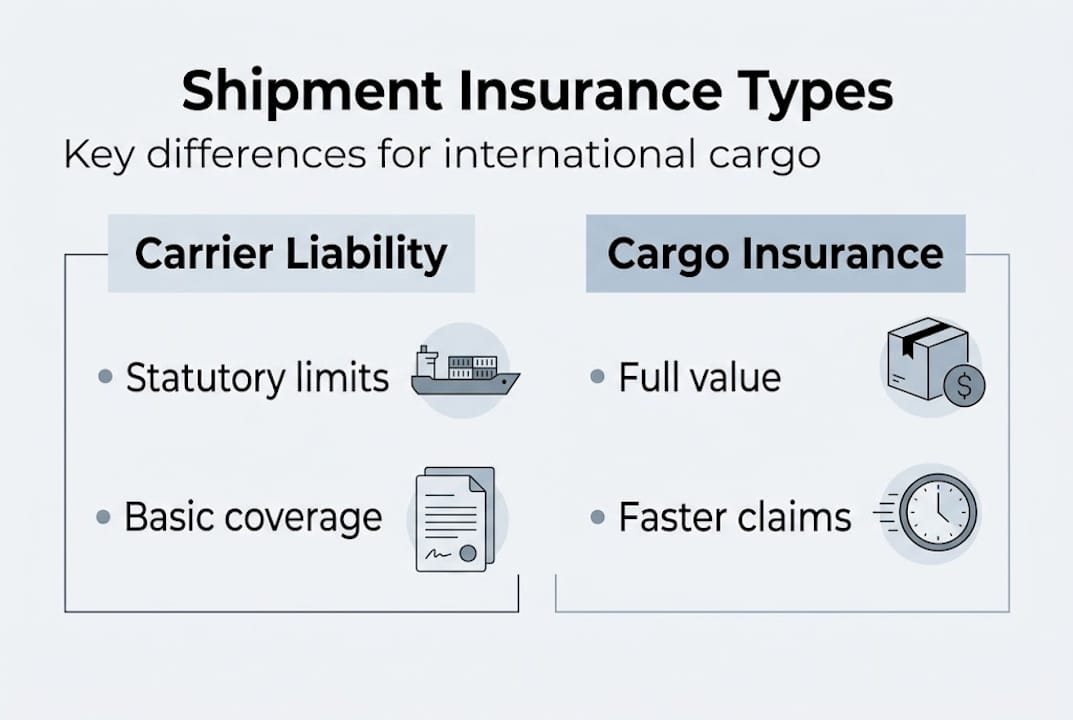
Cargo insurance, by contrast, is a separate policy purchased from a third-party insurer or through a freight forwarder. It covers the actual commercial value of goods, and cargo insurance basics explain how premiums typically run around $0.55 per $100 of insured value, making it relatively affordable compared to the risk exposure it eliminates.
The structure of cargo insurance policies is largely governed by the Institute Cargo Clauses (ICC), a standardized set of terms used globally. Per ICC A/B/C coverage details, the three tiers work as follows:
- ICC A (All Risk): The broadest coverage, protecting against all physical loss or damage except named exclusions. Best for high-value or fragile cargo.
- ICC B (Named Perils): Covers specific risks including earthquake, washing overboard, and entry of seawater. A middle-ground option.
- ICC C (Basic Perils): The most limited option, covering only major casualties like fire, sinking, or collision. Suitable for low-value, durable goods.
Regardless of tier, all ICC policies share common exclusions: losses from delays, inherent vice (meaning cargo that deteriorates by its own nature), war risk, and willful misconduct. Understanding these exclusions before a loss occurs is critical.
“Carrier liability is not insurance. It is a legal minimum that rarely reflects the real-world value of what you’re shipping.”
| Feature | Carrier Liability | Third-Party Cargo Insurance |
|---|---|---|
| Coverage basis | Statutory limits (weight/unit) | Actual commercial value |
| Typical recovery | ~5% of cargo value | Up to 100% of insured value |
| Exclusions | Extensive | Defined and negotiable |
| Claim speed | 30 to 90 days | 5 to 15 days |
| Cost | Included in freight | ~$0.55 per $100 insured |
Exploring import cargo insurance types helps businesses match the right policy structure to their specific trade lanes and cargo categories.
The insurance claim process: Step-by-step
Knowing your policy is only half the battle. When a loss actually occurs, speed and precision in filing your claim determine whether you recover fully or partially.
The moment cargo arrives damaged or fails to arrive at all, the clock starts ticking. Most policies require notification within 14 to 21 days of the delivery date or incident. Missing this window can void your claim entirely, regardless of how solid your documentation is. Here is the process that works:
- Document the damage immediately. Take time-stamped photographs of the packaging, the cargo itself, and any visible damage to the container or vehicle. Do this before moving or unpacking goods whenever possible.
- Obtain a delivery receipt with exceptions noted. If the carrier delivers damaged goods, note the damage explicitly on the delivery receipt. A clean receipt signed without exceptions weakens your claim significantly.
- Request a formal inspection report. For significant losses, a surveyor or inspector appointed by the insurer may need to assess the damage. Arrange this promptly and keep all correspondence.
- Gather supporting documentation. This includes the commercial invoice, packing list, bill of lading, and any prior condition reports or pre-shipment surveys.
- Submit the claim form to your insurer. Complete the insurer’s claim form accurately, attaching all supporting documents. Incomplete submissions are a leading cause of delays.
- Maintain communication with both the carrier and insurer. Follow up regularly and keep a log of all calls, emails, and responses. This paper trail matters if the claim is disputed.
According to the GSA freight damage claims guidance, claims on third-party cargo insurance are typically resolved in 5 to 15 days, while carrier liability claims can drag on for 30 to 90 days due to internal investigation processes and legal review.

Pro Tip: Create a dedicated digital folder for every shipment at the time of booking. Include the policy certificate, commercial invoice, packing list, and carrier contact details. When a loss occurs, your claim file is already 80% complete.
The freight claim process guide provides additional templates and checklists that can be adapted for air, ocean, and road freight claims.
Best practices for maximizing claim success
Filing a claim is one thing. Maximizing what you recover is another. Businesses that consistently achieve full or near-full settlements share a set of disciplined habits that begin long before any loss occurs.
Documentation is your strongest asset. Precise, consistent records stored in accessible digital formats give insurers and adjusters exactly what they need to process claims quickly. Vague or inconsistent descriptions of cargo value or condition create gaps that adjusters may use to reduce payouts. Always match your declared value on the insurance certificate to the commercial invoice, down to the currency and unit of measure.
Match your insurance to actual cargo value, not shipping cost. A common error is insuring cargo for the freight cost rather than the commercial value of the goods. If a shipment is worth $150,000 but insured for $50,000, the maximum recovery is $50,000, even under a comprehensive ICC A policy. Review declared values before every shipment, especially for commodities with fluctuating market prices.
Key documentation best practices include:
- Use standardized packing lists with item descriptions, quantities, unit values, and total values
- Retain pre-shipment condition photos for all high-value or fragile cargo
- Store all shipping documents in a cloud-accessible system with version control
- Confirm policy certificate numbers match the bill of lading references
- Set calendar reminders for claim notification deadlines at the time of booking
Communicate early with both your carrier and insurer. Early notification, even before a formal claim is filed, signals good faith and allows insurers to mobilize surveyors or adjusters faster. Waiting until you have “all the information” often costs you time and recovery.
As cargo insurance data consistently shows, cargo insurance offers broader coverage and faster claims settlement than standard carrier liability. Yet many businesses still default to carrier liability because it requires no additional action at booking.
Statistic callout: Under carrier liability alone, businesses typically recover only about 5% of actual cargo value after a total loss event.
Pro Tip: Develop a standardized loss event checklist specific to your cargo types and trade routes. Laminate a copy and keep it accessible in your shipping department. When a loss occurs, emotions run high and steps get skipped. A checklist removes the guesswork.
Exploring freight insurance options and reviewing best cargo insurance coverage for your specific trade lanes are smart starting points for building a stronger risk management posture.
How to choose the right insurance for your shipment
Selecting the right policy is not a one-size-fits-all decision. The cargo type, trade route, carrier mode, and declared value all influence which coverage structure actually protects your business.
Before purchasing a policy, ask these questions:
- What is the full commercial value of the cargo, including duties and freight?
- What perils are most likely on this specific trade route (theft, weather, handling damage)?
- Does the cargo have any inherent characteristics that could trigger exclusions (perishables, electronics, machinery)?
- How long is the transit, and does coverage extend to inland legs and storage?
- What is the financial impact of a total loss on your business operations?
The answers shape which ICC tier makes sense. ICC A/B/C policy options each fit a different risk profile: ICC A for high-value or vulnerable cargo, ICC B for moderate-risk shipments on established lanes, and ICC C for durable, low-value goods where only catastrophic loss is a realistic concern.
| Policy Type | Coverage Scope | Typical Cost | Claim Speed | Best For |
|---|---|---|---|---|
| Carrier Liability | Statutory limits only | Included in freight | 30 to 90 days | Low-value, durable goods |
| ICC C (Basic) | Major casualties only | Low premium | 10 to 20 days | Bulk commodities |
| ICC B (Named Perils) | Specific named risks | Moderate premium | 7 to 15 days | Standard manufactured goods |
| ICC A (All Risk) | All physical loss/damage | Higher premium | 5 to 10 days | High-value or fragile cargo |
Freight forwarders play an important role in this decision. An experienced forwarder understands the risk profile of specific trade lanes and can recommend policy structures that match your cargo and budget. What is freight insurance breaks down how forwarder-arranged policies often provide better terms than policies purchased independently, because forwarders negotiate volume-based rates with insurers.
Under COGSA and similar frameworks, per-pound statutory limits make carrier liability a poor substitute for real insurance on any shipment with meaningful commercial value. Working with a knowledgeable freight forwarder ensures the insurance structure is built into the shipment plan from day one, not added as an afterthought.
Our take: Why ‘minimum coverage’ is a dangerous myth
There is a persistent belief in international trade that minimum carrier liability is “good enough” for most shipments. It is not, and the businesses that learn this lesson tend to learn it the hard way.
Consider a mid-size importer shipping $80,000 worth of consumer electronics from Asia. The carrier damages the container. Under COGSA’s $500-per-unit limit, the recovery might be $3,000 to $5,000. The remaining $75,000 is an out-of-pocket loss. That is not a minor hiccup. That is a cash flow crisis.
The uncomfortable truth is that the boring details matter most: policy exclusions, claim notification windows, declared value accuracy, and document storage protocols. Businesses that invest 30 minutes reviewing these details before a shipment moves are the ones that recover fully when something goes wrong.
Relying on defaults, whether it is the carrier’s standard liability or a policy a freight forwarder set up three years ago without review, is a form of financial risk that compounds quietly until a single incident makes it visible. Understanding the real difference between a carrier vs freight forwarder arrangement is a smart first step toward making intentional, informed coverage decisions.
Protect your shipments with expert help
Understanding how shipment insurance claims work is a powerful starting point. Taking action on that knowledge is what actually protects your bottom line.
Worldwide Express offers cargo insurance solutions tailored to the realities of international trade, from single-shipment coverage to open cargo policies for high-volume importers and exporters. The team also provides access to a full freight forwarding guide to help businesses structure smarter logistics plans. For businesses navigating complex import and export requirements, customs brokerage services ensure compliance and documentation accuracy from origin to destination. Reach out to explore coverage options built around your specific cargo and trade routes.
Frequently asked questions
What documents are needed to file a shipment insurance claim?
You typically need a bill of lading, delivery receipt, inspection report, photos of the damage, and a completed claim form. Essential claim documents also include commercial invoices and packing lists to verify declared value.
How long does it take to settle a shipment insurance claim?
Third-party cargo insurance claims are usually resolved in 5 to 15 days, while carrier liability claims can take 30 to 90 days due to internal carrier review processes.
What are common exclusions in cargo insurance policies?
ICC policy exclusions commonly include losses caused by delays, inherent vice of the cargo, and war risks, regardless of which ICC tier you hold.
Can I recover the full cargo value with carrier liability?
No. Carrier liability limits recovery to statutory caps based on weight or shipping unit, which typically amounts to roughly 5% of actual cargo value in a total loss scenario.
Recommended
- Master the Freight Claim Process: A Step-by-Step Guide – Worldwide Express, Inc.
- Cargo Insurance Basics: Protecting U.S. Shipments – Worldwide Express, Inc.
- 7 Smart Freight Insurance Options for Safer Shipments – Worldwide Express, Inc.
- International cargo insurance in Pennsylvania: protect your shipments – Worldwide Express, Inc.
- How to Verify a Licensed Interstate Moving Company (Step-by-Step Guide) – AMB Moving Services