TL;DR:
- Accurate product classification and destination screening are essential to avoid penalties and shipment delays.
- Following proper logistics protocols, including Incoterms and special handling, ensures cargo safety and compliance.
- Complete, consistent documentation and automated filings minimize risks and expedite international exports.
Exporting electronics isn’t just a logistics challenge. It’s a compliance minefield where a single classification error or missed screening check can trigger shipment seizure, export bans, or penalties up to 11% of your logistics budget. The stakes are high precisely because electronics often fall under dual-use controls, meaning the same component that powers a consumer device can also have military applications. This guide walks through the full process: classifying your products correctly, screening destinations and parties, planning logistics, and filing airtight documentation so your electronics reach global markets efficiently and without incident.
Table of Contents
- Understand export requirements: Classification and licenses
- Screen destinations and parties: Compliance checks
- Logistics planning: Incoterms, shipping, and handling electronics
- Documentation and export filing: Getting it right
- Our take: Why attention to compliance and logistics pays off
- Take your electronics exports further with expert logistics
- Frequently asked questions
Key Takeaways
| Point | Details |
|---|---|
| Classify with care | Correct ECCN and HS codes are essential for legal and cost-effective electronics exports. |
| Screen all parties | Thorough vetting of destinations and end-users reduces license headaches and compliance risks. |
| Optimize logistics | Strategic Incoterms, trusted forwarders, and safe handling cut costs and avoid delays. |
| Document everything | Complete, accurate paperwork ensures shipments clear customs smoothly every time. |
Understand export requirements: Classification and licenses
The foundation of any successful electronics export is accurate product classification. Two separate coding systems apply, and confusing them is a costly mistake businesses make more often than they should.
Exporting electronics from the US requires classification using the Export Control Classification Number (ECCN) for export controls under the Export Administration Regulations (EAR), administered by the Bureau of Industry and Security (BIS). Separately, Schedule B codes and Harmonized System (HS) codes are used for customs filings and trade statistics via U.S. Customs and Border Protection (CBP). Think of ECCN as your compliance passport and Schedule B as your customs ID. Both must be accurate.
Here’s what each code system covers:
- ECCN: Determines whether a product requires a BIS export license based on technical parameters, destination, and end-use. Categories include telecommunications equipment, semiconductors, sensors, and more.
- HS/Schedule B: Used by CBP to assess tariffs and generate trade data. A wrong HS code can trigger delays, incorrect duty assessments, and audits.
- EAR99: The default classification for items not specifically listed on the Commerce Control List (CCL). EAR99 items may not require a license unless the shipment is heading to an embargoed country or restricted party.
The EAR and BIS controls framework is notoriously detailed, covering everything from general-purpose chips to advanced AI accelerators. Astoundingly, only about 5% of U.S. exports require a formal export license, but that stat offers false comfort. Every shipment still demands a screening process to confirm whether that 5% threshold applies to you.
Statistic callout: Only ~5% of U.S. exports require a BIS export license, yet the consequences of shipping without one when required include criminal charges and permanent denial orders.
For export compliance essentials, businesses should build a product-level classification matrix that maps each SKU to its ECCN, HS code, and license determination status. This is especially important for companies exporting advanced integrated circuits, wireless modules, or products containing encryption technology, all of which attract heightened BIS scrutiny.
Pro Tip: Don’t rely solely on your manufacturer’s suggested ECCN. Independently verify using the BIS Commerce Control List and consult your technology export guide to confirm classifications before filing.
Screen destinations and parties: Compliance checks
Once your products are properly classified and license needs clarified, it’s critical to vet where and to whom you’re exporting. This is an area where businesses frequently underestimate risk, and where violations can be particularly severe.

Screening for end-use, end-users, and denied parties is non-negotiable. Violations carry double penalties, meaning BIS can impose a fine equal to twice the value of the transaction, plus denial orders that cut off a company’s export privileges entirely.
Here’s a practical screening process to follow for every shipment:
- Check the destination country against the EAR Country Chart and current U.S. embargo lists (Cuba, Iran, North Korea, Syria, Russia).
- Screen the end-user against BIS’s Entity List, Denied Persons List, and the Consolidated Screening List maintained by multiple federal agencies.
- Evaluate end-use to ensure the electronics won’t be redirected to military programs or weapons of mass destruction development.
- Review for diversion red flags: Unusual payment terms, requests to remove product markings, vague end-use descriptions, or third-party intermediaries in high-risk locations.
- Document all screening steps with timestamps, database names, and results for each party and transaction.
The expanded BIS requirements for advanced computing integrated circuits (AI chips and semiconductors) add an additional layer of due diligence. BIS now mandates enhanced controls for exports to China, Macau, and other destinations of concern, requiring detailed end-use statements and tighter recordkeeping.
“The greatest compliance risk isn’t intentional fraud. It’s the exporter who assumed a long-standing customer was already cleared, without ever checking for new Entity List additions.” This mindset gap is exactly what regulators exploit during audits.
Reviewing customs compliance best practices alongside your screening workflow helps businesses integrate these checks into everyday operations rather than treating them as one-time events. Pair that with a thorough read of the guide to exporting goods for a complete operational framework.
Pro Tip: Automate your screening using a trade compliance platform that pulls from live government databases. Manual checks against static spreadsheets are a liability, not a system.
Logistics planning: Incoterms, shipping, and handling electronics
After confirming legal compliance, your focus shifts to orchestrating secure, efficient transport of your electronics. This is where smart decisions directly reduce cost and protect cargo integrity.
Choosing the right Incoterms is the first major logistics decision. Incoterms define who bears responsibility for cost, risk, and insurance at each point in the shipment. For electronics exporters, the most commonly used terms are:
| Incoterm | Risk transfers to buyer | Exporter covers freight | Best for |
|---|---|---|---|
| EXW | At exporter’s door | No | Experienced buyers |
| FOB | At origin port | No | Ocean shipments |
| CPT | At origin handoff | Yes (to destination) | Air/multimodal |
| DAP | At named destination | Yes | Full-service delivery |
Choose Incoterms carefully because misaligned terms can leave your business exposed to uninsured losses or unexpected freight costs. DAP and CPT are popular for electronics exporters who want more control over transit conditions.
For mode of transport, the decision typically comes down to value, weight, and urgency:
- Air freight: Preferred for high-value, low-weight electronics (consumer devices, semiconductors). Faster transit reduces in-transit risk.
- Ocean freight: Cost-effective for large volume shipments of finished electronics or components. Requires more robust packaging.
- Road freight: Common for intra-regional moves (e.g., North America, EU) or final-mile delivery from ports.
Special handling requirements for electronics include electrostatic discharge (ESD) protection packaging, climate-controlled containers for temperature-sensitive components, and specific IATA regulations for lithium batteries (classified under UN3480 or UN3481 depending on configuration). Non-compliance with lithium battery rules can result in cargo rejection or airline refusal.
To optimize global logistics for electronics, partner with freight forwarders who specialize in this cargo category. They will know carrier restrictions, labeling requirements, and country-specific import rules that a general logistics provider may miss. Equally important is packing electronics for export with materials that absorb shock, prevent static, and meet destination country labeling requirements.
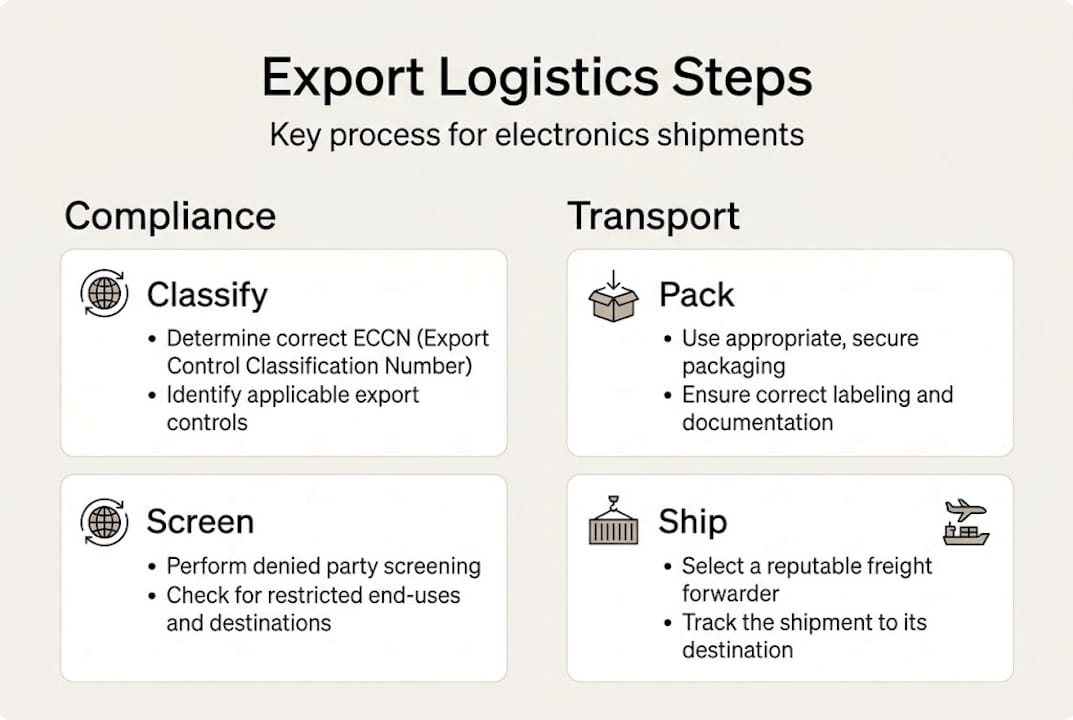
Pro Tip: Always request a freight forwarder’s track record with electronics specifically. Ask about their experience with IATA lithium battery compliance and ESD-sensitive cargo before signing any agreement.
Documentation and export filing: Getting it right
With logistics aligned, accurate and complete documentation is now your last line of defense against costly delays. A single inconsistency between your commercial invoice and your Electronic Export Information (EEI) filing can halt a shipment at the port.
Core documents required for most electronics exports include:
- Commercial invoice: Must include precise product descriptions, quantities, unit values, HS codes, and country of origin.
- Packing list: Details weight, dimensions, and contents of each package. Must match the invoice exactly.
- Export license: Required when the ECCN and destination combination triggers a license requirement. Must accompany the shipment.
- Electronic Export Information (EEI): Filed via the Automated Export System (AES) for shipments valued at $2,500 or more per Schedule B item. This is a legal requirement, not optional.
- Certificate of origin: Required by many destination countries to confirm the goods’ manufacturing origin for tariff purposes.
- End-use statement or technical specifications: Often required for dual-use electronics or controlled components.
The most common documentation errors include mismatched product descriptions across forms, incorrect ECCN or HS codes, undervalued shipments, and late EEI filings. Each error creates audit risk and potential BIS scrutiny.
“An automated Export Compliance Program (ECP), combined with a 3PL provider experienced in electronics, can dramatically reduce manual filing errors and shorten compliance cycles.” Per compliance guidance, businesses should automate EEIs and implement a formal ECP rather than relying on manual processes.
Exporters should also review the export documentation guide for a complete checklist and consult the export documentation process to understand the sequencing of filings and how each document interacts with customs systems.
Consistency is key. Product descriptions on the invoice, packing list, EEI, and any export license must mirror each other word for word to avoid red flags during customs review.
Our take: Why attention to compliance and logistics pays off
Stepping back from the process details, the most resilient electronics exporters share one common trait: they treat compliance and logistics as integrated systems, not separate checklists.
Businesses that cut corners on export compliance guidance don’t just face fines. They face shipment seizure, reputational damage with global partners, and in severe cases, permanent export ban. That’s an existential risk for any company whose revenue depends on international trade.
The real competitive edge comes from investing in automation, experienced freight partners, and end-to-end compliance infrastructure. Automated screening tools and classification platforms are not overhead. They are force multipliers that allow businesses to scale exports without proportionally scaling compliance risk.
The electronics sector moves fast. Regulations around advanced chips, AI hardware, and dual-use components are evolving rapidly, particularly for trade involving China and other controlled destinations. Companies that build adaptive compliance systems today are the ones that ship without interruption tomorrow. Those who wait for a violation to trigger change often pay a price far steeper than the investment in getting it right from the start.
Take your electronics exports further with expert logistics
Navigating the complexity of electronics exports, from ECCN classification and party screening to Incoterms selection and EEI filings, demands more than a compliance manual. It demands a logistics partner who understands the full picture.
Worldwide Express offers end-to-end logistics services built specifically for businesses managing complex international trade. Whether you need support with customs brokerage, freight arrangement, or documentation review, the team is equipped to handle every layer of your electronics export operations. Explore international freight shipping options tailored to high-value cargo, and learn how customs brokerage services can reduce filing errors and accelerate customs clearance at destination.
Frequently asked questions
What export codes do I need for electronics shipments?
You need an ECCN for export controls under EAR/BIS and an HS/Schedule B code for customs filings and trade statistics reporting with CBP.
How do I know if my electronics need an export license?
Check the product’s ECCN, destination country, and end-user status against BIS control lists. Per compliance data, only ~5% of exports require a formal license, but dual-use and controlled items trigger additional scrutiny regardless.
What are the best logistics practices for exporting electronics?
Use freight forwarders experienced with electronics, select appropriate Incoterms based on risk and delivery scope, and ensure special handling compliance for ESD-sensitive components and lithium battery shipments.
What penalties apply for export violations?
BIS can impose a fine of up to twice the transaction value, issue denial orders restricting future export privileges, or pursue criminal charges for willful violations.
Recommended
- How to export technology products: complete business guide – Worldwide Express, Inc.
- Step-by-step guide to exporting goods: compliance to shipment – Worldwide Express, Inc.
- Master Exporting Food Products: A Step-by-Step Approach – Worldwide Express, Inc.
- How to Import Goods: A Step-by-Step Guide for Success – Worldwide Express, Inc.
- How to Prototype Parts | Step-by-Step Guide for Professionals