TL;DR:
- Modern container tracking reduces delays, theft, and operational costs in global logistics.
- GPS and IoT devices provide real-time, high-value cargo visibility for proactive management.
- Effective tracking requires centralized dashboards, team training, and continuous process improvement.
Billions of dollars vanish from the global logistics industry every year because containers go missing, get misrouted, or arrive late with no advance warning. Lost or misrouted containers cause staggering financial and operational damage that ripples across supply chains. For import/export businesses and logistics managers, this isn’t an abstract statistic — it’s a daily operational risk. The good news is that modern container tracking methods have evolved far beyond simple booking confirmations. This article breaks down the leading technologies, how they work in practice, and how to apply them for maximum supply chain visibility and efficiency.
Table of Contents
- Why container tracking matters in global logistics
- Types of container tracking methods explained
- How container tracking technologies work in practice
- Maximizing efficiency: Best practices for container tracking
- Our perspective: Why many businesses underuse container tracking methods
- Bring next-level tracking to your supply chain
- Frequently asked questions
Key Takeaways
| Point | Details |
|---|---|
| Greater supply chain visibility | Real-time container tracking greatly enhances your ability to monitor shipments and respond quickly to issues. |
| Multiple tracking options | Choose from manual, RFID, GPS, or API-based methods depending on your business needs and shipment volume. |
| Improved efficiency and cost savings | Effective tracking reduces delays, cuts losses, and supports smarter supply chain decisions. |
| Best practices matter | Regular audits, training, and integration maximize the ROI of your container tracking investments. |
Why container tracking matters in global logistics
Container tracking is often treated as a passive function, something you check after a problem surfaces. That approach is costly. When a shipment is delayed at a transshipment port, stuck in customs, or quietly diverted, logistics managers need to know immediately — not days later when a client calls to ask where their goods are.
The range of stakeholders who depend on timely tracking data is broad. Shippers need confirmation that cargo left on schedule. Freight forwarders require status updates to coordinate documentation. Importers must anticipate arrival windows for warehouse planning. Consignees want delivery confirmation. Each party needs accurate, real-time information, and a gap for any one of them creates friction across the whole chain.
Here is a quick look at what unmonitored containers can cost a business:
- Delayed deliveries triggering contractual penalties
- Spoiled temperature-sensitive cargo with no alert system in place
- Theft or tampering going undetected until arrival
- Customs holds worsened by poor documentation timing
- Missed transshipment windows causing multi-week delays
Manual tracking systems — spreadsheets, phone calls, emailed status updates — were never designed for today’s shipping volumes or complexity. Businesses that still rely on them are essentially flying blind across large stretches of their cargo journey.
“Real-time tracking helps reduce theft, loss, and operational delays” across all points in the supply chain, making it a foundational tool rather than an optional upgrade.
The data backs this up clearly. Companies that implement real-time supply chain visibility tools cut shipment delays by up to 40%. That’s not a marginal gain — that’s a structural advantage in a competitive market. Understanding the cargo tracking benefits available today makes the case for upgrading from reactive to proactive tracking impossible to ignore.
With the need established, it’s worth examining the main types of tracking methods now available to logistics teams.
Types of container tracking methods explained
Not all tracking methods are created equal. Each carries distinct advantages, limitations, and cost profiles. Choosing the right one depends on your shipment frequency, cargo value, and how much risk your business can absorb.
Here’s how the four primary methods stack up:
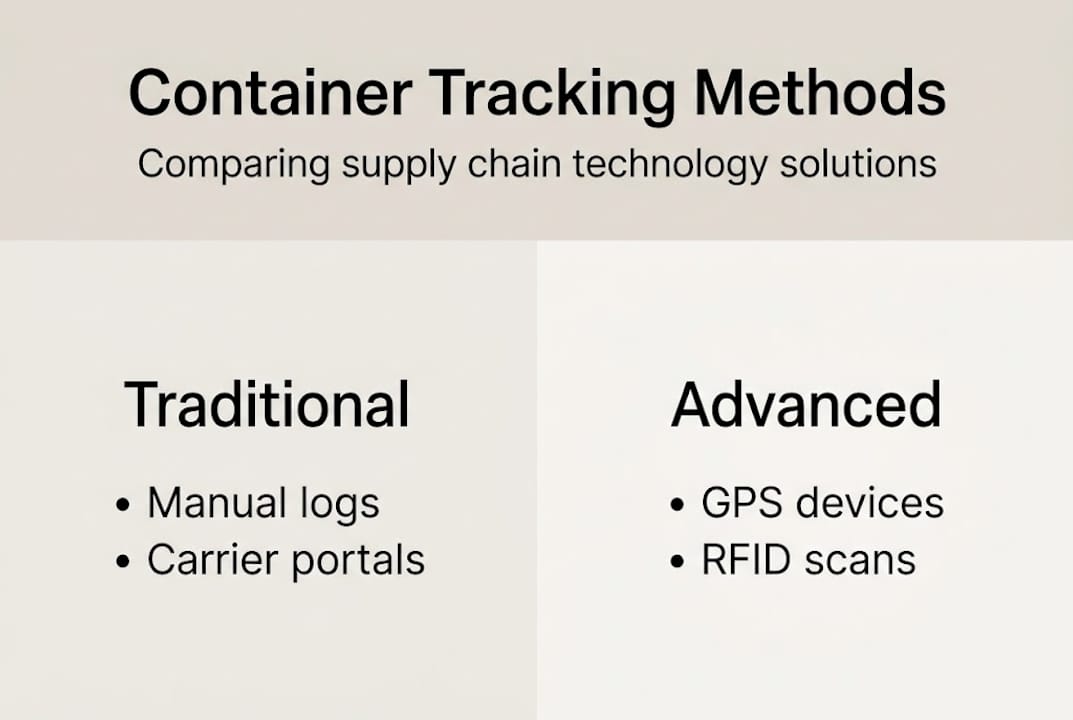
| Method | Data frequency | Best for | Limitation |
|---|---|---|---|
| Manual | On demand | Very low volume | Labor intensive, error prone |
| Barcode/RFID | Scan events | Mid-volume, port-based | No data between scan points |
| GPS/IoT | Continuous | High-value, time-sensitive cargo | Higher device and data cost |
| Carrier/API platforms | Event-based updates | Most business sizes | Limited to carrier data feeds |
Here’s a numbered breakdown of each method and where it fits:
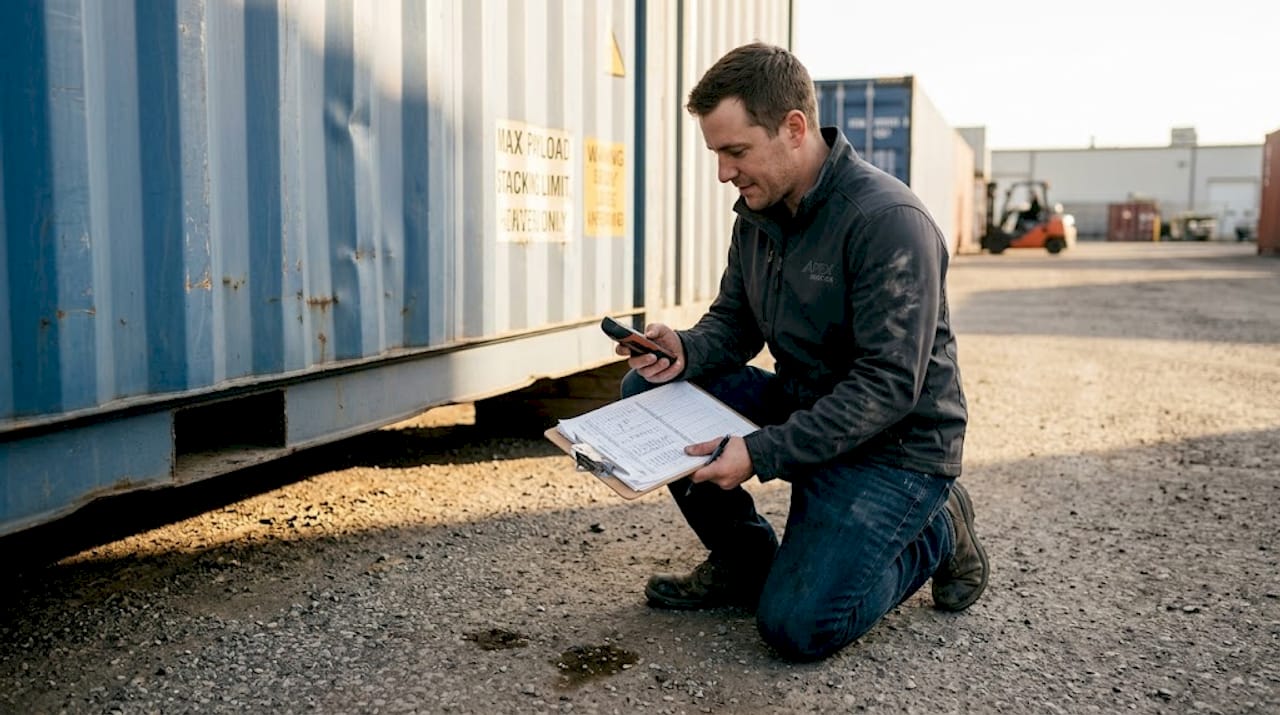
- Manual tracking: Relies on staff manually logging updates from carrier emails, calls, or portals. Useful for very small shipment volumes but impossible to scale without serious data gaps.
- Barcode and RFID: Radio Frequency Identification (RFID) tags are scanned at key checkpoints such as port gates and warehouses. Updates arrive at scan events rather than continuously, which leaves blind spots between locations.
- GPS and IoT devices: Small devices attached to containers send continuous location, temperature, humidity, and tampering alerts. Per industry data, GPS and IoT provide real-time location and condition data far beyond traditional barcode scanning, making them the gold standard for high-value or sensitive cargo.
- Carrier and API-based platforms: Digital platforms aggregate status updates from multiple carriers via application programming interfaces (APIs). These are practical, scalable, and work for most mid-to-large importers without requiring physical devices on every container.
For businesses moving into more sophisticated tracking trucks in real time and last-mile visibility, GPS-IoT integration is particularly powerful. Managers exploring container shipping basics will find that starting with carrier portals and layering in GPS for high-risk lanes is a logical progression.
Pro Tip: Pair RFID scanning at port checkpoints with GPS tracking devices for double-layered visibility. RFID confirms gate movements; GPS fills in the journey between those checkpoints.
Now that you know the main methods, it’s time to see how they actually perform in real-world logistics scenarios.
How container tracking technologies work in practice
Understanding the technology in theory is one thing. Seeing how it maps to your actual shipping operations is where the real value becomes clear.
Business size shapes which tools make sense. A small importer moving ten containers a month may rely entirely on a carrier portal, logging in to check status updates at key milestones: booking confirmed, vessel departed, arrival at destination port, customs cleared. That workflow works — until a transshipment delay hits and nobody notices for four days.
A large importer moving hundreds of containers monthly will typically deploy IoT devices on high-value lanes and use API-connected dashboards to pull status data from multiple carriers simultaneously. Alerts fire automatically when a container deviates from its expected route or when temperature thresholds are breached. Integrated tracking systems provide regular status updates, alarms, and delivery confirmation in a single dashboard view.
Here’s how data granularity compares across methods in practice:
| Data point | Manual | Barcode/RFID | GPS/IoT | API platform |
|---|---|---|---|---|
| Current location | Estimated | Last scan point | Continuous | Carrier reported |
| Temperature | None | None | Real-time | None |
| Tampering alerts | None | Gate only | Immediate | None |
| ETA accuracy | Low | Medium | High | Medium-high |
| Delivery confirmation | Manual | Scan based | Automated | Automated |
Three common scenarios where tracking data directly changes outcomes:
- Customs clearance: Accurate arrival ETAs allow brokers to pre-file documentation, cutting port dwell time significantly.
- Transshipment monitoring: Knowing when a container misses a connecting vessel at a hub port allows teams to rebook before significant delays compound.
- Last-mile delivery: GPS-linked tracking confirms final handoff, critical for regulated goods requiring proof of delivery.
For businesses focused on optimizing global logistics, the data produced by modern tracking systems isn’t just operational — it feeds directly into smarter procurement decisions, route planning, and carrier negotiations.
This understanding of how methods work leads naturally to asking how to extract maximum benefit from them consistently.
Maximizing efficiency: Best practices for container tracking
Having the right tracking technology in place is only half the equation. How your team uses it determines whether you see real returns.
Here are the core best practices logistics managers should build into their operations:
- Centralize your dashboard: All tracking data should feed into one platform with role-based access controls. Fragmented visibility across multiple portals creates the same blind spots as no tracking at all.
- Train your team thoroughly: Tracking protocols only deliver value if every team member from operations to customer service knows how to read alerts and escalate exceptions.
- Review and upgrade regularly: Tracking technology evolves quickly. Build an annual review cycle into your logistics strategy to assess whether your tools still match your shipment volumes and risk profile.
- Align with safety policies: Container tracking data should integrate with your warehouse safety and transport compliance frameworks, not sit in a separate system that nobody checks.
- Feed tracking data into supply chain planning: Exception data from delays, misroutes, and customs holds is enormously valuable for identifying weak lanes and renegotiating carrier contracts.
Per industry insight, consistent tracking protocols and policy enforcement are key to seeing the full return on investment from technology investments. Buying an IoT device and never setting alert thresholds is not a tracking strategy — it’s a wasted budget line.
Pro Tip: Schedule quarterly audits of your tracking data to identify recurring gaps, such as specific ports or carriers with chronic delay patterns. Catching those trends early is far cheaper than reacting to each incident separately.
For businesses looking at the broader financial picture, strong tracking practices also contribute to lowering shipping rates by reducing costly exceptions. Integrating tracking into supply chain risk management frameworks ensures that visibility translates into actual operational resilience. Teams should also align tracking policies with warehouse safety best practices to maintain a consistent standard across the full cargo journey.
By following these best practices, the advantages of container tracking become measurable and repeatable.
Our perspective: Why many businesses underuse container tracking methods
Here is an uncomfortable observation from years of working across global logistics: most businesses that have tracking technology use it reactively. They log in when something goes wrong. They treat it as a customer service tool rather than a strategic asset. That gap between having tracking and using it well is where enormous opportunity is wasted.
The obstacles are real. Teams are stretched. Platforms require integration effort. And when tracking “sort of works” on most shipments, the urgency to invest further simply fades. But “sort of works” is a fragile standard in international logistics.
As industry data confirms, many companies use tracking only as a reactive measure, not for predictive decision making. That means they are generating data without analyzing it, responding to fires instead of preventing them.
The businesses seeing the strongest results are those that treat true supply chain visibility as a continuous improvement initiative, not a one-time technology purchase. They audit their data, cross-reference it with carrier performance, and use it to drive smarter procurement. That mindset shift is where the real competitive edge lives.
Bring next-level tracking to your supply chain
The gap between basic tracking and genuinely intelligent supply chain visibility is narrower than most businesses think — but it requires the right partner and tools to close it.
Worldwide Express offers advanced tracking integration, real-time visibility dashboards, and expert logistics support designed for import/export businesses that need more than a carrier portal. From reviewing your current setup to building a fully integrated freight forwarding guide, the team brings practical experience across ocean, air, and ground logistics. Explore the full range of full logistics services and see how supply chain visibility solutions can turn your tracking data into a genuine competitive advantage.
Frequently asked questions
What is the best container tracking method for small businesses?
Carrier-based digital tracking portals are cost-effective and practical for small businesses shipping fewer containers, providing reliable milestone updates without requiring physical devices. As volume grows, layering in API-connected platforms adds meaningful container shipping visibility.
How does GPS container tracking work?
GPS-enabled devices attached to containers send location and condition data continuously to software dashboards, giving logistics managers real-time awareness of where cargo is and whether it’s been tampered with. GPS and IoT together also monitor environmental conditions like temperature and humidity.
Can container tracking help lower shipping costs?
Accurate tracking reduces time lost to delays and helps teams avoid costly misrouting, ultimately saving money across the shipment lifecycle. Delays and losses are minimized when teams respond proactively rather than after the fact.
Are there privacy concerns with GPS and IoT container tracking?
Data generated by GPS and IoT devices is typically secured by the technology vendor, but businesses should review vendor privacy standards and data retention policies before implementation. Privacy and security considerations should be part of any tracking solution evaluation.
How can I integrate container tracking with warehouse management systems?
Select a tracking solution with open APIs to ensure seamless data sharing between your logistics platforms and warehouse management tools. API-enabled platforms make this integration straightforward and scalable as your operation grows.
Recommended
- Unlock cargo tracking benefits for efficient logistics – Worldwide Express, Inc.
- How to track a delivery truck effectively in 2026 – Worldwide Express, Inc.
- How to Optimize Logistics for Efficient Global Shipping – Worldwide Express, Inc.
- Container shipping basics: Reliable solutions for global trade – Worldwide Express, Inc.