TL;DR:
- Signing freight contracts without fully understanding their terms exposes importers and exporters to costly disputes over liability, charges, and risk allocation. Precise language, clear trade terms, and well-drafted clauses on demurrage, detention, liability, and force majeure are essential to avoid unexpected expenses and legal issues. Regularly reviewing and customizing contracts after disruptions ensures they align with current trade laws, market conditions, and your specific risk appetite.
Signing a freight contract without fully understanding its terms is one of the most expensive habits in international logistics. Disputes over vague liability clauses, unexpected demurrage charges, and misapplied force majeure declarations cost importers and exporters millions every year. The terminology embedded in these agreements is not just legal formality; it is the operational framework that governs who pays when cargo is delayed, who bears the risk when goods are lost, and what recourse exists when carriers fail to perform. This guide breaks down every essential term, explains real-world implications, and gives logistics managers a sharper lens for reading and negotiating contracts.
Table of Contents
- Why freight contracts demand precision
- Must-know freight contract key terms
- Hidden costs: demurrage, detention, and laytime explained
- Liability, indemnity, and insurance: managing risk the smart way
- Force majeure and dispute resolution: avoiding contract dead ends
- What most shipping contracts get wrong—and what you should demand
- Expert support for your freight contracts
- Frequently asked questions
Key Takeaways
| Point | Details |
|---|---|
| Specify every key term | Clear definitions in contracts help prevent disputes and extra costs. |
| Check demurrage and detention clauses | Understand how and when penalty charges apply to avoid surprise fees. |
| Insure beyond carrier limits | Standard agreements cap liability; separate insurance protects your cargo. |
| Document mitigation for force majeure | Always show steps taken to avoid disruption, or force majeure may not apply. |
| Never copy contracts blindly | Customize your agreements to reflect current risks—not just industry templates. |
Why freight contracts demand precision
Freight contracts govern some of the most complex transactions in global commerce. A single misplaced term or an outdated clause can shift financial responsibility in ways that nobody at the signing table anticipated. That gap between intent and language is where expensive disputes are born.
Now that you know what’s at stake, let’s clarify why contract language sets the tone for every freight transaction.
Ambiguity is the enemy of efficient streamlining shipping logistics. When a contract fails to define which party controls the cargo at a specific port, or which version of a trade term governs the deal, both sides often end up paying lawyers instead of moving freight. The consequences ripple quickly: delayed customs clearance, cargo sitting in expensive storage, and strained commercial relationships.
A foundational issue many professionals overlook is the version and specificity of trade terms. Per supply chain legal guidance, freight contracts must specify the Incoterms version (for example, Incoterms 2020), the named place or port, and must avoid mixing those terms with inconsistent provisions like UCC terms under American domestic law. Combining frameworks without acknowledging their differences creates a legal maze that courts and arbitrators sort out at great cost to the parties involved.
Logistics managers reviewing freight terms every importer should know should also be aware of the most common risks that vague language introduces:
- Unclear risk transfer points that leave both parties believing the other bears responsibility
- Missing named locations after Incoterms, making it impossible to determine where obligations end
- Conflicting liability caps that reference multiple legal standards simultaneously
- Undefined free time periods for containers at ports, opening the door to surprise charges
- Absent dispute resolution clauses that force expensive litigation as the only remedy
Each of these gaps is avoidable with precise drafting and a solid working knowledge of the terms involved.
Must-know freight contract key terms
With that foundation, it’s time to dive into the critical vocabulary that shapes real contracts.
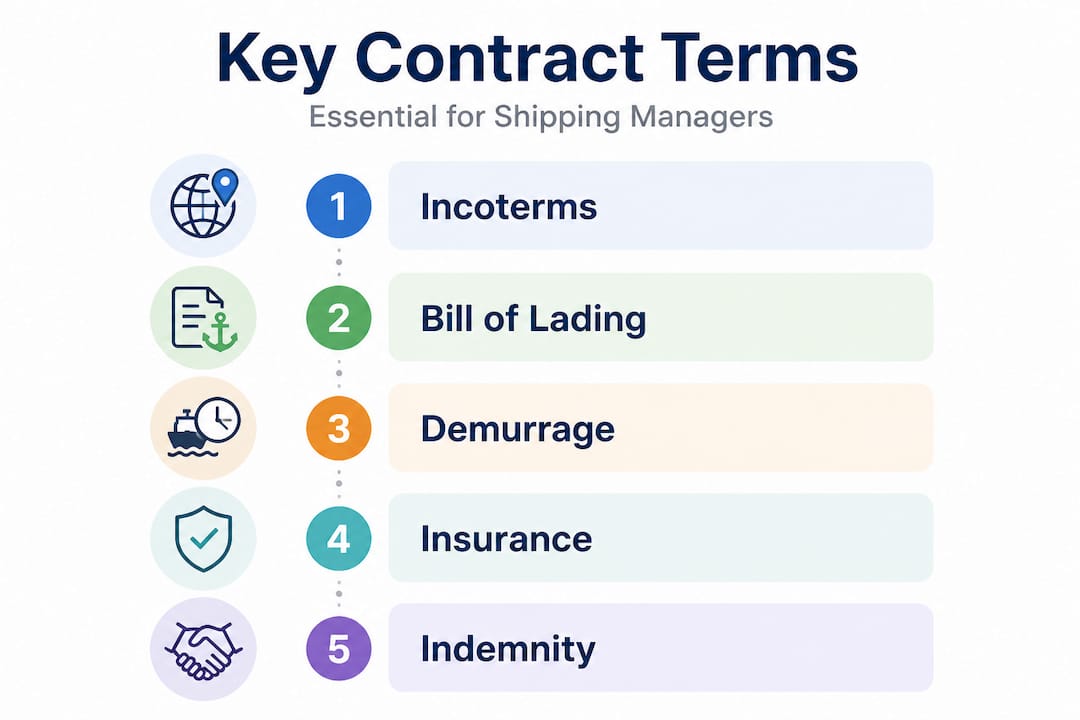
Every logistics manager should be able to recognize and interpret the following terms at a glance. These are not abstract legal concepts; they directly determine who pays what, and when, throughout the life of a shipment.
| Term | Plain explanation | Why it matters |
|---|---|---|
| Incoterms | Standardized trade terms defining cost and risk transfer | Sets the exact point where buyer takes on risk from seller |
| Bill of lading | Legal document serving as receipt, title, and contract | Controls cargo ownership and release at destination |
| Force majeure | Clause excusing performance due to extraordinary events | Protects parties from unforeseeable disruptions |
| Demurrage | Charge for keeping a vessel or container beyond agreed time | Can accumulate rapidly if cargo is not cleared promptly |
| Detention | Charge for keeping equipment (containers) outside the port | Separate from demurrage; often misunderstood and disputed |
| Laytime | Agreed time allowed for loading or unloading cargo | Defines the threshold before demurrage charges begin |
| Liability cap | Maximum financial exposure defined in the contract | Standard carrier limits are frequently far below cargo value |
| Indemnity | Obligation of one party to compensate another for losses | Allocates financial responsibility when things go wrong |
Understanding how bill of lading legalities interact with these terms is particularly important. A negotiable bill of lading, for example, can be transferred to third parties, which changes who can claim cargo at the destination port. Using the wrong type of bill of lading has resulted in cargo being released to the wrong party entirely.
Also critical is understanding Incoterms in trade. The 2020 revision introduced meaningful changes, including new rules for insurance under CIF and CIP terms and clarified delivery vehicle options for FCA shipments. Referencing “CIF New York” without specifying Incoterms 2020 means the contract could be interpreted under an older, less favorable framework.
Per the same supply chain legal framework, contracts that mix Incoterms with contradictory domestic provisions create irreconcilable conflicts that undermine both parties’ original intentions.
Pro Tip: Always confirm which version of Incoterms governs the contract before signing. If the document simply says “FOB” without specifying the year and named port, request an amendment. Outdated versions can trigger different insurance and risk obligations than you expect.
Hidden costs: demurrage, detention, and laytime explained
Beyond basic terms, certain clauses control cash flow by assigning steep penalties when things run late. Let’s break down the details.
Demurrage and detention are among the most financially significant and least understood clauses in ocean freight contracts. Many logistics managers treat them as interchangeable, but they measure two completely different things, and the charges can add up separately and simultaneously.

| Concept | What it measures | Who typically bears the cost |
|---|---|---|
| Laytime | Agreed hours/days for cargo loading or unloading | Charterer or shipper |
| Demurrage | Time a vessel sits idle after laytime expires | Charterer or shipper |
| Detention | Time container equipment stays outside the terminal | Importer or consignee |
| Free time | Grace period before detention begins | Defined in each carrier contract |
According to maritime contract analysis covering the Hormuz disruption claims, demurrage and detention charges for exceeding laytime or free time are governed by contract language that defines the calculation method, the recognized exceptions (including force majeure), and the timelines within which disputes must be filed under Federal Maritime Commission rules. Missing a dispute deadline alone can forfeit a valid claim.
“Contracts define the calculation, exceptions, and dispute timelines. Missing the window to file a demurrage dispute can extinguish a valid claim regardless of the underlying facts.”
The practical implications are significant. A single container sitting uncollected at a busy port can accumulate hundreds of dollars per day in detention charges. Multiplied across a shipment of 20 or 50 containers, the financial impact becomes substantial within days.
To understand and manage demurrage cost and risk proactively, logistics managers should build the following practices into their operations:
- Negotiate free time explicitly rather than accepting carrier defaults, especially during peak seasons
- Map all port dwell times against your customs clearance timelines before booking
- Keep documentation current so that regulatory delays can qualify as valid exceptions under force majeure provisions
- File disputes in writing immediately upon receiving charges you believe are incorrect
- Audit carrier invoices against the contract to catch miscalculations before paying
The “exceptional circumstances” carve-outs in demurrage clauses deserve close reading. Force majeure events, government-mandated port closures, and regulatory delays may legitimately suspend the laytime clock, but only if the contract explicitly lists them and the party claiming the exception can document it.
Liability, indemnity, and insurance: managing risk the smart way
Liability, unfortunately, is seldom obvious, so understanding risk allocation is crucial before signing.
Most standard carrier contracts cap liability at levels that seem reasonable until a real loss occurs. Under the Carriage of Goods by Sea Act (COGSA), the default carrier liability for ocean freight is $500 per package or customary freight unit. For a shipment of electronics or pharmaceuticals worth hundreds of thousands of dollars, that statutory cap leaves importers financially exposed in ways that are shocking to discover after the fact.
Negotiating better contract terms and obtaining adequate coverage is the practical solution. Per legal analysis of essential logistics contract clauses, the correct approach is to negotiate comparative fault indemnity, cap liability at actual cargo value, and obtain separate cargo insurance because standard carrier limits are simply too low to protect most commercial shipments.
Here is a straightforward process for negotiating liability and indemnity terms:
- Request the carrier’s standard tariff and liability schedule before entering contract discussions, so you know the baseline you are negotiating from
- Calculate the declared value of your typical shipment and compare it against the carrier’s default liability cap
- Negotiate a higher declared value clause in the contract, which increases the carrier’s liability ceiling in exchange for a higher freight rate
- Insert a comparative fault indemnity clause that assigns liability proportionally when multiple parties share responsibility for a loss
- Secure separate all-risk cargo insurance to cover the gap between carrier liability limits and actual cargo value
- Verify that your indemnity clause covers third-party claims such as those from customs authorities or port operators if your cargo causes an incident
Pro Tip: Do not assume that your logistics provider’s insurance covers your cargo. Freight forwarder liability policies typically protect the forwarder, not the cargo owner. Explore dedicated freight insurance options and review cargo insurance basics to understand what your policy actually covers before a loss occurs.
Indemnity clauses can also protect against third-party losses. If your cargo leaks hazardous materials and damages other shipments in the same vessel, an indemnity clause determines whether you or the carrier absorbs those third-party claims. Without a clearly negotiated provision, the default outcome is rarely favorable.
Force majeure and dispute resolution: avoiding contract dead ends
With risks and penalties covered, the final layer is planning for what happens when things go sideways.
Force majeure is one of the most frequently invoked and misunderstood clauses in freight contracts. The term translates loosely to “superior force,” and it excuses a party from performing contractual obligations when an extraordinary event beyond their control makes performance impossible. The critical word is impossible, not merely inconvenient or more expensive.
HFW’s legal guidance on force majeure in container contracts makes a pointed observation: force majeure claims fail when alternative options exist. The specific example is telling: if a vessel can reroute via the Cape of Good Hope to avoid a disrupted strait, that option’s existence may nullify the carrier’s force majeure declaration. Documenting whether alternatives were available and what mitigation steps were actually taken is therefore essential for challenging or defending these claims.
Real-world freight disruptions like the Red Sea diversions of recent years tested these clauses heavily. Carriers declared force majeure; shippers contested those declarations by arguing that Cape rerouting was operationally feasible, even if costly. Courts and arbitrators sided with whichever party had better documentation of the mitigation analysis.
For dispute resolution, well-drafted freight contracts should include:
- A mandatory notice period requiring the force majeure-claiming party to notify the other side within a specified timeframe (often 48 to 72 hours)
- A documented mitigation obligation requiring the party invoking force majeure to take all reasonable steps to minimize the impact
- A governing law clause specifying which country’s legal framework applies to interpretation and disputes
- An arbitration or mediation clause that avoids costly litigation by routing disputes to faster resolution forums
- A jurisdiction clause naming the specific court or arbitration body that will hear unresolved disputes
- A time bar clause setting a hard deadline for filing claims, after which rights are extinguished
“Force majeure is not a blanket shield. Courts consistently require evidence of both the extraordinary event and the exhaustion of reasonable alternatives before excusing performance.”
Understanding freight rate negotiations also helps here: carriers are more likely to include favorable dispute resolution mechanisms when there is a strong commercial relationship and ongoing volume commitment in the balance.
What most shipping contracts get wrong—and what you should demand
After working through all the terms and clauses, a final lesson emerges clearly: standard is not always smart.
A significant portion of freight contracts in circulation are recycled templates. Law firms and freight forwarders pass the same base documents forward, updating dates and party names while leaving outdated or irrelevant clauses intact. The result is a contract that looks thorough but is riddled with provisions that no longer reflect current trade law, current Incoterms versions, or the actual supply chain risks the parties face.
The honest reality is that most logistics managers feel some degree of intimidation when confronted with dense contract language, and they hesitate to push back. That hesitation is costly. Carriers and forwarders expect negotiation. The professionals who secure the best contract terms are rarely the ones with the deepest legal expertise. They are the ones willing to ask direct questions, flag inconsistencies, and request specific amendments.
The most valuable habit is to review contracts after every significant supply chain disruption. After a major port strike, a regulatory overhaul, or a regional conflict that reroutes global shipping lanes, the carrier vs freight forwarder contracts your team relies on may have been quietly updated by the other party. Provisions that protected you in the previous contract may no longer appear. Others may have shifted liability in new directions.
Pro Tip: After any major disruption in your trade lanes, pull your active freight contracts and audit them against current Incoterms, current carrier tariffs, and current FMC guidelines. A term that worked perfectly during normal operations may create significant exposure under new market conditions.
Demanding custom clauses that match your actual cargo types, trade lanes, and risk appetite is not aggressive; it is professional. A contract that allocates risk accurately protects everyone at the table and reduces the chance of a dispute that benefits nobody.
Expert support for your freight contracts
When you’re ready to act on this knowledge, expert support helps you implement airtight terms.
Navigating freight contracts is far easier when you have experienced professionals reviewing the fine print alongside your team. Worldwide Express offers integrated logistics services covering customs brokerage, freight forwarding, documentation compliance, and cargo protection, giving importers and exporters a single point of coordination for the complex elements that contracts define.
From reviewing Incoterms alignment to sourcing proper cargo insurance solutions, Worldwide Express brings deep operational expertise to every contract conversation. The freight forwarding guide is an excellent starting point for understanding how forwarding relationships interact with your contract obligations. Reach out to the Worldwide Express team to explore tailored solutions for your specific trade lanes and cargo types.
Frequently asked questions
What is the most critical term in freight contracts for risk allocation?
Incoterms precisely define the point at which risk and cost transfer from seller to buyer, making version and named place selection the most consequential decisions in any international freight contract. Per supply chain Incoterms guidance, contracts must specify the Incoterms version and avoid mixing with inconsistent legal provisions.
How are demurrage and detention charges determined?
Contracts set out the allowed laytime or free time, after which daily charges accumulate; the calculation method, recognized exceptions, and dispute deadlines are all defined within the contract language. As maritime contract analysis confirms, missing the dispute filing window can forfeit an otherwise valid claim.
Can force majeure always excuse non-performance in shipping contracts?
No. If alternative routes or methods of performance exist, force majeure claims can fail, which is why documenting mitigation steps is essential for both challenging and defending these declarations. Container contract analysis confirms that alternatives like Cape rerouting can defeat the claim.
How can you protect against low carrier liability in contracts?
Obtain separate all-risk cargo insurance and negotiate a declared value clause or liability cap at actual cargo value before signing. Legal guidance makes clear that standard carrier limits are too low for most commercial shipments and that comparative fault indemnity adds additional protection.
Why should you review standardized freight contracts after supply chain disruptions?
Contract templates may have changed after a major disruption, with carriers or forwarders quietly revising provisions that previously protected your interests. A post-disruption review ensures all clauses still align with your current risk profile and the latest regulatory environment.
Recommended
- International courier vs freight: guide for managers 2026 – Worldwide Express, Inc.
- Understanding Freight Rate Negotiation: Key Concepts Explained – Worldwide Express, Inc.
- Understanding freight forwarding: a 2026 guide – Worldwide Express, Inc.
- Guide to managing freight claims for smooth international trade – Worldwide Express, Inc.
- Essential insurance concepts for SA fleet managers