TL;DR:
- Treating all international shipments the same leads to costly compliance errors due to the critical difference between exports and re-exports.
- Exports are goods shipped permanently from domestic production, whereas re-exports involve imported goods sent onward without substantial alteration, affecting duty refunds and reporting.
- Accurate classification of shipments improves compliance, unlocks duty refunds, and optimizes supply chain operations, essential for managing complex international trade efficiently.
Not every shipment crossing an international border is an “export” in the eyes of customs authorities, and treating them all the same is one of the most costly assumptions a trade-focused business can make. The distinction between a standard export and a re-export carries real consequences: different documentation requirements, different duty obligations, different reporting standards, and in some cases, significant refund opportunities that businesses routinely miss. For companies managing complex international supply chains, getting this classification right is not a minor detail. It is a foundational compliance requirement that shapes cost structure, risk exposure, and operational efficiency.
Table of Contents
- What is an export and what is a re-export?
- Key differences between export and re-export
- How exports and re-exports affect compliance and logistics
- Export and re-export in global trade statistics
- The real cost of getting export vs. re-export wrong
- Optimize your export and re-export processes with expert support
- Frequently asked questions
Key Takeaways
| Point | Details |
|---|---|
| Definitions matter | Clearly distinguishing export and re-export protects your business from compliance errors. |
| Documentation is different | Exports and re-exports require unique paperwork and customs handling. |
| Cost-saving opportunities | Proper re-export classification can enable duty refunds and lower expenses. |
| Impacts trade statistics | Your reporting category affects how your company appears in official trade data. |
What is an export and what is a re-export?
Let’s clarify exactly what each term means in international trade, because the gap between these two concepts is wider than most businesses assume.
An export refers to goods that originate domestically and are shipped permanently out of the country. These are goods manufactured, grown, or substantially transformed within the exporting nation. When a U.S. manufacturer ships finished electronics to a buyer in Germany, that is a straightforward export. The goods originated domestically, changed hands permanently, and left the country for a new final destination.
A re-export, by contrast, involves goods that were originally imported into a country and then shipped outward again, typically without being substantially altered. Think of a trading hub like Singapore or the Netherlands, where goods from Asia arrive, pass through customs, and are then sent onward to buyers in other countries. The goods never became domestic products. They simply transited through.
“Re-exports are goods in the same state as previously imported; they are goods which were produced, manufactured, or grown in a foreign country. Exports on the other hand include domestic exports and re-exports.” Per RMS Logistics, the distinction directly affects how countries track balance-of-payments data.
This difference matters on paper and in practice. Customs authorities in most jurisdictions distinguish these categories for a reason, and that reason tends to have financial teeth.
Key contexts where each term appears in compliance documentation:
- Import declarations and bonded warehouse records, where goods are identified as foreign merchandise held for re-export
- Balance of payments reporting, where domestic exports and re-exports are counted separately
- Export licenses and end-use certificates, where re-exports of controlled items require additional authorization
- Free trade zone documentation, where goods transiting without transformation are classified as re-exports
- Trade statistics filings, where international freight shipping patterns are tracked differently depending on goods origin
Per Eurostat’s international trade standards, EU trade in goods statistics include both final exports and re-exports, particularly under customs procedures such as inward processing, and these figures feed directly into broader economic policy analyses.
Key differences between export and re-export
With basic definitions in place, the direct distinctions become critically important for staying compliant and operationally efficient. Below is a side-by-side comparison of the most meaningful differences.
| Factor | Export | Re-export |
|---|---|---|
| Origin of goods | Domestic production or manufacture | Foreign goods previously imported |
| Customs treatment | Standard export declaration | May require separate re-export declaration |
| Duty drawback eligibility | Drawback may apply if duties were paid on inputs | Duty refund often available if goods remain unaltered |
| Balance of payments | Counted as domestic export | Counted separately as re-export |
| Documentation complexity | Standard commercial invoice, packing list, EEI | May require original import records, re-export license |
| Risk of non-compliance | Standard customs penalties | Additional risk under export control laws for controlled goods |
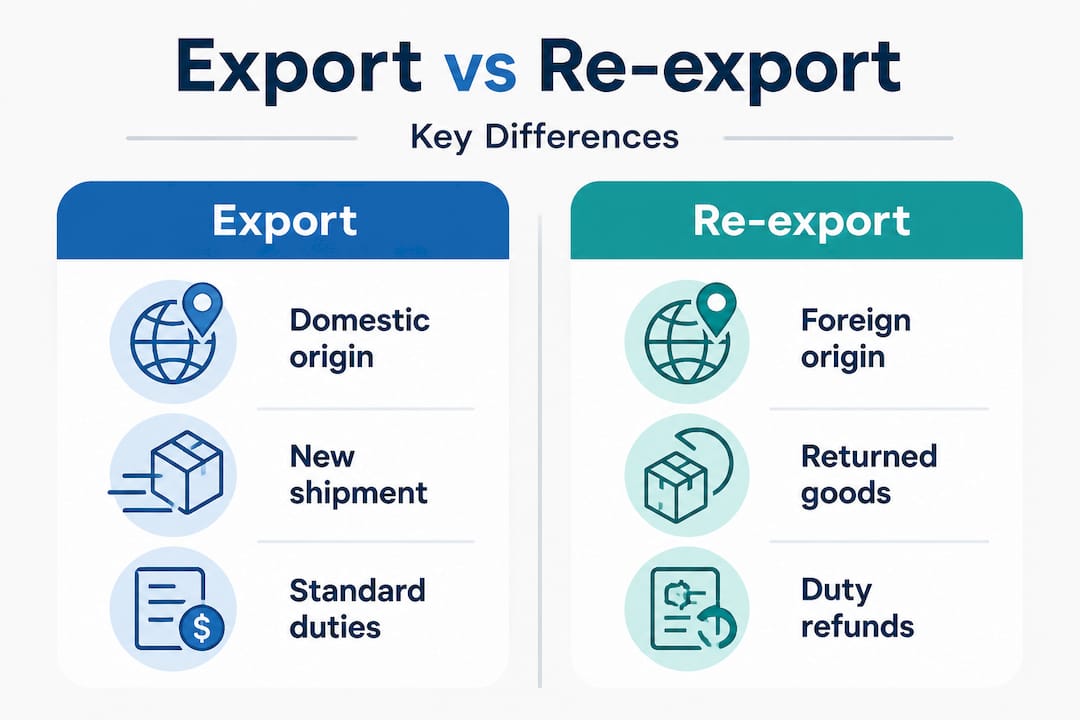
One of the most financially significant distinctions concerns duty refunds. Under provisions similar to Section 74 of the Customs Act, re-exporters may qualify for a refund of customs duties paid at import, provided the goods are re-exported within a defined window, often six months, and meet conditions such as being defective, unused, or in their original state. Missing this window is a direct hit to margins.

Understanding freight forwarding basics is important here because the logistics structure around a shipment determines whether goods are positioned correctly for re-export treatment. Goods held in bonded warehouses, for example, may preserve their foreign status and remain eligible for re-export duty refunds in ways that goods released into domestic circulation are not.
Pro Tip: Before classifying a shipment, check whether the goods have been modified, further processed, or incorporated into a new product. Substantial transformation can convert a re-export into a domestic export, changing your duty exposure and documentation requirements entirely.
For exporters managing high-volume or high-value trade lanes, reviewing customs compliance tips and building classification procedures into your standard operating processes is not optional. It is a core part of responsible supply chain management.
How exports and re-exports affect compliance and logistics
Now that you know the differences, it’s time to see how those distinctions play out in the real world for compliance and shipping strategy.
The practical consequences of misclassifying an export versus a re-export can surface in several ways, and they are rarely minor. Per balance-of-payments categorization standards, failing to distinguish re-exports from domestic exports distorts official trade records, which can trigger scrutiny from customs authorities reviewing your filing patterns.
Here is how misclassification tends to create downstream problems:
- Incorrect export declarations: Filing a standard export declaration for goods that should be classified as re-exports may trigger a customs query, especially if the declared origin does not match the goods’ actual country of manufacture.
- Lost duty refund opportunities: Re-exports handled without proper tracking of original import duties mean businesses forfeit refunds they were legally entitled to claim, sometimes amounting to thousands of dollars per shipment.
- Export control violations: Certain controlled goods, including dual-use technology and military items, require specific re-export licenses before they can be shipped to a third country from an intermediary location. Missing this requirement is a serious legal exposure.
- Bonded warehouse mismanagement: Goods stored in bonded warehouses must be carefully tracked as foreign merchandise. Moving them into domestic inventory without proper clearance converts them from re-exportable goods into imports, triggering full duty liability.
- Disrupted supply chain timing: Incorrect classification often results in delays at the port of export when customs queries arise. For time-sensitive shipments, this translates directly into missed delivery windows and customer penalties.
| Compliance Area | Impact of Correct Classification | Impact of Misclassification |
|---|---|---|
| Duty refunds | Recovered duties improve margins | Forfeited refunds increase landed cost |
| Customs clearance | Smooth export processing | Potential holds and audits |
| Export control licensing | Correct licenses secured in advance | Risk of shipment seizure or fines |
| Trade statistics | Accurate reporting protects compliance record | Reporting errors attract regulatory attention |
Businesses leveraging bonded warehouses or free trade zones as part of their logistics services strategy gain the most from precise classification, because these structures are specifically designed to facilitate re-export flows. Using them correctly means cost savings. Using them incorrectly means compliance exposure.
There is also meaningful overlap with landed cost calculations. Companies focused on cost-saving tips for importers often overlook the duty drawback and refund mechanisms available under re-export rules, which are among the most underused cost recovery tools in international trade. Getting classification right unlocks those tools.
Pro Tip: Build a simple internal checklist that asks three questions about every outbound international shipment: Where did the goods originate? Were duties paid on import? Have the goods been substantially transformed? The answers determine classification and the appropriate documentation path before a single document is filed.
For businesses looking to streamline international trade operations, classification discipline is not bureaucratic overhead. It is a genuine competitive advantage that reduces costs, accelerates clearance, and supports accurate compliance records.
Export and re-export in global trade statistics
Beyond operations and compliance, these differences also shape how governments and organizations interpret global trade data, and that has indirect effects on your business.
National trade statistics are not simply accounting exercises. They inform tariff policy, free trade agreement negotiations, and market access decisions. When re-exports are reported inaccurately or lumped together with domestic exports, the resulting data misrepresents a country’s actual productive capacity and trade relationships. This matters for businesses because policy built on distorted data can lead to unexpected regulatory changes.
Per Eurostat’s reporting framework, EU trade in goods statistics explicitly differentiate between final exports of domestically produced goods and re-exports under customs procedures such as inward processing relief. Inward processing allows businesses to import goods, process or incorporate them, and then export the finished product with partial or full duty relief, a mechanism that depends entirely on accurate re-export classification to function legally.
Key implications for businesses tracking global trade statistics:
- Market access discussions: Countries with high re-export volumes, such as the Netherlands and Singapore, are treated differently in bilateral trade negotiations than countries with predominantly domestic export economies.
- Compliance audits: Trade authorities cross-reference your export declarations against national statistics. Patterns that diverge significantly from industry norms can trigger audits.
- Policy anticipation: Understanding how your shipments are classified in official statistics helps predict when new regulations or duties might apply to your trade lanes.
- Supplier due diligence: Knowing whether a foreign supplier’s goods will be classified as imports or re-exports at your destination market affects your total duty exposure before you finalize sourcing decisions.
For businesses developing global logistics strategies, this statistical layer is not abstract. It shapes the regulatory environment in which your supply chain operates, and proactive attention to it reduces surprises when policy shifts occur.
A statistic worth noting: the Netherlands alone consistently accounts for a substantial portion of EU re-exports, largely because Rotterdam functions as a transshipment hub where goods arrive from non-EU origins and are forwarded to buyers across Europe. Companies that route goods through such hubs must understand that re-export treatment, not domestic export treatment, will govern their customs obligations at every stage.
The real cost of getting export vs. re-export wrong
From a practical standpoint, the financial consequences of blurring this line are often invisible until they compound into a serious problem.
The conventional risk narrative focuses on regulatory fines and penalties, and those are real. But the more immediate damage tends to be operational: shipments held at the port of export because declarations are questioned, refund claims rejected because time windows lapsed, and customs audits triggered because inconsistent classifications created red flags across multiple filings. These disruptions hit cash flow, damage customer relationships, and consume disproportionate staff time to resolve.
Even sophisticated companies with dedicated trade compliance teams sometimes get this wrong. The failure mode is usually systemic rather than isolated. A purchasing team treats a re-import as a standard return. A logistics coordinator files a domestic export declaration for goods that were bonded foreign merchandise. Nobody catches it until an audit surfaces a pattern. By then, the forfeited duty refunds and compliance remediation costs far exceed what a proper classification system would have cost to implement.
The practical fix is not complicated, but it requires deliberate action. Classify goods at the point of purchase order creation, not at the shipping dock. Train operations teams to recognize the indicators of re-exportable goods: foreign origin, no substantial transformation, import duties on record. Partner with a freight forwarder that has documented advanced freight forwarding guidance experience with re-export documentation, because the paperwork requirements are genuinely different from standard export filings.
Most importantly, treat re-export management as a revenue protection exercise. The duty refunds available under re-export provisions, the tariff savings from bonded warehouse strategies, and the audit risk reduction from accurate reporting all have direct dollar values. Getting classification right is not just about staying compliant. It is about capturing money that is already yours by law and protecting margins in an increasingly scrutinized trade environment.
Optimize your export and re-export processes with expert support
Ready to put these lessons into action and stay ahead of compliance risk? Here’s how to get started with expert support from Worldwide Express.
Worldwide Express brings deep expertise in both export and re-export logistics, with dedicated teams that understand how documentation, duty drawback, bonded warehouse management, and classification decisions interact in real supply chains. Whether you need reliable US customs brokerage to navigate complex re-export requirements or want structured freight forwarding expertise to build classification discipline into your operations, the resources are ready. Businesses that work with experienced logistics partners consistently recover more duty refunds, clear customs faster, and maintain stronger compliance records than those managing these details internally without specialized support. Connect with Worldwide Express to build a smarter, more compliant approach to your international trade operations.
Frequently asked questions
What is the main difference between an export and a re-export?
An export involves domestically produced goods shipped abroad, while a re-export involves foreign goods that were previously imported and then sent to a third country, as confirmed by standard trade categorization guidelines used in balance-of-payments reporting.
Why does it matter if something is classified as a re-export?
Re-exports may qualify for duty refunds under provisions such as Section 74 of the Customs Act, and they carry separate documentation and export control requirements that do not apply to standard domestic exports.
Are re-exports reported differently in trade statistics?
Yes, most countries and international bodies, including the EU under Eurostat’s reporting standards, record re-exports separately from domestic exports to preserve accuracy in balance-of-payments and trade policy data.
Can a company get a duty refund if it re-exports goods?
Companies may recover duties paid at import when they re-export goods that meet specific conditions, including time limits and product status requirements, as outlined under customs duty refund provisions in applicable trade law.
Recommended
- Export compliance essentials: Key regulations and best practices – Worldwide Express, Inc.
- Understanding Import Export Basics for Global Trade – Worldwide Express, Inc.
- Step-by-step guide to exporting goods: compliance to shipment – Worldwide Express, Inc.
- Import License Requirements: Ensuring U.S. Trade Compliance – Worldwide Express, Inc.