TL;DR:
- Logistics work has injury rates that surpass many manufacturing sectors, causing operational disruptions and human costs.
- Controlling risks involves physical separation of pedestrians and vehicles through barriers, signage, and layout redesigns to prevent accidents.
Logistics work carries injury rates that would raise eyebrows in most corporate safety briefings. According to the U.S. transportation and warehousing sector, injury rates consistently land between 4.1 and 4.7 per 100 workers, a figure that outpaces many manufacturing categories. For logistics managers and safety officers at companies engaged in international trade, that number isn’t abstract. It represents real operational disruption, liability exposure, and human cost. This guide cuts through the compliance checkbox mindset and delivers evidence-driven protocols covering engineering controls, equipment safety, workforce training, and smarter performance benchmarking.
Table of Contents
- Why logistics safety matters: Key risks and realities
- Separating people and equipment: Engineering controls that work
- Layered protection: Best practices for powered equipment safety
- Training and regulatory alignment: Embedding safety in daily work
- Measuring what matters: Injury rates, benchmarking, and leading indicators
- What most safety programs overlook in real-world logistics
- Partner with experts to strengthen logistics safety
- Frequently asked questions
Key Takeaways
| Point | Details |
|---|---|
| Logistics risks are underestimated | Injury rates in logistics rival those of heavy industry, making safety protocols essential for trade operations. |
| Separation is critical | Physically separating people and vehicles is the most effective way to cut risk in warehouses and docks. |
| Layered controls save lives | Combining training, technology, and physical barriers reduces fatal equipment accidents. |
| Real metrics drive improvement | Tracking leading indicators like near misses and equipment checks boosts long-term safety more than incident reporting alone. |
Why logistics safety matters: Key risks and realities
With those surprising injury rates in mind, let’s clearly identify what makes logistics environments especially hazardous, and why protocol upgrades are urgent for international trade operations.
Logistics and warehousing operations share a common trait: high activity density. Forklifts, pallet jacks, conveyors, loading docks, and foot traffic all compete for space simultaneously. According to warehouse hazard data, the most frequent injury mechanisms are lifting and moving materials, slips, trips, and falls, and vehicle interactions. These aren’t freak accidents. They are predictable outcomes of environments where the margin for error is narrow and the pace is relentless.
International trade operations introduce additional complexity. A warehouse serving cross-border freight handles diverse equipment types, rotating contractor teams, multilingual workforces, and irregular shipment schedules. That variability creates risk states that static safety programs simply weren’t designed to address. As HSE warehousing guidance reinforces, workplace transport and material handling are the recurring themes behind serious injuries in warehouse environments.
“The most significant risks in warehousing come from moving vehicles, falls from height, manual handling, and racking collapse. Recognizing these hazards is the first step toward controlling them effectively.”
Managers focused on improving facility safety often find that compliance checklists mark the floor, not the ceiling, of what’s needed. Compliance gets your facility to minimum standards. Real risk reduction requires proactive hazard identification and systematic control.
Common logistics hazards by frequency and severity:
- Manual lifting and moving materials (highest frequency, moderate severity)
- Slips, trips, and falls on the warehouse floor (high frequency, variable severity)
- Powered industrial truck (forklift) incidents (lower frequency, very high severity)
- Racking and shelving failures (lower frequency, potentially catastrophic)
- Loading dock incidents involving vehicles and personnel (moderate frequency, high severity)
| Hazard category | Frequency | Typical severity | Primary affected role |
|---|---|---|---|
| Lifting/moving materials | High | Moderate | Warehouse associates |
| Slips, trips, and falls | High | Moderate to severe | All roles |
| Powered vehicle interactions | Moderate | Severe to fatal | Operators and pedestrians |
| Racking collapses | Low | Catastrophic | All roles nearby |
| Loading dock incidents | Moderate | Severe | Dock staff and drivers |
Investing in smart warehousing strategies that address these specific categories isn’t just good safety practice. It’s sound operational risk management that protects throughput, reduces insurance claims, and maintains workforce stability across busy international shipping cycles.
Separating people and equipment: Engineering controls that work
Having surfaced the main risks, the next step is controlling them. The biggest opportunity lies in rethinking how people and vehicles move within your facility.
Physical separation of pedestrians and powered vehicles is widely recognized as the gold standard. HSE warehousing guidance is explicit on this point: traffic routes should be suitable for the people and vehicles using them, and pedestrians and vehicles should be separated wherever they share those routes. This isn’t advisory language. It reflects decades of incident investigation data showing that interactions between pedestrians and moving equipment produce some of the most severe outcomes in logistics.
The distinction between active and passive controls matters enormously in practice:
| Control type | Examples | Effectiveness | Cost level |
|---|---|---|---|
| Passive physical | Barriers, bollards, marked walkways | Very high, works without human compliance | Moderate |
| Active physical | Signal lights, gates, proximity alarms | High, requires maintenance | Moderate to high |
| Administrative | Signage, policies, training | Moderate, depends on compliance | Low |
| Behavioral | Awareness campaigns, buddy systems | Variable, not reliable alone | Low |
Passive controls win because they don’t rely on a worker or operator making the right decision under time pressure. A physical barrier doesn’t take shortcuts. A smart warehousing layout that routes vehicles and pedestrians through physically separated corridors removes the most dangerous interactions entirely.
Steps to redesign warehouse traffic flow for separation:
- Map every current pedestrian route and vehicle route on a floor plan, including informal paths workers actually use.
- Identify all crossing points where pedestrians and vehicles currently share space simultaneously.
- Prioritize crossings by frequency and vehicle speed to rank redesign urgency.
- Install physical barriers (bollards, guardrails) at the highest-risk crossing points first.
- Mark pedestrian lanes clearly with floor striping and maintain that striping rigorously.
- Add convex mirrors at blind corners and intersections to expand driver sightlines.
- Introduce signal lights or gates at high-traffic crossings where full separation isn’t structurally possible.
- Review the redesigned layout through both a pedestrian lens and a forklift operator lens before finalizing.
Special consideration is needed for international and multi-site operations. Facilities that handle diverse cargo types often reconfigure their floor layouts seasonally or based on shipment volume spikes. Each reconfiguration is a safety event. As HSE warehousing guidance emphasizes, traffic routes need to be actively managed for the actual people and vehicles using them at any given time, not just as drawn on a static floor plan.
Pairing physical controls with real-time cargo tracking tools gives managers visibility into when high-volume shipments are arriving, enabling them to adjust staffing and traffic management ahead of the surge rather than reacting to it.
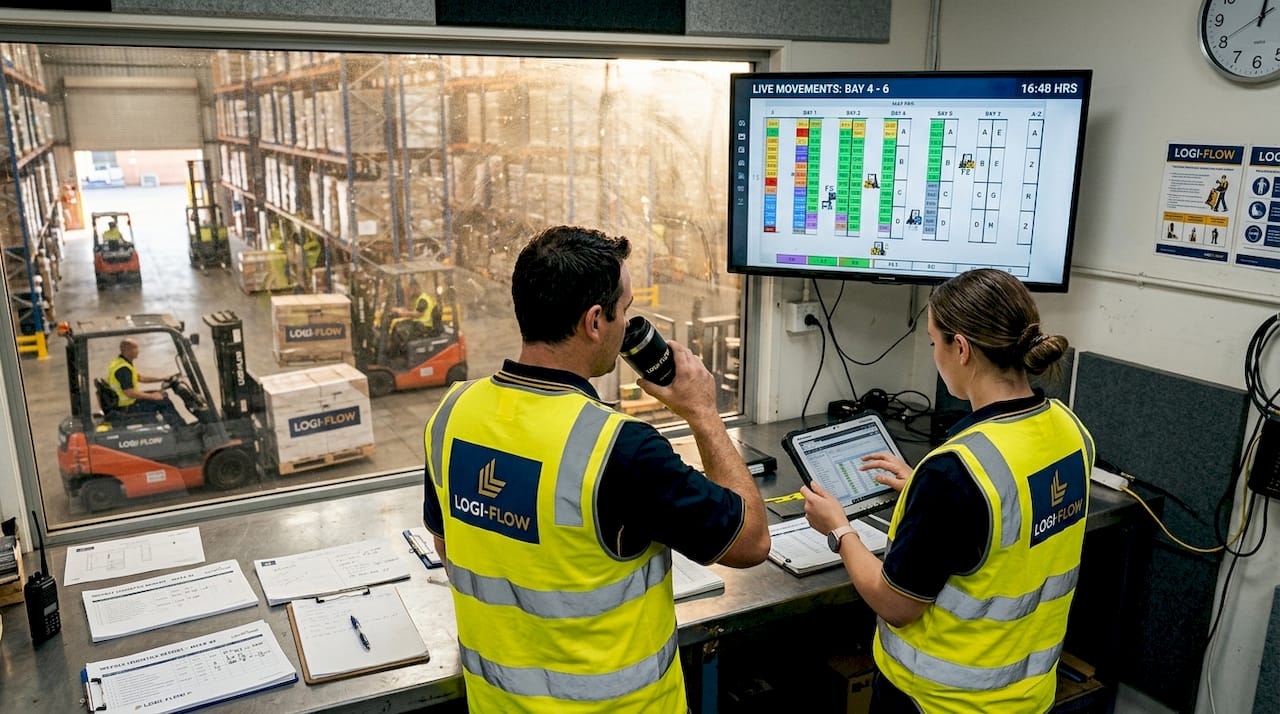
Pro Tip: Conduct a walkthrough of your facility from both a pedestrian’s perspective and a forklift operator’s perspective on the same day. You’ll notice different hazards from each vantage point, and both sets of hazards need to be on your action list.
Layered protection: Best practices for powered equipment safety
Layout is only one layer. The next focus should be on the moving equipment that multiplies risk with even a single lapse in process.
Forklift and powered industrial truck incidents are disproportionately represented in serious injury and fatality data across logistics operations worldwide. The severity of these incidents, not just their frequency, is why a layered protection approach is so critical. Per the MMH special report on pedestrian safety, reducing pedestrian risk at warehouses and docks requires combining operator training with both active and passive protection systems. No single measure is sufficient on its own.
“Relying on operator awareness alone to prevent pedestrian-vehicle incidents is like relying on a driver to never blink. The conditions for failure are always present. Engineering must do what attention cannot sustain.”
A layered approach for powered equipment includes:
- Operator certification and refresher training: All forklift operators must hold current certification, and refresher training should be triggered by any observed unsafe behavior, near miss, or incident, not just by calendar schedule.
- Pre-shift equipment inspections: Operators complete a structured daily checklist covering brakes, horns, lights, forks, fluid levels, and seatbelts before operation begins.
- Route controls: Designated vehicle routes that physically prevent forklifts from entering pedestrian-only zones, especially around workstations, break areas, and office access points.
- Proximity warning systems: Camera systems and audible/visual alarms at blind corners, dock doors, and aisle intersections that alert both the operator and nearby pedestrians.
- Speed controls: Physical speed limiters on powered equipment, combined with posted limits and enforcement mechanisms, particularly in congested zones.
The OSHA Logistics Safety Awareness lesson plan provides a structured framework that logistics operations can adapt directly into their training programs. It addresses both powered equipment hazards and the human factors that contribute to incidents, making it a practical starting resource for safety officers building or refreshing their programs.
Blind corners and dock intersections deserve particular attention. These are the locations where forklift speed, limited sightlines, and pedestrian movement combine to create the highest probability of a serious incident. Mirrored corners, audible warnings triggered by motion sensors, and firm no-pedestrian rules during active loading operations all belong in the control set for these zones.
Warehouse equipment best practices are evolving rapidly, with telematics and onboard camera systems now cost-effective enough for mid-sized operations. Combining these with delivery and fleet tracking tools creates a safety data picture that extends from the dock door to the road.
Pro Tip: Audit both routine tasks and edge cases. Most incidents don’t happen during normal operations. They happen during unusual tasks, like shifting oversized cargo, clearing a jam, or maneuvering in a temporarily reconfigured area. Build those scenarios into your safety review.
Training and regulatory alignment: Embedding safety in daily work
Technology and barriers are powerful, but people remain the front line. Effectively embedding regulatory guidance into daily workflows is crucial for sustaining safety gains over time.
Both HSE warehousing guidance and the OSHA logistics safety lesson plan offer logistics managers freely available, operationally grounded frameworks. The challenge isn’t access to these resources. The challenge is translating them from documents into behaviors that workers actually apply on the floor, under time pressure, during peak periods.
The most effective training programs embed learning into the rhythm of work rather than isolating it in annual compliance sessions. Here’s a structured process that moves beyond the checkbox:
- Onboarding safety integration: New hires complete facility-specific hazard orientation before touching any equipment, covering the specific routes, traffic patterns, and high-risk zones in that building.
- Task-linked refreshers: Each time a worker is assigned a new task type (operating a different piece of equipment, working in a new zone, handling a new cargo category), a brief targeted safety review accompanies the task assignment.
- Near-miss driven retraining: Every near miss is treated as a training event. The team involved reviews what happened, what could have been worse, and what changes in behavior or environment would prevent a recurrence.
- Edge case scenario drills: Quarterly drills focus specifically on non-routine situations: receiving an oversized shipment, clearing a blocked dock, operating during a power interruption.
- Regulatory update reviews: When HSE or OSHA updates guidance, a brief team review is scheduled to discuss what, if anything, changes in daily practice.
For companies managing logistics across multiple international sites, maintenance safety procedures and training consistency become even more critical. A safety culture that varies dramatically from site to site creates blind spots that consolidated injury data won’t easily surface.
Pro Tip: Incorporate near-miss reporting into every regular staff meeting as a standing agenda item. When workers see that near misses are taken seriously and result in real changes, reporting rates increase dramatically, and higher reporting rates are one of the strongest leading indicators of a healthy safety culture.
Measuring what matters: Injury rates, benchmarking, and leading indicators
Effective training only leads to safer workplaces if you are measuring the right outcomes. Let’s make sense of what’s worth tracking.
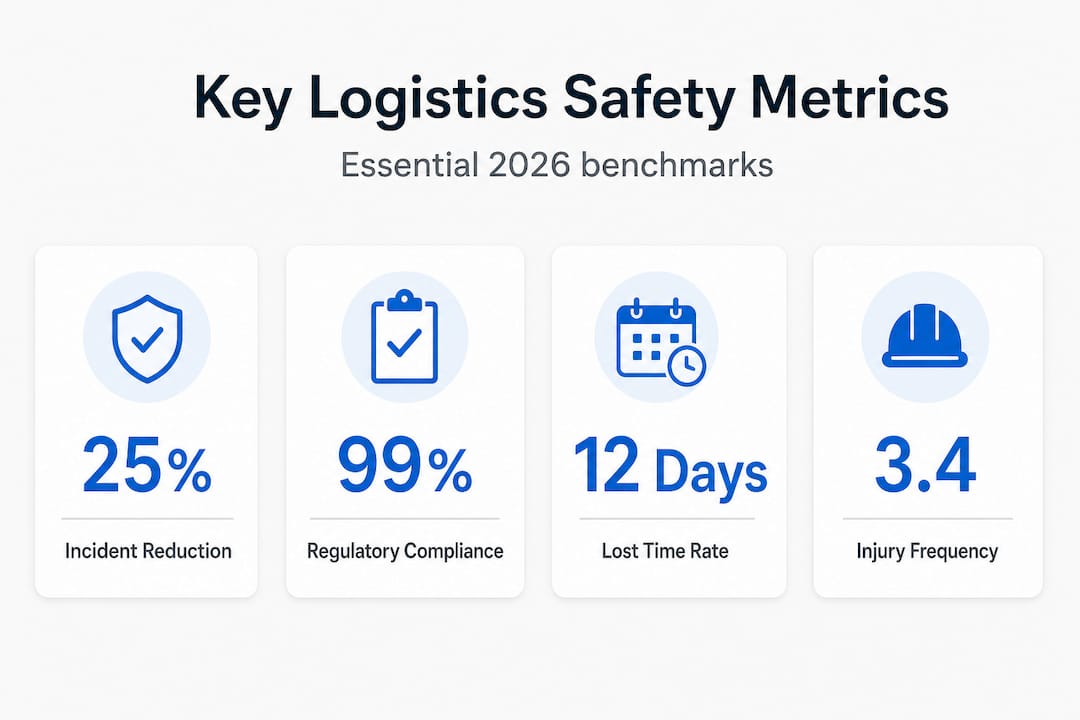
Most logistics operations track lagging indicators, the injury counts and lost-time rates that appear after something has already gone wrong. These numbers matter, but they are backward looking. By the time lagging data shows a trend, multiple workers may already have been hurt. Per warehouse safety fact sheet data, the injury mechanisms most commonly tracked (musculoskeletal strains, fall-related injuries) are exactly the categories that leading indicators can help prevent before they escalate.
Benchmarking safety performance against federal and state-level injury rate data gives managers context for how their operation compares to industry norms. But benchmarking alone isn’t a safety strategy. The real value is in mapping those benchmark targets to site-specific leading indicators that managers can actually influence day to day.
| Indicator type | Examples | Time horizon | Action signal |
|---|---|---|---|
| Lagging | Recordable injuries, lost-time days, workers’ comp claims | Backward looking | Trend exceeds benchmark |
| Leading | Near misses reported, training completion rates, equipment defects found | Forward looking | Rate changes signal risk |
| Process | Pre-shift inspection completion, route compliance audits | Current state | Gap between target and actual |
High-value leading indicators for logistics safety programs:
- Near-miss reports per month (higher reporting with no corresponding incidents signals strong safety culture)
- Percentage of pre-shift equipment inspections completed on schedule
- Time between equipment defect identification and repair completion
- Training completion rates for all active operators and dock workers
- Number of traffic route compliance audits conducted vs. planned
- Worker-initiated safety suggestions submitted per quarter
For international trade sites operating across multiple time zones and regulatory environments, standardizing on a shared set of leading indicators creates consistency. Managers can compare safety performance across facilities without waiting for injury data to accumulate.
What most safety programs overlook in real-world logistics
With a better understanding of measures and metrics, it’s time for an honest look at what typical safety initiatives don’t capture.
The uncomfortable reality is that most formal safety programs are designed around routine operations. The onboarding materials, the training videos, the inspection checklists, they all reflect what happens on a normal day. But the most serious incidents in logistics don’t happen on normal days. They happen during maintenance windows, when a piece of equipment is being repaired in a live workspace. They happen during loading anomalies, when an oversized or unusually heavy shipment arrives without advance notice. They happen during non-routine tasks that workers improvise because no established procedure exists for that specific situation.
Conventional safety programs rarely include explicit controls for these risk states. The near-miss that almost became a fatality is usually a story about a non-routine moment, a gap in the procedure, a situation nobody anticipated. Programs that optimize logistics safety with real-world impact treat these edge cases with the same rigor applied to standard operations.
The most effective safety programs share a specific characteristic: they treat safety as a real-time, site-engaged process rather than a documentation exercise. Continuous improvement beats one-and-done compliance, and the difference shows up in both injury rates and near-miss reporting trends. Managers who are genuinely curious about what almost went wrong, rather than relieved that it didn’t, build the kind of safety cultures that actually protect workers.
Partner with experts to strengthen logistics safety
If you’re ready to put these best practices into action at scale, here’s how working with Worldwide Express can help.
Safety protocols don’t operate in isolation from logistics efficiency. When your freight operations run on precise schedules with clear documentation, compliant routing, and proactive risk management built into every shipment, your workers face fewer of the chaotic situations where injuries are most likely.
Worldwide Express offers logistics services designed to bring structure and visibility to international trade operations, reducing the unpredictable conditions that generate safety risk at docks and warehouses. From customs brokerage to real-time cargo tracking, the goal is a supply chain where workers know what’s coming, when it’s arriving, and how to handle it safely. Explore supply chain risk management solutions built for companies that take both operational efficiency and worker safety seriously. Contact the team today to discuss a customized approach for your operation.
Frequently asked questions
What are the main causes of injuries in logistics operations?
The most common causes are lifting and moving materials and slips, trips, and falls, with musculoskeletal injuries and vehicle interaction incidents accounting for a significant share of recorded harm across the sector.
How can managers reduce injuries around moving vehicles in warehouses?
Managers should separate pedestrian and vehicle traffic using physical barriers and marked walkways, improve sightlines at intersections, and require certification and ongoing training for all powered equipment operators.
What does a layered safety approach mean in logistics?
A layered protection approach combines certified operator training with physical controls like barriers and bollards, plus technology such as proximity alarms and cameras, so no single failure point can cause a serious incident.
Where can I find logistics safety training materials?
OSHA offers a structured logistics safety awareness lesson plan available as a free PDF download, while HSE warehousing guidance provides practical, regulation-grounded frameworks for UK-connected and international operations alike.
Recommended
- Remote work in logistics: efficient strategies for global teams – Worldwide Express, Inc.
- How to Optimize Logistics for Efficient Global Shipping – Worldwide Express, Inc.
- Shipping Risk Mitigation: Proven Strategies for Global Logistics – Worldwide Express, Inc.
- 6 Key Trends in International Logistics for U.S. Managers – Worldwide Express, Inc.