TL;DR:
- Misunderstanding shipping terminology can lead to unexpected costs, delays, and disputes in international trade transactions. Precise, documented terms like Incoterms and proper management of key documents such as the bill of lading are essential for operational clarity and risk mitigation. Building workflow clarity and seeking expert support helps businesses navigate complex logistics, ensuring smoother cross-border shipments and stronger compliance.
Misread a single shipping term and you could find yourself absorbing unexpected freight costs, watching a cargo release get blocked at the port, or losing a dispute you were certain you would win. For importers, exporters, and logistics managers, the language of international trade is not academic. It is operational. Every term on a contract, invoice, or bill of lading carries legal weight and financial consequence. This guide cuts through the confusion by defining the terms that matter most, showing how they work on real shipments, and giving you a practical framework to apply them with confidence on your next cross-border transaction.
Table of Contents
- Why shipping terminology matters in international trade
- Decoding common shipping terms: Incoterms®, bill of lading, and more
- Incoterms® in action: Comparing C and D terms
- Critical documents: Bill of lading functions and best practices
- Demurrage, detention, and delivery: Avoiding preventable disputes
- A smarter approach: Ditching jargon for operational clarity
- Navigate shipping terms with expert support
- Frequently asked questions
Key Takeaways
| Point | Details |
|---|---|
| Terms shape risk | Understanding shipping terminology directly impacts your cost, risk, and ability to control shipments. |
| Incoterms® clarify roles | Incoterms® allocate responsibility but do not change customs or tariff rules. |
| Document precision matters | B/L details and documentation wording are crucial for securing payment and cargo release. |
| Define demurrage vs detention | Clear definitions of demurrage and detention help prevent costly disputes in logistics contracts. |
| Operational clarity beats jargon | Translating shipping terms into actionable contract instructions reduces errors and supports smooth trade. |
Why shipping terminology matters in international trade
With the challenge now clear, let’s explore the real business impact of getting shipping terminology right.
Shipping terms are not just labels. They are the legal architecture of an international transaction. The moment a seller and buyer agree on a term like CIF or DAP, they have allocated who pays for freight, who arranges insurance, who handles customs clearance, and who bears the financial loss if cargo is damaged in transit. Get that allocation wrong, and the consequences can be severe.
Ambiguity is the most common culprit. When a contract says “freight included” without specifying an Incoterm, both parties often assume different things. The seller may believe the buyer handles import duties. The buyer may assume the seller covers delivery to their warehouse. Neither assumption is documented, and neither is enforceable. Disputes that could have been avoided with two or three words on a contract instead become expensive arbitration cases.
“Incoterms® rules do not change tariff rates or customs procedures, but they do allocate responsibilities between buyer and seller, which can affect how tariff-risk is managed contractually.”
This is a critical distinction. Many businesses assume that selecting a favorable Incoterm will somehow shield them from tariff exposure. It will not. But it can determine who is contractually responsible for managing that exposure and who absorbs the cost if tariff rates change unexpectedly. That is a meaningful operational advantage when you understand it clearly.
Key reasons why precise terminology matters:
- Cost allocation: Terms define who pays for each leg of transportation, port handling, and insurance.
- Risk transfer: They establish the exact moment when risk passes from seller to buyer.
- Customs responsibility: They indicate which party arranges and pays for import or export clearance.
- Documentation alignment: The wrong term can create a mismatch between your contract and your shipping documents, triggering payment delays.
Understanding shipping logistics explained at a structural level helps businesses match the right terms to the right trade lanes and transaction types.
Pro Tip: Always write the full Incoterm, the named place, and the edition year in your contracts. For example: “CIF Port of Los Angeles, Incoterms® 2020.” This eliminates ambiguity and prevents disputes before they start.
Decoding common shipping terms: Incoterms®, bill of lading, and more
Understanding the impact is one thing. Let’s now make these terms practical by defining them and highlighting how they operate on real shipments.
Incoterms® 2020 are published by the International Chamber of Commerce and consist of 11 rules grouped into categories. For most ocean and multimodal shipments, the “C” and “D” categories are where most confusion lives.
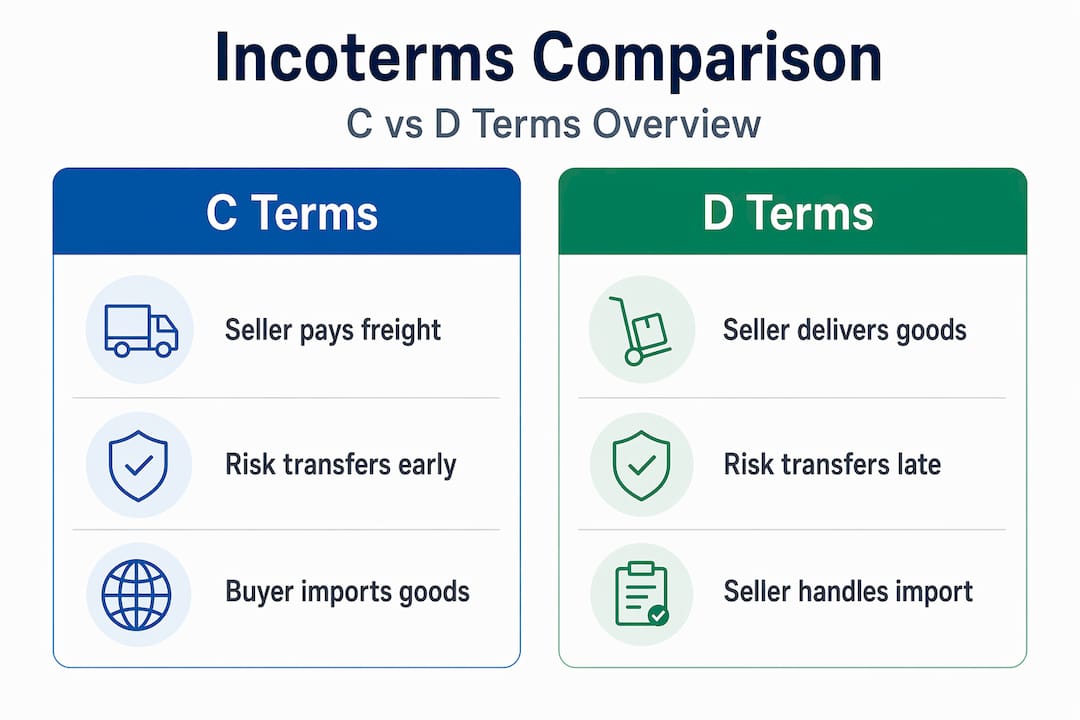
According to ICC Academy, the “C” vs “D” structure represents a fundamental operational split: under “C” terms, the seller pays for main carriage to the destination but risk transfers earlier, typically when goods are handed to the contracted carrier at origin. Under “D” terms, both delivery and risk transfer happen at the destination. This distinction is not subtle. It changes who files the insurance claim when cargo is damaged at sea.
Here is a quick reference table for the most commonly used Incoterms® 2020:
| Incoterm | Category | Seller pays freight? | Risk transfers at… | Buyer handles import? |
|---|---|---|---|---|
| CPT | C | Yes | Origin (handover to carrier) | Yes |
| CIP | C | Yes | Origin (handover to carrier) | Yes |
| CFR | C | Yes | Origin (on board vessel) | Yes |
| CIF | C | Yes | Origin (on board vessel) | Yes |
| DAP | D | Yes | Named destination | Yes |
| DPU | D | Yes | Named destination (unloaded) | Yes |
| DDP | D | Yes | Named destination | No (seller handles) |
The bill of lading (B/L) is equally critical. As the bill of lading guide explains, it functions as a receipt for cargo, a contract of carriage between shipper and carrier, and in ocean shipping, it can act as a document of title that controls who can physically take possession of the goods at destination. No other document in international trade carries that triple function.

Understanding the different bill of lading types is essential before you ship. A negotiable B/L, for example, can be endorsed and transferred to a third party, making it a financial instrument. A non-negotiable or straight B/L names a specific consignee and cannot be transferred. Using the wrong type can freeze a payment under a letter of credit or delay cargo release by days.
Other terms worth defining clearly:
- Demurrage: A charge applied when cargo or a container sits at a terminal beyond the carrier’s free time allowance.
- Detention: A charge applied when equipment (typically a container) is kept outside the terminal beyond the free time.
- Cargo insurance: Coverage arranged separately from freight, protecting the cargo owner against physical loss or damage during transit.
- Free time: The number of days a shipper or consignee can use terminal space or carrier equipment at no extra charge.
Pro Tip: Learning how to read a bill of lading step by step is one of the highest-value skills for any logistics manager. Errors in the consignee field, port of discharge, or notify party can delay cargo release and trigger costly amendments.
Incoterms® in action: Comparing C and D terms
Now that the terms are defined, let’s compare them directly to expose the practical consequences of your choice.
The “C” vs “D” structure under Incoterms® 2020 is where most first-time exporters make expensive mistakes. The seller under CIF believes they have covered everything by paying for freight and insurance to the destination port. But risk actually transferred when the goods were loaded on the vessel at origin. If the ship encounters damage mid-voyage, the buyer bears the loss, even though the seller arranged and paid for the insurance. That is a counterintuitive outcome that surprises many traders.
| Feature | C Terms (e.g., CIF, CPT) | D Terms (e.g., DAP, DDP) |
|---|---|---|
| Who pays main freight | Seller | Seller |
| Risk transfers at | Origin (loading/handover) | Destination |
| Import customs | Buyer | Buyer (except DDP: Seller) |
| Seller’s control at destination | Low | High |
| Buyer’s predictability | Lower (risk shifts early) | Higher (risk stays with seller) |
| Best for experienced buyers | Yes | Less critical |
Common pitfalls when selecting the wrong term:
- Using DDP without customs authority: Sellers who agree to DDP must be able to act as importer of record in the buyer’s country. Many cannot, which creates compliance failures.
- Confusing CIF with delivery: Buyers who assume CIF means door-to-door delivery are often surprised by port handling fees, customs duties, and inland freight costs they must cover.
- Ignoring named place precision: Writing “CIF USA” instead of “CIF Port of New York, Incoterms® 2020” creates ambiguity about where risk and cost responsibilities end.
- Mismatching terms with payment methods: A letter of credit requiring CIF documents is incompatible with a DAP agreement. The documents will not match, and payment will be rejected.
A checklist for choosing the right Incoterm:
- Identify who has more logistics expertise: buyer or seller.
- Determine who can clear customs in the destination country.
- Assess your risk tolerance for mid-voyage cargo loss.
- Confirm the term aligns with your payment method and banking requirements.
- Verify the named place is specific enough to eliminate ambiguity.
Businesses focused on shipping risk mitigation strategies consistently report that Incoterm selection is one of the first places they look when auditing their trade compliance programs.
Critical documents: Bill of lading functions and best practices
Equipped with term comparisons, it’s vital to understand how core paperwork like the bill of lading underpins both compliance and cash flow.
The bill of lading is arguably the most powerful document in ocean freight. As the bill of lading guide makes clear, it is a document of title that controls who can take possession of cargo. In practical terms, this means that whoever holds the original negotiable B/L holds the cargo. Banks use this fact to secure financing. Sellers use it to ensure payment before releasing goods.
“Bill of lading (B/L) terminology is operationally critical because it functions as a receipt, a contract of carriage, and (in ocean shipping) can act as a document of title controlling who can take possession of cargo.”
The distinction between a master B/L and a house B/L matters enormously in consolidated shipments. The master B/L is issued by the ocean carrier to the freight forwarder. The house B/L is issued by the freight forwarder to the actual shipper. If your payment terms require an original ocean B/L, a house B/L from a forwarder may not satisfy your bank’s requirements, and your letter of credit could be rejected.
Key best practices for managing your bill of lading:
- Verify all fields before cargo loads. Errors in the shipper name, consignee, or port of discharge require amendments that cost time and money.
- Match the B/L to your letter of credit terms exactly. Even minor discrepancies in wording can trigger a documentary rejection.
- Understand when to use a telex release. A telex release allows cargo to be released at destination without presenting original paper documents, which speeds up delivery for trusted trading relationships.
- Confirm negotiable vs non-negotiable status. Using a negotiable B/L when a straight B/L was required (or vice versa) can block cargo release entirely.
The bill of lading legalities around endorsement, transfer, and release are complex enough that many businesses keep annotated templates on file. Reviewing an example of bill of lading for a U.S. shipment helps teams understand what each field means before they are under deadline pressure.
Demurrage, detention, and delivery: Avoiding preventable disputes
Having covered the documents that transfer cargo, let’s zero in on common cost-control traps, beginning with where most disputes and unexpected charges arise: demurrage and detention.
These two charges are frequently confused, and that confusion is expensive. Demurrage accrues when a container sits inside the terminal beyond the carrier’s free time. Detention accrues when a container is taken out of the terminal but not returned within the allowed period. They are different clocks, measured at different locations, and governed by different clauses in your carrier contract.
As the demurrage vs detention analysis explains, disputes in this area are fundamentally a clock-and-location problem. The key is to review the free time definition and the equipment custody sequence in your carrier and terminal terms, not just the label on the invoice.
Steps to proactively manage demurrage and detention:
- Read your carrier’s tariff before booking. Free time allowances vary significantly between carriers, trade lanes, and ports.
- Track container milestones in real time. Know when your container arrives at the terminal and when free time begins.
- Coordinate customs clearance before vessel arrival. Delays in customs are the single most common cause of demurrage charges.
- Negotiate free time extensions proactively. Carriers often grant extensions if you ask before free time expires, not after.
- Document every communication. If a carrier or terminal causes a delay that extends your free time, you need written evidence to dispute the charge.
Understanding demurrage in shipping at a contractual level gives logistics managers the leverage to push back on unjustified charges and negotiate better terms on future bookings.
Pro Tip: Build a simple tracking spreadsheet for every active shipment that logs the vessel arrival date, free time expiration date, container pickup date, and return date. This single habit eliminates most demurrage and detention disputes before they become invoices.
A smarter approach: Ditching jargon for operational clarity
With the groundwork complete, it’s time for a reality check about where most businesses actually trip up, and what truly works.
Here is an uncomfortable truth: most shipping term disputes do not happen because someone failed to memorize the Incoterms® rulebook. They happen because two parties assumed they meant the same thing without writing it down. The terminology itself is rarely the problem. The absence of explicit, documented definitions in the actual transaction is.
The businesses that handle international trade most effectively are not necessarily the ones with the deepest theoretical knowledge of shipping law. They are the ones who have built operational clarity into every step of their workflow. They use annotated contract templates that define every term in plain language. They maintain summary tables that show, for each trade lane, exactly who does what and when. They train their teams not to recite definitions but to ask the right questions before a shipment moves.
The relationship between bill of lading and letters of credit is a perfect example of where assumed meaning causes real damage. A seller who assumes their forwarder’s house B/L will satisfy a letter of credit requirement may not discover the problem until the bank rejects the documents, the payment is delayed, and the goods are already at sea. That is not a vocabulary failure. It is a workflow failure.
The most valuable shift a logistics team can make is treating every new trade relationship as if nothing is assumed. Write out the responsibilities. Define the terms in the contract. Confirm the document types required for payment. Clarity is not bureaucracy. It is competitive advantage.
Navigate shipping terms with expert support
If you’re ready to turn understanding into smoother, safer shipments, here’s how to connect with support for your international logistics needs.
Knowing the terms is the foundation. Executing on them under real-world conditions, with customs authorities, carriers, banks, and foreign counterparties all in play, is where expert support makes a measurable difference.
Worldwide Express offers the full range of services that international traders need to put this knowledge into practice: customs brokerage, freight forwarding, cargo insurance, and supply chain visibility tools that keep you informed at every milestone. Whether you need a deeper freight forwarding guide to understand how forwarding works, access to shipping logistics resources that clarify your options, or direct access to licensed customs brokerage services that handle your clearances with precision, Worldwide Express brings the expertise and global reach to back every shipment you move.
Frequently asked questions
What is the main difference between demurrage and detention?
Demurrage is charged when cargo sits at the terminal beyond the carrier’s free time, while detention applies when equipment is kept outside the terminal longer than allowed. As the demurrage/detention analysis notes, these are distinct clocks measured at different locations.
Do Incoterms® rules affect the customs process or tariffs directly?
No. Incoterms® rules only allocate risk and responsibility between buyer and seller and do not alter customs procedures or tariff rates in any way.
Why is the bill of lading so important in ocean shipping?
It serves simultaneously as proof of receipt, contract of carriage, and a document of title. Per the bill of lading guide, it controls who can legally take possession of cargo at the destination port.
What practical steps can help prevent shipping term disputes?
Spell out all responsibilities explicitly in your contracts and verify every timing and term definition with your carrier before cargo moves. The demurrage/detention framework recommends reviewing free time definitions and equipment custody sequences in advance.
How do I choose between C and D Incoterms®?
Compare where risk and cost transfer in your transaction and assess who controls the cargo at each stage. The C vs D structure under Incoterms® 2020 is the clearest framework for matching the right term to your risk tolerance and logistics capabilities.
Recommended
- Freight contract terms: essential guide for shipping managers – Worldwide Express, Inc.
- Complete Guide to International Shipping Basics – Worldwide Express, Inc.
- 8 Key Freight Terms Definitions Every Importer Should Know – Worldwide Express, Inc.
- International courier vs freight: guide for managers 2026 – Worldwide Express, Inc.