TL;DR:
- Customs inspections are conducted for every international shipment, not just suspicious ones, and require thorough workflow management. The process involves electronic risk targeting, conditional releases, physical or document-based examinations, and can result in delays if holds are not promptly resolved. Proactive monitoring, compliance programs, and accurate documentation are crucial for minimizing inspection delays and ensuring efficient trade flow.
Customs inspections are not reserved for suspicious or flagged cargo. Every shipment crossing an international border is electronically profiled, risk-scored, and potentially subject to physical examination before goods ever reach a warehouse floor. For import/export businesses and supply chain managers, this reality carries a serious operational implication: unresolved holds or exam requirements keep goods detained regardless of their commercial urgency. Understanding the full inspection workflow, from pre-arrival electronic targeting through final release, is one of the most direct ways to reduce delays, protect revenue, and maintain reliable trade lanes.
Table of Contents
- What is the customs inspections process?
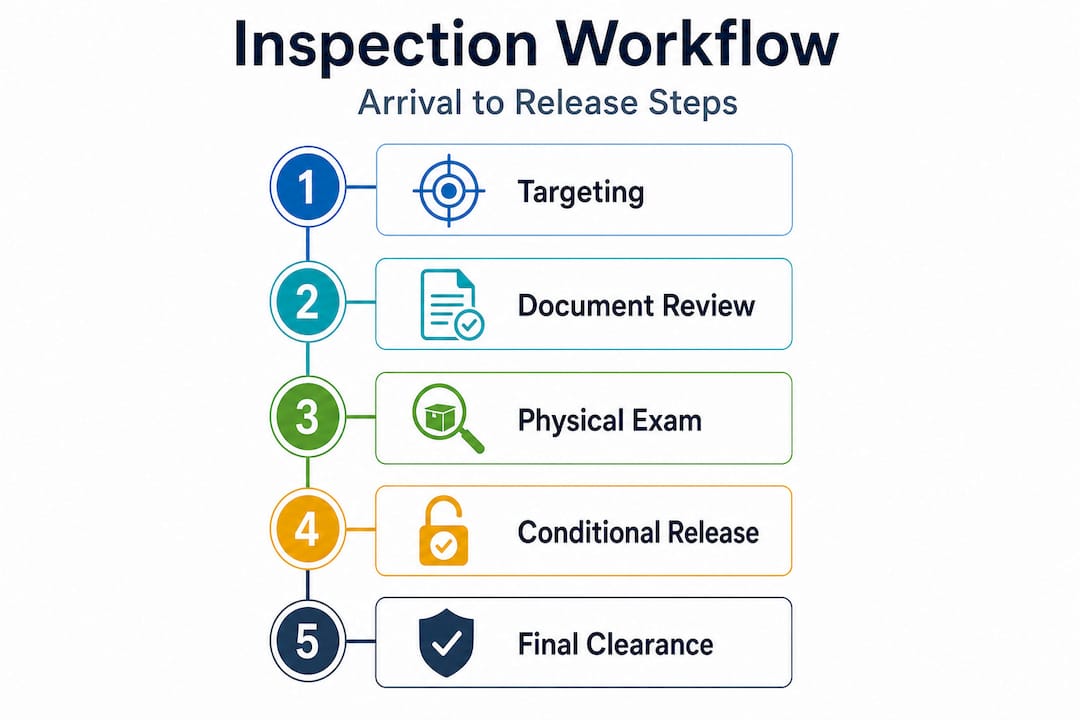
- Step-by-step walkthrough: From arrival to release
- Compliance programs and responsibilities for businesses
- Inspection statistics and practical benchmarks
- Why most businesses misunderstand customs inspections — and how to fix it
- Next steps: Streamline your shipping and compliance with expert help
- Frequently asked questions
Key Takeaways
| Point | Details |
|---|---|
| Inspections are system-driven | Every shipment is electronically profiled and may face intensive examination based on risk assessment. |
| Compliance prevents delays | Accurate declarations and robust internal controls are the most effective way to avoid costly holds and audits. |
| Track CBP statuses | Monitoring ‘Pending Intensive Exam’ and other customs statuses helps businesses anticipate and resolve potential bottlenecks. |
| Use benchmark data | CBP publishes encounter statistics, providing practical benchmarks for inspection rates and release timelines. |
What is the customs inspections process?
The customs inspections process is far more layered than most operators realize. It is not a single checkpoint at the border. It is a structured, multi-phase workflow that begins the moment shipment data is transmitted electronically and ends only when every hold or examination requirement is formally closed in the system.
For U.S. import and export trade, U.S. Customs and Border Protection (CBP) operates under a framework built around electronic filings and risk-based targeting, with cargo release tied directly to the resolution of any holds or examination requirements. That means a shipment is never truly “released” until every flag in CBP’s Automated Commercial Environment (ACE) system is cleared. ACE is the centralized platform through which importers, brokers, and carriers file required documentation and CBP processes entry.
Two core types of inspections exist in practice. Document-based reviews focus on entry filings, invoices, packing lists, and certificates of origin. Physical inspections involve actual examination of cargo, sometimes with imaging technology, sometimes with direct physical inspection by CBP officers. Both types can result in holds that stop release entirely.
A useful way to frame this is through the lens of “conditional release.” Goods may be granted a conditional release under bond while an examination is pending. But conditional does not mean free. A shipment sitting under a “Pending Intensive Exam” designation is still detained, still incurring storage charges, and still unavailable for delivery.
Routine release vs. flagged inspection at a glance:
| Scenario | Process | Typical outcome |
|---|---|---|
| Clean electronic profile | Automated review, no holds | Rapid conditional or full release |
| Document discrepancy | CBP reviews filing details | Possible delay pending correction |
| Flagged for physical exam | Cargo moved to exam facility | Hold until exam closed in system |
| Pending Intensive Exam | Full physical or imaging inspection | No release until CBP formally closes |
Key terms every supply chain manager should know:
- Electronic targeting: The automated risk-scoring of shipment data before arrival
- Conditional release: A provisional release pending resolution of any outstanding exams or holds
- Pending Intensive Exam: A CBP system status indicating cargo cannot be released until examination is complete
- ACE (Automated Commercial Environment): The U.S. government’s primary trade processing platform
- Entry: The formal declaration filed with CBP to import goods
Reviewing CBP’s customs inspection process guide provides additional operational context, especially for first-time importers managing complex commodity classifications.
Step-by-step walkthrough: From arrival to release
Building on the foundation of what customs inspections are, it helps to walk through the process chronologically. Each phase carries specific requirements and potential delay points.
- Pre-arrival electronic filing. Before cargo physically arrives at a U.S. port, importer security filings (ISF) for ocean freight and advance cargo information for air freight must be submitted. CBP’s systems begin risk-scoring the moment these electronic filings land.
- Risk targeting and flagging. CBP’s National Targeting Center (NTC) analyzes cargo data using intelligence feeds, historical compliance records, and anomaly detection. High-risk shipments are flagged for exam; lower-risk cargo moves toward conditional release.
- Arrival and entry filing. When cargo arrives, the customs broker files a formal entry in ACE. This entry includes the Harmonized Tariff Schedule (HTS) classification, declared value, country of origin, and applicable duty rates.
- Conditional release or hold assignment. CBP either grants conditional release or assigns an exam type. Common exam types include the Intensive Exam (physical inspection at a CBP facility), the Tailgate Exam (inspection at the point of unlading), and the X-ray or Non-Intrusive Inspection (NII, where imaging equipment scans containers without opening them).
- Physical inspection or document review. If flagged, cargo is moved to a designated exam facility. Drayage (short-distance trucking to move containers) is typically the importer’s cost. Inspection timelines vary from hours to several days depending on volume at the facility.
- Closing holds and final release. Once inspection is complete and CBP is satisfied, the hold is formally closed in ACE. Only then is full release granted and cargo eligible for delivery.
Per CBP’s ACE business rules documentation, the inspection workflow is an end-to-end process: pre-arrival electronic targeting and conditional release, then one or more physical exam states that can prevent release until formally closed in the system, including the “Pending Intensive Exam” designation.
Exam type comparison:
| Exam type | Inspection method | Average timeline | Cost driver |
|---|---|---|---|
| Non-Intrusive Inspection (NII) | X-ray imaging | Hours | Low |
| Tailgate Exam | Visual inspection at dock | Hours to 1 day | Moderate |
| Intensive Exam | Full physical at CBP facility | 1 to 5 days | High (drayage + storage) |
| Document Review | Review of entry filings | Hours to 2 days | Low |
Pro Tip: Track shipment status in ACE daily when a hold is suspected or confirmed. The “Pending Intensive Exam” status is not always communicated proactively by ports. Knowing the status early lets brokers and importers take action faster, reducing costly storage fees. Resources on avoiding customs delays outline exactly how proactive status monitoring translates into real time and cost savings.

CBP’s statistical data shows the scale of CBP enforcement operations, reinforcing just how systematic and high-volume the inspection environment really is. It is not anecdotal. It is machinery running at national scale.
For air freight operations specifically, streamlining airport customs clearance requires additional attention to Importer Security Filing timing and commodity-level documentation, since air cargo moves faster and errors surface more rapidly.
Compliance programs and responsibilities for businesses
Having mapped the step-by-step workflow, the logical next question is: what can businesses actually do to avoid inspection trouble and accelerate releases? The answer sits squarely in compliance.
CBP’s approach to importer responsibility is framed around what the agency calls “reasonable care.” This is not a vague concept. According to CBP’s Trade Compliance Handbook, documented compliance programs and reasonable care in declarations are a core expectation, framing the program around importers’ responsibilities for accurate declarations covering value, classification, and rate of duty, alongside robust internal controls.
In practical terms, reasonable care means:
- Filing accurate HTS classifications for every commodity
- Declaring correct transaction values (not undervaluing to reduce duties)
- Providing complete and truthful country of origin information
- Maintaining internal documentation that shows the process followed to arrive at declarations
- Reviewing and updating compliance procedures when trade regulations change
“Importers of record are responsible for using reasonable care to enter, classify, and value imported merchandise, and to provide any other information necessary to enable CBP to properly assess duties, collect accurate statistics, and determine whether all applicable legal requirements are met.” — CBP Trade Compliance Handbook 5.0, December 2025
This expectation has real teeth. Importers who cannot demonstrate reasonable care face penalties under 19 U.S.C. § 1592, the statute governing fraud, gross negligence, and negligence in customs matters. Penalty amounts can reach the full domestic value of the merchandise for fraud cases.
Common compliance pitfalls that trigger inspections or post-entry audits include:
- Misclassification: Placing a commodity under the wrong HTS code, intentionally or inadvertently
- Undervaluation: Declaring a lower transaction value than was actually paid or payable
- Incomplete documentation: Missing certificates of origin, licenses, or permits required for certain commodities
- Inconsistent records: Discrepancies between invoices, packing lists, and entry filings
Pro Tip: Build a compliance documentation library that includes your classification rationale, supplier agreements, and any ruling letters you have received from CBP. This library becomes your first line of defense during audits and can significantly speed up response time when CBP requests information. Detailed customs compliance tips and practical business customs compliance frameworks are available for businesses ready to formalize their internal programs.
Inspection statistics and practical benchmarks
After understanding compliance practices, it helps to ground expectations in real data. CBP publishes enforcement and encounter statistics, including datasets derived from live CBP systems. It is worth noting that statistical information can change until final fiscal-year conclusions are reached, so published interim numbers should be treated as directional rather than definitive.
What the data consistently shows is that CBP processes an astounding volume of trade. Tens of millions of entry summaries are filed annually, covering ocean containers, air cargo, truck shipments, and rail. Physical inspections represent a small percentage of total shipments, but that percentage translates to enormous absolute numbers given trade volumes.
Directional benchmarks for supply chain planning:
| Trade mode | Approximate inspection rate | Key risk driver |
|---|---|---|
| Ocean containerized cargo | 3 to 5% of containers examined | Commodity type, origin country |
| Air express cargo | Less than 1% physical exam | Speed of processing, lower volumes |
| Truck (land border) | Varies widely by port of entry | Country of origin, cargo type |
| Rail | Less than 2% physical exam | Targeting intelligence |
Key takeaways for supply chain managers working with these benchmarks:
- A 3 to 5% ocean inspection rate sounds low, but at scale it means thousands of containers held weekly across major U.S. ports
- Inspection rates are not evenly distributed. Certain commodity categories, countries of origin, and carrier histories drive disproportionate targeting
- Resolution timelines for intensive exams range from one to five business days on average, but complex cases involving other Partner Government Agencies (PGAs) such as FDA or USDA can extend significantly longer
- Storage and drayage costs during holds are typically borne by the importer, not CBP
Understanding where your shipments fall on the risk spectrum is foundational to customs clearance progress monitoring. Businesses that proactively track inspection outcomes build institutional knowledge about their own risk profile over time, which in turn informs smarter sourcing and routing decisions. Deeper analysis of why holds occur is available through resources on customs clearance delays, which map the most common root causes to actionable fixes.
Why most businesses misunderstand customs inspections — and how to fix it
Here is a candid observation: the majority of import/export businesses treat customs inspections as unpredictable weather events. They happen, they cause damage, and then operations move on. This reactive posture is one of the most expensive misunderstandings in international trade.
Inspections are not random. They are workflow-driven and, to a significant degree, predictable once you understand what CBP’s targeting algorithms are actually looking for. A business with a long history of accurate filings, consistent commodity classifications, and reliable suppliers from lower-risk origin countries will face far fewer intensive exams than a business with a spotty compliance record importing from flagged regions.
The more damaging misconception is that delays happen “at customs.” In reality, most delays happen before customs has even acted, because importers submit incomplete documentation, brokers receive incorrect commercial invoices, or HTS classifications have not been reviewed since trade agreements changed. These preventable errors are what feed the targeting engine.
The practical fix involves three shifts. First, move from reactive to proactive status monitoring. Every hold, every “Pending Intensive Exam,” every PGA flag should be tracked in real time, not discovered when a consignee calls asking where their goods are. Second, invest in annual compliance reviews. Tariff schedules change. Free trade agreement rules of origin evolve. A classification that was correct three years ago may be incorrect today. Third, treat documentation as infrastructure, not paperwork. The business that can produce a complete audit trail in hours, rather than days, moves through customs audit handling situations dramatically faster than competitors scrambling to reconstruct records.
The straightforward truth is that most customs inspection delays are not acts of regulatory aggression. They are the predictable outcome of gaps that businesses introduced themselves. Closing those gaps is entirely within the importer’s control.
Next steps: Streamline your shipping and compliance with expert help
Navigating the customs inspections process requires more than theoretical knowledge. It requires real-time systems, experienced brokers, and a logistics infrastructure that keeps pace with CBP requirements at every step.
Worldwide Express offers U.S. customs brokerage services built specifically for businesses that need accurate entry filings, proactive hold monitoring, and expert guidance through exam and inspection scenarios. From HTS classification support to PGA coordination, the goal is to move cargo through the system with as few friction points as possible. Explore the full range of logistics services designed for import/export operations of all scales, or review international shipping solutions tailored to your industry’s specific trade lane needs.
Frequently asked questions
What causes a shipment to be flagged for intensive customs inspection?
CBP uses electronic targeting and risk-based scoring to flag shipments, analyzing factors like commodity type, origin country, importer compliance history, and data anomalies. Per CBP’s ACE business rules, the import process is built around electronic filings and risk-based targeting, meaning any data inconsistency can elevate a shipment’s risk score.
How can businesses speed up customs inspections?
Accurate documentation, proactive compliance programs, and real-time monitoring of CBP statuses are the most effective levers. CBP’s Trade Compliance Handbook is explicit that documented compliance programs and reasonable care in declarations are core expectations for importers seeking smoother clearance outcomes.
Where can I find the latest customs inspection statistics?
CBP publishes up-to-date enforcement and encounter statistics on its official website, with datasets updated periodically and final numbers confirmed after each fiscal year. The nationwide encounters data is the primary public source for empirical benchmarks on inspection volumes and trends.
What does “Pending Intensive Exam” mean for my shipment?
It means your shipment is undergoing a physical or imaging-based examination and will not be released until CBP formally closes the exam in ACE. Per CBP’s ACE business rules, this status actively prevents release until the exam is completed and closed in the system, making proactive monitoring critical for minimizing storage costs.
Recommended
- Master customs compliance tips for smoother shipping – Worldwide Express, Inc.
- How to Avoid Customs Delays for Smooth International Shipping – Worldwide Express, Inc.
- Streamline customs documentation for trouble-free shipping – Worldwide Express, Inc.
- Complete Guide to the Customs Inspection Process – Worldwide Express, Inc.