TL;DR:
- A single non-compliant wooden pallet can cause an entire shipment to be rejected at customs, leading to costly delays and rework. International standards like ISPM 15 require properly treated, debarked wood with clear marks and matching documentation to ensure smooth cross-border trade. Proper packaging, markings, and compliance practices are essential to prevent supply chain disruptions and avoid significant penalties.
A single non-compliant wooden pallet can get an entire container turned away at the border. That is not a hypothetical. Export packing requirements govern everything from the thickness of your corrugated boxes to the exact ink color on a stamp pressed into your wooden crate. Get them wrong and you face cargo rejection, mandatory fumigation bills, and supply chain disruptions that ripple for weeks. This guide covers the international standards, material choices, marking rules, and documentation practices that logistics managers and import/export businesses need to keep shipments moving without interruption.
Table of Contents
- Understanding international export packing standards
- Selecting the right export packaging materials
- Marking and documentation requirements for export packing
- Best practices to ensure export packing compliance and shipment safety
- Revealing overlooked pitfalls and practical lessons in export packing
- How Worldwide Express supports your export packing and freight compliance
- Frequently asked questions
Understanding international export packing standards
Export packing requirements are anchored by a handful of key international regulations, and the most consequential one for global shippers is ISPM 15. The International Standards for Phytosanitary Measures No. 15 governs all wood packaging materials used in cross-border trade to prevent the spread of invasive insects and plant diseases. It applies to wooden pallets, crates, and dunnage thicker than 6mm, covering essentially every standard wooden shipping platform in use today.
To comply, wooden packaging must undergo one of two approved treatments before export. Heat treatment requires the wood to reach a core temperature of 56°C sustained for 30 continuous minutes. Approved fumigation using methyl bromide is the alternative, though many countries are phasing it out. Both methods must be performed by a certified treatment facility, not in-house.
Debarking is equally non-negotiable. ISPM 15 sets strict bark limits because bark provides shelter for pests that can survive treatment. Any bark piece wider than 3cm is grounds for rejection, regardless of whether the wood was treated and stamped. This is a detail that catches exporters off guard more often than almost any other compliance point.
After treatment, the wood must display the IPPC (International Plant Protection Convention) mark on at least two opposite sides. The mark must be legible, permanent, and printed in black ink only. Here is what compliant ISPM 15 wood packaging requires at a glance:
- Wood thickness exceeding 6mm requires treatment
- Heat treatment at 56°C core temperature for 30 minutes minimum
- Full debarking with no bark piece wider than 3cm remaining
- IPPC mark on at least two opposing sides, in black ink
- Treatment performed by a certified, approved facility
- Certificate of treatment available for documentation purposes
Packaging for overseas shipment that uses raw or untreated wood is the fastest path to a customs hold. Border protection agencies in the U.S., EU, Australia, and Canada enforce ISPM 15 aggressively. A stamp alone is not enough. The wood behind that stamp must genuinely meet the standard.
Now that you know the importance of export packing standards, let’s examine material requirements in detail. For a broader view of where ISPM 15 fits within the full picture of cross-border compliance, export compliance essentials is a useful reference, and an efficient packing guide covers the operational side of putting it into practice.
Selecting the right export packaging materials
Matching the packaging material to the cargo is one of the more underappreciated decisions in logistics. The wrong choice does not just risk damage. It can mean a shipment fails inspection because the packaging itself does not meet the structural standards expected for the declared cargo weight or transport mode.
For carton-based shipments, corrugated box strength is measured by ply count and burst factor. Per export packaging guidance for 2026, 7-ply triple-wall corrugated boxes are recommended for sea freight goods over 25kg, while 5-ply double-wall boxes handle lighter items effectively. Ocean freight subjects boxes to stacking pressure, humidity, and extended transit time, all of which degrade lower-grade corrugated faster than air freight.
For heavy or irregularly shaped cargo, wooden crates and pallets remain the standard. Seaworthy wooden packaging goes a step further than basic construction. It typically incorporates moisture barriers, internal cushioning, and through-bolted construction to handle port handling, rough seas, and container stacking loads.

Here is a comparison of common export packaging materials by use case:
| Material | Best for | Transport mode | Key consideration |
|---|---|---|---|
| 5-ply corrugated box | Light goods under 25kg | Air and sea | Burst factor rating |
| 7-ply triple-wall box | Heavy goods over 25kg | Sea freight | Humidity resistance |
| Wooden crate | Heavy, fragile, or oversized items | Sea and road | ISPM 15 compliance required |
| Plastic pallet | Clean, chemical-sensitive cargo | All modes | ISPM 15 exempt |
| Presswood/corrugated pallet | Lighter unit loads | Air and sea | ISPM 15 exempt under 6mm |
When building a packing plan for overseas shipment, follow this sequence:
- Classify cargo by weight, fragility, and sensitivity to moisture or vibration
- Select primary packaging (inner box or wrapping) matched to product dimensions
- Choose outer packaging rated for the total gross weight and stacking pressure
- Add internal dunnage, foam, or cushioning to fill void space and absorb shock
- Apply PP strapping or stretch film to secure palletized loads before loading
Pro Tip: Request the manufacturer’s sustainable packaging options spec sheet when sourcing corrugated boxes. Recycled-content boxes often carry lower burst factor ratings, which matters for heavy sea freight loads.
Understanding packaging materials leads us to the critical markings and documentation needed for compliance.
Marking and documentation requirements for export packing
Even perfectly packed cargo can be stopped at customs if the markings on the outside of the packages do not align exactly with the submitted documentation. Packing regulations for exports treat marks as the physical identifier of each package. Customs officers cross-reference what they see on the boxes against what appears on the packing list. Any mismatch triggers scrutiny.
A compliant export shipment requires the following markings on each package:
- Shipper’s mark: A unique code identifying the exporter
- Consignee’s mark: Recipient identification code or abbreviation
- Country of origin: Clearly stated in the language of the destination country where required
- Port of destination: The final delivery port
- Package number and total count: For example, “Box 3 of 12”
- Gross and net weight: In kilograms for most international markets
- Handling labels: Fragile, This Side Up, Keep Dry, or other required instructions in both English and the destination country’s language when necessary
The packing list must match exactly what is physically marked on the packages. Number sequences, weights, and dimensions recorded on the document should mirror the marks visible on the boxes. Customs agencies use the packing list as a road map. When they find discrepancies, the result is often a full container exam, which costs time, money, and sometimes refrigerated cargo.
Wooden packaging documentation adds another layer. ISPM 15 certificates and stamp legibility are both required and enforced. A faded stamp, a stamp applied over paint, or a stamp in red or orange ink is considered invalid. Red and orange are reserved for hazardous goods markings internationally, and their use on wood packaging stamps causes immediate rejection.
Pro Tip: Before the shipment leaves the warehouse, assign one team member to photograph every package against its corresponding packing list entry. This creates a visual audit trail that resolves disputes quickly and supports insurance claims if damage occurs in transit. For a detailed breakdown of what your packing list must contain, packing list essentials is a practical reference, and customs compliance tips covers common documentation errors worth avoiding.
With proper markings and paperwork in place, let’s look at practical steps to ensure shipment safety and compliance.
Best practices to ensure export packing compliance and shipment safety
Knowing the rules is one thing. Building a repeatable process that applies them consistently across every shipment is what separates businesses that clear customs without incident from those that learn through expensive mistakes. These best practices for export packing address both cargo protection and regulatory compliance.
- Match packaging to transit conditions, not just product specs. Ocean freight can spend six weeks in a humid container. Air freight moves fast but gets rough handling. Factor in the transit environment when selecting materials and cushioning.
- Fill every void inside cartons. Empty space allows products to shift and absorb impact directly. Foam inserts, bubble wrap, and crumpled kraft paper all prevent movement.
- Use desiccants for moisture-sensitive cargo. Silica gel packets inside sealed cartons and moisture-absorbing panels inside wooden crates protect electronics, textiles, and metal components from condensation damage over long ocean transits.
- Seal with heavy-duty pressure-sensitive tape rated for the box weight. H-taping all seams, both top and bottom, doubles the box’s structural resistance to bursting under compression.
- Conduct pre-shipment drop and compression tests. Drop testing per ISTA (International Safe Transit Association) protocols confirms that the packaging survives realistic handling conditions before cargo leaves your facility.
- Verify country-specific requirements at the destination. Some markets, including Australia, Brazil, and the European Union, maintain their own packaging material restrictions on top of ISPM 15. Plastics, inks, and certain foam materials face import restrictions in specific countries.
- Prepare a complete documentation package. This includes the commercial invoice, packing list, certificate of origin, any required ISPM 15 treatment certificate, and hazmat declarations if applicable.
The financial exposure from skipping these steps is significant. Non-compliant wood packaging can result in cargo rejection or mandatory fumigation costs exceeding $1,000 per container, and that figure does not account for storage fees, rescheduling costs, or the impact on customer relationships.
Pro Tip: Build a pre-shipment checklist that your warehouse team completes before any container seals. Include a sign-off line for the ISPM 15 stamp check, a packing list cross-reference, and a photo capture step. It takes ten minutes and prevents hours of customs delays. For a broader framework, customs compliance best practices offers a solid operational foundation.
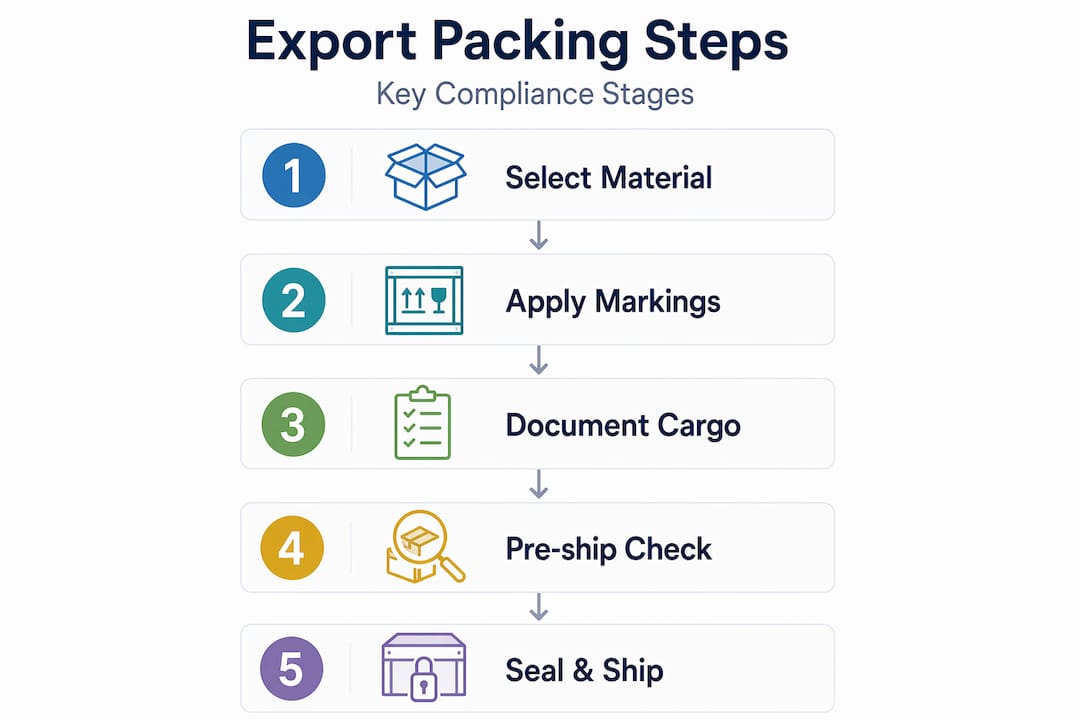
Now that you know how to implement compliance best practices, consider the unique insights below on navigating export packing challenges.
Revealing overlooked pitfalls and practical lessons in export packing
Most discussions of export packing requirements focus on the obvious: treat your wood, mark your boxes, match your documents. What they rarely address are the failure modes hiding in the details, the ones that trip up experienced shippers who believe they have everything covered.
The bark size rule is one of the most underestimated compliance risks in practice. Many exporters confirm that their supplier uses certified treatment facilities and assume that is sufficient. But bark wider than 3cm causes total shipment rejection even when the ISPM 15 stamp is present and valid. The stamp certifies the treatment process, not the final physical state of every plank. Inspection officers examine the wood itself. A single oversized bark piece on one pallet board can hold an entire container.
Stamp degradation is another silent problem. IPPC marks applied months before shipment can fade, get painted over during warehouse storage, or become illegible after exposure to moisture. An illegible stamp carries the same legal weight as no stamp at all. Shippers should inspect wood packaging at the point of loading, not just at the point of purchase from the supplier.
The mismatch problem between packing and documentation teams is more common than most logistics managers would like to admit. Packing happens in the warehouse. Documentation happens in an office. When these two processes run independently without a final cross-check, package numbers get transposed, weight figures get rounded differently, and carton counts come out inconsistent. A photo-supported packing list, where each package photo is linked to its packing list entry, makes customs inspections faster and provides a strong foundation for cargo insurance claims when losses occur.
Finally, color matters more than many exporters realize. Red and orange ink are internationally recognized hazardous materials colors. Using them on wood treatment stamps, even accidentally, causes rejection. Black ink only, applied cleanly, applied to bare wood or a light-colored surface.
These are not obscure edge cases. They are patterns that repeat across thousands of shipments each year, and they share a common cause: the assumption that good-enough compliance is the same as full compliance. It is not.
How Worldwide Express supports your export packing and freight compliance
Navigating export packing requirements, ISPM 15 standards, country-specific rules, and documentation alignment is a significant operational burden. Getting it right every time requires expertise that goes beyond a checklist.
Worldwide Express provides freight forwarding services built around the realities of international packing and compliance, helping businesses move cargo through customs without the costly surprises. Their customs brokerage team reviews documentation, verifies marking compliance, and coordinates with destination port authorities to prevent holds before they happen. For cargo that faces the real risks of transit damage, cargo insurance coverage through Worldwide Express protects your investment from port to door. Partnering with experienced logistics professionals means fewer rejected containers, lower compliance risk, and supply chains that stay on schedule.
Frequently asked questions
What wood packaging materials require ISPM 15 compliance?
Wood packaging thicker than 6mm, including pallets, crates, boxes, and dunnage, must be heat treated or fumigated and carry the ISPM 15 mark to prevent the spread of invasive pests across borders.
Why is debarking required for wooden export packaging?
Debarking removes bark that can harbor pests that survive treatment. Per ISPM 15 requirements, bark wider than 3cm causes total shipment rejection at inspection, even when a valid treatment stamp is present on the packaging.
How does matching packaging marks with the packing list affect customs clearance?
Mismatches between packaging marks and the submitted packing list give customs officers grounds to conduct a full container exam, resulting in significant delays and storage costs that could have been avoided with a simple pre-shipment cross-check.
What are the risks of non-compliant wooden packaging?
Non-compliance with ISPM 15 can lead to cargo rejection, mandatory fumigation at the shipper’s expense, or outright destruction of the goods. Fumigation fees alone often exceed $1,000 per container, not counting the downstream costs to schedules and customer relationships.
Are there alternatives to wooden packaging for exports?
Plastic pallets, corrugated and presswood pallets, and wood panel products such as plywood or particleboard thinner than 6mm are all exempt from ISPM 15 and represent practical alternatives for shippers who want to avoid the treatment and certification requirements entirely.
Recommended
- Efficient packing goods for export: a comprehensive guide – Worldwide Express, Inc.
- Step-by-step guide to exporting goods: compliance to shipment – Worldwide Express, Inc.
- 8 Packing List Essentials for International Trade Success – Worldwide Express, Inc.
- How to Optimize Logistics for Efficient Global Shipping – Worldwide Express, Inc.