TL;DR:
- Getting a shipment across an international border depends on timely and accurate manifest filing, which is strictly enforced by customs agencies in the US and Canada. Proper sequencing, technology use, and adherence to deadlines are critical to avoid holds, fines, or rejection; operational processes are often the root cause of failures, not knowledge gaps. Mastering manifest compliance leads to faster shipments, trusted carrier relationships, and a competitive operational advantage.
Getting a shipment across an international border is never just about moving cargo. The manifest filing process sits at the center of every compliant cross-border shipment, and a single missed deadline or sequencing error can trigger holds, fines, or outright rejection at the port. Logistics teams that treat manifest filing as a formality tend to learn the hard way that customs agencies in both the U.S. and Canada enforce these requirements with no flexibility. This guide cuts through the regulatory complexity and gives import/export professionals a clear, practical path to accurate and timely manifest submissions.
Table of Contents
- Key Takeaways
- Understanding the manifest filing process
- Preparing to file: data requirements and tools
- Step-by-step filing workflow by shipment mode
- Common mistakes and how to fix them
- My take on manifest filing as a competitive edge
- How Worldwideexpress supports your manifest compliance
- FAQ
Key Takeaways
| Point | Details |
|---|---|
| Deadlines are strict and mode-specific | Highway manifests must be filed at least 1 hour before arrival; vessel cargo requires 24 hours before loading. |
| Submission order matters | Cargo documents must be accepted before conveyance documents, or the filing will be rejected. |
| Technology reduces human error | Using approved EDI software or portal systems with data validation catches errors before they reach customs. |
| Data acceptance is not automatic | Receiving a transmission confirmation does not mean acceptance; teams must verify the customs system response. |
| Errors compound quickly | Incomplete data, wrong sequence, or missed lead sheet presentation each carry separate compliance consequences. |
Understanding the manifest filing process
A shipping manifest is a structured declaration that tells customs authorities exactly what is being transported, by whom, and in what conveyance. It is not interchangeable with a commercial invoice or bill of lading. The manifest specifically covers cargo details, carrier identification, conveyance data, and routing information in a format that customs risk-screening systems can parse automatically.
In the United States, the Customs and Border Protection agency administers the ACE e-Manifest program through the Automated Commercial Environment (ACE) portal. In Canada, the Canada Border Services Agency (CBSA) operates the ACI eManifest program under a parallel structure. Both systems require electronic advance filing, but the specific timing rules, data fields, and submission sequences differ by mode of transport.
The three primary manifest categories logistics teams encounter are:
- Highway truck eManifests for land crossings at U.S. and Canadian ports of entry
- Vessel export manifests for ocean cargo departing U.S. ports under Electronic Export Manifest (EEM) rules
- Hazardous waste eManifests filed through the EPA’s dedicated system for regulated waste shipments
Understanding which manifest type applies to a given shipment, and which regulatory body governs it, is the starting point for every filing. Getting that wrong upstream means every subsequent step is built on a faulty foundation.
Key timing requirements by mode

| Mode | Program | Advance Filing Deadline |
|---|---|---|
| Highway (standard) | ACE / ACI | 1 hour prior to arrival |
| Highway (FAST lanes) | ACE | 30 minutes prior to arrival |
| Vessel export cargo | EEM (CBP) | 24 hours before loading |
| Hazardous waste | EPA e-Manifest | At time of shipment origination |
Preparing to file: data requirements and tools
Accurate manifest filing starts before any data touches a portal. Logistics coordinators need to assemble a complete set of records covering the shipment, the carrier, and the conveyance before initiating any submission.
For highway eManifests in both the ACE and ACI systems, the required profiles include:
- Driver profile: name, license number, issuing country, citizenship
- Truck profile: vehicle identification number (VIN), license plate, country of registration
- Trailer profile: trailer number, license plate, and seal number where applicable
- Cargo details: shipper and consignee information, commodity descriptions, harmonized tariff codes, quantities, and weights
- Carrier codes: the Standard Carrier Alpha Code (SCAC) or equivalent identifier recognized by the relevant customs system
The ACI eManifest program also requires drivers to carry and present a lead sheet (also called a cover sheet) at the port. This document contains a confirmation number generated once the filing has been accepted, and border officers use it to pull up the manifest data. Without it, the driver cannot proceed through the FAST or standard lane.
On the technology side, filers can use the CBP ACE Portal directly for smaller volumes, or work with an approved EDI software provider for high-frequency operations. Service providers connect directly to customs systems via automated transmissions, which significantly reduces manual entry errors. For Canadian shipments, the CBSA’s own portal supports direct submission, and third-party software providers certified under the ACI program are widely used by carriers and brokers.
Pro Tip: Build at least a 30-minute internal buffer beyond the regulatory minimum before vehicle departure. This accounts for data validation turnaround time, potential system latency, and any corrections needed before the acceptance confirmation comes back from customs.
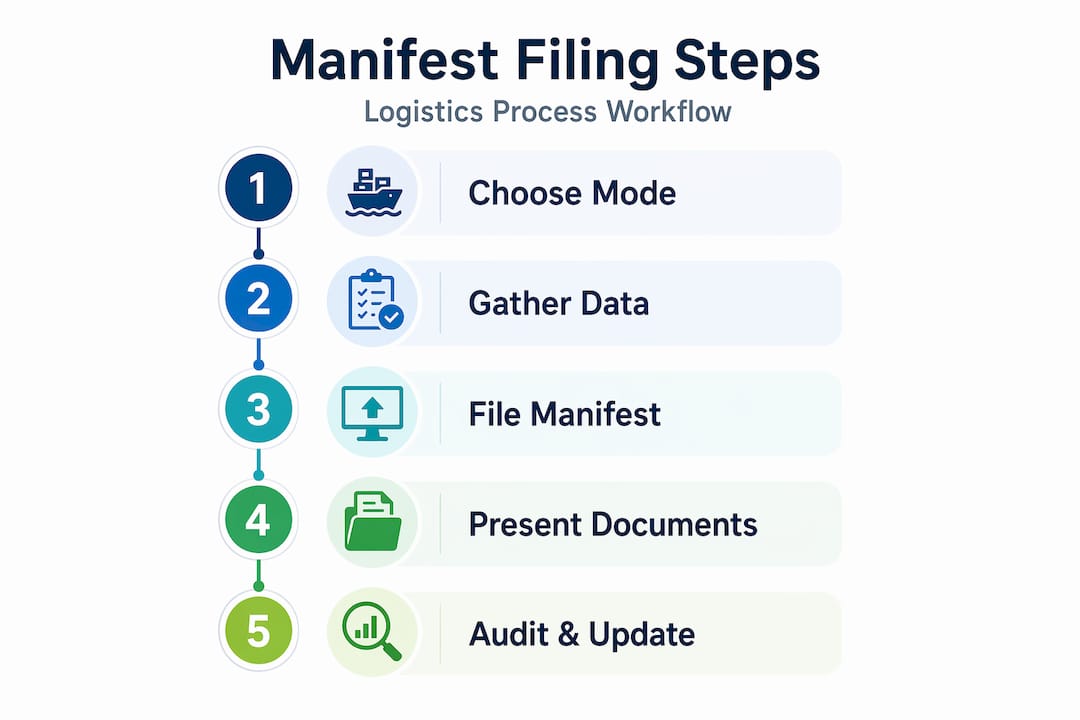
Step-by-step filing workflow by shipment mode
Highway eManifests (ACE and ACI)
The workflow for a highway eManifest follows a specific sequence that cannot be reversed. Filing the conveyance document before the cargo manifest has been accepted is one of the most common reasons for rejection.
- Create and submit the cargo manifest first, including all shipment and commodity details.
- Wait for the acceptance response from the customs system before proceeding.
- Create and link the conveyance manifest (truck and driver data) to the accepted cargo filing.
- Transmit the conveyance and confirm a second acceptance response.
- Generate and print the lead sheet for the driver to present at the port.
- Monitor the filing status until the vehicle arrives and clears the border.
Per the CBSA eManifest Portal Guide, cargo documents must be accepted before linking and submitting conveyance documents. Skipping this step causes rejection. It is not a suggestion about best sequencing. It is a hard system rule.
Vessel export manifests (EEM)
The Federal Register’s 2026 rule on vessel export manifests establishes a staged submission structure. Initial cargo data must be submitted no later than 24 hours before loading begins, with updates permitted up to 2 hours before the vessel’s departure. This staged approach allows corrections as cargo manifests evolve, rather than forcing a single high-stakes submission at the last minute.
- Submit initial cargo data at least 24 hours before loading.
- Update the manifest as additional cargo is confirmed.
- Finalize and transmit the complete manifest no later than 2 hours before departure.
- Retain all submission records and acceptance responses for compliance documentation.
Pro Tip: Do not wait until all cargo is confirmed before starting the vessel manifest. Filing partial data early and updating it gives you a correction window that a last-minute, all-at-once submission does not.
Hazardous waste eManifests (EPA)
The EPA e-Manifest system supports fully electronic manifests, hybrid manifests (paper with electronic signatures), and paper manifests. Electronic submissions require mandatory e-signatures from the generator, transporter, and receiving facility. Receiving facilities must submit paper manifests within 30 days of delivery; electronic manifests are signed and transmitted within the system itself. The EPA updates fee schedules biennially, and all corrections maintain auditable records for regulatory review.
Common mistakes and how to fix them
Most manifest filing failures are not caused by complex regulatory misunderstandings. They come from predictable, preventable operational errors.
- Submitting conveyance before cargo is accepted. This is the single most frequently cited rejection cause in CBSA portal documentation. The fix is a rigid internal checklist that requires confirmation of cargo acceptance before anyone touches the conveyance submission.
- Assuming a broker’s filing covers your eManifest. Customs brokers handle entry filings. The eManifest is a separate, carrier-side obligation. Many companies discover this distinction only after a shipment is held at the border.
- Missing the lead sheet at the port. Drivers who arrive without a printed or digital lead sheet create delays regardless of how accurately the manifest was filed. Carrier dispatch teams need a protocol for confirming lead sheet delivery before the driver departs.
- Inaccurate cargo descriptions or mismatched seal numbers. Any field that does not match the physical shipment can trigger a secondary inspection.
- Late corrections after departure. Amendments filed after a vehicle has left the facility but before the advance filing window closes may still be accepted, but they typically incur fees and draw scrutiny.
“Advance-manifest timing enforcement ensures customs risk screening before arrival; manifest data must be accepted by customs system to prevent shipment delays.” (CBSA eManifest Portal Guide)
Pro Tip: Create a pre-submission audit checklist that requires sign-off from both the logistics coordinator and the carrier before any manifest is transmitted. An audit trail is also your best defense during a customs audit.
Good customs compliance practices treat the manifest not as a checkbox but as the first communication between your operation and customs. Make it count.
My take on manifest filing as a competitive edge
I’ve worked with logistics teams at every level, from small importers moving a handful of shipments per month to freight operations handling hundreds of cross-border moves weekly. What I’ve consistently observed is that the companies with the fewest manifest-related delays are not necessarily the ones with the most experienced staff. They are the ones with the tightest processes.
What I’ve learned is that most manifest filing failures are process failures disguised as knowledge gaps. A team might know the 1-hour rule for ACE highway filings perfectly well, and still miss it because nobody built in the buffer time needed for data validation to return an acceptance before the truck leaves the yard. The knowledge is there. The operational structure is not.
My take is that investing in approved EDI software is not optional for any business moving more than 20 cross-border shipments per week. Manual portal entries at that volume are a compliance liability. The staged vessel manifest approach outlined in the 2026 Federal Register rule is a model worth borrowing for all shipment types: file early, update often, and never treat the manifest as a last step.
The businesses that master manifest filing gain something real beyond compliance. Shipments clear faster. Carriers trust the relationship. And customers notice when their freight consistently arrives on schedule. That is a measurable advantage.
— Ian
How Worldwideexpress supports your manifest compliance
Navigating ACE, ACI, EEM, and EPA eManifest requirements across multiple shipment modes is genuinely complex work. The margin for error is thin, and the consequences of mistakes, from port holds to fines to strained carrier relationships, are real costs.
Worldwideexpress brings experienced customs brokerage and freight forwarding teams to each client relationship, with specialists who understand both U.S. and Canadian manifest documentation process requirements inside out. From ensuring your eManifest submissions follow the correct sequencing rules to coordinating timely vessel cargo filings, the Worldwideexpress team works as an extension of your logistics operation. For businesses looking to understand the broader freight picture, the freight forwarding guide on the Worldwideexpress website is an excellent starting point for connecting manifest compliance to your full shipping strategy. Explore the full range of services at Worldwideexpress to reduce cross-border risk and build a more predictable shipping operation.
FAQ
What is the manifest filing process for U.S. highway shipments?
The manifest filing process for U.S. highway shipments requires carriers to submit cargo and conveyance data through the ACE portal or approved EDI at least 1 hour before arrival, with FAST lane shipments requiring 30 minutes advance notice.
Why does submission order matter in eManifest filing?
Per CBSA rules, cargo documents must be accepted before conveyance documents can be submitted and linked; reversing this sequence causes automatic rejection of the filing.
What are the vessel export manifest filing deadlines?
Initial cargo data for vessel exports must be submitted at least 24 hours before loading, with the final manifest due no later than 2 hours before vessel departure under the 2026 EEM rule.
How does the EPA hazardous waste eManifest work?
The EPA e-Manifest system accepts fully electronic, hybrid, and paper submissions, with mandatory e-signatures and an auditable record trail for all hazardous waste shipments.
What is the most common manifest filing mistake?
The most common error is submitting the conveyance document before the cargo manifest has received a confirmed acceptance from the customs system, a sequencing mistake that results in immediate rejection and delays shipment clearance.
Recommended
- Understanding What is a Shipping Manifest – Worldwide Express, Inc.
- Master the Freight Claim Process: A Step-by-Step Guide – Worldwide Express, Inc.
- Export packing requirements: a logistics manager’s guide – Worldwide Express, Inc.
- Guide to managing freight claims for smooth international trade – Worldwide Express, Inc.