TL;DR:
- E-commerce customs clearance in 2026 involves strict documentation, correct tariff classification, and the use of licensed customs brokers. The suspension of the $800 de minimis exemption requires all shipments, including low-value goods, to undergo formal or informal entry procedures. Proper compliance and proactive planning help prevent delays and costly penalties at the border.
E-commerce customs clearance is the process through which online retailers and international traders ensure their shipments comply with trade regulations, pay appropriate duties, and gain timely entry into destination countries. The U.S. Customs and Border Protection (CBP) framework governs this process, and 2026 has brought significant changes that every cross-border seller must understand. The indefinite suspension of the $800 de minimis exemption for non-postal shipments means low-value goods now face the same scrutiny as high-value cargo. This guide covers the current entry procedures, documentation requirements, broker roles, and practical strategies to keep your shipments moving.
What are the current e-commerce customs clearance procedures?
Two entry types define how CBP processes imported goods: formal entry and informal entry. The dividing line is shipment value. Shipments valued above $2,500 require formal entry, which involves a customs bond, a full commercial invoice, and a 10-digit Harmonized Tariff Schedule of the United States (HTSUS) classification. Shipments at or below $2,500 typically qualify for informal entry, a simpler process with fewer documentation requirements.

The bigger shift in 2026 is the de minimis exemption suspension for all non-postal shipments. Previously, goods valued at $800 or less entered the U.S. duty-free with minimal paperwork. That exemption is now indefinitely suspended for shipments arriving by air freight, ocean, and truck. The practical effect is significant: a $50 product shipped via air courier now requires a formal or informal entry filing, complete with duties and documentation.
Customs regulations protect public safety and U.S. economic interests by preventing illicit goods from entering the country. That public-safety mandate is exactly why CBP enforces these rules uniformly, regardless of shipment size.
Here is a quick reference for the two entry types:
| Entry Type | Value Threshold | Key Requirements |
|---|---|---|
| Informal entry | $2,500 or below | Commercial invoice, basic merchandise description, HTSUS classification |
| Formal entry | Above $2,500 | Customs bond, full commercial invoice, 10-digit HTSUS classification, entry summary |
Pro Tip: If your shipments frequently cluster just below $2,500, audit your product bundling strategy. Combining items in one shipment can push value above the formal entry threshold and trigger bond requirements you may not have budgeted for.
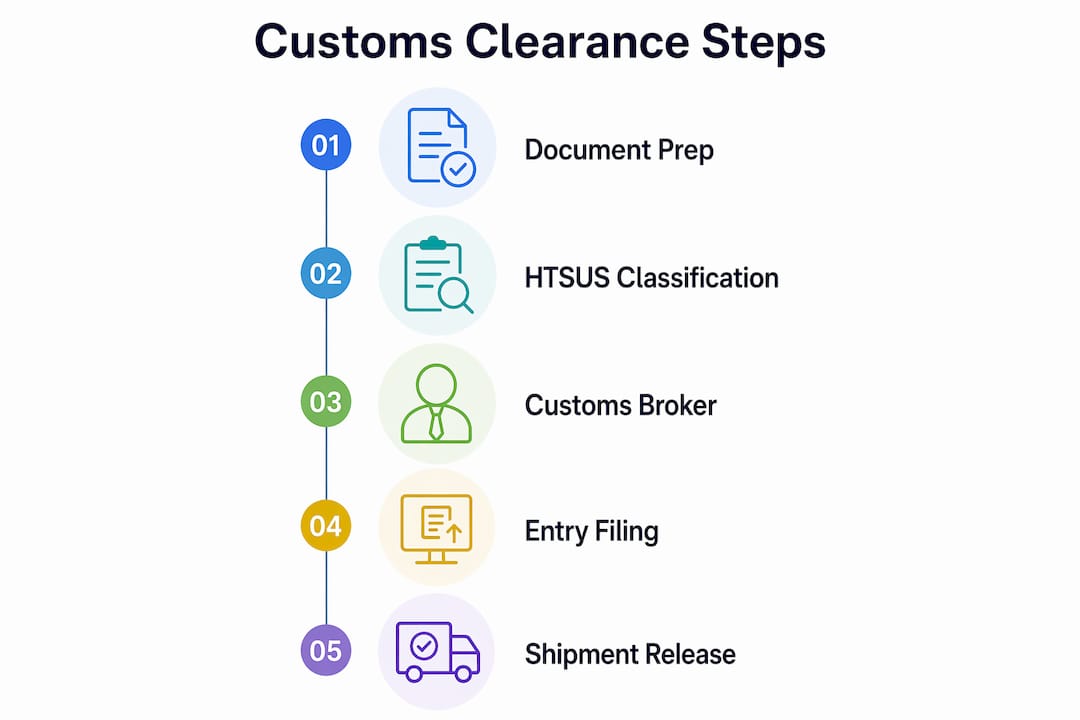
What documentation does your e-commerce business need for clearance?
Accurate documentation is the single most controllable factor in customs clearance speed. CBP requires all importers, regardless of business size, to meet the same documentation and procedural standards. A small Shopify seller faces the same compliance bar as a Fortune 500 importer.
The core documents for most e-commerce shipments include:
- Commercial invoice: Must state the buyer, seller, country of origin, full merchandise description, quantity, and declared value in U.S. dollars.
- HTSUS classification: A 10-digit code from the Harmonized Tariff Schedule that determines the applicable duty rate. Misclassification is one of the most common causes of cargo holds.
- Packing list: Itemizes the contents of each package, including weight and dimensions.
- Customs bond: Required for all formal entries. A continuous bond covers all shipments for 12 months; a single-entry bond covers one shipment only.
- Electronic filing data: New 2026 regulations require additional data elements in electronic filings, including seller information, buyer details, and enhanced merchandise descriptions.
The HTSUS is a living document. CBP updates it periodically, and a classification that was correct last year may carry a different duty rate today. Checking the current schedule before each new product launch is standard practice, not optional due diligence.
Pro Tip: Use CBP’s free ACE (Automated Commercial Environment) portal to file entries electronically. ACE reduces manual errors and creates a digital audit trail that speeds up any CBP inquiry.
How do customs brokers help with e-commerce clearance?
A customs broker is a CBP-licensed professional who prepares and files entry documents on behalf of importers. Brokers manage HTSUS classification, calculate duties, post customs bonds, and communicate directly with CBP on your behalf. For e-commerce businesses scaling into new markets, a broker is the fastest way to avoid costly errors.
Broker involvement becomes necessary in several situations:
- Formal entries: Any shipment above $2,500 benefits from broker oversight because the documentation requirements are extensive and errors trigger delays.
- New postal informal entry processes: Under the 2026 rules, new postal entry processes require that entries be filed only by licensed brokers or the importer of record. Third-party filers without a license are no longer permitted.
- Unfamiliar product categories: Brokers specialize in classification and can identify duty-saving opportunities through tariff engineering or free trade agreement eligibility.
- High-volume operations: Businesses processing hundreds of shipments per month cannot realistically manage entry filings manually.
The cost-benefit calculation is straightforward. A single misclassified shipment can result in CBP penalties, cargo holds, and back-duty assessments that far exceed a broker’s annual fee. Brokers also stay current on regulatory changes, which is a full-time job in 2026.
Looking ahead, Entry Type 13, a new electronic informal entry test for mail shipments, is scheduled to begin in september 2026. This system will require electronic submission of shipment data, including customs bond information and tariff classifications. Businesses that build broker relationships now will be better positioned to adopt this system without disruption.
Pro Tip: Ask your broker for a classification ruling letter from CBP on your top-selling SKUs. A binding ruling locks in your duty rate and protects you from reclassification disputes during audits.
What causes customs clearance delays and how do you avoid them?
Delays at the border are almost always preventable. Inaccurate tariff classification, missing customs bonds, and undervalued goods are the three most common triggers for CBP holds and penalties. Each one has a clear fix.
The most frequent causes of clearance delays, ranked by how often they appear in CBP enforcement actions:
- Incorrect HTSUS classification. CBP requires a 10-digit code. A 6-digit code or a wrong chapter assignment triggers an immediate review. Verify classification against the current HTSUS schedule before filing.
- Undervalued goods. Declaring a lower value to reduce duties is a customs violation. CBP cross-references declared values against market data. Penalties include fines and shipment seizure.
- Missing or incomplete commercial invoice. An invoice without country of origin, full merchandise description, or accurate pricing stalls the entry review process.
- No customs bond for formal entries. Shipments above $2,500 without a bond cannot clear. A continuous bond through a licensed surety company eliminates this risk for regular importers.
- Failure to update filings after regulatory changes. The 2026 de minimis suspension caught many businesses unprepared. Shipments that previously cleared automatically now require full entry filings.
When a shipment is held, act immediately. Contact your customs broker or review clearance delay causes to identify the specific CBP request. Responding within 24 hours of a CBP inquiry typically prevents escalation to a formal examination, which adds days to the release timeline.
How can e-commerce businesses optimize their international shipping process?
Preparation before a shipment leaves the origin country determines how fast it clears customs at the destination. Advance filing, electronic data interchange, and correct Incoterms reduce errors and accelerate border crossings. These are not aspirational goals. They are operational standards for any business shipping internationally at scale.
The most effective optimization strategies break into two categories:
Pre-shipment preparation
- File entry documents electronically through ACE before the shipment arrives at the U.S. port of entry.
- Confirm HTSUS classification and duty rates for every new product before the first shipment.
- Choose Incoterms that clearly assign customs clearance responsibility. DDP (Delivered Duty Paid) places full customs responsibility on the seller. DAP (Delivered at Place) transfers it to the buyer. Mismatched expectations between seller and buyer cause clearance failures.
- Maintain a master product catalog with pre-verified classifications, declared values, and country-of-origin documentation.
Ongoing compliance management
- Subscribe to CBP Federal Register updates to track regulatory changes in real time.
- Conduct quarterly audits of your top-selling products’ classifications and valuations.
- Coordinate with your freight forwarder and customs broker as a unified team, not as separate vendors. Shared data reduces duplication and filing errors.
- For European market shipments, understanding logistics and transportation regulations in destination countries adds another layer of compliance readiness.
The businesses that clear customs fastest are not the ones with the most resources. They are the ones with the most organized data. A well-maintained product database with accurate classifications and valuations is worth more than any single technology investment.
Key Takeaways
Effective e-commerce customs clearance in 2026 requires accurate documentation, correct HTSUS classification, a valid customs bond for formal entries, and a licensed customs broker for complex or high-volume shipments.
| Point | Details |
|---|---|
| De minimis suspension | The $800 exemption is indefinitely suspended for non-postal shipments as of june 2026. |
| Entry type thresholds | Shipments above $2,500 require formal entry with a customs bond; those at or below use informal entry. |
| Documentation accuracy | Correct HTSUS classification and accurate declared values prevent the majority of CBP holds. |
| Broker necessity | Licensed brokers are now required for new postal informal entry filings under 2026 rules. |
| Advance filing advantage | Filing electronically before arrival reduces errors and speeds up CBP release times. |
The compliance gap most e-commerce sellers ignore
The honest reality about customs compliance is that most e-commerce businesses treat it as a back-office problem until a shipment gets held. I have seen this pattern repeat across businesses of every size. A seller builds a profitable cross-border operation, ships hundreds of packages a month, and then one regulatory change, like the de minimis suspension, exposes years of under-documented filings.
What surprises most operators is how little it takes to get compliance right from the start. A current HTSUS classification for your top 20 SKUs, a continuous customs bond, and a licensed broker on retainer covers the vast majority of risk. The administrative burden sounds heavy until you compare it to the cost of a single cargo hold or CBP penalty assessment.
The 2026 regulatory changes are not a temporary disruption. CBP has signaled that tighter oversight of low-value shipments is a permanent policy direction. Businesses that build compliance infrastructure now, including electronic filing capabilities and broker relationships, will absorb future regulatory changes without operational disruption. Those that wait will keep reacting to each new rule as a crisis.
My strongest recommendation is to treat your customs broker as a strategic partner, not a transaction vendor. A good broker flags classification risks before you launch a new product, not after CBP flags your shipment. That proactive relationship is the difference between a smooth operation and an expensive lesson.
— Ian
Worldwideexpress customs brokerage and freight forwarding services
Worldwideexpress brings deep expertise in U.S. customs brokerage to e-commerce businesses navigating the 2026 regulatory environment. From managing formal entry filings and customs bonds to staying current on CBP rule changes, the team handles the compliance details so you can focus on growing your business.
Worldwideexpress supports businesses with U.S. customs brokerage services designed to handle the full entry process, including HTSUS classification, bond management, and electronic ACE filings. For businesses expanding their international reach, the freight forwarding guide covers the end-to-end process of moving goods across borders efficiently. Whether you are shipping a single container or managing high-volume cross-border orders, Worldwideexpress provides the compliance infrastructure your operation needs.
FAQ
What is e-commerce customs clearance?
E-commerce customs clearance is the process of submitting required documentation to CBP so that imported goods can legally enter a destination country, with applicable duties paid and trade regulations satisfied.
Is the $800 de minimis exemption still in effect?
The $800 de minimis exemption is indefinitely suspended for all non-postal shipments as of june 2026. Goods arriving by air freight, ocean, or truck now require formal or informal entry filings regardless of value.
When does an e-commerce shipment require a customs bond?
Any shipment valued above $2,500 entering the U.S. requires a customs bond as part of the formal entry process. A continuous bond covers all shipments for 12 months and is the standard choice for regular importers.
What does a customs broker do for e-commerce businesses?
A licensed customs broker prepares and files entry documents, manages HTSUS classification, posts customs bonds, and communicates with CBP on your behalf. Under 2026 postal entry rules, only licensed brokers or the importer of record may file certain entry types.
How can I avoid customs clearance delays?
Accurate HTSUS classification, correct declared values, complete commercial invoices, and advance electronic filing through ACE are the most effective ways to prevent CBP holds and keep shipments on schedule.
Recommended
- E-Commerce Returns and Customs: A 2026 Retailer Guide – Worldwide Express, Inc.
- Customs compliance best practices: stay penalty-free in 2026 – Worldwide Express, Inc.
- Master customs compliance tips for smoother shipping – Worldwide Express, Inc.
- Customs clearance for businesses: compliance and smooth trade – Worldwide Express, Inc.