TL;DR:
- Most U.S. importers must obtain a customs bond for shipments exceeding $2,500, with the bond amount based on 10% of prior duties and minimum $50,000. Continuous bonds are recommended for frequent importers to cover all shipments and ISF filings, whereas single entry bonds serve occasional shipments but often lack critical coverage. Managing bond sufficiency proactively and correctly choosing bond types and amounts helps prevent delays, penalties, and compliance issues at ports.
Many importers and exporters hit an unexpected wall when their first commercial shipment arrives at a U.S. port: a customs bond requirement they never saw coming. Customs bond requirements catch new and experienced shippers alike off guard, often because the rules are more specific than a quick internet search reveals. This guide breaks down exactly what U.S. Customs and Border Protection (CBP) requires, which bond type fits your situation, how bond amounts are calculated, and how to get one without unnecessary delays or penalties.
Table of Contents
- Key takeaways
- Customs bond requirements: what CBP actually mandates
- Types of customs bonds and how to choose
- How bond amounts are calculated
- The customs bond application and management process
- Common pitfalls and how to avoid them
- My perspective on customs bond misconceptions
- Let Worldwideexpress handle your bond compliance
- FAQ
Key takeaways
| Point | Details |
|---|---|
| Who needs a customs bond | Any commercial import valued over $2,500 into the U.S. requires a customs bond filed with CBP. |
| Two primary bond types | Continuous bonds cover all entries for a year; single entry bonds cover one shipment only. |
| Bond amount formula | CBP sets the amount at 10% of annual duties, taxes, and fees, with a $50,000 minimum. |
| ISF coverage gap | Single entry bonds typically do not cover ISF filings, creating a compliance risk for ocean shipments. |
| Proactive monitoring matters | CBP reviews bond sufficiency continuously and can hold cargo if your bond falls short without notice. |
Customs bond requirements: what CBP actually mandates
A customs bond is a financial guarantee between three parties: the importer (the principal), a licensed surety company, and CBP. It promises that the importer will fulfill all legal obligations, including paying duties, taxes, and fees, and complying with all federal regulations governing imports. As customs bonds act as a guarantee allowing goods to move before all obligations are settled, they protect government revenue while keeping commerce flowing.
The threshold is clear. Any commercial import with a value exceeding $2,500 requires a customs bond. Shipments of restricted or regulated goods, such as firearms, food products, and pharmaceuticals, require a bond regardless of value. Formal entry, the CBP term for the standard process on higher-value shipments, cannot proceed without one.
The governing document is CBP Form 301, which specifies the bond type and activity code corresponding to the importer’s role. Activity codes matter more than most importers realize. The codes break down as follows:
- Activity Code 1: Covers importers and customs brokers filing entries on behalf of importers.
- Activity Code 2: Applies to custodians of bonded merchandise, such as warehouse operators.
- Activity Code 3: Covers international carriers transporting goods to the U.S.
- Activity Code 6: Applies to Foreign Trade Zone (FTZ) operators.
Choosing the wrong activity code delays clearance and can expose the importer to compliance gaps. Most commercial importers need Activity Code 1, but if you operate a bonded warehouse or FTZ, you will need additional or separate bonds.
Types of customs bonds and how to choose
Understanding the types of customs bonds is the single most practical step any importer can take before shipping. The two primary options are continuous bonds and single entry bonds, and the choice between them has real financial and compliance consequences.
| Bond Type | Coverage | Best For | Typical Annual Cost |
|---|---|---|---|
| Continuous bond | All CBP entries for 12 months, including ISF | Frequent importers, multiple shipments per year | $400 to $600 (at $50,000 bond amount) |
| Single entry bond | One shipment only | Occasional importers, one-time or rare entries | Usually 0.4% to 0.5% of shipment value |
| Custodial bond | Bonded warehouses and storage of merchandise | Warehouse and distribution operators | Varies by exposure |
| International carrier bond | Transport of merchandise to U.S. ports | Ocean, air, and truck carriers | Varies by carrier volume |
| FTZ bond | Operations within a Foreign Trade Zone | FTZ operators and users | Varies by zone activity |
A continuous bond is the right choice for any importer making more than three or four shipments per year. The math is simple: a single entry bond premium can equal or exceed the annual cost of a continuous bond after just a few entries. You can learn more about calculating bond values based on your specific duty exposure before committing to either option.

One frequently overlooked risk involves ocean shipments. Continuous bonds cover ISF filings, but single entry bonds typically do not. ISF (Importer Security Filing) is a mandatory pre-arrival filing for ocean cargo, and failing to cover it properly can result in liquidated damages assessed directly against your bond. Importers who rely on single entry bonds for ocean freight often discover this gap only after receiving a penalty notice. For a deeper look at ISF compliance requirements, understanding this distinction early prevents expensive surprises.
Pro Tip: If you import via ocean even once, opt for a continuous bond. The ISF coverage alone justifies the annual premium over any single entry alternative.
How bond amounts are calculated
This is where confusion tends to compound. Many importers conflate the bond premium with the bond amount, but they are entirely different figures. The bond premium is what you pay annually, typically around 1% of the bond amount. The bond amount is the maximum coverage limit CBP can draw against if you default. For a $50,000 bond, expect to pay roughly $400 to $600 per year in premium.
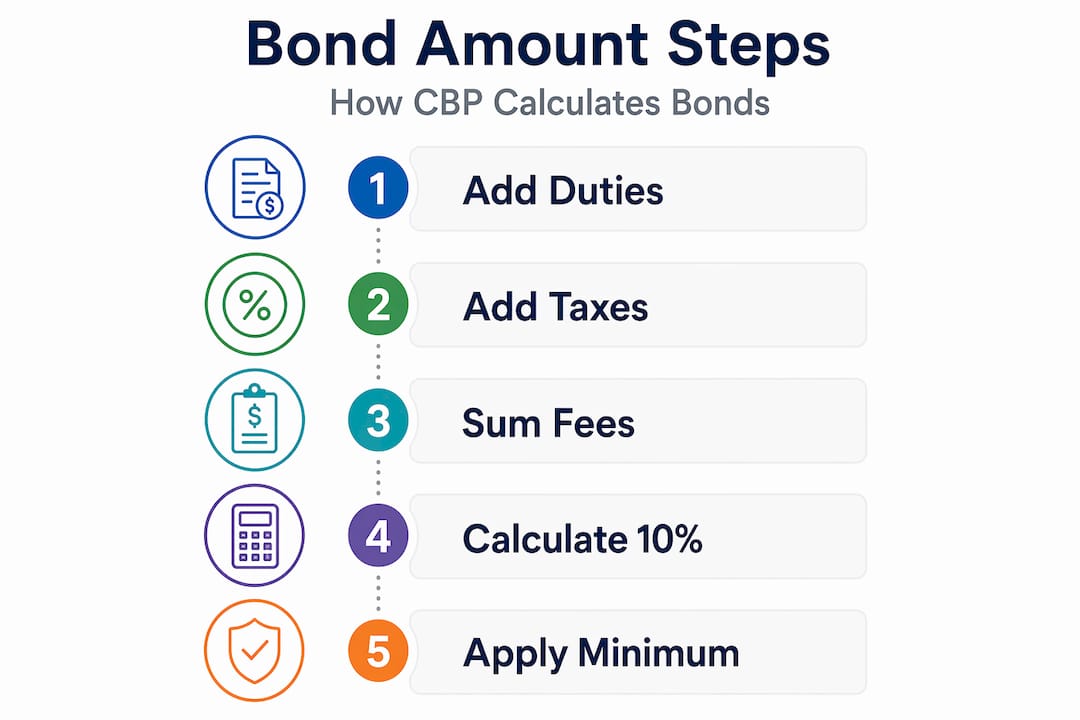
CBP sets the continuous bond amount using a straightforward formula: 10% of duties, taxes, and fees paid in the prior 12 months, rounded up to the next $10,000 increment for amounts under $100,000, and to the next $100,000 for amounts above that. The absolute minimum is $50,000.
Here is how the rounding works in practice:
| Prior 12-Month DTF | Calculated 10% | Required Bond Amount |
|---|---|---|
| $300,000 | $30,000 | $50,000 (minimum applies) |
| $650,000 | $65,000 | $70,000 |
| $1,200,000 | $120,000 | $200,000 |
| $2,500,000 | $250,000 | $300,000 |
Tariff increases hit bond amounts hard. Importers subject to Section 301 tariffs on Chinese goods, antidumping duties, or countervailing duties saw their bond requirements climb sharply as duty rates escalated. Bond sufficiency reviews surged after tariff rate hikes, catching many importers unprepared and forcing emergency bond increases to avoid cargo holds.
For importers who want to avoid the surety underwriting process entirely, cash in lieu of a surety bond is a legal alternative. You deposit the full bond amount with CBP as cash collateral. The downside is obvious: it ties up working capital that could otherwise be deployed in the business.
Pro Tip: Review your bond amount every time your duty exposure changes significantly, not just at renewal. A mid-year tariff change can make your bond insufficient before the annual review catches it.
The customs bond application and management process
Getting a customs bond is a structured process, but it moves quickly when you know the steps. Here is the standard path from application to active bond:
- Choose your bond type and calculate the required amount. Use your prior 12-month DTF data or estimate based on expected import volume and applicable duty rates.
- Select a licensed surety company or work through a customs broker. Most importers use a licensed customs broker who handles the surety relationship on their behalf, which speeds the process significantly.
- Complete CBP Form 301. Specify the activity code, bond amount, and principal information accurately. Errors on this form cause delays.
- Submit to the surety for underwriting. Surety underwriting evaluates your financial strength, expected customs exposure, and compliance history. Incomplete applications or underestimated exposure are the most common reasons for delays at this stage.
- File electronically via the CBP eBond system. Electronic bond transmission is required by CBP, and sureties must submit all bonds, riders, and terminations through this system. Paper filing is no longer standard practice.
- Receive confirmation and begin importing. Standard processing takes 2 to 5 business days, though brokers with established surety relationships often close faster.
Once your bond is active, management is ongoing. Bond riders handle updates such as name changes, address corrections, or bond amount increases. When CBP issues an insufficiency notice, you must act fast. Failure to increase a bond after receiving such a notice can result in shipment delays, cargo holds, and financial penalties. Use the ACE (Automated Commercial Environment) portal to verify your bond status and monitor for any CBP flags before they become cargo problems.
Common pitfalls and how to avoid them
Customs bond compliance errors are usually preventable. The most damaging ones tend to follow predictable patterns.
- Relying on single entry bonds for ocean shipments. As noted, this leaves ISF filings uncovered. Importers who rely on single entry bonds for ocean freight frequently receive liquidated damages notices that exceed what a full year of continuous bond coverage would have cost.
- Underestimating bond amounts due to antidumping duties. Antidumping and countervailing duty rates can multiply your effective duty rate by a factor of three or more. If your bond was calculated before a new duty order applied to your product category, it is almost certainly insufficient now.
- Ignoring the ACE portal. CBP posts bond insufficiency notices and compliance flags in the ACE system. Importers who check this regularly catch problems before they affect cargo. Those who ignore it often learn about issues from a detained shipment.
- Confusing bond premium with bond amount. This distinction matters. If a surety quotes you a $500 annual premium on a $50,000 bond and your duty exposure grows to $900,000, your bond amount needs to increase dramatically. The premium will rise accordingly, but the coverage gap is the real risk.
- Liquidated damages from bond violations reduce your available bond coverage and can trigger higher bond requirements going forward. Respond to any CBP claim promptly and in writing to preserve your right to contest or mitigate the penalty.
Pro Tip: Work with a customs broker who monitors bond sufficiency as part of their service, not just at renewal. CBP does not always give importers much lead time before a hold.
My perspective on customs bond misconceptions
I’ve seen more importers than I can count walk into their first major U.S. shipment genuinely believing a customs bond is a one-time formality. They treat it like a box to check rather than a living financial instrument that needs active management. That mindset leads to real consequences, and most of them are avoidable.
What I’ve learned over years of watching importers navigate this is that the bond amount calculation is where the most damage happens quietly. An importer starts with a $50,000 minimum bond, their duty exposure doubles over 18 months because they added a new product category with higher tariffs, and nobody flags it until CBP issues an insufficiency notice with a 10-day response window. The cargo holds that follow are expensive in ways that go beyond the penalties.
The tariff environment of the past several years made this worse. Section 301 duties and antidumping orders pushed effective duty rates to levels most importers had never planned for, and bond amounts did not keep pace automatically. The importers who fared best were the ones who treated bond sufficiency like a quarterly finance review item, not an annual renewal task.
My honest take: if you are importing frequently and you are still using single entry bonds to save a few hundred dollars annually, you are taking on ISF exposure that is not worth the risk. A continuous bond is not just more convenient. It is genuinely better protection.
— Ian
Let Worldwideexpress handle your bond compliance
Customs bond compliance is one piece of a larger import picture, and getting it wrong creates ripple effects across your entire supply chain. Worldwideexpress brings deep experience in U.S. customs brokerage and international freight forwarding, helping importers and exporters get bonds filed correctly, monitor sufficiency, and respond to CBP notices before they affect cargo. Whether you need guidance on the right bond type or full-service support from filing to clearance, the customs brokerage team at Worldwideexpress is built for exactly this kind of work. For a broader look at how freight forwarding and customs compliance fit together, the 2026 freight forwarding guide from Worldwideexpress covers the full picture in practical terms.
FAQ
What are the basic customs bond requirements for U.S. imports?
Any commercial shipment valued over $2,500 entering the U.S. requires a customs bond filed with CBP on Form 301. Restricted goods require a bond regardless of value.
What is the difference between a continuous and single entry bond?
A continuous bond covers all CBP entries including ISF for 12 months, while a single entry bond covers only one shipment and typically does not include ISF coverage for ocean freight.
How is the customs bond amount calculated?
CBP requires a continuous bond amount equal to 10% of duties, taxes, and fees paid in the prior 12 months, with a $50,000 minimum and standard rounding increments applied to the result.
How long does it take to get a customs bond?
Standard processing through the CBP eBond system takes 2 to 5 business days. Working with an experienced customs broker can reduce this timeline through established surety relationships.
What happens if my customs bond becomes insufficient?
CBP will issue an insufficiency notice requiring a bond increase within a short deadline. Failure to act can result in shipment delays, cargo holds, and financial penalties against the existing bond.