TL;DR:
- Freight shipment tracking combines multiple hardware technologies with software platforms to monitor cargo location and condition in real time. Using integrated systems allows logistics professionals to prevent data gaps, respond quickly to exceptions, and ensure high-value or sensitive cargo remains compliant.
Freight shipment tracking is the continuous monitoring of cargo location and condition using technologies like GPS, cellular networks, RFID, and IoT sensors through integrated logistics platforms. Logistics professionals who master how to track a freight shipment gain a direct operational advantage: fewer costly surprises, faster exception response, and stronger customer confidence. This guide covers the core freight tracking methods, essential tools, a step-by-step monitoring process, common pitfalls, and a platform comparison built for importers, exporters, and freight managers working at scale in 2026.
What tools and technologies are essential for tracking freight shipments?
No single tracking technology covers all freight environments. Hybrid solutions combining GPS, cellular, satellite IoT, RFID, Bluetooth, and Wi-Fi are the standard for full supply chain visibility across ocean, road, rail, air, and indoor warehouse settings. Each technology fills a specific gap the others cannot.

GPS excels on open roads and in air freight. Satellite IoT covers remote ocean lanes where cellular networks fail. RFID and Bluetooth handle indoor facility tracking, such as cross-dock scans and warehouse door events. Wi-Fi positioning works inside large distribution centers where GPS signals are blocked. The right combination depends on your freight lanes and cargo type.
On the software side, Transportation Management Systems (TMS), carrier APIs, and ERP integrations pull data from these hardware sources into a single dashboard. Without software integration, hardware data stays siloed and loses most of its value.
| Technology | Best Use Case | Coverage | Relative Cost |
|---|---|---|---|
| GPS | Road and air freight | Outdoor, global | Low to medium |
| Satellite IoT | Ocean and remote lanes | Global, no cellular needed | Higher per device |
| Cellular | Domestic road freight | Urban and suburban | Low |
| RFID | Warehouse and cross-dock | Indoor, short range | Medium |
| Bluetooth | Indoor asset tracking | Very short range | Low |
| Wi-Fi | Distribution center tracking | Indoor, facility-wide | Low |
Connectivity costs vary significantly by technology. Cellular roaming runs roughly £2–5 per device monthly, while satellite IoT reaches £8–15 per device monthly. For high-value or temperature-sensitive cargo, satellite coverage justifies the premium. For domestic lanes, cellular is sufficient and far more affordable.
Pro Tip: Select a multi-modal platform that switches automatically between GPS, cellular, and satellite based on signal availability. This prevents blind spots when a shipment moves from a domestic highway to an ocean vessel.
How to track a freight shipment step by step
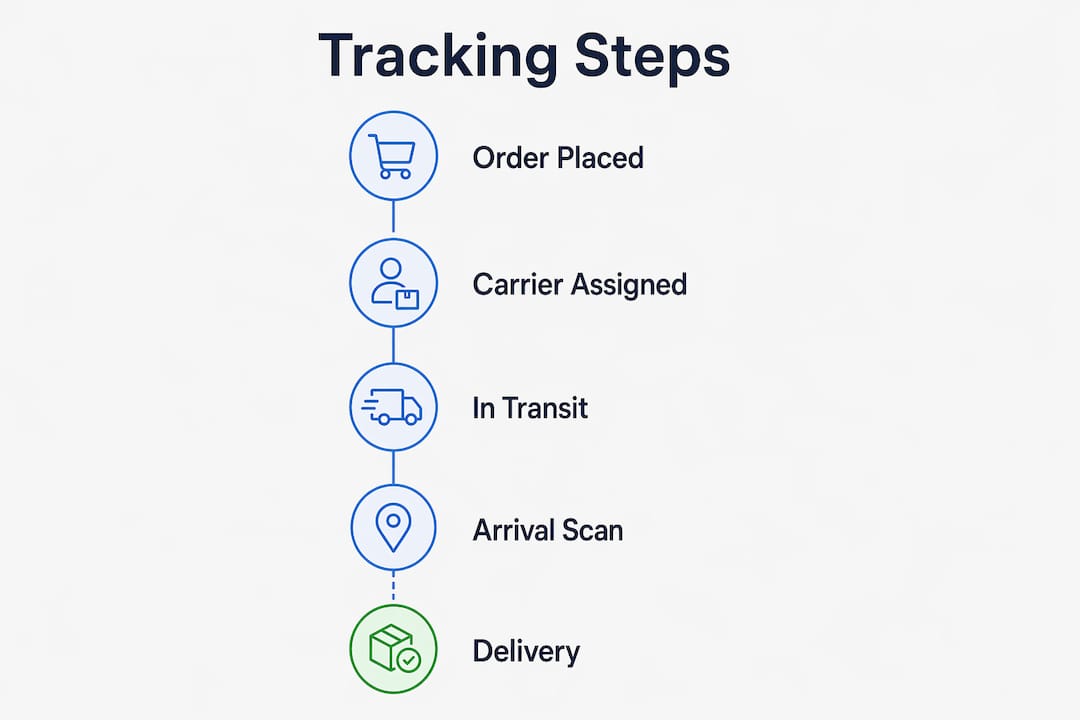
Tracking a freight shipment follows a defined sequence. Skipping steps, especially early ones, creates data gaps that are difficult to recover later in transit.
-
Obtain your tracking reference. Every shipment generates a unique identifier. For LTL and FTL road freight, this is the PRO number. For air freight, use the Air Waybill (AWB) number. For ocean freight, use the Bill of Lading (BOL) or container number. Verify this reference at booking confirmation, not after departure.
-
Choose the right tracking platform or carrier portal. Large carriers like UPS provide their own portals, such as the UPS Forwarding Hub. Third-party platforms like FreightCenter and Freightquote aggregate data across multiple carriers. For complex multi-leg shipments, a TMS with carrier API integration gives the most complete picture.
-
Enter shipment details and read the dashboard. Tracking dashboards display location, status, ETA, milestones, and event history in one view. Read the event log carefully. A status of “in transit” without a recent scan event may indicate a connectivity gap, not smooth progress.
-
Set up notifications and exception alerts. Configure alerts for departure, arrival, customs holds, and delivery confirmation. Real-time tracking replaces slow manual updates with automated, proactive alerts that reach your team before a delay becomes a crisis.
-
Troubleshoot signal gaps or stale data. If a shipment shows no update for an extended period, check whether the leg is ocean or remote rail, where satellite coverage applies. Contact the carrier directly if the last scan is more than 24 hours old on a domestic lane. Cross-reference the carrier portal with your TMS to identify which data source is lagging.
Pro Tip: Customize exception alerts by shipment priority. High-value or time-critical freight should trigger immediate SMS and email alerts. Standard cargo can use daily digest notifications. This prevents alert fatigue and keeps your team focused on what matters.
What are the common challenges in freight tracking and how to avoid them?
Freight tracking fails in predictable ways. Knowing the failure modes in advance lets logistics professionals build systems that catch problems before they escalate.
The most common errors and their fixes include:
- Relying on manual check calls. Phone-based status checks are slow, inconsistent, and expensive. Automated tracking reduces costly manual check calls and cuts exception response time significantly. Replace check calls with TMS-integrated carrier API feeds.
- Confusing location tracking with condition monitoring. Knowing where a shipment is does not tell you if the cargo is intact. Location tracking alone does not satisfy cold chain or high-value cargo risk management needs. Add IoT condition sensors for temperature, shock, and door status on sensitive freight.
- Failing to integrate data sources. Checking individual carrier portals manually creates visibility gaps. Manual portal checks are insufficient compared to centralized, automated data integration. Connect carrier APIs, customs data feeds, and ERP systems into one platform.
- Misreading tracking vs. tracing. Tracking shows current shipment location; tracing shows status history and route. Both are needed for complete visibility. Use platforms that display both in a unified event timeline.
- Ignoring connectivity costs on remote lanes. Satellite IoT coverage for ocean freight costs more per device than cellular. Budget for this difference when planning tracking for international shipments. For small fleet tracking on a budget, cellular-only solutions work well on domestic lanes but will fail mid-ocean.
Critical warning: Failing to monitor cargo condition on perishable or pharmaceutical shipments is not just an operational risk. It creates compliance exposure and can void cargo insurance claims. Condition sensors are non-negotiable for these freight categories.
How does data integration improve freight visibility?
Data integration, not tracking hardware, is the true source of value in modern freight visibility. Connecting carrier APIs, customs feeds, and ERP systems into a centralized TMS turns raw location pings into decisions your team can act on.
Consider a practical example. A shipment of electronics moves from Shenzhen to Chicago via ocean and then domestic truck. The ocean leg generates container events from the shipping line’s API. U.S. Customs generates clearance events. The domestic carrier generates PRO number scans. Without integration, your team checks three separate portals. With a TMS pulling all three feeds, the full event timeline appears in one view, and an exception alert fires automatically if customs clearance stalls.
Predictive ETA algorithms and exception management engines take this further by converting raw data into forward-looking alerts. Instead of learning a shipment is late after it misses a delivery window, your team receives a flag 48 hours in advance based on port congestion data or weather patterns. This technology directly reduces expedited freight costs and inventory holding expenses.
Condition monitoring with IoT sensors for temperature, shock, and tamper detection adds a second data layer beyond location. For pharmaceutical cold chains or high-value electronics, this sensor data feeds directly into compliance documentation and insurance records. Location data tells you where the cargo is. Condition data tells you whether it is still worth delivering. For more on supply chain visibility, the operational gains from integrated data are well documented.
Comparing popular freight tracking platforms for 2026
Popular freight tracking platforms offer multi-modal visibility with integrated carrier and customer portals, but they differ significantly in target user, feature depth, and pricing structure.
| Platform | Strengths | Best For | Pricing Model |
|---|---|---|---|
| FreightCenter | Multi-carrier aggregation, LTL focus | SMB shippers and brokers | Quote-based |
| Freightquote | Rate comparison with tracking | Domestic shippers | Quote-based |
| UPS Forwarding Hub | Deep UPS network integration | UPS-heavy shippers | Carrier portal, free |
| TMS platforms (e.g., integrated ERP) | Full API integration, custom alerts | Enterprise logistics teams | Subscription |
Choosing the right platform depends on three factors: the number of carriers you use, the complexity of your freight lanes, and whether you need condition monitoring alongside location data.
Key features to prioritize when evaluating any platform:
- Carrier API connectivity: The platform must connect directly to your primary carriers, not rely on manual data entry.
- Exception alert configuration: Look for granular alert settings by shipment priority, lane, or cargo type.
- Condition sensor support: For sensitive freight, the platform must ingest IoT sensor data alongside GPS events.
- Customs data integration: For international shipments, customs clearance status must appear in the same timeline as transport events.
For a detailed comparison of leading options, the global freight tracking tools review from Worldwideexpress covers the top platforms with feature breakdowns relevant to importers and exporters.
Key Takeaways
Effective freight shipment tracking requires combining multi-modal hardware technologies with integrated software platforms that deliver real-time exception alerts and condition monitoring across every leg of the supply chain.
| Point | Details |
|---|---|
| Use hybrid tracking technologies | Combine GPS, satellite IoT, RFID, and cellular to cover all freight environments without blind spots. |
| Integrate all data sources | Connect carrier APIs, customs feeds, and ERP systems into one TMS for complete, actionable visibility. |
| Add condition monitoring for sensitive cargo | IoT sensors for temperature, shock, and tamper detection are required for cold chain and high-value freight compliance. |
| Automate exception alerts | Configure proactive notifications by shipment priority to replace manual check calls and cut response time. |
| Know tracking vs. tracing | Use platforms that display both current location and full event history in a unified timeline. |
What I’ve learned from watching freight tracking evolve
The biggest shift I’ve observed in freight visibility is not the hardware. GPS has been reliable for years. The real change is in how teams use the data once it arrives. Most logistics operations I’ve seen still treat tracking as a reactive tool. A shipment goes missing, and then someone logs into a portal. That approach costs money every time.
The professionals who get the most from freight tracking have moved to exception-based management. They set their alerts, trust the system to flag problems, and only intervene when something falls outside the expected parameters. This is not a technology problem. It is a workflow problem. The technology to do this well has existed for several years. The barrier is organizational habit.
The other thing I’d push back on is the assumption that more data always means better decisions. I’ve seen teams drown in tracking events without a clear protocol for which events require action. Condition sensor alerts for a 2-degree temperature variance on a non-perishable shipment are noise. The same alert on a pharmaceutical load is critical. Calibrating your alert thresholds to your actual cargo risk profile is the work that separates good freight managers from great ones.
For importers and exporters managing international lanes, the customs data integration piece is consistently underinvested. Shipments clear the ocean leg on time and then sit at a port for days because no one was watching the customs clearance feed. That is a solvable problem with the right platform setup.
— Ian
How Worldwideexpress supports freight shipment monitoring
Worldwideexpress provides integrated logistics services that connect importers, exporters, and freight managers to real-time shipment data across air, ocean, and trucking lanes. The platform brings carrier tracking, customs clearance status, and documentation into one view, removing the need to check multiple portals manually.
For businesses managing international freight, Worldwideexpress combines customs brokerage, cargo insurance, and international freight shipping tools into a single solution. Whether you are tracking a container from Shanghai or an air freight shipment from Frankfurt, the visibility tools at Worldwideexpress are built for the complexity of cross-border logistics. Reach out to the Worldwideexpress team to set up a tracking workflow that fits your freight volume and lane profile.
FAQ
What is the difference between freight tracking and tracing?
Tracking shows where a shipment is right now. Tracing shows the full history of where it has been and every status event along its route.
What tracking reference do I need to monitor a freight shipment?
Use the PRO number for LTL and FTL road freight, the Air Waybill number for air freight, and the Bill of Lading or container number for ocean freight.
Why does my freight shipment show no update for hours?
Signal gaps are common on ocean lanes and remote rail corridors where cellular coverage is unavailable. Satellite IoT devices continue tracking in these environments, but update intervals may be longer than cellular.
Do I need condition sensors in addition to GPS tracking?
Yes, for temperature-sensitive, pharmaceutical, or high-value cargo. GPS confirms location. IoT condition sensors confirm whether temperature, shock, and tamper thresholds have been maintained throughout transit.
What is the best way to track shipments across multiple carriers?
Use a TMS or multi-carrier aggregation platform with direct carrier API connections. This pulls all shipment events into one dashboard and eliminates the need to check individual carrier portals manually.