TL;DR:
- Digital freight forwarding uses digital platforms to automate global logistics tasks like booking and tracking. The market is rapidly growing, driven by AI, automation, and cross-border eCommerce, with regional and business model differences affecting competition. Choosing a forwarder requires evaluating expertise, technology, and control over operations, not just price.
Digital freight forwarding is defined as the coordination of international logistics through integrated digital platforms that automate booking, tracking, customs compliance, and documentation in one connected workflow. The digital freight forwarding market was valued at USD 42.46 billion in 2025 and is projected to reach USD 118.12 billion by 2031, growing at an 18.09% CAGR. That growth rate signals a structural shift, not a trend. Companies like Flexport, Freightos, and Maersk have already moved aggressively into digital logistics solutions, forcing traditional forwarders to adapt or lose relevance. For businesses involved in international trade, understanding this market now determines which logistics partners will still be competitive in three years.
What are the main drivers fueling growth in the digital freight forwarding market?
Technology adoption is the primary engine behind this market’s expansion. AI and automation now handle repetitive data tasks across booking, rate comparison, and customs filing, cutting processing time and reducing human error at scale. Digital platforms automate workflows across booking, tracking, and customs, which directly improves compliance rates and operational throughput for shippers of all sizes.

Cross-border eCommerce is adding fuel to that fire. Cross-border eCommerce grows at 15–20% annually, and that pace demands logistics infrastructure that can respond in hours, not days. Traditional freight forwarding, built on phone calls and PDF documents, cannot match that speed. Digital platforms built on carrier APIs and real-time rate feeds can.
Cloud-based freight forwarding software has also lowered the barrier to entry for small and mid-sized businesses. A company shipping 50 containers a year can now access the same rate visibility and tracking tools that were once reserved for enterprise shippers. This democratization of digital supply chain management is accelerating adoption across sectors that previously relied on manual brokers.
Regional dynamics matter here too. Asia-Pacific leads as the largest and fastest-growing digital freight forwarding region, driven by infrastructure investment and multi-modal trade corridors connecting China, Southeast Asia, and South Asia. That regional concentration means businesses with Asia-Pacific supply chains face the most immediate pressure to adopt digital logistics solutions.
Key growth drivers at a glance:
- AI and automation reduce manual data entry and cut booking cycle times
- Cross-border eCommerce growth at 15–20% annually demands faster, more flexible logistics
- Cloud platforms give SMEs access to enterprise-grade freight forwarding software
- Asia-Pacific infrastructure investment creates the world’s densest digital freight network
- Supply chain diversification post-pandemic pushes businesses toward multi-forwarder digital setups
Pro Tip: If your business ships to or from Asia-Pacific, prioritize forwarders with carrier API integrations in that region. Rate volatility there is high, and manual rate checks create costly delays.
How do digital freight forwarding business models differ?
Two distinct models now define the competitive structure of this industry. Tech-first platforms aggregate supply chain data across carriers and forwarders without owning the execution layer. AI-powered digital forwarders, by contrast, control the full workflow from booking through final delivery. The difference is significant for shippers evaluating partners.
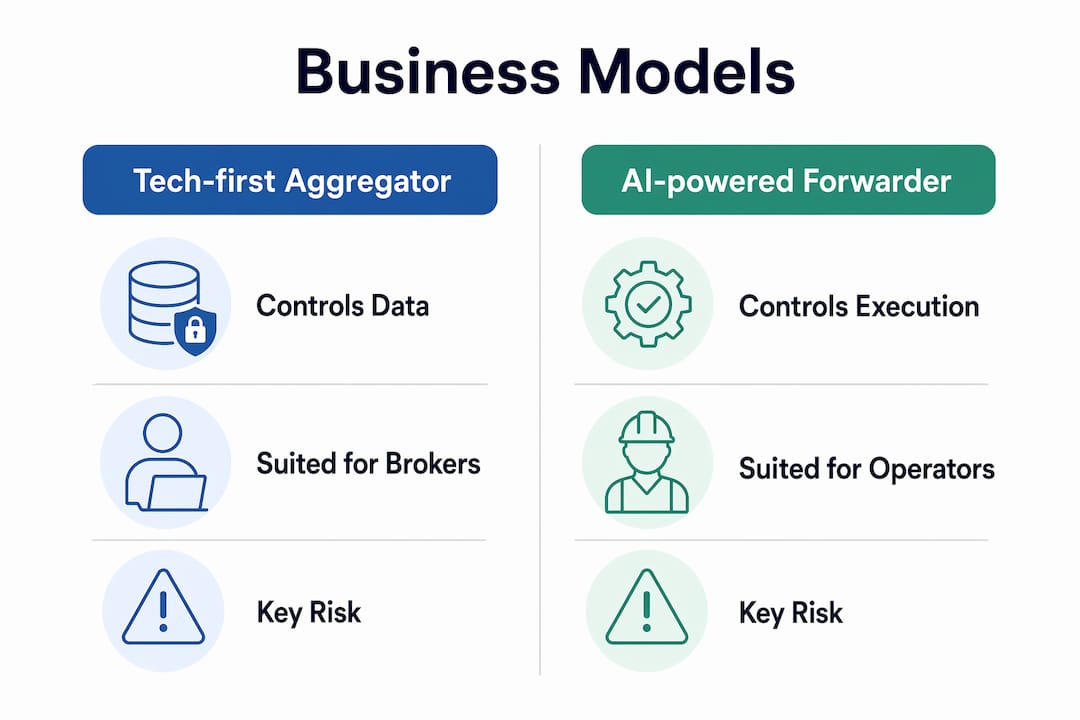
| Model | What it controls | Best suited for | Key risk |
|---|---|---|---|
| Tech-first aggregator | Data and rate visibility | Price-sensitive shippers with stable lanes | Limited control over execution quality |
| AI-powered digital forwarder | Full workflow and execution | Complex, high-volume international trade | Higher cost, deeper integration required |
| Traditional forwarder with digital tools | Partial automation of existing processes | Businesses transitioning from manual workflows | Inconsistent digitization depth |
The human role in forwarding is also shifting. AI shifts forwarder roles away from repetitive data tasks and toward relationship management, exception handling, and strategic advising. This is not a story about replacing people. It is a story about redeploying them where they add more value.
Industry consolidation is accelerating this bifurcation. Larger digital forwarders are acquiring niche specialists to expand trade lane coverage, while smaller players are carving out defensible positions in specific verticals like pharma cold chain or oversized cargo. The strategic battleground is shifting toward controlling data and decision-making layers, not just providing shipment visibility. Forwarders that own their workflows hold a durable competitive advantage over those that simply resell carrier capacity with a digital interface on top.
Pro Tip: Ask any prospective forwarder directly: “Do you own the execution, or do you aggregate third-party capacity?” The answer tells you exactly how much control they have when a shipment goes wrong.
What should businesses consider when choosing a digital freight forwarder?
Selecting a digital forwarder on price alone is one of the most common and costly mistakes in international trade. Choosing a forwarder requires evaluating trade lane expertise, technology capabilities, communication transparency, and crisis management capacity as primary criteria. Price is a secondary filter, not the first one.
A structured evaluation process produces better outcomes. Use this sequence:
- Assess trade lane expertise. A forwarder with deep experience on your specific lanes, say, U.S. to Vietnam or Germany to Brazil, will have carrier relationships and regulatory knowledge that a generalist cannot replicate.
- Evaluate technology integration. Does the platform connect to your ERP or TMS via API? Can it push automated status updates to your operations team? Freight forwarding software that requires manual data re-entry defeats the purpose of going digital.
- Test communication transparency. Request a demo of their tracking portal. Real-time shipment tracking and digital document management are baseline expectations, not premium features, in 2026.
- Probe crisis management protocols. Ask for a specific example of how they handled a port congestion event or customs hold in the past 12 months. Vague answers indicate weak operational depth.
- Consider forwarder specialization. A specialist in your commodity type, whether that is perishables, hazardous materials, or high-value electronics, will navigate compliance requirements faster than a generalist.
- Plan for multi-forwarder risk management. Relying on a single forwarder for all lanes creates concentration risk. Maintaining two or three vetted digital partners across different trade lanes protects against service failures.
For a detailed breakdown of how to choose a freight forwarder that fits your specific trade profile, Worldwideexpress has published a practical guide covering each evaluation step.
Pro Tip: Run a parallel shipment test before committing to a new digital forwarder. Send the same shipment type through your existing provider and the new candidate simultaneously. The operational comparison reveals more than any sales presentation.
What challenges and risks does the digital freight forwarding market face?
The market’s growth numbers are impressive, but the adoption gap inside the industry is striking. Only 23% of freight forwarders have digitized at least 75% of their core processes. That means the majority of forwarders still rely heavily on manual workflows for tasks like rate quoting, document handling, and status updates.
That gap creates direct risk for shippers. Manual processes introduce delays and errors that compound quickly in volatile rate environments. A forwarder using spreadsheets and email to manage bookings cannot respond to a sudden rate spike or carrier capacity cut with the speed that a cloud-integrated platform can. Businesses reluctant to digitize face longer procurement cycles, higher error rates, and reduced visibility with modern carriers.
Additional challenges shaping the market include:
- Regulatory compliance complexity. Cross-border shipments involve customs regimes, sanctions screening, and documentation standards that vary by country. Digital platforms must maintain current compliance rules across dozens of jurisdictions simultaneously.
- Data interoperability. Many legacy carrier and port systems do not share data in standardized formats. Digital forwarders must build and maintain custom integrations, which is expensive and fragile.
- Competitive pressure from new entrants. Well-funded digital freight startups can undercut incumbents on price during their growth phase, compressing margins across the industry.
- Resistance to change. Traditional logistics organizations with established manual workflows face internal resistance when adopting new freight forwarding software, slowing the pace of digitization.
- Cybersecurity exposure. Platforms handling financial transactions, customs data, and carrier contracts are high-value targets. A breach can halt operations and expose shippers to regulatory liability.
The 23% digitization figure is the most telling number in the market right now. It means that for every digital leader operating at full automation, there are roughly three forwarders still processing shipments the way they did in 2005. Shippers who do not vet their forwarder’s actual digitization depth are accepting operational risk they may not see until a shipment is already delayed.
Key Takeaways
The digital freight forwarding market is the fastest-growing segment in global logistics, and businesses that select forwarders based on technology depth, trade lane expertise, and execution control will outperform those that compete on price alone.
| Point | Details |
|---|---|
| Market growth is substantial | The market is projected to reach USD 118.12 billion by 2031, growing at 18.09% annually. |
| Adoption gap creates risk | Only 23% of forwarders have digitized 75% or more of their processes, leaving most shippers exposed to manual errors. |
| Two models dominate | Tech-first aggregators provide visibility; AI-powered forwarders control execution. Know which one you are hiring. |
| Selection criteria matter | Evaluate trade lane expertise, technology integration, and crisis management before comparing price. |
| Exception automation wins | Automating exception management, not just tracking, delivers the largest operational efficiency gains. |
The next frontier is not visibility. It is automated exception management.
Most of the conversation in digital freight forwarding focuses on tracking. Shippers want to know where their cargo is. That is a solved problem. The real competitive gap now sits one layer deeper: automating exception management to prevent delays before they cascade into missed delivery windows and demurrage charges.
I have watched companies invest heavily in tracking dashboards and then still lose days to manual back-and-forth when a customs hold or vessel delay triggers a re-routing decision. The visibility was there. The automated response was not. That is the gap that separates a genuinely digital forwarder from one that has simply added a portal to a manual operation.
The forwarders that will dominate this market through 2031 are the ones building decision logic into their platforms, not just data feeds. When a vessel misses a port call, the platform should automatically identify the next viable routing option, notify the shipper, and initiate rebooking without a human having to open a ticket. Forwarders combining AI with human expertise will capture more value and scale faster than those relying on either alone.
My recommendation for businesses evaluating partners right now: ask specifically about exception management workflows. How does the platform detect a delay? What happens next, automatically? If the answer involves a human manually reviewing a report, that forwarder is not as digital as their marketing suggests. The digital freight forwarding trends that matter most in 2026 are not about interface design. They are about operational intelligence built into the execution layer.
— Ian
Worldwideexpress and the shift to digital freight
Businesses moving toward digital freight forwarding need more than a platform. They need a partner with the operational depth to back it up when conditions get complicated.
Worldwideexpress provides comprehensive logistics services that span international air and ocean freight, customs brokerage, real-time shipment tracking, and compliance documentation, all integrated into a single operational framework. For businesses managing complex cross-border trade, Worldwideexpress combines the technology capabilities of a digital forwarder with the trade lane expertise and crisis management depth that pure-platform providers often lack. Whether you are shipping high-volume ocean freight or time-sensitive air cargo, Worldwideexpress builds logistics plans around your specific trade profile, not a one-size-fits-all template. Explore international freight shipping solutions to see how Worldwideexpress supports global trade at scale.
FAQ
What is digital freight forwarding?
Digital freight forwarding is the use of integrated software platforms to manage international shipping tasks including booking, tracking, customs compliance, and documentation. It replaces manual, paper-based processes with automated, real-time workflows.
How large is the digital freight forwarding market in 2026?
The market was valued at USD 42.46 billion in 2025 and is projected to reach USD 118.12 billion by 2031, growing at an 18.09% CAGR according to Mordor Intelligence.
What is the difference between a tech-first aggregator and an AI-powered digital forwarder?
A tech-first aggregator provides rate visibility and data across multiple carriers without controlling execution. An AI-powered digital forwarder owns the full workflow from booking through delivery, giving it more control over outcomes when disruptions occur.
How do I choose the right digital freight forwarder?
Evaluate trade lane expertise, technology integration depth, communication transparency, and crisis management protocols before comparing price. A forwarder with strong API integrations and documented exception management processes will outperform a cheaper but more manual alternative.
Why do only 23% of freight forwarders have high digitization rates?
Legacy systems, high integration costs, and internal resistance to change slow adoption. Most traditional forwarders have digitized customer-facing tools like tracking portals while leaving back-office processes such as rate quoting and document handling largely manual.
Recommended
- Understanding freight forwarding: a 2026 guide – Worldwide Express, Inc.
- Digital freight forwarding trends: navigate logistics smarter – Worldwide Express, Inc.
- Freight marketplace trends shaping logistics in 2025 – Worldwide Express, Inc.
- Freight Matching Platforms: Top Picks for 2026 – Worldwide Express, Inc.