TL;DR:
- A bill of lading is a legal document that functions as a receipt, a contract of carriage, and a document of title in international trade. Its type and negotiability determine cargo control, payment security, and legal risks, with order bills being negotiable and straight bills being non-negotiable. Exporters should verify documentation details with their banks to prevent shipment delays, loss of rights, or payment issues.
A bill of lading is a legal document that simultaneously serves as a receipt for goods, a contract of carriage, and a document of title in international trade. Export professionals who misidentify the right type risk delayed cargo release, rejected letters of credit, and serious financial exposure. The types of bill of lading in export are not interchangeable. Each category reflects a distinct legal status, issuer relationship, or cargo condition that directly affects payment security, cargo control, and regulatory compliance. Understanding these distinctions is the foundation of sound export documentation practice.
What are the main types of bill of lading based on negotiability?
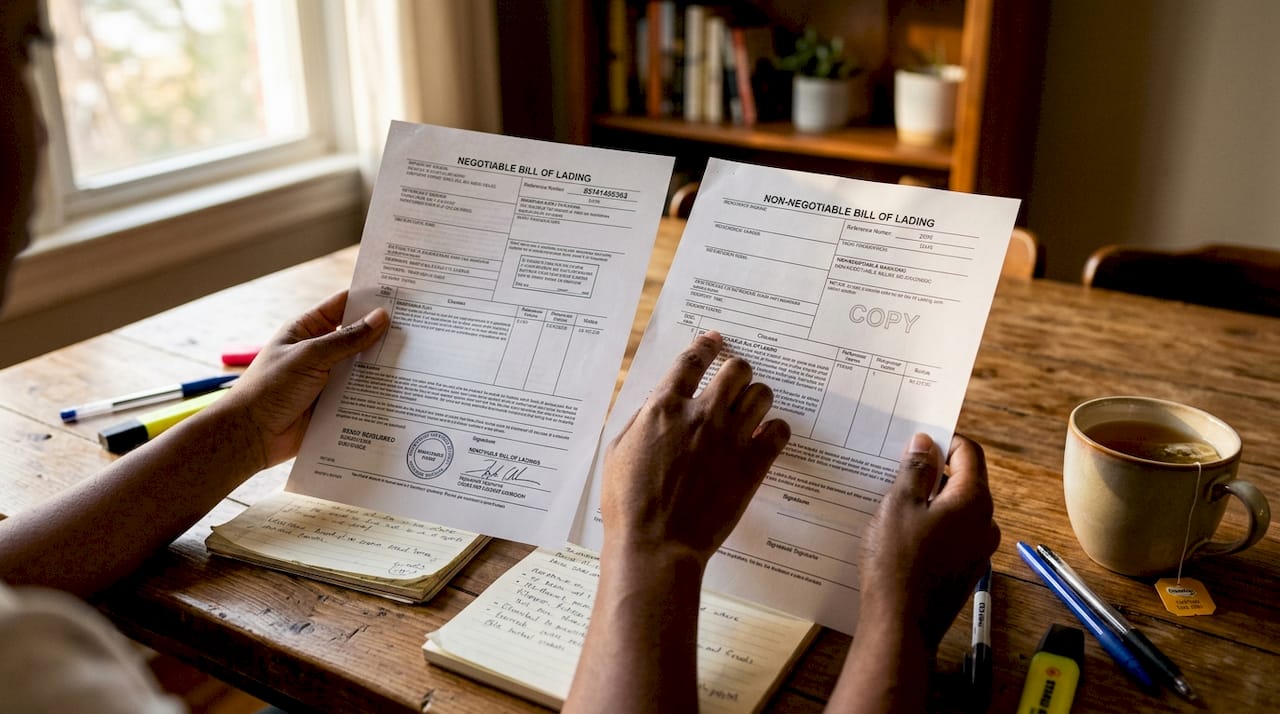
Negotiability determines who can claim cargo at the destination port. It is the single most consequential classification in export shipping documents, and getting it wrong can freeze a shipment or void a payment arrangement.
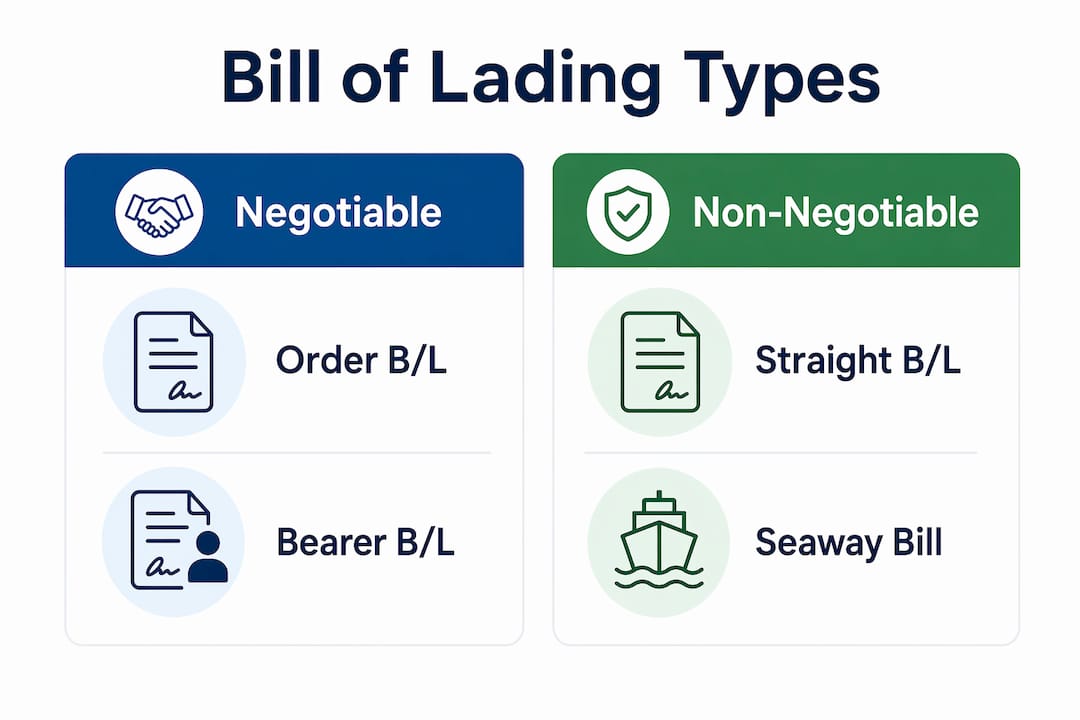
An Order Bill of Lading is negotiable. Ownership transfers by endorsement, the same way a check passes between parties. This makes it the required document for Letter of Credit (L/C) transactions, where a bank holds the bill as security until payment clears. The exporter retains cargo control until the buyer pays, which is a powerful financial safeguard on high-value or first-time transactions.
A Straight Bill of Lading names a fixed consignee and is non-negotiable. The carrier releases cargo only to that named party, with no endorsement possible. Exporters use this type for trusted buyers on open accounts, where the relationship is established and payment risk is low. It moves faster through ports because no original document needs to change hands.
A Bearer Bill of Lading transfers ownership by physical possession alone, making it extremely high risk. Modern banks generally refuse bearer bills for trade finance due to loss and theft vulnerability. This type is considered outdated in international trade and rarely appears in current commercial practice.
| Type | Negotiable | Consignee | Best Use Case |
|---|---|---|---|
| Order B/L | Yes | “To order” or named party | Letter of Credit transactions |
| Straight B/L | No | Fixed named party | Open account, trusted buyers |
| Bearer B/L | Yes (by possession) | Whoever holds it | Effectively obsolete |
Pro Tip: Always confirm with your bank whether an Order B/L must be made out “to order of” the issuing bank or the buyer. The wrong phrasing triggers a documentary discrepancy and delays payment.
How do master and house bills of lading affect export documentation?
The issuer of a bill of lading determines its legal weight and its acceptance by banks. Two bills can cover the same shipment but carry very different risks depending on who signed them.
A Master Bill of Lading (MBL) is issued by the ocean carrier or shipping line. It covers the entire container and names the freight forwarder as the shipper when the cargo is consolidated. The MBL is the carrier’s direct legal commitment to deliver goods.
A House Bill of Lading (HBL) is issued by a freight forwarder or Non-Vessel Operating Common Carrier (NVOCC) for individual shippers within a Less than Container Load (LCL) consolidation. The HBL covers individual cargo while the MBL covers the full container. This layered structure creates a risk that many exporters overlook.
The legal weight of an HBL depends entirely on the forwarder’s financial stability. If the forwarder becomes insolvent, the MBL remains with the carrier and the exporter may lose rights to the goods entirely. Banks involved in L/C transactions frequently require MBL acceptance rather than an HBL, precisely because of this counterparty risk. Exporters should confirm L/C conditions before booking with any forwarder.
- MBL: issued by the ocean carrier, covers the full container, accepted by most banks
- HBL: issued by the freight forwarder, covers one shipper’s cargo within a consolidated load
- Risk: forwarder insolvency can sever the exporter’s legal link to the goods
- Action: verify whether your L/C explicitly requires an MBL before booking LCL freight
Pro Tip: Before committing to an LCL shipment under a letter of credit, ask your bank in writing whether an HBL is acceptable. Many exporters discover this requirement only after the cargo has already sailed.
For a detailed breakdown of forwarder-issued documents, the forwarder bill guide from Worldwideexpress covers the key distinctions and risks in practical terms.
What bill of lading types are defined by cargo status and condition?
Two additional classification axes matter enormously for trade finance: when the bill is issued relative to loading, and what condition the cargo is in at the time of issue.
Received for shipment vs. shipped on board
A “Received for Shipment” bill confirms the carrier has taken custody of the goods but has not yet loaded them onto the vessel. Banks and buyers under L/C terms almost always require a “Shipped on Board” notation, which confirms the cargo is physically on the named vessel on a specific date. Without that notation, the bill does not satisfy most L/C conditions and payment will not be released.
Clean vs. claused bills
A Clean Bill of Lading certifies that goods arrived at the carrier in apparent good order and condition, with no notations about damage or defects. Banks universally require a clean bill for L/C negotiations. A Claused Bill, also called a dirty or foul bill, carries written notations from the carrier about observed damage, short count, or defective packaging. Banks reject claused bills in L/C transactions because they signal financial and insurance risk.
The clean vs. claused distinction directly affects insurance claims. A claused bill gives insurers grounds to dispute coverage, leaving the exporter exposed. Some exporters attempt to obtain a clean bill by issuing a Letter of Indemnity to the carrier, but this practice is considered fraudulent and exposes the exporter to severe legal and financial consequences.
| Bill Type | Cargo Status | Bank Acceptance | Key Risk |
|---|---|---|---|
| Received for Shipment | In custody, not loaded | Rarely accepted | L/C non-compliance |
| Shipped on Board | Loaded on named vessel | Required for L/C | Date accuracy |
| Clean B/L | Good apparent condition | Accepted | None if accurate |
| Claused B/L | Damage or defect noted | Rejected | Payment and insurance loss |
Pro Tip: Conduct a pre-shipment inspection and photograph cargo at the time of loading. A documented condition record gives you grounds to dispute any carrier notation before the bill is issued.
What specialized bill of lading types exist and when are they used?
Beyond the core categories, several specialized bill types address specific commercial and logistical scenarios. Each carries trade-offs between speed, security, and document of title function.
A Switch Bill of Lading replaces an original bill with updated commercial data. Traders use it to correct errors, reflect a change in buyer, or protect the identity of the original supplier in back-to-back transactions. The original bill must be surrendered before a switch bill is issued. Misuse of switch bills to conceal fraud is a recognized risk, so banks scrutinize them carefully.
A Seaway Bill is non-negotiable and acts only as a receipt and contract of carriage. It does not function as a document of title, which means the carrier releases cargo to the named consignee without requiring an original document. This speeds up release significantly and suits shipments to trusted buyers who have paid in advance. The trade-off is that the exporter surrenders cargo control the moment the bill is issued.
A Telex Release achieves a similar outcome through a different process. The shipper surrenders the original negotiable bill to the carrier at origin, and the carrier instructs its destination agent to release cargo without a physical document. It adds an administrative step compared to a Seaway Bill and can cause delays if the instruction is mishandled or lost.
A Through Bill of Lading, also called a Multimodal Bill, covers cargo moving across multiple transport modes under a single contract. An exporter shipping from a factory in the U.S. Midwest to a buyer in Southeast Asia might use a through bill that covers truck, ocean, and inland rail under one document. This reduces paperwork and clarifies liability across the entire journey.
Key use cases by type:
- Switch B/L: back-to-back trades, supplier identity protection, commercial corrections
- Seaway Bill: advance payment transactions, trusted buyers, high-volume repeat shipments
- Telex Release: when original negotiable B/L has already been issued and physical transfer is impractical
- Through/Multimodal B/L: complex routes involving two or more transport modes
Key Takeaways
Selecting the correct bill of lading type is a legal and financial decision, not an administrative formality, and the wrong choice can block payment or forfeit cargo rights entirely.
| Point | Details |
|---|---|
| Negotiability drives payment security | Order B/Ls protect exporters in L/C transactions; straight B/Ls suit trusted open-account buyers. |
| HBL carries forwarder risk | If your forwarder becomes insolvent, an HBL may not protect your cargo rights. |
| Clean bills are non-negotiable for L/C | Banks reject claused bills; control cargo condition at loading to avoid costly notations. |
| Specialized types trade speed for control | Seaway bills and telex releases speed release but remove document of title protection. |
| Shipped on Board notation is required | Most L/C terms reject “Received for Shipment” bills; confirm the notation before cargo sails. |
What I’ve learned after years of watching exporters get this wrong
The most expensive mistake I see export professionals make is treating the bill of lading as a paperwork formality rather than a legal instrument. The document type you choose determines who controls the cargo, who gets paid, and who bears the loss if something goes wrong.
The HBL versus MBL confusion causes more shipment holds than almost any other documentation error. Exporters book LCL freight, receive an HBL from their forwarder, and then discover their bank will not accept it under the L/C terms. The cargo is already at sea. The options at that point are expensive and slow. The fix is a five-minute conversation with your bank before booking, not a frantic call after departure.
The clean bill issue is equally preventable. Carriers issue claused notations when packaging is visibly damaged or counts are short at the time of loading. Exporters who invest in proper packaging and pre-shipment inspection almost never face this problem. Those who cut corners on packaging to save money often spend far more resolving the documentary fallout.
My honest recommendation: treat your bill of lading selection as part of the sales contract negotiation, not as an afterthought at the freight booking stage. The type of bill, the consignee field, the notify party, and the “to order” language all need to match your payment terms exactly. A freight forwarder with genuine documentation expertise, not just rate competitiveness, is worth the premium.
— Ian
How Worldwideexpress supports exporters with documentation accuracy
Export documentation errors cost businesses time, money, and buyer relationships. Worldwideexpress brings deep expertise in managing the full documentation lifecycle, from selecting the correct bill of lading type to coordinating MBL and HBL flows in consolidated shipments.
Worldwideexpress handles customs brokerage, freight forwarding, and cargo insurance under one roof, which means your bill of lading, commercial invoice, and customs filings stay aligned from origin to destination. For exporters managing L/C transactions, the team understands exactly what banks require and how to structure documentation to avoid discrepancies. Explore Worldwideexpress’s full range of international freight shipping services to see how expert documentation support protects your shipments and your payment terms. For a broader view of available tools and resources, the logistics services page is the right starting point.
FAQ
What is a bill of lading in export?
A bill of lading is a legal document issued by a carrier that serves as a receipt for goods, a contract of carriage, and a document of title. It governs cargo release and is required for most international trade transactions.
What is the difference between a negotiable and non-negotiable bill of lading?
A negotiable bill (Order B/L) allows ownership transfer by endorsement and is required for letter of credit transactions. A non-negotiable bill (Straight B/L) restricts delivery to a named consignee and suits open-account shipments with trusted buyers.
Why do banks reject claused bills of lading?
Banks reject claused bills in letter of credit negotiations because notations about cargo damage or defects signal financial and insurance risk. A clean bill certifying good apparent condition is required for L/C payment release.
When should an exporter use a house bill of lading?
An HBL is appropriate for LCL consolidations where a letter of credit is not involved. When a letter of credit is in play, exporters must confirm with their bank whether an HBL is acceptable or whether an MBL is required.
What is a switch bill of lading used for?
A switch bill of lading replaces an original bill to reflect updated commercial data, such as a change in buyer or corrections to shipment details. The original bill must be surrendered before the switch bill is issued.
Recommended
- 7 Key Types of Bill of Lading Explained for Exporters – Worldwide Express, Inc.
- Bill of lading legalities: essential 2026 guide – Worldwide Express, Inc.
- How to Read a Bill of Lading: A Step-by-Step Guide – Worldwide Express, Inc.
- Bill of Lading Types: Cut Shipping Errors by 30% in 2026 – Worldwide Express, Inc.