TL;DR:
- Express shipping guarantees delivery within 1 to 3 business days using priority handling and dedicated transport. It is ideal for urgent shipments like legal documents, high-value goods, and time-sensitive inventory replenishment. Cost factors include distance, weight, delivery speed, and customs clearance delays for international shipments.
Express shipping is defined as a premium delivery service that guarantees package arrival within 1–3 business days domestically, prioritizing speed and handling above all else. Standard ground services take 5–8 business days by comparison, making express the clear choice when time is the constraint. Services like USPS Priority Mail Express and FedEx Priority Overnight represent the industry benchmark for guaranteed delivery windows. For individuals and businesses managing urgent shipments, understanding how express delivery works, what it costs, and when to use it is the difference between a missed deadline and a satisfied customer.
How does express shipping work?
Express shipping works by pulling packages out of the standard logistics queue and routing them through priority sorting facilities with fewer handling touchpoints. Fewer touches mean less time in transit and a lower risk of damage or loss. That operational difference is what separates express from standard ground delivery at a fundamental level.

Once a package enters the express network, it moves through a dedicated chain of custody. Carriers use real-time GPS tracking at every checkpoint, and many services include insurance coverage up to $50,000 for high-value shipments. That level of security is rarely available with standard shipping tiers.
Air transport is the backbone of most domestic express services. Road transport fills the final mile, but the long-haul leg moves by air to compress transit time. This combination is what makes next-business-day delivery physically possible across long distances.
Cut-off times are the most misunderstood part of the process. Orders placed after daily cut-offs start processing the next business day, which shifts the entire delivery clock by 24 hours. A package dropped off at 6:00 PM when the cut-off is 5:00 PM will not arrive on the schedule you expect.
Key operational features of express shipping include:
- Priority sorting: Packages bypass standard queues and move through expedited facilities.
- Dedicated air and road transport: Air handles the long haul; road covers the final mile.
- Real-time tracking: GPS updates at every checkpoint give full visibility.
- Money-back guarantees: Most carriers offer refunds if the guaranteed window is missed.
- Enhanced insurance: Coverage up to $50,000 protects high-value cargo.
Pro Tip: Always confirm the carrier’s daily cut-off time before booking express shipping. Missing it by even one minute adds a full business day to your delivery window.
What are the types of express shipping services?
Express shipping is not a single product. It is a category of services with meaningfully different speed tiers, and choosing the wrong tier is a common and costly mistake.
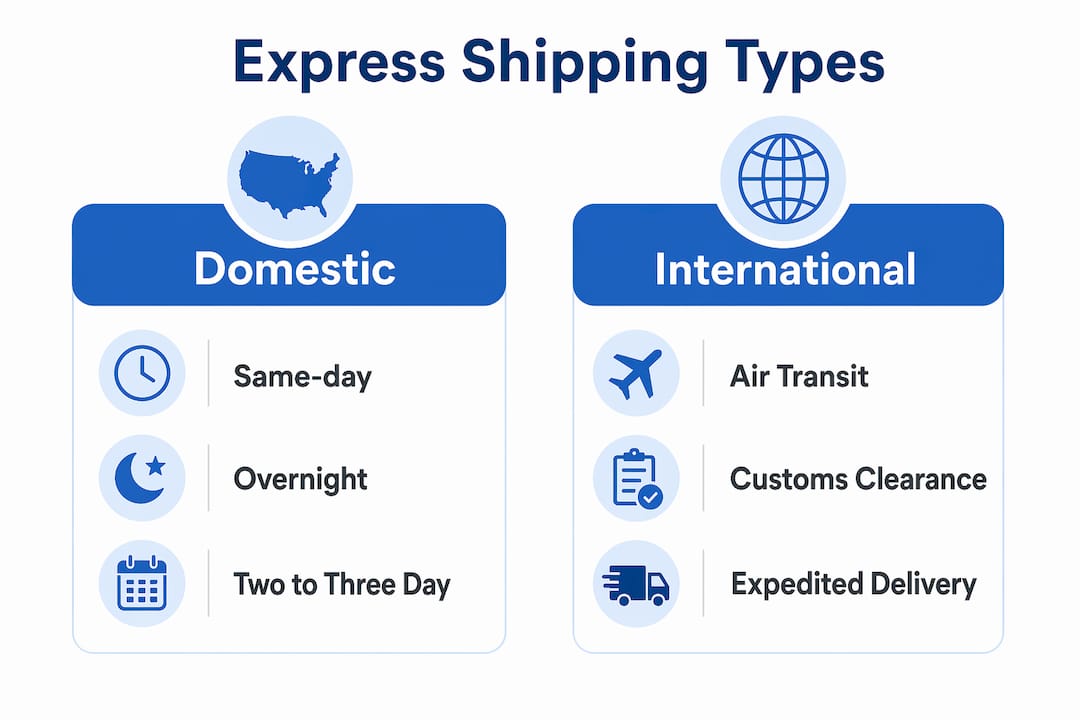
Same-day delivery
Same-day delivery is the fastest option available, typically completing within hours of pickup. Availability is limited to metropolitan areas where carriers maintain local fulfillment infrastructure. Cost is the highest of any tier, and it is best reserved for genuine emergencies: a legal document that must reach a courthouse, a medical device needed at a hospital, or a replacement part that stops a production line.
Overnight delivery
Overnight delivery is the most widely used express tier for businesses. FedEx Priority Overnight guarantees arrival by 10:30 AM the next business day, while FedEx First Overnight pushes that to 8:00 AM for select ZIP codes. USPS Priority Mail Express offers overnight delivery to most domestic addresses, with starting prices around $33. This tier works well for contracts, samples, and any shipment where 24 hours is the hard deadline.
Two to three day express
Two to three day express delivery sits between overnight and standard ground. It costs less than overnight but still guarantees delivery within a defined window. This tier is the most practical choice for e-commerce sellers who need speed without absorbing overnight premiums on every order.
International express shipping
International express shipping adds customs clearance to the equation. Air transit between countries can be completed in 24–48 hours, but customs clearance is the major bottleneck that turns a two-day shipment into a five-day one. Inaccurate invoices, missing documentation, or random inspections each add days. For cross-border shipments, the express label on the carrier side means little if the paperwork is not airtight. Worldwideexpress specializes in expedited international shipping precisely because customs compliance is where most express timelines break down.
| Service tier | Typical delivery window | Best use case |
|---|---|---|
| Same-day | Hours | Medical, legal, production emergencies |
| Overnight | Next business day by 10:30 AM | Contracts, samples, urgent B2B orders |
| 2–3 day express | 2–3 business days | E-commerce, time-sensitive retail |
| International express | 2–5 business days (customs dependent) | Cross-border urgent cargo |
What factors affect express shipping costs in 2026?
Express shipping rates increased an average of 5.9% in 2026 across major carriers. That increase compounds on an already premium price point, making cost management a real concern for high-volume shippers.
Four variables drive the final price of any express shipment. Distance is the most obvious: a cross-country overnight shipment costs significantly more than a regional one. Package weight and dimensional weight (the larger of actual weight versus volume-based weight) determine the billable weight. Delivery speed multiplies the base rate, with same-day premiums running several times higher than two-day rates. Declared value also affects cost when enhanced insurance is added.
USPS Priority Mail Express starts around $33 for lighter domestic shipments, making it one of the more accessible overnight options. Enterprise-level shippers negotiating volume contracts with carriers can reduce per-shipment costs, but those rates are not publicly listed and vary by account.
Pro Tip: Calculate dimensional weight before booking. Carriers charge whichever is higher, actual or dimensional weight, and a large but light box can cost far more than its physical weight suggests.
Heavy reliance on express shipping can erode profit margins for businesses that absorb the cost rather than passing it to customers. The smarter approach is to reserve express tiers for shipments where the business cost of delay exceeds the shipping premium. For everything else, reducing shipping costs through tiered carrier agreements and route optimization keeps margins intact.
Who benefits most from express shipping?
Express shipping delivers the most value in situations where the cost of delay is measurable and real. That covers a wider range of scenarios than most shippers initially assume.
Individuals with urgent personal needs represent one clear group. Legal documents with court deadlines, prescription medications, and replacement parts for essential home equipment all qualify. For these shipments, the premium is not optional. It is the only viable choice.
Businesses benefit in several distinct ways:
- Inventory recovery: A stockout at a retail location costs sales every hour it continues. Express replenishment stops the bleeding faster than any other method.
- Customer retention: E-commerce sellers who offer express options at checkout convert more buyers and reduce cart abandonment, particularly for gift purchases near holidays.
- High-value cargo: Jewelry, electronics, and pharmaceutical products benefit from chain of custody protocols and enhanced insurance that standard shipping does not provide.
- Perishable goods: Food, biologics, and temperature-sensitive materials require fast transit to arrive in usable condition.
- B2B time-sensitive orders: Manufacturing components, trade show materials, and signed contracts all carry hard deadlines that standard ground cannot reliably meet.
The risk of overusing express shipping is real. Businesses that default to express for routine shipments pay a premium that compounds quickly across thousands of orders. The best practice is to build a tiered shipping policy: express for defined urgent categories, standard for everything else. Worldwideexpress helps businesses build those policies as part of broader logistics services that match speed requirements to cost constraints.
Key Takeaways
Express shipping is the most reliable choice for urgent domestic and international shipments, but its value depends entirely on matching the right service tier to the actual deadline and cost tolerance.
| Point | Details |
|---|---|
| Delivery speed | Express shipping guarantees domestic delivery in 1–3 business days vs. 5–8 for standard ground. |
| Cut-off times matter | Orders placed after daily cut-offs shift the delivery clock by a full business day. |
| Cost drivers in 2026 | Rates rose 5.9% in 2026; distance, weight, speed, and declared value all affect final price. |
| International complexity | Customs clearance, not air transit, is the primary cause of delays in international express. |
| Strategic use | Reserve express tiers for shipments where the cost of delay exceeds the shipping premium. |
The case for using express shipping less often than you think
There is a counterintuitive truth that most logistics guides skip: express shipping is most valuable when you use it sparingly. I have seen businesses treat overnight delivery as a default setting, and the margin impact is brutal. A $33 overnight surcharge on a $40 product order is not a shipping cost. It is a loss.
The carriers have done an excellent job marketing guaranteed delivery windows as a universal need. They are not. The real question to ask before booking express is simple: what does it cost the business if this shipment arrives in five days instead of one? If the answer is “nothing significant,” standard ground is the right call.
Where express shipping genuinely earns its premium is in three scenarios. First, when a missed deadline has a contractual or legal consequence. Second, when the shipment contains a high-value item that benefits from enhanced tracking and insurance coverage up to $50,000. Third, when a stockout or production delay is actively costing money by the hour.
The other thing most shippers underestimate is the customs variable on international express. I have watched companies pay for priority air freight and then lose four days at the border because an invoice had the wrong harmonized tariff code. The express label on the carrier side means nothing if the documentation is wrong. Getting customs right is not a nice-to-have for international express. It is the whole game.
— Ian
Worldwideexpress and your time-sensitive shipments
Time-sensitive shipments require more than a fast carrier. They require a logistics partner who understands priority handling, customs compliance, and the cost of getting it wrong.
Worldwideexpress provides freight forwarding, customs brokerage, and expedited shipping solutions built for businesses that cannot afford delays. Whether you are managing a domestic overnight shipment or a cross-border urgent cargo move, Worldwideexpress brings the documentation expertise and carrier relationships that keep express timelines intact. Explore the freight forwarding guide to understand how professional logistics management reduces risk on every express shipment. For businesses navigating tariff volatility in 2026, having a knowledgeable partner is not optional. It is the margin protection your operation needs.
FAQ
What is express shipping, exactly?
Express shipping is a premium delivery service that guarantees domestic package arrival within 1–3 business days through priority handling, dedicated transport, and real-time tracking. It is faster and more secure than standard ground shipping.
How fast is express shipping compared to standard delivery?
Standard ground shipping takes 5–8 business days domestically, while express shipping delivers in 1–3 business days. Overnight express services like FedEx Priority Overnight guarantee arrival by 10:30 AM the next business day.
Why does international express shipping sometimes take longer than expected?
Customs clearance is the primary cause of delays in international express shipping. Inaccurate invoices or random inspections can add multiple days to transit time, even when air freight moves quickly between countries.
How much does express shipping cost in 2026?
Express shipping rates increased an average of 5.9% in 2026. USPS Priority Mail Express starts around $33 for lighter domestic shipments, with costs rising based on distance, package weight, and delivery speed.
When should a business choose express shipping over standard options?
A business should choose express shipping when the cost of a delayed delivery, such as a stockout, missed contract deadline, or spoiled perishable, exceeds the premium price of the express service.
Recommended
- Express Shipping for E-Commerce: A 2026 Business Guide – Worldwide Express, Inc.
- Top International Shipping Solutions Reviewed – 2025 – Worldwide Express, Inc.
- How to Reduce Shipping Costs: Effective Strategies for 2025 – Worldwide Express, Inc.
- Worldwide Express Shipping and Related Tools for Efficient