TL;DR:
- A copy non-negotiable bill of lading names a fixed consignee and cannot transfer cargo ownership. It is used mainly for prepaid and trusted transactions, where identity verification replaces document surrender. Proper handling ensures speed and prevents delays or legal issues in international shipping.
A copy non-negotiable bill of lading, formally known as a straight bill of lading (straight B/L), is a shipping document that names a fixed consignee and cannot transfer ownership of the cargo to any other party. Unlike its negotiable counterpart, this document does not function as a title instrument. The carrier delivers goods only to the named consignee, verified by identity, not by possession of the original document. Understanding the copy non negotiable bill of lading meaning is critical for import/export professionals who manage cargo release, trade finance, and cross-border compliance every day.
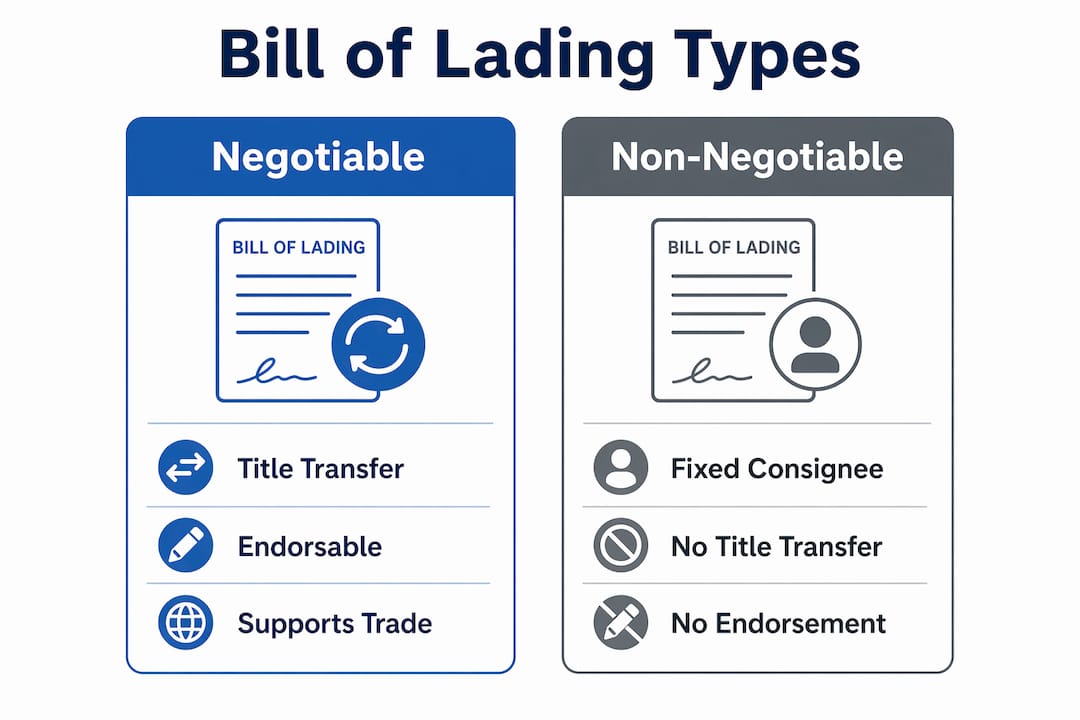
What distinguishes a non-negotiable bill of lading copy from a negotiable bill?
The core legal difference between these two bill of lading types is title transferability. A negotiable bill of lading functions as a document of title. The holder can endorse it to a third party, effectively transferring ownership of the cargo while it is still at sea. Banks use this feature to secure letters of credit, and traders use it to sell goods before they arrive at port.

A non-negotiable bill of lading names a specific consignee and cannot be endorsed or traded. Ownership stays fixed from the moment the document is issued. The carrier is legally obligated to deliver only to that named party, regardless of who physically holds a copy of the document.
The term “negotiable” confuses many logistics professionals because it sounds like it relates to price. It refers strictly to the legal ability to transfer ownership through endorsement, a concept rooted in property law, not commercial bargaining. Getting this distinction wrong can expose a shipper to serious financial and legal risk.
| Feature | Negotiable bill of lading | Non-negotiable bill of lading |
|---|---|---|
| Title transfer | Yes, by endorsement | No, fixed consignee only |
| Cargo release method | Surrender of original document | Consignee identity verification |
| Use in trade finance | Supports letters of credit | Not accepted for letters of credit |
| Risk if document lost | High, cargo can be claimed by holder | Lower, carrier verifies identity |
| Common use case | Open market commodity trades | Prepaid shipments, intercompany transfers |
Pro Tip: If your transaction involves a letter of credit, always request a negotiable bill of lading. A non-negotiable copy will not satisfy the bank’s documentary requirements and can trigger payment delays.
What are the key legal and operational implications of a non-negotiable bill of lading copy?
The legal meaning of a non-negotiable bill of lading copy shapes every step of the cargo release process. Because the document does not confer title, a copy carries no power to claim goods. Carriers strictly enforce identity verification before releasing cargo to the named consignee, and no copy, whether printed or digital, overrides that requirement.
Several operational realities follow from this structure:
- No pledge of cargo. The consignee cannot use a non-negotiable B/L copy to pledge goods as collateral to a bank or financier.
- No re-direction mid-voyage. Once issued, the shipper loses the ability to redirect the cargo to a different buyer if the original consignee defaults on payment.
- No original surrender required. The carrier releases goods based on identity, not on physical possession of the document. This speeds up port clearance significantly.
- Customs compatibility. Customs authorities in most jurisdictions accept non-negotiable B/Ls for import declarations, but professionals should verify local requirements before shipment.
- Letters of credit incompatibility. Banks operating under UCP 600 (the Uniform Customs and Practice for Documentary Credits, published by the International Chamber of Commerce) will not accept a non-negotiable B/L as a compliant transport document for credit settlement.
The most dangerous pitfall is treating a copy as equivalent to an original. Incorrectly assuming a copy has the same power as an original causes shipment delays and carrier refusal. Carriers are trained to reject delivery requests that rely on copies alone, precisely to prevent fraud and cargo theft.
Pro Tip: Always confirm with your carrier in writing whether the B/L issued is negotiable or non-negotiable before the vessel departs. Changing document type after departure is costly and sometimes impossible.
How do non-negotiable bill of lading copies affect international logistics and supply chain processes?
Non-negotiable B/L copies play a specific and valuable role in global trade, but only when matched to the right transaction type. The document works best when payment risk is already managed and the trading relationship is established.
The most common scenarios where logistics professionals reach for a non-negotiable B/L are:
- Prepaid shipments. The buyer pays before the goods ship. Because payment is secured, the shipper has no need to retain title control during transit.
- Intercompany transfers. A parent company shipping goods to its own subsidiary in another country has no reason to use a negotiable instrument. Over 90% of intercompany transfers prefer non-negotiable B/Ls to avoid the cost and delay of couriering original documents.
- Open account transactions with trusted buyers. Long-term trading partners with a clean payment history often operate on open account terms. A non-negotiable B/L fits this model because it speeds release without adding document handling costs.
- Domestic and short-sea shipments. When transit times are short, the original negotiable B/L often arrives after the cargo. A non-negotiable document eliminates that timing mismatch.
The speed advantage is real. A straight B/L eliminates the need to surrender original documents, reducing delays and courier dependence. That efficiency comes at a cost, though. The shipper surrenders the ability to stop or redirect the shipment if something goes wrong with payment.
Sea Waybills represent the modern evolution of this concept. Sea Waybills are non-negotiable documents similar to straight B/Ls but enable electronic cargo release, which further accelerates logistics. Like non-negotiable B/Ls, Sea Waybills cannot be used for trade finance. The choice between the two often comes down to whether the carrier and port system support electronic release.
For professionals managing international freight shipping, the document type is not a formality. It determines who controls the cargo, how fast it clears, and what financial instruments are available to both parties.
What practical steps should logistics professionals take when handling non-negotiable B/L copies?
Proper handling of non-negotiable B/L copies prevents delays, disputes, and fraud. The document’s simplicity is deceptive. Because no original surrender is required, the process feels informal, and that informality creates risk.
Follow these practices to manage non-negotiable B/L copies correctly:
- Verify consignee identity documentation in advance. Confirm that the consignee named on the B/L matches the entity presenting identification at the port. Discrepancies, even minor ones like abbreviations in a company name, can trigger carrier refusal.
- Store copies securely and track distribution. Every copy of a non-negotiable B/L should be logged. Unauthorized copies circulating in a supply chain create confusion and potential fraud exposure.
- Never present a copy as an original. Shippers often err by treating copies as originals. Carriers enforce identity verification precisely because the document type does not require original surrender, and any attempt to substitute a copy for an original in a negotiable context is a serious compliance failure.
- Communicate document type clearly to customs brokers. Your customs broker needs to know whether the B/L is negotiable or non-negotiable before filing the import entry. The bill of lading legal meaning affects how the entry is structured and what supporting documents are required.
- Coordinate with your finance team on payment terms. Non-negotiable B/Ls are appropriate only when payment is secured before or at shipment. If your finance team is still negotiating credit terms, the document type may need to change.
Pro Tip: Build a simple checklist into your pre-shipment workflow: confirm payment status, confirm B/L type, confirm consignee details match exactly. Three checks prevent the majority of non-negotiable B/L disputes.
Shipping risk mitigation starts at the document level. The non-negotiable B/L is a powerful tool when used correctly and a liability when misapplied.
Key Takeaways
A non-negotiable bill of lading names a fixed consignee, transfers no title, and requires identity verification for cargo release, making document type selection a critical decision in every international shipment.
| Point | Details |
|---|---|
| Fixed consignee, no title transfer | A non-negotiable B/L delivers cargo only to the named party; ownership cannot be endorsed to others. |
| Not valid for letters of credit | Banks under UCP 600 require negotiable B/Ls; non-negotiable copies will not satisfy documentary credit requirements. |
| Speeds cargo release | No original document surrender is needed; the carrier verifies consignee identity instead, reducing port delays. |
| Best for trusted, prepaid transactions | Use non-negotiable B/Ls for intercompany transfers, prepaid shipments, and open account trades with established buyers. |
| Copies carry no delivery rights | A copy of a non-negotiable B/L does not confer automatic delivery; carriers strictly enforce identity verification to prevent fraud. |
Why the “non-negotiable” label deserves more respect than it gets
The phrase “non-negotiable” makes this document sound like a lesser option. In practice, it is simply a different tool, and professionals who treat it as a default without thinking through the transaction often pay for that assumption.
I have seen shipments stall at port because a consignee’s legal name on the B/L differed by one word from their customs registration. The carrier would not release. The fix took four days and cost more in demurrage than the courier fees a negotiable B/L would have required. The non-negotiable B/L was the right choice for that transaction type, but the execution was sloppy.
The trend toward electronic documents, including electronic Sea Waybills and digital B/L platforms, is accelerating. These tools reduce physical document handling and speed release further. But they do not change the underlying legal framework. A non-negotiable document, whether paper or digital, still fixes the consignee and still excludes trade finance use. Professionals who assume digital means flexible are setting themselves up for the same old problems in a faster format.
My view is that the document strategy should follow the payment strategy, not the other way around. Decide how you are getting paid, then choose the B/L type that matches that risk profile. That sequence prevents most of the disputes I have seen in cross-border logistics.
— Ian
Worldwideexpress and your bill of lading documentation
Choosing the right bill of lading type is one of the most consequential decisions in any international shipment. Worldwideexpress brings deep expertise in freight forwarding, customs brokerage, and documentation compliance to help businesses get it right the first time.
Worldwideexpress supports import/export professionals with end-to-end guidance on ocean freight forwarding processes, including B/L selection, consignee verification, and customs coordination. Whether you are managing a single prepaid shipment or a high-volume intercompany transfer program, the team at Worldwideexpress can help you match your document type to your payment terms and trade risk. Reach out to Worldwideexpress for a tailored logistics consultation and get your documentation strategy right from the start.
FAQ
What does “copy non-negotiable bill of lading” mean?
A copy non-negotiable bill of lading, also called a straight B/L, is a transport document that names a fixed consignee and cannot transfer cargo ownership to another party. The carrier releases goods based on identity verification, not document possession.
Can a copy of a non-negotiable bill of lading be used to claim cargo?
No. A copy of a non-negotiable B/L does not confer delivery rights. Carriers require identity verification of the named consignee and will refuse release based on a copy alone.
What is the difference between a negotiable and non-negotiable bill of lading?
A negotiable B/L functions as a document of title that can be endorsed and transferred to third parties, supporting trade finance instruments like letters of credit. A non-negotiable B/L fixes the consignee and cannot be transferred or used for trade finance.
When should a shipper use a non-negotiable bill of lading?
Non-negotiable B/Ls are appropriate for prepaid shipments, intercompany transfers, and open account transactions with trusted buyers where payment is secured before or at the time of shipment.
Are Sea Waybills the same as non-negotiable bills of lading?
Sea Waybills are non-negotiable documents that function similarly to straight B/Ls but support electronic cargo release. Like non-negotiable B/Ls, they cannot be used for letters of credit or trade finance.
Recommended
- Understanding Bill of Lading Types in Trade Transactions – Worldwide Express, Inc.
- Bill of lading legalities: essential 2026 guide – Worldwide Express, Inc.
- 7 Key Types of Bill of Lading Explained for Exporters – Worldwide Express, Inc.
- Example of Bill of Lading – Key Elements and Legal Impact – Worldwide Express, Inc.