TL;DR:
- International logistics involves managing cross-border shipment flows, customs compliance, and transportation planning to ensure efficient delivery. Businesses rely on freight forwarders, customs brokers, and digital tools to navigate tariffs, compliance, risk, and network optimization effectively. Building strong partnerships, proactive risk management, and integrating AI-enabled technologies are key to success in 2026.
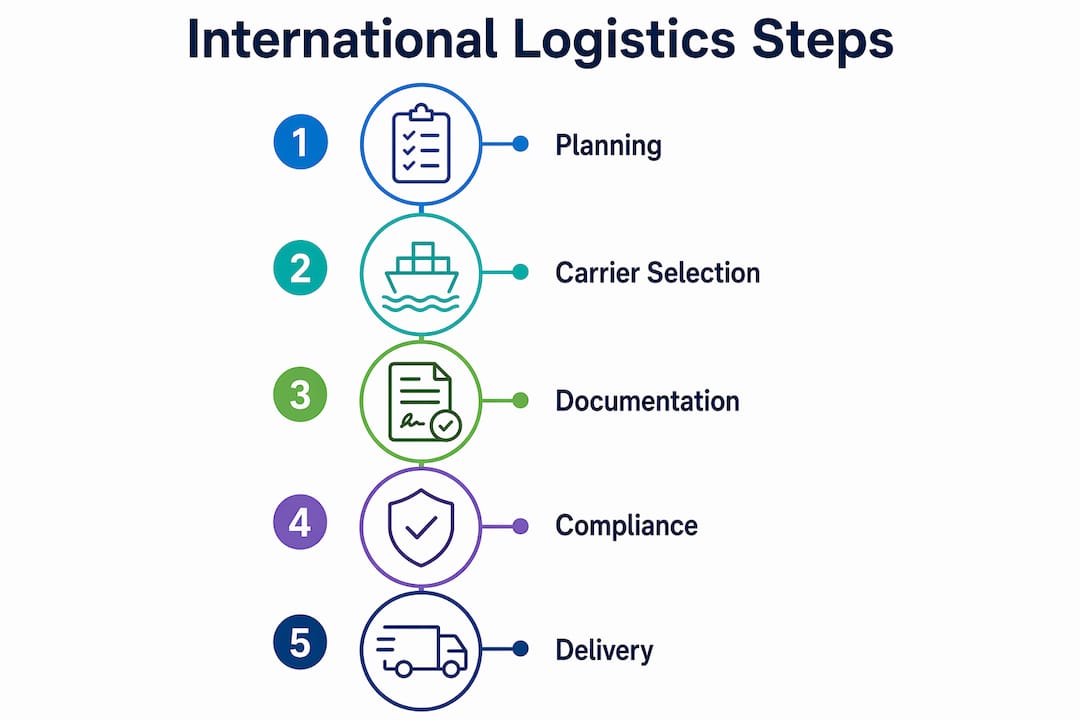
International logistics is defined as the coordinated management of cross-border shipment flows, customs compliance, transportation planning, and risk mitigation to move goods between countries efficiently. Formally called global freight management or international supply chain management, the discipline covers far more than booking a carrier. It spans Electronic Export Information filing, tariff classification, cargo insurance, and multi-modal route design. For businesses engaged in cross-border trade, getting these elements right is the difference between predictable delivery and costly border delays. This guide covers the strategies, compliance requirements, and digital tools that define effective international logistics in 2026.
What are the key components of international logistics?
Freight forwarding services sit at the center of every successful international shipment. A freight forwarder coordinates transportation across multiple carriers and modes, handles documentation, and acts as the operational link between shipper and destination. Customs brokerage complements that role by managing tariff classification, duty payment, and regulatory clearance at the border. Together, these two functions form the operational backbone of any cross-border freight program.
Transportation mode selection shapes cost, speed, and risk exposure. The five primary modes are:
- Air freight: Fastest transit, highest cost per kilogram. Best for time-sensitive or high-value goods.
- Ocean freight: Lowest cost for large volumes. Full Container Load (FCL) and Less than Container Load (LCL) options suit different shipment sizes.
- Rail: Competitive for overland routes, particularly trans-Eurasian corridors connecting Asia and Europe.
- Trucking: The final-mile connector for most shipments, and the primary mode for cross-border freight within North America.
- Intermodal combinations: Blending ocean, rail, and truck reduces cost while maintaining reasonable transit windows.
Route selection and lead time planning require more precision than most businesses apply. Carrier partnerships with defined service levels outperform spot-market buying in both reliability and cost predictability. Strategic partnerships with freight forwarders who specialize in your product category reduce regulatory risk more effectively than chasing the lowest base freight rate. That finding reflects a structural truth: a forwarder who knows your commodity’s HS code history and import restrictions will resolve customs holds faster than a generalist who won the bid on price.
Sophisticated logistics contracts define service level agreements (SLAs), documentation responsibilities, and force majeure clauses to protect against lane instability and carrier disputes. Without these terms in writing, businesses have limited recourse when port congestion or weather events disrupt a shipment.

Pro Tip: Request a sample contract from any freight forwarder before signing. Verify it specifies escalation windows, cargo liability limits, and the process for disputed charges. Vague contracts cost money when disruptions hit.
How do tariff changes and compliance requirements impact international logistics?
Tariff volatility has become one of the most significant cost pressures in global shipping solutions planning. Sourcing costs for many U.S. companies increased by more than 25% in the past year, and 55% of those companies plan to pass those increases on through price hikes. That figure signals a market-wide repricing of cross-border goods, not a temporary adjustment.
Businesses are responding with three primary mitigation strategies, per Q1 2026 data:
| Mitigation Strategy | Share of U.S. Businesses Using It |
|---|---|
| Changing sourcing patterns | 65% |
| Renegotiating supplier contracts | 57% |
| Nearshoring operations | 51% |
Each strategy carries trade-offs. Nearshoring reduces tariff exposure but requires new supplier qualification and logistics network redesign. Sourcing diversification spreads risk but adds complexity to customs documentation and country-of-origin tracking. Supplier renegotiation is the fastest lever but depends on contract terms and supplier leverage.
U.S. export compliance adds another layer of obligation. U.S. export shipments must file Electronic Export Information (EEI) via the Automated Export System when the shipment value exceeds $2,500 per Schedule B number, or when a validated export license is required. The U.S. Principal Party in Interest (USPPI), typically the seller or manufacturer, bears primary responsibility for accurate EEI filing. Errors or omissions carry civil penalties and can result in shipment holds. For a detailed walkthrough of the filing process, the export compliance guide from Worldwideexpress covers USPPI responsibilities and threshold rules in depth.
Pro Tip: Classify every product under its correct Schedule B number before the shipment is booked. Reclassifying at the border delays clearance and triggers scrutiny on future shipments from the same shipper.
What are the best practices for managing risks in international logistics?
Risk management in cross-border freight requires planning for the worst case, not the average case. Most businesses build lead times around average transit durations. Planning customs buffers based on historical maximum transit times is the more reliable method. If a lane’s maximum documented transit is 21 days and the average is 14, the buffer should be built around 21. That approach prevents stockouts when border congestion, weather, or inspection delays push a shipment to its outer limit.
Carrier diversification follows the same logic. A single-carrier strategy creates a single point of failure. The recommended structure is:
- Primary carrier: Your highest-volume partner with negotiated rates and defined SLAs for standard lanes.
- Secondary carrier: A qualified backup on the same routes, activated when the primary carrier has capacity issues or service failures.
- Emergency carrier: A spot-market or premium-service option for time-critical recovery shipments when both primary and secondary options fail.
- Route variety: Maintain at least two port-of-entry options per major trade lane to avoid congestion at a single gateway.
Documentation accuracy before a shipment departs is the single most effective way to avoid customs delays. Commercial invoices, packing lists, certificates of origin, and any required permits must be complete and consistent before the cargo moves. Discrepancies between the invoice value and the declared customs value are the most common trigger for holds and fines.
Contracts that specify service levels, escalation windows, and force majeure clauses provide a clear framework for managing port congestion and weather disruptions. When a strike closes a major port, a well-written contract defines who bears the cost of rerouting and how quickly the carrier must notify the shipper. Without that language, the negotiation happens in real time, under pressure, with no leverage.
Pro Tip: Build a one-page disruption response playbook for each major trade lane. List the secondary carrier contact, the alternative port of entry, and the escalation contact at your customs broker. When a disruption hits, you execute the plan instead of making decisions under pressure.
For a broader view of supply chain risk management frameworks, Worldwideexpress publishes detailed guidance on building resilience across global trade networks.
How do digital technologies and AI transform international logistics efficiency?
AI and digital tools are reshaping how businesses manage their international supply chains. AI is increasingly used to automate workflows, optimize transportation networks, and enhance warehouse operations, driving productivity gains that go beyond simple demand recovery. The practical applications include:
- Demand forecasting: AI models analyze historical shipment data, seasonal patterns, and supplier lead times to generate more accurate inventory positioning across global nodes.
- Route optimization: Algorithms evaluate carrier capacity, fuel costs, transit times, and tariff exposure to recommend the most cost-effective routing for each shipment.
- Automated documentation: Machine learning tools extract data from purchase orders and generate draft customs documents, reducing manual entry errors.
- Real-time visibility: Digital freight platforms aggregate tracking data from multiple carriers into a single interface, giving logistics teams a live view of every shipment in transit.
The logistics market is undergoing a structural reset, with supply chain fragmentation, uneven regional growth, and capacity imbalances in ocean and air freight reshaping how networks are designed. That structural shift makes digital tools less of a competitive advantage and more of a baseline requirement. Businesses that have not yet integrated real-time tracking and AI-assisted forecasting into their logistics management services are operating with a visibility gap that compounds every disruption.
Embedding AI into daily logistics workflows is the structural priority for the coming years, according to the annual State of Logistics report. The challenge is adoption. Many mid-size businesses have invested in digital freight platforms but have not integrated them with their ERP or order management systems. Disconnected data is nearly as costly as no data. The digital freight forwarding trends resource from Worldwideexpress outlines how integration between platforms and internal systems drives measurable efficiency gains.
For businesses exploring how AI specifically improves compliance and network design, the AI in international shipping analysis from Worldwideexpress is worth reviewing.
Key Takeaways
Effective international logistics requires combining freight expertise, compliance discipline, carrier diversification, and digital visibility into a single, coordinated program.
| Point | Details |
|---|---|
| Freight partnerships over price | Choose forwarders with product-category expertise to reduce regulatory risk and customs hold times. |
| EEI filing thresholds matter | File Electronic Export Information for any U.S. export exceeding $2,500 per Schedule B number. |
| Buffer with maximum transit times | Build lead times around historical maximum durations, not averages, to prevent stockouts from border delays. |
| Tariff mitigation is active work | 65% of U.S. businesses changed sourcing patterns to offset tariff increases; reactive responses cost more. |
| AI adoption is now baseline | Disconnected digital tools create visibility gaps. Integrate platforms with ERP systems to realize efficiency gains. |
What I’ve learned after years of watching businesses get international logistics wrong
The most common mistake I see is treating international logistics as a cost center to minimize rather than a capability to build. Businesses spend months negotiating a half-percent reduction in base freight rates, then lose three times that savings in a single customs hold caused by a documentation error their broker flagged six months earlier.
The KPMG 2026 Tariff Survey makes the case clearly: businesses must move from reactive tariff responses to proactively building resilient and flexible supply chains. That is not a consulting abstraction. It means having a secondary carrier qualified before you need one, having your HS codes audited before a trade policy change, and having your customs broker in the room when procurement is negotiating a new supplier contract in a new country.
Cross-department coordination is the piece most businesses underinvest in. Cross-department trade risk councils that bring Finance, Operations, Procurement, and Compliance together improve risk management by breaking the silos that let problems fall through the cracks. When compliance learns about a new sourcing country from procurement at the same time the shipment is being booked, it is already too late to do the regulatory groundwork properly.
The businesses that handle cross-border freight well share one trait: they treat their freight forwarder and customs broker as strategic partners, not vendors. They share forecasts, flag regulatory changes early, and invest in the relationship before a crisis. That posture pays off every time a port closes or a tariff rate changes overnight.
— Ian
Professional logistics support for your cross-border operations
Running a compliant, efficient international freight program requires expertise across customs brokerage, freight forwarding, trade compliance, and cargo insurance. Most businesses reach a point where the complexity of managing those functions internally outweighs the cost of working with a specialist.
Worldwideexpress provides freight forwarding and customs brokerage services designed for businesses that move goods across borders regularly. The service portfolio covers air and ocean transportation, trucking, warehousing, EEI filing support, and global shipment tracking. For businesses that need to understand their full range of options before committing, the international freight shipping guide from Worldwideexpress walks through the decision points from carrier selection to customs clearance. Working with a partner who knows your product category and your trade lanes reduces both risk and cost over time.
FAQ
What is international logistics?
International logistics is the coordinated management of cross-border shipment flows, including transportation, customs clearance, documentation, and risk management. It covers all activities required to move goods between countries efficiently and in compliance with applicable regulations.
How do I ship internationally as a business?
Businesses ship internationally by working with a licensed freight forwarder who coordinates carrier booking, documentation, and customs clearance. For U.S. exports exceeding $2,500 per Schedule B number, Electronic Export Information must be filed through the Automated Export System before the shipment departs.
What are freight forwarding services?
Freight forwarding services are third-party logistics functions where a forwarder coordinates transportation across carriers and modes, manages customs documentation, and acts as the operational link between the shipper and the destination. Forwarders do not typically own the physical transport assets they book.
How do tariffs affect international logistics planning?
Tariffs directly increase landed costs and force businesses to reconsider sourcing geography, supplier contracts, and routing. According to the KPMG 2026 Tariff Survey, sourcing costs for many U.S. companies rose more than 25% in the past year, prompting 65% of businesses to change sourcing patterns as a mitigation measure.
What is a customs buffer and why does it matter?
A customs buffer is the additional lead time built into a shipment schedule to account for potential border delays. Planning buffers based on the historical maximum transit time for a lane, rather than the average, prevents stockouts when inspections, congestion, or weather push a shipment to its outer delivery limit.
Recommended
- Global Shipping 2026: 72% Face Tariff Volatility – Worldwide Express, Inc.
- Shipping logistics explained: streamline your international trade – Worldwide Express, Inc.
- Top e-commerce shipping strategies for logistics success 2026 – Worldwide Express, Inc.
- 6 Key Trends in International Logistics for U.S. Managers – Worldwide Express, Inc.