TL;DR:
- LTL trucking consolidates shipments from multiple shippers on one trailer, offering cost savings for loads between 150 and 15,000 pounds. It involves multiple terminal transfers, which increases handling risks but reduces costs for smaller, durable freight. Shippers should choose LTL for moderate loads and FTL for full trailers or fragile goods, balancing cost and control.
Less-than-truckload (LTL) trucking is defined as a freight shipping method where multiple shippers share space on the same trailer, moving shipments that do not fill an entire truck. The industry standard for LTL freight covers shipments from 150 to 15,000 pounds, placing it squarely between parcel delivery and full truckload (FTL) shipping. For businesses moving smaller loads regularly, LTL transportation services offer a cost structure that parcel carriers simply cannot match at that weight range. Understanding how LTL freight works, what it costs, and when to use it gives shippers a real advantage in controlling logistics spend.
What does “define LTL trucking” actually mean?
LTL trucking is the practice of consolidating freight from multiple shippers onto one trailer. Each shipper pays only for the portion of the trailer their cargo occupies. The carrier fills the remaining space with other customers’ freight, spreading the fixed cost of the truck and driver across several shipments.
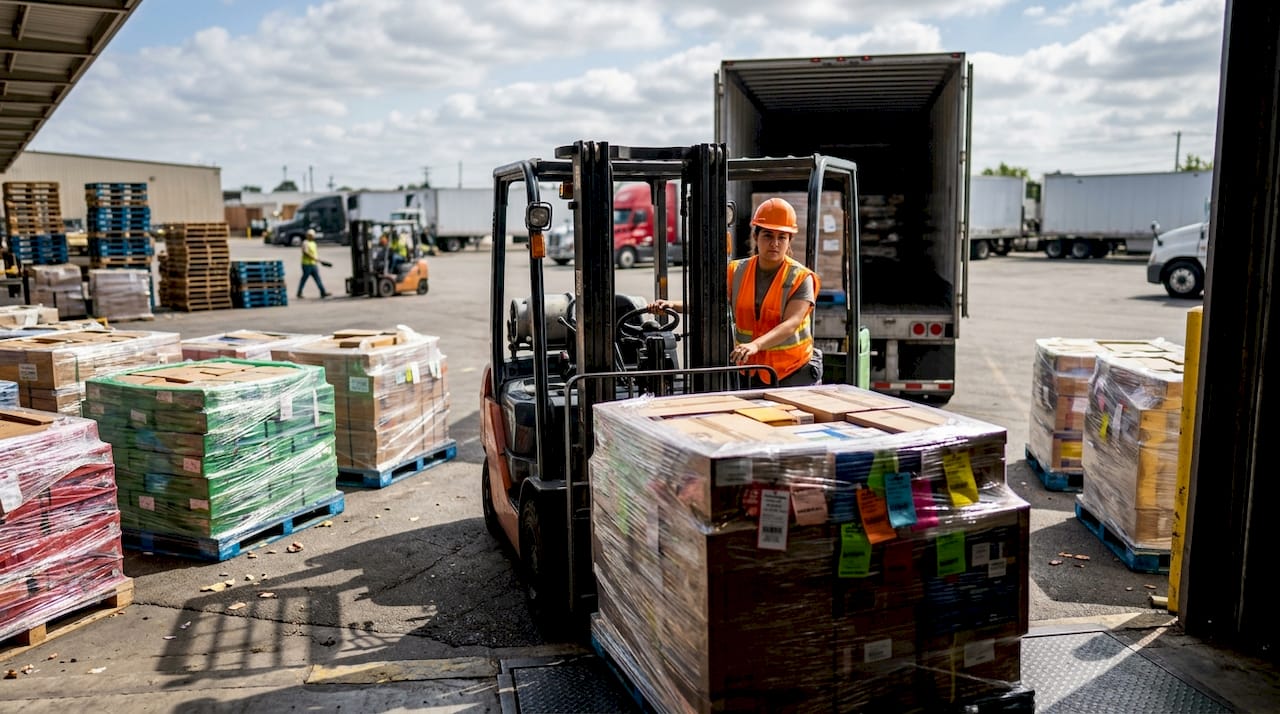
The term “less-than-truckload” is the recognized industry standard, used by carriers, freight brokers, and the Federal Motor Carrier Safety Administration (FMCSA) alike. You may also hear it called LTL freight or LTL shipping, but the underlying definition stays the same. Shipments in this category are too large for standard parcel services like UPS or FedEx Ground, yet too small to justify booking an entire trailer. That gap is exactly where LTL transportation services operate.
LTL carriers accept loose, non-palletized cargo more readily than FTL or parcel carriers do. That flexibility makes LTL a practical option for manufacturers, retailers, and distributors shipping one to six pallets at a time.
How does LTL trucking work operationally?
LTL carriers run freight through a hub-and-spoke terminal network. Understanding this structure explains both the efficiency and the complexity of LTL shipping.
Here is the typical sequence a shipment follows:
- Pickup. A local driver collects your freight from your facility and hauls it to the nearest regional terminal, sometimes called a service center.
- Inbound sort. Terminal staff unload the trailer and sort freight by destination region. Your pallet may share floor space with dozens of other shipments headed in the same direction.
- Linehaul. Sorted freight loads onto a long-haul trailer for the main leg of the journey. Carriers often use double trailers, known in the industry as “wiggle wagons,” to move high volumes between major hubs efficiently.
- Transfer terminal. For longer routes, freight may pass through one or more intermediate terminals before reaching the destination region.
- Outbound sort and delivery. A local driver at the destination terminal picks up your freight and delivers it to the final address.
Freight consolidation at terminals is what makes the economics work. Each handling point adds time, but it also allows the carrier to fill trailers to capacity, which keeps per-pound rates low for every shipper on the load.
Pro Tip: Request a transit time estimate from your carrier before booking. LTL routes with two or more terminal transfers can add one to three business days compared to direct FTL lanes.
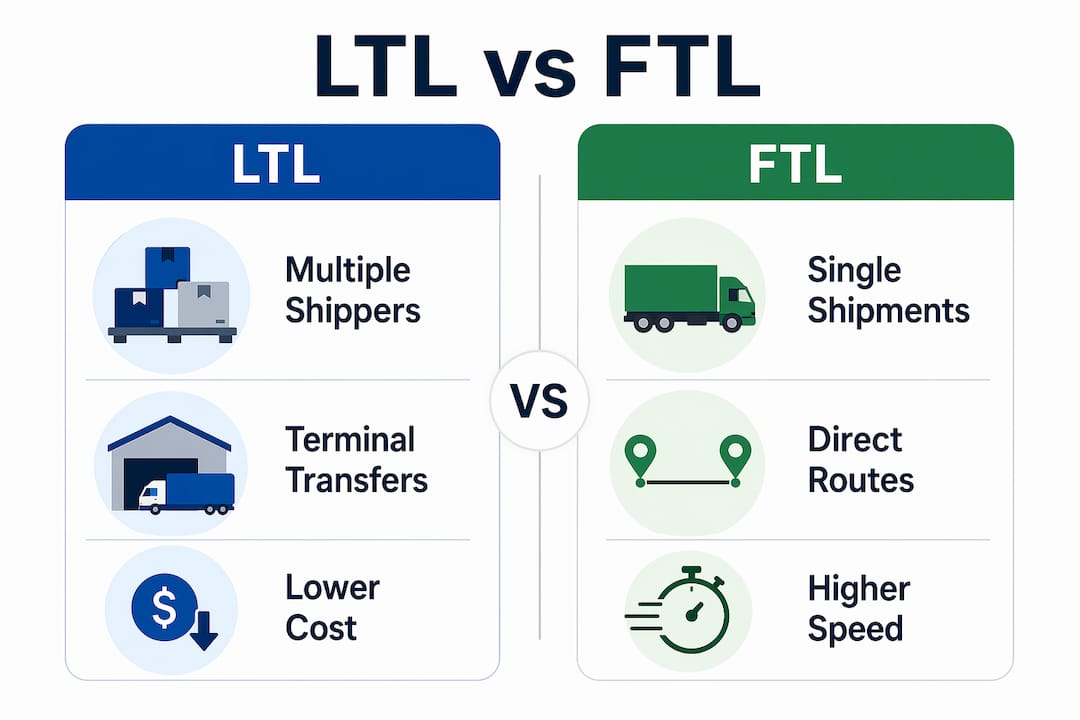
The multiple handling points are the defining operational difference between LTL and FTL. An FTL shipment loads at origin and unloads at destination, with no intermediate stops. LTL freight, by contrast, moves through a structured network designed for consolidation, not speed.
What are the cost factors and pricing structures for LTL trucking?
LTL pricing is more complex than FTL pricing because carriers charge based on several variables simultaneously. Knowing these factors helps you predict costs and avoid surprises.
The primary pricing variables are:
- Freight class. The National Motor Freight Traffic Association (NMFTA) assigns every commodity a freight class from 50 to 500 based on density, stowability, handling difficulty, and liability. Lower class numbers mean denser, easier-to-handle freight and lower rates.
- Weight. Carriers price LTL freight in weight breaks. Heavier shipments within the same class cost more in total but less per pound.
- Distance. Longer lanes cost more, though not always proportionally. Regional shipments often carry lower rates than cross-country moves.
- Density. A light but bulky shipment occupies more trailer space per pound, pushing it into a higher freight class and raising the rate.
- Accessorial fees. Liftgate service, residential delivery, inside delivery, and fuel surcharges all add to the base rate.
Per-pound LTL rates are typically lower than parcel carrier rates for shipments above 150 pounds. That cost advantage grows as shipment weight increases toward the 10,000-pound range, where LTL becomes dramatically cheaper than parcel on a per-pound basis.
Pro Tip: Measure and weigh every shipment accurately before booking. Carriers re-weigh and re-measure freight at terminals. An incorrect freight class declaration triggers a reclassification fee that can double your invoice.
The consolidation model is the engine behind LTL cost savings. Because the carrier spreads fixed costs across multiple shippers, each shipper pays a fraction of what a dedicated trailer would cost. For a business shipping two pallets, LTL is almost always the most economical ground freight option available.
When should shippers choose LTL over FTL?
The choice between LTL and FTL comes down to shipment size, urgency, cargo sensitivity, and budget. Neither mode is universally better. Each fits a specific set of conditions.
| Factor | LTL is the better choice | FTL is the better choice |
|---|---|---|
| Shipment size | 1–6 pallets or under 10,000 lbs | 10–12 pallets or a full trailer load |
| Cost priority | Paying only for space used | Predictable flat rate for the whole trailer |
| Time sensitivity | Standard delivery windows are acceptable | Tight deadlines require direct, fast transit |
| Cargo type | Durable, non-fragile goods | Fragile, high-value, or temperature-sensitive freight |
| Handling tolerance | Freight can withstand multiple transfers | Cargo must stay on one trailer from pickup to delivery |
FTL freight moves directly from pickup to delivery with minimal handling. LTL freight transfers through multiple terminals, which increases both transit time and the number of times workers touch the cargo. That distinction matters most for fragile or high-value goods.
A practical example: a furniture manufacturer shipping 20 sofas across the country should book FTL. The shipment fills a trailer, the goods are fragile, and the direct route protects them. A hardware distributor shipping 800 pounds of fasteners to a regional warehouse, on the other hand, has no reason to pay for a full trailer. LTL fits that load perfectly.
The cost-versus-control trade-off is the core decision factor. LTL saves money but introduces more handling. FTL costs more but gives you full control over the trailer. Matching the mode to the freight type is the skill that separates experienced logistics managers from those who overpay or over-handle their cargo. For a deeper look at analogous decisions in ocean freight, the LCL vs FCL comparison from Worldwideexpress applies the same logic to container shipping.
What are the benefits and challenges of LTL freight shipping?
LTL shipping delivers clear advantages, but it also carries risks that shippers should plan around.
Benefits:
- Cost savings. Sharing trailer space means paying only for what you use. For shipments under 10,000 pounds, LTL almost always beats FTL on price.
- Flexibility. LTL carriers accept shipments on short notice and handle a wide range of cargo types, including non-palletized freight.
- Reduced environmental impact. Consolidated loads mean fewer trucks on the road per unit of freight moved. Shippers who care about carbon footprint benefit from the shared-load model.
- Tracking and visibility. Most major LTL carriers provide real-time tracking through terminal scans, giving shippers reasonable shipment visibility.
Challenges:
- Increased handling risk. Multiple handling points raise damage risk, particularly for fragile or oddly shaped freight. Each terminal transfer is an opportunity for mishandling.
- Longer transit times. The hub-and-spoke network adds days compared to direct FTL lanes. Shippers with hard delivery deadlines should factor this in.
- Freight class complexity. Misclassifying freight leads to reclassification fees and billing disputes that slow down accounting.
- Delivery window variability. LTL carriers provide estimated delivery dates, not guaranteed ones, unless you pay for a premium service level.
Mitigating these challenges is straightforward with the right preparation. Palletize freight securely, use corner boards and stretch wrap, and declare the correct freight class from the start. For high-value LTL shipments, freight insurance coverage fills the gap between carrier liability limits and actual cargo value. Carrier liability for LTL freight is typically limited and may not cover the full replacement cost of damaged goods.
The strategic role of LTL in modern logistics
The cost-versus-control trade-off in LTL shipping is real, and I have seen it catch shippers off guard more times than I can count. Businesses focus on the rate savings and underestimate how much the additional handling points matter for certain cargo types.
My honest observation after years of watching freight move through terminal networks is this: LTL works brilliantly for the right freight and fails expensively for the wrong freight. Durable industrial goods, packaged consumer products, and standard palletized shipments move through LTL networks without incident every day. Artwork, electronics, and custom fabricated parts do not belong in an LTL trailer unless they are extraordinarily well packaged and insured.
The shippers who get the most out of LTL treat it as a deliberate tool, not a default. They know their freight class, they weigh accurately, and they build the longer transit window into their supply chain planning. Technology has improved LTL reliability significantly. Real-time terminal scans, electronic proof of delivery, and carrier API integrations now give shippers visibility that was unavailable a decade ago.
For businesses new to LTL, the best starting point is a freight broker relationship. A good broker knows which carriers perform well on specific lanes, which ones have lower damage rates, and how to negotiate accessorial fees before they appear on your invoice. That knowledge shortens the learning curve considerably.
— Ian
How Worldwideexpress supports your LTL and freight logistics needs
Worldwideexpress brings deep expertise to freight forwarding, trucking, and supply chain management for businesses of every size. Whether you are shipping domestically via LTL or moving freight across international borders, the team at Worldwideexpress provides the guidance and operational support to keep your cargo moving efficiently.
The freight forwarding services guide from Worldwideexpress covers the full scope of shipping options available to importers and exporters, including how LTL fits into broader logistics strategies. For businesses ready to move beyond guesswork and build a freight plan that controls costs without sacrificing reliability, Worldwideexpress offers tailored solutions backed by years of hands-on logistics experience. Reach out to the Worldwideexpress team to get a freight assessment and start shipping smarter.
Key takeaways
LTL trucking is the most cost-effective ground freight option for shipments between 150 and 15,000 pounds that do not require a dedicated trailer.
| Point | Details |
|---|---|
| LTL freight definition | Shipments from 150 to 15,000 lbs that share trailer space with other shippers’ cargo. |
| How pricing works | Rates depend on freight class, weight, distance, and density. Accurate classification avoids costly reclassification fees. |
| LTL vs FTL decision | Choose LTL for 1–6 pallets of durable goods; choose FTL for full loads, fragile cargo, or time-sensitive deliveries. |
| Main challenge | Multiple terminal transfers increase handling risk. Proper packaging and freight insurance reduce exposure. |
| Strategic advantage | LTL saves money on smaller shipments but requires accurate freight data and realistic transit time expectations. |
FAQ
What is LTL trucking in simple terms?
LTL trucking is a shipping method where multiple shippers share space on the same truck, each paying only for the portion of the trailer their freight occupies. Shipments typically weigh between 150 and 15,000 pounds.
How is LTL different from FTL shipping?
LTL freight shares trailer space with other shipments and passes through multiple terminals, while FTL freight occupies an entire trailer and travels directly from pickup to delivery. FTL is faster and involves less handling; LTL costs less for smaller loads.
What determines the cost of an LTL shipment?
LTL rates depend on freight class, shipment weight, shipping distance, and cargo density. Accessorial fees such as liftgate service or residential delivery add to the base rate.
Is LTL shipping safe for fragile goods?
LTL shipping carries higher handling risk than FTL because freight transfers through multiple terminals. Experts recommend FTL for fragile or high-value shipments, or at minimum, thorough packaging and dedicated freight insurance for LTL moves.
What freight class system does LTL use?
LTL carriers use the National Motor Freight Classification (NMFC) system, maintained by the NMFTA, which assigns classes from 50 to 500 based on density, stowability, handling difficulty, and liability. Lower class numbers indicate denser, easier-to-handle freight and lower shipping rates.
Recommended
- Freight contract terms: essential guide for shipping managers – Worldwide Express, Inc.
- Understanding What is Transloading in Logistics and Trade – Worldwide Express, Inc.
- What Does a Trucking Broker Do for Logistics? – Worldwide Express, Inc.
- Expedite Trucking: Strategies for On-Time, Profitable Delivery – Worldwide Express, Inc.