TL;DR:
- AI logistics companies use machine learning, OCR, and agentic AI to automate and optimize supply chain functions. They focus on data integrity, system integration, and workforce training to overcome organizational barriers and fully leverage AI benefits. Proper implementation begins with cleaning data, running pilots, and establishing governance to ensure compliance and efficiency.
An AI logistics company is defined as an organization that applies artificial intelligence to automate, optimize, and manage logistics operations across the full supply chain. These companies use machine learning, optical character recognition (OCR), and agentic AI to handle tasks from customs document processing to real-time route optimization. Nearly 80% of logistics professionals cite cost reduction and operational efficiency as their primary reasons for adopting AI. That number signals a clear industry shift, not a passing trend. Worldwideexpress operates at the center of this shift, offering AI-supported freight forwarding, customs brokerage, and international shipping services built for the demands of modern trade.
What AI technologies do AI logistics companies use?
The core toolkit of an AI logistics company includes agentic AI, large language models (LLMs), OCR, and orchestration layers that connect these tools to existing systems. Each technology addresses a specific pain point in the logistics workflow.

Agentic AI handles trade compliance with remarkable accuracy. U.S. Customs error rates as low as 0.2% have been recorded during agentic AI pilots, outperforming manual processing by a wide margin. These systems run 24/7, enabling real-time validation across global shipping corridors without human fatigue or time-zone constraints.
Real-time data analytics power predictive supply chain planning. Integration with ERP systems like SAP and Oracle improves SKU-level profitability visibility and logistics optimization. That means supply chain professionals can see which routes, carriers, and inventory positions deliver the best margins, not just the fastest delivery times.
The table below summarizes the key AI technologies and their primary logistics applications:
| AI Technology | Primary Logistics Application |
|---|---|
| Agentic AI | Customs compliance, HS code classification, error reduction |
| OCR and document AI | Invoice extraction, bill of lading processing, document automation |
| Large language models | Regulatory interpretation, exception triage, customer communication |
| Predictive analytics | Demand forecasting, route optimization, inventory planning |
| Orchestration layers | Connecting AI tools to TMS, ERP, and customs brokerage systems |
Pro Tip: Before selecting an AI platform, map every system your team touches daily, including your TMS, ERP, and customs portal. AI tools that cannot connect to these systems through APIs will create data silos rather than solve them.
What challenges do logistics companies face when integrating AI?
Organizational barriers, not technology gaps, are the primary obstacle to AI adoption in logistics. Over 53% of supply chain executives cite lack of in-house AI expertise and change-management capability as the key barrier to scaling AI. The technology exists. The readiness often does not.
Data quality is the second major barrier. AI readiness depends more on data integrity across ERP, TMS, and customs systems than on technology acquisition alone. A company can purchase the most advanced AI platform available and still produce inaccurate customs filings if its product data is inconsistent or fragmented across systems.
Legacy system integration compounds the problem. Many freight and customs platforms were built before modern APIs existed. Connecting AI tools to these systems requires middleware, custom development, or a phased migration plan. The common barriers logistics teams encounter include:
- Fragmented product data spread across multiple systems with no single source of truth
- Resistance from operations staff who view AI as a threat to job security rather than a productivity tool
- Insufficient governance frameworks for audit trails, exception escalation, and regulatory accountability
- Unclear ROI measurement, with 62.8% of companies reporting they do not measure or are unsure how to measure AI initiative returns
- Underestimated change management requirements during rollout phases
Pro Tip: Run a 90-day pilot on a single trade lane or document type before committing to a full deployment. Measure error rates, processing time, and staff adoption weekly. Pilots that fail fast and cheaply teach more than enterprise rollouts that fail slowly and expensively.
How is AI transforming workforce roles in logistics?
AI does not eliminate logistics jobs. It changes what those jobs require. The shift is from manual data entry and document handling toward strategic oversight, exception triage, and compliance interpretation. Logistics roles are moving from manual work to strategic oversight as automation absorbs repetitive tasks. That transition demands new skills that most logistics teams have not yet developed.
Automation reduces manual document processing touch time by 30–80% and speeds customs clearance cycles by up to 40%. Those gains free up experienced staff to focus on high-value decisions, such as resolving customs holds, managing carrier relationships, and interpreting regulatory changes. The professionals who thrive are those who learn to work alongside AI rather than around it.
The emerging skill set for logistics professionals in an AI-enabled environment includes:
- Prompt safety: Knowing how to query AI systems accurately and identify when outputs require human review
- Regulatory literacy: Understanding trade compliance rules well enough to validate AI-generated HS codes and duty calculations
- Exception triage: Diagnosing and resolving the shipments that fall outside automated workflows
- AI governance: Maintaining audit trails, escalation paths, and accountability structures for automated decisions
- Data stewardship: Keeping product master data clean, current, and structured for AI consumption
Successful AI transformation requires prioritizing training in AI interaction and compliance literacy across the logistics workforce. Companies that invest in this training outperform those that treat AI as a plug-and-play solution.
How to implement AI logistics solutions in international trade workflows
A structured implementation approach separates successful AI deployments from costly failures. The foundation is always data before technology. Building a Centralized Knowledge Core by unifying product data, HS codes, and regulatory requirements into a single structured source enables accurate AI automation in customs clearance and compliance. Without that foundation, AI amplifies existing data errors rather than correcting them.
The regional adoption gap illustrates the urgency. Asia-Pacific leads with 31% of companies embedding AI into core operations, compared to 14% in North America and just 6% in Europe. North American logistics professionals who delay structured implementation risk falling further behind as customer expectations for AI-driven speed and accuracy rise globally.
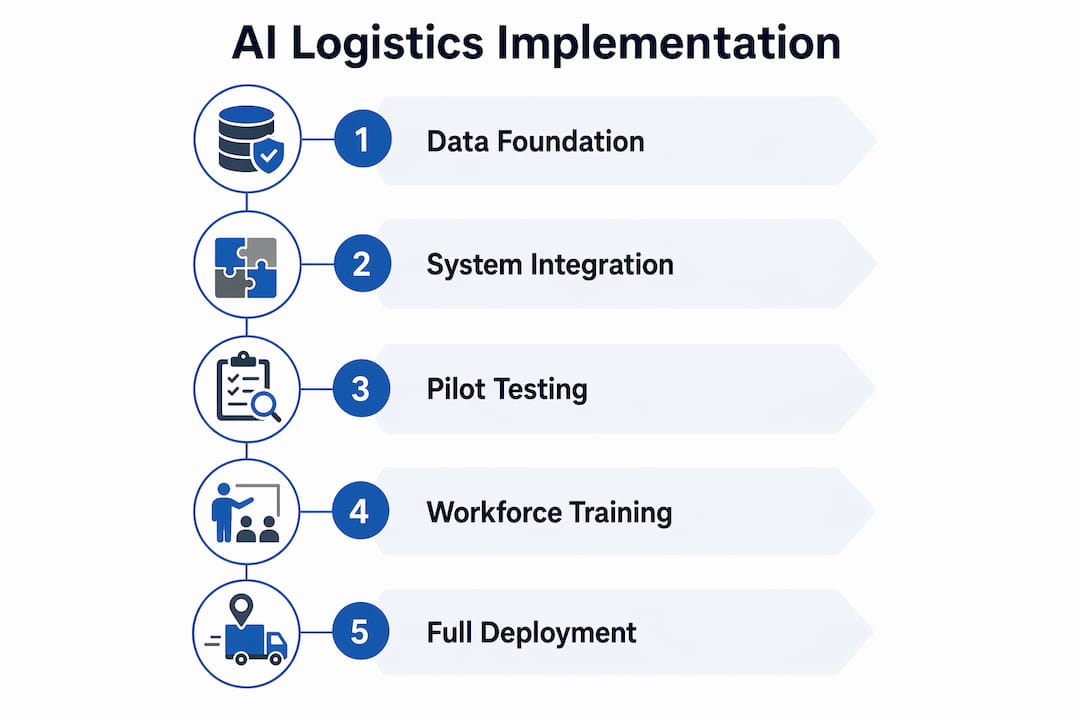
The implementation framework below covers the five stages that consistently produce measurable results:
-
Establish your data foundation. Audit product master data, HS code libraries, and regulatory records. Resolve inconsistencies before connecting any AI tool. Clean data is the prerequisite for accurate customs documentation.
-
Launch a scoped pilot. Select one trade lane, one document type, or one compliance workflow. Define success metrics upfront: error rate, processing time, and staff hours saved.
-
Integrate with core systems. Connect your AI layer to your TMS, ERP, and customs brokerage platform through verified APIs. Confirm that data flows bidirectionally and that exceptions trigger human review automatically.
-
Build governance and audit infrastructure. Every automated decision needs a traceable log. Establish escalation paths for exceptions and assign accountability for AI output review. This step protects your trade compliance standing with customs authorities.
-
Train and upskill your team. Pair technical training on the AI platform with regulatory literacy workshops. Staff who understand both the tool and the rules it enforces make better decisions when automation reaches its limits.
| Implementation stage | Key action | Success metric |
|---|---|---|
| Data foundation | Unify HS codes, product specs, and compliance data | Zero duplicate or conflicting records |
| Pilot launch | Automate one document type on one trade lane | Error rate below 1%, processing time reduced |
| System integration | Connect AI to TMS, ERP, and customs systems | Bidirectional data flow confirmed |
| Governance setup | Create audit trails and escalation workflows | 100% of exceptions logged and assigned |
| Workforce training | Train staff in prompt safety and regulatory literacy | Staff confidence score improvement |
Key Takeaways
The most effective AI logistics strategy combines clean, unified data with phased deployment, workforce training, and governance frameworks that keep humans accountable for automated decisions.
| Point | Details |
|---|---|
| Data integrity comes first | Unify product data, HS codes, and compliance records before deploying any AI tool. |
| Pilot before scaling | Run a 90-day scoped pilot to measure real error rates and adoption before full rollout. |
| Workforce training is non-negotiable | Train logistics staff in prompt safety, exception triage, and regulatory literacy to capture AI’s full value. |
| Governance protects compliance | Build audit trails and escalation paths into every automated workflow from day one. |
| Regional urgency is real | Asia-Pacific leads AI adoption at 31% of core operations; North American teams must accelerate or risk competitive disadvantage. |
What I’ve learned about AI readiness in logistics
The loudest conversation in logistics right now is about which AI platform to buy. The quieter, more important conversation is about whether your organization is ready to use one. After years of watching freight operations adopt new technology, the pattern is consistent: companies that succeed with AI spend more time cleaning their data and training their people than they spend evaluating software.
The 0.2% customs error rate achieved by agentic AI in pilots is genuinely exciting. But that number assumes structured, accurate input data and a team that knows how to handle the 0.2% that does fall through. The technology delivers on its promise only when the organizational foundation is solid.
The workforce evolution piece is also underestimated. Logistics professionals who learn to triage AI exceptions and validate automated compliance outputs become significantly more valuable than those who resist the shift. The firms that will lead in intelligent shipping services are not necessarily the ones with the most advanced AI. They are the ones where experienced logistics professionals and AI systems work together, each doing what the other cannot.
My honest advice: start with your data, not your vendor shortlist. Fix the fragmentation in your product master and HS code library first. Then pilot on a single lane. The results from that pilot will tell you more about your AI readiness than any technology demo ever will.
— Ian
Worldwideexpress and AI-powered international freight solutions
Worldwideexpress has built its international freight operations around the same principles that make AI adoption successful: clean data, integrated systems, and experienced professionals who know when to let automation run and when to step in.
For logistics professionals looking to apply AI across customs brokerage, freight forwarding, and compliance workflows, Worldwideexpress offers international logistics services that integrate these capabilities into a single, managed solution. The team handles HS code classification, customs clearance, cargo insurance, and global tracking, giving your operations the data infrastructure that AI-powered delivery systems require to perform accurately. Explore international freight shipping options built for the complexity of modern cross-border trade.
FAQ
What is an AI logistics company?
An AI logistics company applies artificial intelligence, including machine learning, OCR, and agentic AI, to automate and optimize logistics operations such as customs compliance, route planning, and document processing.
How does AI improve customs compliance in logistics?
Agentic AI systems achieve U.S. Customs error rates as low as 0.2% during pilots by validating shipment data in real time, 24 hours a day, across global shipping corridors.
What is the biggest barrier to AI adoption in supply chains?
Over 53% of supply chain executives identify lack of in-house AI expertise and change-management capability as the primary barrier, not the availability of technology itself.
How does AI affect logistics workforce roles?
AI shifts logistics roles from manual data entry toward strategic oversight, exception triage, and compliance interpretation, requiring new skills in prompt safety, regulatory literacy, and AI governance.
How do you start implementing AI in international trade logistics?
Start by building a Centralized Knowledge Core that unifies product data, HS codes, and regulatory requirements into one structured source, then launch a scoped pilot on a single trade lane before scaling.
Recommended
- Freight marketplace trends shaping logistics in 2025 – Worldwide Express, Inc.
- Understanding Artificial Intelligence in Logistics – Worldwide Express, Inc.
- How AI optimizes international shipping: efficiency and compliance – Worldwide Express, Inc.
- How to Optimize Logistics for Efficient Global Shipping – Worldwide Express, Inc.