TL;DR:
- UPS ships internationally to over 220 countries, offering various service tiers from next-day express to economy freight. Proper documentation and customs compliance are essential to ensure smooth cross-border deliveries, with costs influenced by weight, destination, and duties. Treating customs processes as a core operation helps businesses avoid delays and unexpected fees in international shipping.
UPS ships internationally to over 220 countries and territories worldwide, making it one of the most geographically broad carriers available to businesses and individuals. The network handles an average of 22.4 million packages daily. That scale means UPS international delivery services cover everything from urgent next-day express shipments to economy freight moving across multiple continents. Whether you are sending a single parcel overseas or managing regular cross-border trade, UPS offers service levels, customs brokerage, and tracking tools built for the task. This guide breaks down every major aspect of sending packages internationally with UPS, from service selection to cost management.
Can UPS ship internationally, and what services does it offer?
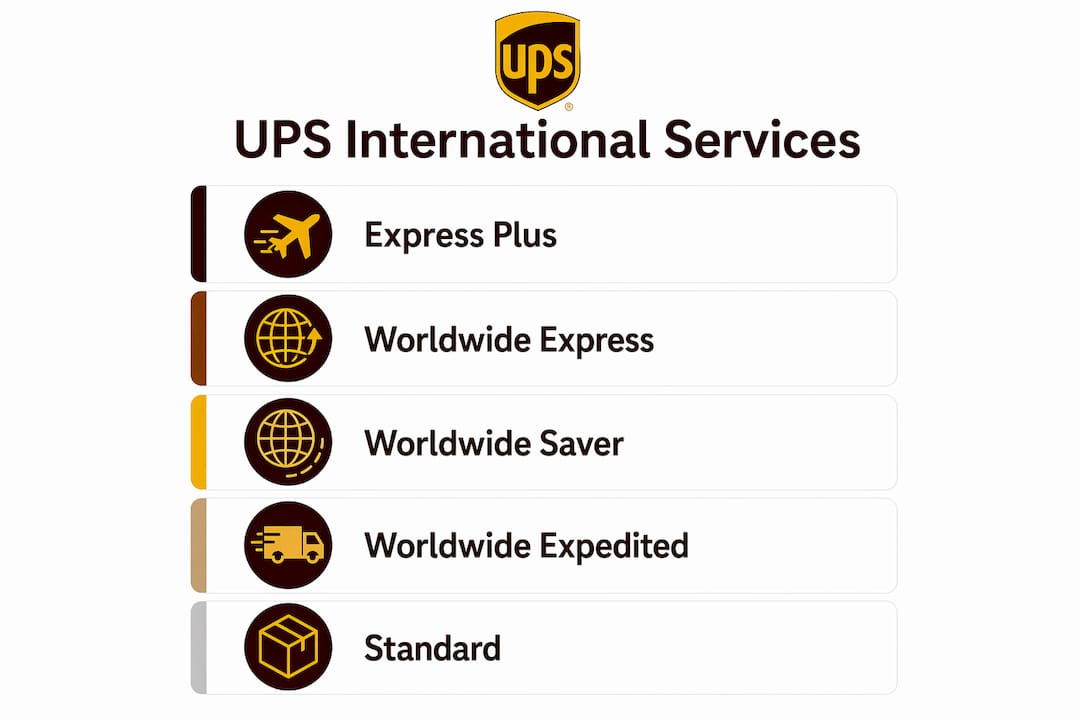
UPS does ship internationally, and the range of service options is wider than most shippers realize. The carrier structures its overseas offerings into five primary tiers, each designed for a different combination of speed, package size, and budget.

UPS Worldwide Express Plus delivers to key global cities in 55+ countries with a guaranteed next-business-day morning window. This is the fastest option available and carries a premium price to match. It suits time-critical shipments where a missed delivery window has real business consequences.
UPS Worldwide Express and Worldwide Saver both target 1–3 business day delivery. Express guarantees end-of-day delivery, while Saver provides a slightly later delivery window at a lower rate. Both include money-back guarantees and full tracking.
UPS Worldwide Expedited targets 2–5 business days and works well for shipments where cost matters more than speed. UPS Worldwide Economy extends that window to 5–12 business days and is the most budget-friendly option for non-urgent parcels. For heavier freight above 150 lbs, UPS Air Freight provides 3–5 day transit with capacity for palletized or oversized cargo.
| Service | Transit Time | Best For |
|---|---|---|
| Worldwide Express Plus | Next business day (morning) | Urgent, time-sensitive shipments |
| Worldwide Express / Saver | 1–3 business days | Standard express international |
| Worldwide Expedited | 2–5 business days | Cost-conscious, moderate urgency |
| Worldwide Economy | 5–12 business days | Budget shipments, no rush |
| Air Freight | 3–5 business days | Heavy cargo over 150 lbs |
Key features shared across most UPS international services include:
- End-to-end shipment tracking via the UPS portal
- Money-back delivery guarantees on express tiers
- Customs brokerage support integrated into the shipping process
- Delivery confirmation and recipient notification options
Pro Tip: If your shipment is time-sensitive but not overnight-critical, Worldwide Saver often delivers the best balance of speed and cost. Compare it directly against Expedited before committing.
What documentation does UPS international shipping require?
Customs clearance is the single biggest source of delays in cross-border shipping. Getting documentation right before the shipment leaves is far more effective than trying to resolve issues after a package is held at the border.
The three mandatory documents for nearly every international UPS shipment are the commercial invoice, the air waybill, and the packing list. The commercial invoice must accurately state the declared value, a full description of the goods, the country of origin, and the Harmonized System (HS) code for each item. Errors on the commercial invoice are the leading cause of customs holds.
Beyond the core three, additional documents apply depending on the goods and destination:
- Certificate of Origin — Required for goods claiming preferential tariff treatment under trade agreements such as USMCA.
- Import License — Certain regulated goods, including electronics, chemicals, and agricultural products, require the recipient country’s import license before clearance.
- Export License — Controlled goods leaving the U.S. may require a license from the Bureau of Industry and Security.
- Electronic Export Information (EEI) — U.S. exporters must file EEI via AES for shipments meeting export data thresholds. Failure to file results in shipment holds and potential penalties.
- Dangerous Goods Declaration — Required for any shipment containing hazardous materials, per IATA regulations.
UPS acts as customs broker for many of its international services, handling the clearance process on the shipper’s behalf. The scope of that brokerage support varies by service tier, so shippers should confirm exactly what is included when booking. Working with a dedicated customs brokerage provider alongside UPS adds an extra layer of compliance oversight, particularly for high-value or regulated goods.
Incoterms also play a direct role in documentation. Under Delivered Duty Paid (DDP), the shipper is responsible for all duties and taxes, and that obligation must be reflected in the invoice. Under Delivered at Place (DAP), the recipient pays duties on arrival. Mismatched Incoterms between the invoice and the UPS account settings cause billing disputes and clearance delays.
How are UPS international shipping costs calculated?
International UPS shipping costs depend on four primary variables: package weight, dimensions (billable weight applies when dimensional weight exceeds actual weight), destination country, and service level. That base rate is only the starting point.
Brokerage fees, duties, and taxes often add significant expenses on top of the base shipping rate. These charges are not always visible at the time of booking, which is why shippers frequently report surprise invoices after delivery. The total landed cost, meaning the full amount paid to get a package to its destination, can be substantially higher than the label price.
Key cost components to account for before shipping:
- Base shipping rate — Set by weight, dimensions, destination, and service tier
- Fuel surcharge — Applied as a percentage and adjusted periodically
- Customs duties and import taxes — Determined by the destination country’s tariff schedule and the declared HS code
- Brokerage fees — Included in some UPS services, billed separately in others
- Remote area surcharges — Applied when the delivery address falls outside standard service zones
- Residential delivery fees — Added for deliveries to home addresses in many countries
Rate shopping tools that calculate total landed cost, including all duties and fees, give a far more accurate picture than base rate comparisons alone. Worldwideexpress provides rate management tools that factor in these variables, helping businesses avoid cost surprises on international shipments.
Pro Tip: Set your Incoterms explicitly in your UPS account settings before shipping. Leaving them undefined defaults to DAP in most cases, which shifts duty liability to the recipient and can cause refused deliveries.
Shippers moving heavy freight internationally should also compare air freight rate options against ocean freight for non-urgent cargo. Air freight through UPS is fast, but ocean freight forwarding can cut costs significantly for large volumes.
What practical steps ensure smooth UPS international shipments?
Preparation before the shipment leaves the warehouse prevents the majority of clearance problems. The most common issues, including holds, delays, and unexpected fees, trace back to documentation errors or packaging failures that could have been caught in advance.
Accurate HS codes and declared values are the foundation of smooth customs clearance. An incorrect HS code can trigger the wrong duty rate or flag a shipment for inspection. A declared value that does not match the commercial invoice creates an immediate red flag for customs authorities.
Additional steps that reduce risk on every international shipment:
- Verify recipient contact details — Customs authorities and UPS both contact the recipient during clearance. An incorrect phone number or email address stalls the process.
- Use UPS-compliant packaging — Packages that fail dimensional or weight standards at origin can be re-rated or rejected. Follow UPS packaging guidelines for the specific service tier.
- Label shipments completely — Include the HS code, country of origin, and declared value on the label and in the commercial invoice. Discrepancies between label and invoice cause holds.
- Confirm brokerage scope — Know whether your chosen UPS service includes brokerage or whether you need a separate broker. The shipping documents guide from Worldwideexpress covers what each document must contain.
- Use tracking proactively — Monitor shipments through the UPS portal and respond immediately to any customs queries. Delays in responding extend holds significantly.
Businesses shipping regularly should consider automating document generation through their shipping platform. Automation reduces manual entry errors, which are the primary cause of HS code and declared value mismatches. The 7 essential tips for UPS international shipping from Worldwideexpress provides a practical checklist for teams managing high shipment volumes.
Key Takeaways
UPS ships internationally to over 220 countries and territories, with service tiers ranging from next-day express to 12-day economy, but total landed cost and documentation accuracy determine whether a shipment clears smoothly.
| Point | Details |
|---|---|
| Global reach | UPS delivers to over 220 countries and territories, averaging 22.4 million packages daily. |
| Service tiers | Five main options span 1-day express to 12-day economy, plus air freight for heavy cargo. |
| Documentation is critical | Commercial invoice, air waybill, packing list, and EEI filing are required for most U.S. exports. |
| Total landed cost | Base rates exclude duties, brokerage fees, and surcharges; always calculate the full landed cost. |
| Incoterms matter | Setting DDP or DAP correctly in your UPS account prevents billing disputes and refused deliveries. |
Why customs management is the real differentiator in international shipping
Most shippers focus on transit time when choosing a service. That is the wrong priority. In my experience working with businesses across multiple industries, the shipments that fail do not fail because of the carrier. They fail because of what happens at the border.
UPS’s global network is genuinely impressive. The reach into 220-plus countries, the range of service tiers, and the integrated tracking give shippers real flexibility. But that infrastructure only delivers value when the customs side is handled correctly. A shipment with a wrong HS code or a missing EEI filing can sit in customs for days, regardless of which express service was selected.
The shippers who get the most out of UPS international delivery are the ones who treat customs compliance as a core operational function, not an afterthought. They invest in accurate product classification, maintain clean recipient data, and set their Incoterms deliberately. They also know when to bring in a dedicated customs broker rather than relying solely on the carrier’s brokerage service.
The unexpected fee problem is real. Brokerage charges that appear post-delivery, duties the recipient refuses to pay, and re-rating surprises at origin are all avoidable. They require upfront attention to cost structure and account configuration, not just a fast service selection at checkout.
— Ian
How Worldwideexpress supports your international shipping operations
International shipping through UPS becomes significantly more manageable when you have expert logistics support behind the process. Worldwideexpress specializes in customs brokerage, freight forwarding, and end-to-end logistics management for businesses moving goods across borders.
The team at Worldwideexpress handles the complexity that catches most shippers off guard: HS code classification, EEI filings, Incoterm configuration, and brokerage coordination. For businesses scaling their international operations, the freight forwarding guide from Worldwideexpress explains how professional forwarding integrates with carrier services like UPS to reduce cost and risk. For import-heavy operations, the U.S. customs brokerage services page outlines how Worldwideexpress manages clearance from end to end.
FAQ
Does UPS deliver overseas to all countries?
UPS delivers to over 220 countries and territories worldwide, covering the vast majority of global destinations. Some remote locations may have limited service options or longer transit times.
What is the fastest UPS international shipping option?
UPS Worldwide Express Plus is the fastest service, offering guaranteed next-business-day morning delivery to major cities in 55+ countries.
How are UPS international shipping rates calculated?
Rates depend on package weight, dimensions, destination, and service level. Brokerage fees, duties, taxes, and surcharges add to the base rate and must be included in any total landed cost calculation.
What documents are required for sending packages internationally with UPS?
The core documents are the commercial invoice, air waybill, and packing list. U.S. exporters must also file Electronic Export Information via the Automated Export System for shipments above regulatory thresholds.
What do Incoterms DDP and DAP mean for UPS international shipments?
DDP means the shipper pays all duties and taxes; DAP means the recipient pays on arrival. Setting the correct Incoterm in your UPS account prevents unexpected charges and refused deliveries.
Recommended
- Top International Shipping Solutions Reviewed – 2025 – Worldwide Express, Inc.
- How to Request a UPS Quote International for U.S. Logistics – Worldwide Express, Inc.
- 7 Key Tips for Managing UPS International Shipping Rates – Worldwide Express, Inc.
- 7 Essential Tips for Successful UPS International Shipping – Worldwide Express, Inc.