TL;DR:
- USPS international shipping costs depend on service level, package weight, dimensions, and destination zone.
- Choosing the right service—First-Class, Priority, or Express—can save money and reduce delivery times.
USPS international shipping cost is determined by three core factors: the service level you select, your package’s weight and dimensions, and the destination country zone. As of 2026, rates start at $19.40 for First-Class Package International Service, $32.65 for Priority Mail International, and $62.70 for Priority Mail Express International. Flat-rate box and envelope options simplify pricing by locking in a fixed cost regardless of weight, up to service limits. Optional services like insurance and signature confirmation add to the base postage price and should factor into your total budget before you purchase postage.
What are the main USPS international shipping services and their 2026 costs?
USPS offers three primary international parcel services, each targeting a different balance of cost, speed, and reliability. Choosing the wrong one can mean overpaying by a wide margin or leaving your customer waiting three weeks for a package that could have arrived in five days.
First-Class Package International Service
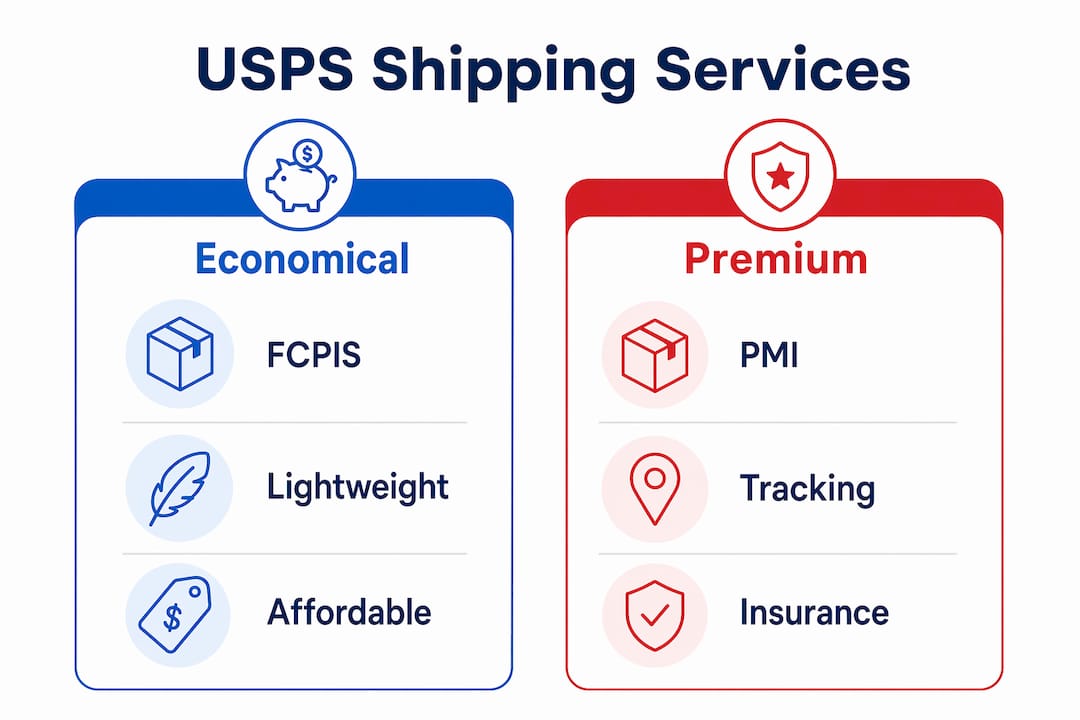
First-Class Package International Service (FCPIS) is the most economical option for light packages. It starts at $19.40 and covers packages up to 4 lbs. Tracking is limited compared to premium services, and insurance is not included by default. This service suits low-value, non-urgent shipments where keeping postage costs down is the top priority.
Priority Mail International
Priority Mail International (PMI) is the mid-tier service for shippers who need tracking and basic insurance. Rates range from $32.65 to $62.70 depending on package size, format, and destination zone. Every PMI shipment includes end-to-end tracking and up to $200 in insurance coverage at no extra charge. That built-in insurance makes PMI a strong choice for shipments containing goods worth more than a few dollars.

Priority Mail Express International
Priority Mail Express International (PMEI) is USPS’s fastest international option. It starts at approximately $62.70 and delivers in 3–5 business days to most destinations. PMEI includes full tracking, insurance, and a money-back guarantee for select countries. Businesses shipping time-sensitive documents or high-value goods will find this service worth the premium.
Flat-rate options
USPS flat-rate envelopes and boxes remove the guesswork from international postage prices. Flat-rate envelopes and small boxes have a 4 lb weight limit, while medium and large flat-rate boxes allow up to 20 lbs. The price is fixed by destination zone, not by what you pack inside, which makes them ideal for dense, heavy items.
| Service | Delivery time | Weight limit | Insurance | Starting price |
|---|---|---|---|---|
| First-Class Package International | 7–21 business days | 4 lbs | Not included | $19.40 |
| Priority Mail International | 6–10 business days | 70 lbs | $200 included | $32.65 |
| Priority Mail Express International | 3–5 business days | 70 lbs | Included | $62.70 |
| PMI Flat-Rate Envelope | 6–10 business days | 4 lbs | $200 included | Zone-based fixed rate |
| PMI Flat-Rate Box (Large) | 6–10 business days | 20 lbs | $200 included | Zone-based fixed rate |
Pro Tip: USPS updated its international rates effective january 18, 2026, with an average increase of 5.9% across services. If you budgeted shipping costs before that date, recalculate your postage before your next shipment.
How does USPS calculate international shipping costs?
USPS international shipping fees are not a single flat number. They result from a formula that combines package weight, package dimensions, and destination zone. Understanding each variable helps you predict costs accurately and avoid surprises at the counter.
Weight: actual vs. dimensional
USPS charges based on whichever is higher: actual weight or dimensional weight. Packages exceeding 1,728 cubic inches are subject to dimensional weight pricing. Dimensional weight is calculated by multiplying length by width by height and dividing by a set divisor. A large, lightweight box shipping to Canada can cost significantly more than its actual weight suggests.
Destination zones
USPS groups destination countries into price groups. Shipping to Canada or Mexico costs less than shipping to Australia or Japan. The price difference between zones can be substantial, so always check the destination group before selecting a service. The USPS international shipping calculator on the USPS website gives you zone-specific rates instantly.
Additional fees
Several optional and mandatory fees add to the base postage:
- Signature confirmation: Required for some high-value shipments; adds a flat fee per package.
- Insurance above included limits: PMI includes $200; additional coverage costs extra per $100 of declared value.
- Customs forms: Required for all international parcels; no direct fee, but errors cause delays that cost money.
- Special handling: Available for fragile or hazardous items at an added surcharge.
Commercial pricing discounts
Businesses using authorized PC Postage software access commercial base pricing that can reduce base postage costs compared to retail counter rates. Those discounts apply to base postage only. Insurance, signature confirmation, and other add-ons are charged at standard rates regardless of how you purchase postage.
Pro Tip: Measure every package precisely before purchasing postage. A package that is 1 inch too tall can push it into a higher dimensional weight tier and add several dollars to your international shipping rates.
What are the typical USPS international delivery times and service features?
Delivery time is one of the most misunderstood aspects of USPS global shipping cost decisions. Shippers often focus on postage price and overlook transit time, which directly affects customer satisfaction.
USPS transit times by service are:
- First-Class Package International: 7–21 business days
- Priority Mail International: 6–10 business days
- Priority Mail Express International: 3–5 business days
These are estimates, not guarantees. Actual delivery depends on the destination country’s postal infrastructure and customs clearance speed. A package to Germany typically clears faster than one to a country with less developed customs processing.
Tracking and insurance by service
| Service | Tracking | Insurance |
|---|---|---|
| First-Class Package International | Limited | None included |
| Priority Mail International | Full end-to-end | $200 included |
| Priority Mail Express International | Full end-to-end | Included |
Tracking capability matters beyond customer reassurance. Full tracking creates a documented chain of custody, which supports insurance claims if a package is lost or damaged. FCPIS’s limited tracking means you may not know a package’s status until it is delivered or returned.
Money-back guarantee
PMEI includes a money-back guarantee for shipments to select countries. That guarantee does not apply to delays caused by customs holds or incorrect documentation. Proper customs forms are the shipper’s responsibility, and errors there void the guarantee regardless of how fast USPS moves the package.
A practical example: a 2 lb electronics accessory shipped to the United Kingdom costs roughly $19.40 via FCPIS with a potential 21-day wait, or approximately $32.65 via PMI with full tracking and a 10-day window. For a $50 item, the extra $13 for PMI is often worth the tracking alone.
How to choose the most cost-effective USPS international shipping option
The right service depends on four variables: package weight, declared value, how fast the recipient needs it, and your destination country. Getting this decision right every time requires a repeatable process, not guesswork.
Use this checklist before purchasing postage:
- Weigh and measure the package. Record actual weight and all three dimensions. Calculate dimensional weight if the package exceeds 1,728 cubic inches.
- Identify the destination price group. Use the USPS international shipping calculator to confirm the zone.
- Assess the item’s value. If the declared value exceeds $200, budget for additional insurance.
- Set a delivery deadline. If the recipient needs it within 10 days, FCPIS is not a viable option.
- Compare flat-rate vs. weight-based pricing. Dense, heavy items often ship cheaper in flat-rate boxes.
- Check commercial pricing eligibility. If you ship regularly, authorized PC Postage software lowers base postage costs meaningfully.
- Communicate customs duties to the recipient. Import duties and taxes are never included in USPS postage. The recipient pays them upon delivery.
Matching service to shipment type
Choose FCPIS for low-value, non-urgent items under 4 lbs where cost is the only priority. Choose PMI when you need tracking, insurance, and a reliable 6–10 day window. Choose PMEI when the shipment is time-sensitive, high-value, or when a customer expects a guaranteed delivery window.
Flat-rate boxes make the most sense when your item is heavy relative to its size. A 15 lb box of machine parts ships at a fixed flat-rate price regardless of actual weight, which can save significantly over weight-based PMI pricing for dense goods.
Pro Tip: Consolidate multiple small orders into one shipment when possible. Shipping costs for packages abroad drop on a per-unit basis when you combine items, and you reduce the number of customs declarations your recipient has to manage. Review customs compliance best practices before consolidating to avoid classification errors.
Key Takeaways
USPS international shipping cost is controlled most effectively by matching service level to package weight, declared value, and delivery deadline before purchasing postage.
| Point | Details |
|---|---|
| Service selection drives cost | FCPIS starts at $19.40; PMI at $32.65; PMEI at $62.70 for 2026 shipments. |
| Dimensional weight adds cost | Packages over 1,728 cubic inches are priced on dimensional weight, not actual weight. |
| Flat-rate boxes suit dense items | Fixed pricing up to 20 lbs makes flat-rate boxes cost-effective for heavy shipments. |
| Customs duties are separate | Recipients pay import duties and taxes; shippers must communicate this clearly upfront. |
| Commercial discounts reduce base postage | Authorized PC Postage software lowers base rates; add-on fees remain at standard pricing. |
What I’ve learned about USPS international shipping after years in logistics
The single most expensive mistake shippers make is treating USPS international pricing as simpler than it is. They weigh the package, pick the cheapest service, and move on. Then they get a call from a customer in France who just paid an unexpected customs bill, or a complaint from a buyer in Japan who waited 19 days for a package that had no tracking updates.
Dimensional weight catches people off guard constantly. A lightweight foam-padded gift box that measures 14 by 14 by 10 inches can trigger dimensional weight pricing even if the actual contents weigh under 2 lbs. That surprise can double the postage cost on a single shipment.
The customs duty issue is equally predictable and equally ignored. Recipients always pay import duties on goods above their country’s de minimis threshold. Shippers who do not communicate this upfront generate chargebacks, negative reviews, and lost repeat business. A single line in your order confirmation email prevents most of that friction.
My honest recommendation: run every international shipment through the USPS calculator before committing to a service, and revisit your default service selection every time USPS updates rates. The 2026 rate increase averaged 5.9%, which is enough to shift the cost-efficiency balance between services for certain package profiles. Staying current on USPS compliance essentials is not optional for anyone shipping internationally at volume.
— Ian
How Worldwideexpress supports your international shipping strategy
USPS works well for parcels, but businesses shipping at volume or handling complex cross-border trade need more than postage. Worldwideexpress specializes in freight forwarding, customs brokerage, and supply chain management for companies that need reliable, compliant international logistics at scale.
Worldwideexpress provides rate comparison tools, customs documentation support, and cargo insurance options that go beyond what standard postal services offer. For businesses managing high-value shipments, regulated goods, or multi-country distribution, the freight forwarding expertise at Worldwideexpress reduces risk and keeps shipments moving. The team also handles U.S. customs brokerage to clear imports efficiently and keep your supply chain on schedule.
FAQ
What is the cheapest USPS international shipping option?
First-Class Package International Service is the least expensive option, starting at $19.40 for packages up to 4 lbs. It does not include insurance or full tracking.
How do I calculate my USPS international shipping cost?
Use the USPS international shipping calculator on the USPS website. Enter your package weight, dimensions, destination country, and desired service to get an accurate rate.
Does USPS international shipping include customs duties?
No. Customs duties and taxes are never included in USPS postage. The recipient pays them to their country’s customs authority upon delivery.
How long does USPS international shipping take?
Transit times range from 3–5 business days for Priority Mail Express International to 7–21 business days for First-Class Package International, depending on the destination country and customs processing speed.
Are there discounts on USPS international shipping fees?
Yes. Businesses using authorized PC Postage software access commercial base pricing that reduces postage costs compared to retail counter rates. Additional fees like insurance are not discounted under commercial pricing.
Recommended
- International Postage Rates and Options: 2026 Guide – Worldwide Express, Inc.
- USPS International Shipping: Compliance Essentials for 2026 – Worldwide Express, Inc.
- Complete Guide to International Shipping Basics – Worldwide Express, Inc.
- USPS International Shipping Rates: 2026 Cost Guide – Worldwide Express, Inc.