TL;DR:
- B2B e-commerce logistics involves managing complex freight, warehousing, and delivery processes designed for bulk business orders. Success relies on integrated technology, compliance, and choosing suitable fulfillment models to ensure timely and accurate delivery. Proper system synchronization and proactive supply chain practices are essential for maintaining customer trust and operational efficiency.
B2B e-commerce logistics is the integrated management of freight, warehousing, distribution, and parcel shipping specifically designed to fulfill business-to-business online orders at scale. Unlike consumer shipping, B2B logistics handles bulk orders, contractual delivery windows, custom labeling, and multi-location distribution, making it far more operationally complex. The stakes are higher too. A missed delivery to a retail chain or manufacturer disrupts production lines, not just a single customer’s weekend. In 2026, providers like Amazon Supply Chain Services are reshaping what integrated B2B logistics looks like, and companies that align with these models gain measurable supply chain advantages.
What is B2B e-commerce logistics and why does it matter?
B2B e-commerce logistics is the operational backbone connecting online ordering systems to physical goods delivery for business customers. It encompasses every step from inventory positioning and order management to carrier selection, customs clearance, and final-mile delivery. The industry term used by supply chain professionals is B2B fulfillment, though “B2B e-commerce logistics” captures the digital ordering layer that now drives most of this activity.
What separates B2B logistics from B2C is the order profile. Business customers place larger, less frequent orders with specific routing requirements, purchase order matching, and compliance documentation. A single shipment might require EDI transaction sets, freight class assignments, and customs filings before it ever leaves the warehouse. Managing that complexity through a single, synchronized system is the defining challenge of modern B2B logistics management.
How does technology integration power the e-commerce supply chain?
End-to-end real-time visibility across ERP, WMS, CRM, and logistics platforms is the technical foundation of effective B2B e-commerce logistics. According to Virto Commerce’s supply chain strategy guide, lack of synchronization causes operational failures and broken customer promises. That finding is not abstract. When inventory data in a WMS does not match what the e-commerce portal displays, customers order stock that does not exist, and trust erodes fast.

Modern B2B e-commerce platforms function as execution hubs, not just storefronts. They must pull live inventory counts from the WMS, delivery estimates from the TMS, and account terms from the ERP to present a single, accurate version of reality to the buyer. Platforms like Virto Commerce are built specifically for this integration depth, supporting complex catalog structures and multi-warehouse fulfillment logic that generic platforms cannot handle.
The risks of fragmentation are concrete. Fragmented B2B logistics, where sales, inventory, warehouse, and carrier data operate in silos, produces missed delivery promises and poor customer experience at scale. Integration reduces manual reconciliation work and gives operations teams the data they need to act before problems escalate.
Key integration priorities for B2B logistics teams include:
- ERP to e-commerce sync: Real-time pricing, credit limits, and order history visible at checkout
- WMS to carrier systems: Automated rate shopping and label generation at pick-and-pack
- EDI partner compliance: Oracle B2B integration supports standards like EDIFACT and X12, enabling schema customization for specific partner requirements
- Customs data feeds: Pre-populated export documentation pulled from order data, reducing manual entry errors
Pro Tip: Before selecting a B2B e-commerce platform, map every data handoff between your order management, warehouse, and carrier systems. Any gap in that map is a future operational failure waiting to happen.
What logistics service models work best for B2B fulfillment?
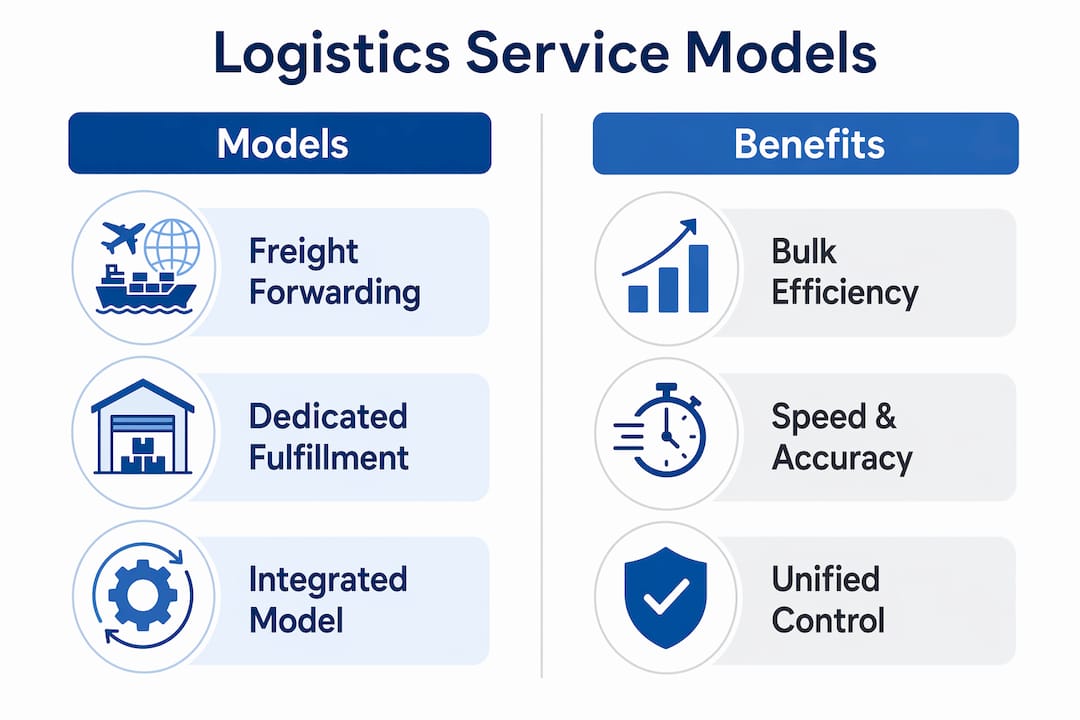
B2B companies use four primary logistics models, and the right choice depends on order volume, geographic reach, and service level requirements. Each model carries distinct tradeoffs in speed, cost, and operational complexity.
| Model | Best for | Speed | Cost | Scalability |
|---|---|---|---|---|
| Freight forwarding | Large bulk international orders | 5-30 days | Low per unit | High |
| Dedicated fulfillment centers | High-volume domestic distribution | 1-3 days | Medium | Medium |
| Parcel shipping networks | Smaller B2B orders, last-mile | 1-5 days | Higher per unit | High |
| Integrated supply chain services | End-to-end multi-modal needs | 2-5 days | Variable | Very high |
Amazon Supply Chain Services (ASCS), launched in 2026, represents the integrated model taken to its logical conclusion. Amazon’s logistics portfolio includes ocean, air, ground, and rail freight backed by 80,000+ trailers and 100+ aircraft, delivering two-to-five-day predictability with AI-powered inventory forecasting. That offering is now available to businesses of all sizes, not just Amazon sellers. The practical implication is that mid-market B2B companies can now access logistics infrastructure previously reserved for enterprise shippers.
Centralized inventory models concentrate stock in one or two large distribution centers, reducing carrying costs but increasing transit times for distant customers. Distributed models position inventory closer to buyer clusters, improving delivery speed at the cost of higher warehousing overhead. Most high-growth B2B e-commerce operations land on a hybrid approach, using centralized freight for inbound international goods and distributed fulfillment centers for domestic last-mile execution. Reviewing top e-commerce shipping strategies can help logistics managers decide which hybrid configuration fits their network.
How do customs and compliance affect international B2B logistics?
International B2B e-commerce logistics adds a regulatory layer that domestic operations never face. Customs declarations, export manifests, tariff classifications, and trade compliance documentation must all be accurate and submitted on time, or shipments stop moving.
The U.S. Customs and Border Protection’s CAPE Phase I program, active from April 20, 2026, enables electronic tariff refund declarations through the ACE Secure Data Portal. Refunds are issued within 60 to 90 days of filing, with a 9,999 entry limit per CSV upload. For B2B importers managing high-volume shipments under IEEPA tariffs, this program represents a meaningful cost recovery mechanism, but only for companies with organized documentation systems.
On the export side, electronic export manifests for vessel cargo must reach U.S. Customs no later than 24 hours before loading. That deadline is not flexible. Late submissions delay cargo loading, disrupt carrier bookings, and cascade into missed delivery windows for the business customer waiting on the other end.
Practical compliance priorities for B2B logistics teams managing international trade:
- Register in the ACE Secure Data Portal before the first CAPE filing to avoid last-minute access issues
- Assign a licensed customs broker to manage tariff classification and entry filing for complex product categories
- Build the 24-hour EEM submission deadline into carrier booking workflows, not as a manual reminder but as a system-enforced checkpoint
- Maintain organized commercial invoices, packing lists, and certificates of origin for every international shipment
- Review customs documentation requirements regularly, as regulatory changes in 2026 have accelerated
Working with a customs broker who integrates directly with your logistics platform eliminates the documentation gaps that cause most international delays. Worldwideexpress provides licensed customs brokerage services that connect compliance workflows directly to shipment execution, reducing the manual handoffs where errors typically occur.
What best practices optimize B2B logistics performance?
Optimizing B2B e-commerce logistics performance requires more than faster carriers. It demands synchronized inventory, predictive demand signals, and communication protocols that keep business customers informed at every stage.
-
Implement real-time shipment visibility. Business customers expect the same tracking transparency they get as consumers, applied to pallet-level freight. Predictive analytics and real-time visibility reduce disruptions and improve service levels across consolidated logistics networks. Visibility tools that surface exceptions before they become delays give operations teams time to act.
-
Synchronize inventory across all channels. The biggest failure in B2B logistics is treating the sales channel and supply chain as separate systems. Integrating them digitally decreases manual overhead and improves operational reliability. A buyer who sees accurate stock levels at checkout places orders with confidence rather than calling to verify availability.
-
Enable partial and split shipments. Large B2B orders often include items with different lead times or warehouse locations. Configuring your OMS to support partial fulfillment prevents a single backordered SKU from holding up an entire order worth thousands of dollars.
-
Use AI forecasting for inventory positioning. AI-powered forecasting is a key enabler for scalable B2B logistics networks. Amazon’s ASCS uses this capability to position inventory ahead of demand signals. Smaller operators can access similar functionality through platforms like NetSuite, Blue Yonder, or Kinaxis.
-
Align SLAs with carrier performance data. Service level agreements with business customers must reflect what your carrier network can actually deliver. Review carrier scorecards quarterly and adjust SLA commitments when performance data shows consistent gaps.
Pro Tip: Set up automated exception alerts for shipments that miss scan milestones. Proactive outreach to a business customer before they ask about a late delivery preserves the relationship far more effectively than reactive apologies.
Key takeaways
Effective B2B e-commerce logistics requires synchronized technology, compliant international processes, and the right fulfillment model matched to order volume and geography.
| Point | Details |
|---|---|
| Integration is the foundation | Connect ERP, WMS, CRM, and carrier systems to eliminate data silos and broken delivery promises. |
| Model selection drives cost and speed | Match freight forwarding, fulfillment centers, or integrated services to your order profile and geography. |
| Customs compliance is time-critical | Submit electronic export manifests 24 hours before loading and register for CAPE filings in ACE before deadlines hit. |
| AI forecasting improves scalability | Predictive inventory tools reduce stockouts and position goods closer to demand before orders arrive. |
| Visibility builds customer trust | Real-time tracking and proactive exception management protect B2B relationships better than reactive fixes. |
The uncomfortable truth about B2B logistics integration
Most B2B companies I encounter are not failing because they chose the wrong carrier. They are failing because their systems do not talk to each other. The e-commerce portal promises a delivery date the WMS cannot support, or the ERP holds pricing that the order management system never received. These are not technology problems. They are integration discipline problems.
The companies that get this right treat their logistics platform as a live operational system, not a reporting tool. They invest in API connections between their ERP and their 3PL. They test their EDI transmissions before going live with a new partner, because misconfigured envelope settings can cause entire transmission batches to be rejected. They assign someone to own the data flows, not just the carrier relationships.
The international dimension adds another layer that many companies underestimate until their first customs hold. The 24-hour EEM filing requirement is not a suggestion. CAPE refund filings require organized documentation going back months. Companies that treat compliance as an afterthought pay for it in delays, fines, and lost customer confidence.
My honest observation after years of watching B2B logistics operations: the businesses that win are the ones that invest in integration infrastructure before they need it, not after a crisis forces the issue. The technology exists. Amazon Supply Chain Services, Virto Commerce, and specialized freight forwarders like Worldwideexpress have built the tools. The gap is almost always in how companies connect and manage those tools internally.
— Ian
How Worldwideexpress supports your B2B logistics operations
Worldwideexpress delivers end-to-end logistics solutions built specifically for B2B companies managing complex international trade. From freight forwarding expertise across air, ocean, and ground to licensed customs brokerage services that keep shipments moving through regulatory checkpoints, Worldwideexpress handles the operational complexity so your team can focus on growth.
The platform includes shipment tracking tools, compliance documentation support, and cargo insurance options that protect high-value B2B freight. Whether you are managing inbound ocean freight from Asia or outbound air shipments to European distributors, Worldwideexpress provides the coverage and expertise to keep your supply chain performing at the service levels your business customers expect.
FAQ
What is B2B e-commerce logistics?
B2B e-commerce logistics is the integrated management of freight, warehousing, fulfillment, and parcel shipping for online orders placed between businesses. It differs from B2C logistics in order size, compliance requirements, and the need for EDI and ERP integration.
How does technology improve B2B logistics management?
Connecting ERP, WMS, CRM, and carrier systems into a unified data environment eliminates the fragmentation that causes missed deliveries and inventory errors. Platforms like Virto Commerce are built to support this level of integration for complex B2B operations.
What customs requirements apply to international B2B shipments?
Electronic export manifests must be submitted to U.S. Customs at least 24 hours before vessel cargo loading. For imports, CBP’s CAPE Phase I program allows electronic tariff refund declarations through the ACE Secure Data Portal, with refunds issued in 60 to 90 days.
What is the best fulfillment model for B2B e-commerce?
The best model depends on order volume and geography. High-volume domestic operations benefit from dedicated fulfillment centers, while international B2B trade typically requires freight forwarding combined with regional distribution. Integrated providers like Amazon Supply Chain Services offer a multi-modal alternative for companies needing end-to-end coverage.
How can B2B companies improve shipping reliability?
Real-time shipment visibility, AI-powered inventory forecasting, and proactive exception management are the three most effective levers. Aligning carrier SLAs with actual performance data and enabling partial shipment fulfillment also reduce the service failures that damage long-term B2B customer relationships.
Recommended
- Top e-commerce shipping strategies for logistics success 2026 – Worldwide Express, Inc.
- Global Shipping 2026: 72% Face Tariff Volatility – Worldwide Express, Inc.
- 6 Key Trends in International Logistics for U.S. Managers – Worldwide Express, Inc.
- Growing Your Business Online: Strategies for Logistics – Worldwide Express, Inc.