TL;DR:
- The Importer Security Filing (ISF) is a mandatory electronic submission for all ocean shipments to the United States, with strict deadlines and penalties for non-compliance. It requires specific data elements to be filed at least 24 hours before cargo loading at the foreign port, and penalties can reach up to $5,000 per violation. Importers have three options for filing: self-filing, using a licensed broker, or delegating to a freight forwarder, with professional help reducing compliance risks.
The Importer Security Filing (ISF) is a mandatory electronic submission required by U.S. Customs and Border Protection (CBP) for every ocean freight shipment bound for the United States. Known formally as the 10+2 filing, ISF usa shipping compliance is not optional. Penalties for non-compliance can reach $5,000 per violation. That single number explains why importers and freight forwarders treat ISF deadlines as non-negotiable. This guide covers what ISF requires, who files it, when it must be submitted, and how to avoid the most expensive mistakes in U.S. ocean freight compliance.
What is ISF in shipping and who must file it?
ISF, also called the 10+2 filing, is defined as a mandatory pre-arrival data submission transmitted electronically to CBP before cargo is loaded onto a vessel at a foreign port. The “10+2” label refers to 10 data elements provided by the importer and 2 provided by the ocean carrier. CBP uses this data to screen cargo for security threats before it ever reaches a U.S. port.
Two distinct filing types exist under the ISF framework. ISF-10 applies to all U.S.-bound cargo and requires 10 data elements filed by the importer or an authorized agent. ISF-5 applies to Freight Remaining on Board (FROB) and transit shipments, requiring only 5 data elements filed by the booking party. Most importers deal exclusively with ISF-10.
The “ISF importer” is legally defined as the party causing goods to arrive in the United States. That is typically the buyer or consignee named on the commercial invoice. This party bears full legal responsibility for the accuracy and timeliness of the filing, even when a third party submits it on their behalf.
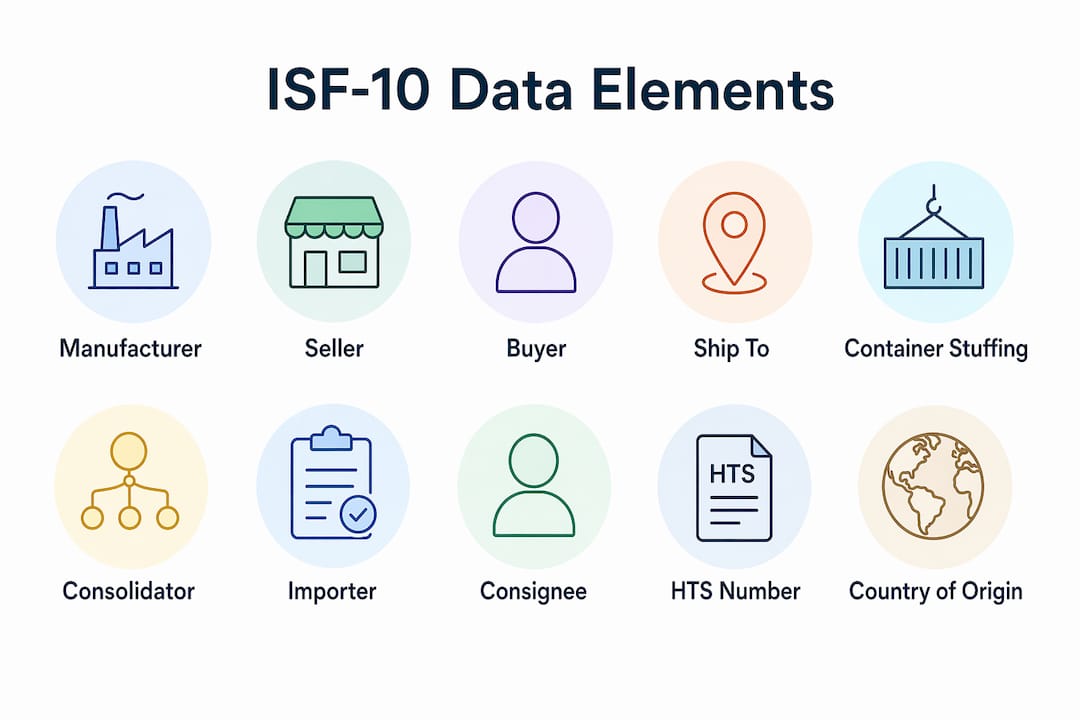
The 10 required data elements for isf-10
The following information must appear in every ISF-10 submission:
- Seller name and address
- Buyer name and address
- Importer of record number (IRS EIN, SSN, or CBP-assigned number)
- Consignee number
- Manufacturer or supplier name and address
- Ship-to party name and address
- Country of origin
- Commodity HTS (Harmonized Tariff Schedule) number (6-digit minimum)
- Container stuffing location
- Consolidator name and address
The last two elements, container stuffing location and consolidator, may be updated up to 24 hours before the vessel arrives at the first U.S. port. All other elements must be accurate at the time of initial filing.
Pro Tip: Start gathering ISF data the moment a purchase order is confirmed. Waiting for the commercial invoice or packing list to arrive often pushes you past the filing deadline.
When does ISF have to be filed?
ISF must be filed electronically at least 24 hours before cargo is loaded onto the vessel at the foreign port of origin. This is the single most misunderstood rule in ISF compliance. The deadline is not 24 hours before vessel departure. It is not 24 hours before U.S. arrival. It is 24 hours before loading at the origin port.
This distinction matters enormously in practice. On major Asia-to-U.S. trade lanes, ISF must typically be filed 14–20 days before the cargo arrives in the United States, simply because of transit times and carrier cargo cutoff schedules. An importer who waits until the ship leaves Shanghai has already missed the legal deadline.
The procedural steps for a compliant ISF submission follow a clear sequence:
- Confirm shipment details with the supplier, including HTS codes, manufacturer address, and container stuffing location.
- Transmit the ISF electronically through CBP’s Automated Broker Interface (ABI) or Automated Manifest System (AMS). Paper filing is not acceptable under any circumstances.
- Receive CBP acknowledgment confirming the filing was accepted without errors.
- Update flexible elements (container stuffing location, consolidator) no later than 24 hours before U.S. port arrival if initial data was estimated.
- Retain filing records for a minimum of five years per CBP recordkeeping requirements.
Statistic to know: Violations of ISF filing rules carry penalties of up to $5,000 per shipment, and CBP does not require a pattern of violations before issuing fines. A single late filing on a first shipment qualifies for a penalty notice.
How to file ISF: comparing your three options
Importers can file ISF through three distinct methods: self-filing via ABI-certified software, hiring a licensed customs broker, or delegating the task to a freight forwarder as part of the overall shipment workflow. Each approach carries different cost structures and compliance risks.

| Filing Method | Cost | Control | Compliance Risk | Best For |
|---|---|---|---|---|
| Self-filing (ABI software) | Low per filing | High | High if inexperienced | High-volume importers with dedicated trade compliance staff |
| Licensed customs broker | Moderate fee per filing | Moderate | Low | Importers without in-house expertise |
| Freight forwarder | Often bundled with freight | Low | Low to moderate | Importers using full-service logistics providers |
Self-filing requires direct access to ABI-certified software and a thorough understanding of HTS classification, CBP data requirements, and update procedures. The upside is cost savings at scale. The downside is that a single data error triggers a penalty, and there is no buffer of professional review.
A licensed customs broker brings regulatory expertise and direct CBP system access. Brokers typically charge a flat fee per ISF filing, which varies by provider. Per Freightos, ISF filing fees are commonly incorporated into overall customs brokerage or freight forwarding charges, making it difficult to compare costs without requesting itemized quotes. Brokers also carry liability for errors made under their license, which creates a strong professional incentive for accuracy.
Freight forwarders offer the most integrated option. When you book ocean freight through a forwarder, ISF filing is often part of the service package. The forwarder coordinates directly with your supplier and carrier to gather the required data, then transmits the filing on your behalf. This reduces the administrative burden on your team significantly.
Pro Tip: When comparing self-filing vs. customs broker options, calculate the true cost of a missed filing. One $5,000 penalty wipes out years of savings from handling ISF in-house without proper training.
ISF fees, penalties, and how to protect yourself
ISF-related costs fall into two categories: routine filing fees and penalty exposure. Understanding both is necessary for accurate import budgeting.
Routine filing fees are straightforward. Most customs brokers and freight forwarders charge between $25 and $75 per ISF filing, though this varies by provider and shipment complexity. These fees are often bundled into the broader freight invoice rather than itemized separately.
Penalty exposure is where the real financial risk lives:
- Late filing: Up to $5,000 per violation, assessed per shipment, not per container.
- Inaccurate filing: Up to $5,000 per violation for incorrect data elements, including wrong HTS codes or supplier addresses.
- Missing filing: Up to $5,000 per violation, plus CBP may place a hold on the shipment until compliance is achieved.
- Shipment holds: CBP can issue a “do not load” order at the origin port or hold cargo at the U.S. port of entry, generating demurrage and detention charges on top of the penalty itself.
Mitigation is available for first-time offenders. Penalties can be reduced to $1,000–$2,000 in some cases through a formal petition process. This requires submitting a written request to CBP explaining the circumstances of the violation and demonstrating corrective action. Mitigation is not guaranteed, and CBP grants it at its discretion.
The most effective protection against penalties is a documented filing process. Assign a specific team member or external partner responsibility for ISF on every shipment. Build ISF data collection into your purchase order workflow so the required information arrives before the cargo reaches the port. Review your ISF bond requirements as well, since a continuous bond covering ISF activity is required for most commercial importers.
Key takeaways
ISF compliance requires filing accurate, complete data at least 24 hours before cargo loads at the foreign port, with penalties reaching $5,000 per violation for any failure.
| Point | Details |
|---|---|
| ISF is mandatory for all U.S. ocean freight | Every ocean shipment to the U.S. requires an ISF-10 filing before vessel loading. |
| The 24-hour deadline is tied to loading, not departure | File before cargo is loaded at the origin port, not when the ship leaves or arrives. |
| Three filing methods exist | Self-file via ABI software, use a licensed customs broker, or delegate to a freight forwarder. |
| Penalties reach $5,000 per violation | Late, inaccurate, or missing filings each qualify as separate violations with separate fines. |
| First-time mitigation is possible | CBP may reduce penalties to $1,000–$2,000 for first offenders who petition formally. |
Why ISF compliance is simpler than most importers expect
After years of working in international logistics, I have seen ISF compliance cause more anxiety than it deserves. The regulation is strict, but the process itself is not complicated once you understand two things: what data you need and when you need it submitted.
The biggest mistake I see consistently is treating ISF as a last-minute task. Importers wait for the final commercial invoice, then scramble to file before the vessel loads. That approach works until it does not, and when it fails, the penalty arrives before the cargo does. The fix is structural. Build ISF data collection into your purchase order process. When you confirm an order with a supplier, request the manufacturer address, HTS codes, and container stuffing location at the same time. By the time the booking is confirmed, you already have 80% of what you need to file.
The second mistake is underestimating the value of a licensed customs broker for importers who ship fewer than 50 containers per year. At that volume, the cost of maintaining ABI software access and keeping staff trained on CBP requirements exceeds what a broker charges. The math is straightforward. What is less obvious is the compliance buffer a broker provides. A good broker catches data errors before they reach CBP, which is worth far more than the filing fee.
The long-term benefit of consistent ISF compliance is not just avoiding fines. CBP tracks importer compliance history. Importers with clean records experience faster cargo release, fewer exams, and less friction at every stage of the clearance process. That operational advantage compounds over time in ways that are genuinely difficult to quantify but very easy to feel when your competitors are sitting on delayed shipments.
— Ian
Let Worldwideexpress handle your ISF filing
ISF compliance is one part of a larger ocean freight process that demands precision at every step. Worldwideexpress provides full-service ocean freight forwarding and U.S. customs brokerage that covers ISF filing, cargo tracking, and clearance coordination under one roof.
When you work with Worldwideexpress, your ISF is filed accurately and on time, every shipment. The team manages data collection from your suppliers, handles CBP transmission through ABI-certified systems, and monitors filing status through to cargo release. For importers who want compliance without the administrative overhead, that is a direct path to fewer delays and zero penalty exposure.
FAQ
What is ISF filing in shipping?
ISF filing is a mandatory electronic pre-arrival data submission to U.S. Customs and Border Protection required for all ocean freight shipments destined for the United States. It must be submitted at least 24 hours before cargo is loaded at the foreign port.
Who is responsible for filing ISF?
The ISF importer, defined as the party causing goods to arrive in the U.S., bears legal responsibility for the filing. This party may file directly, or authorize a licensed customs broker or freight forwarder to file on their behalf.
What happens if ISF is filed late or incorrectly?
CBP can assess penalties of up to $5,000 per violation for late, inaccurate, or missing ISF filings. Shipments may also be held at the origin port or U.S. port of entry until compliance is achieved.
What is the difference between isf-10 and isf-5?
ISF-10 applies to all cargo destined for the United States and requires 10 data elements from the importer. ISF-5 applies to Freight Remaining on Board and transit shipments, requiring only 5 data elements from the booking party.
Can ISF penalties be reduced for first-time violations?
CBP offers a mitigation process for first-time offenders. Penalties may be reduced to $1,000–$2,000 in some cases through a formal written petition, though mitigation is granted at CBP’s discretion and is not guaranteed.
Recommended
- Master ISF filing for seamless US imports in 2026 – Worldwide Express, Inc.
- What is ISF 10+2? A 2026 Guide for US Importers – Worldwide Express, Inc.
- What Is ISF and Its Role in U.S. Import Compliance – Worldwide Express, Inc.
- ISF Shipping: Ensure Timely and Compliant Cargo Entry – Worldwide Express, Inc.