TL;DR:
- Managing international e-commerce returns involves recovering import duties, complying with regulations, and optimizing logistics to protect margins.
- Proper documentation, clear labeling of “Returned Goods,” and strategic use of regional consolidation hubs are crucial for effective duty drawback claims.
E-commerce returns and customs define the process of managing returned international shipments while recovering import duties, maintaining compliance, and controlling reverse logistics costs. Retailers lose an estimated $230 billion annually on international returns, largely because import duties paid on outbound shipments go unreclaimed when goods come back. Tools like DutyPilot, regulations such as 19 U.S.C. § 1313© and EU UCC Article 117, and 2026 regulatory changes across the US and EU have made this a business-critical function, not a back-office afterthought. Retailers who treat customs duty recovery as a distinct operational priority recover margin that most competitors simply write off.
What customs duties apply to e-commerce returns and customs processes?
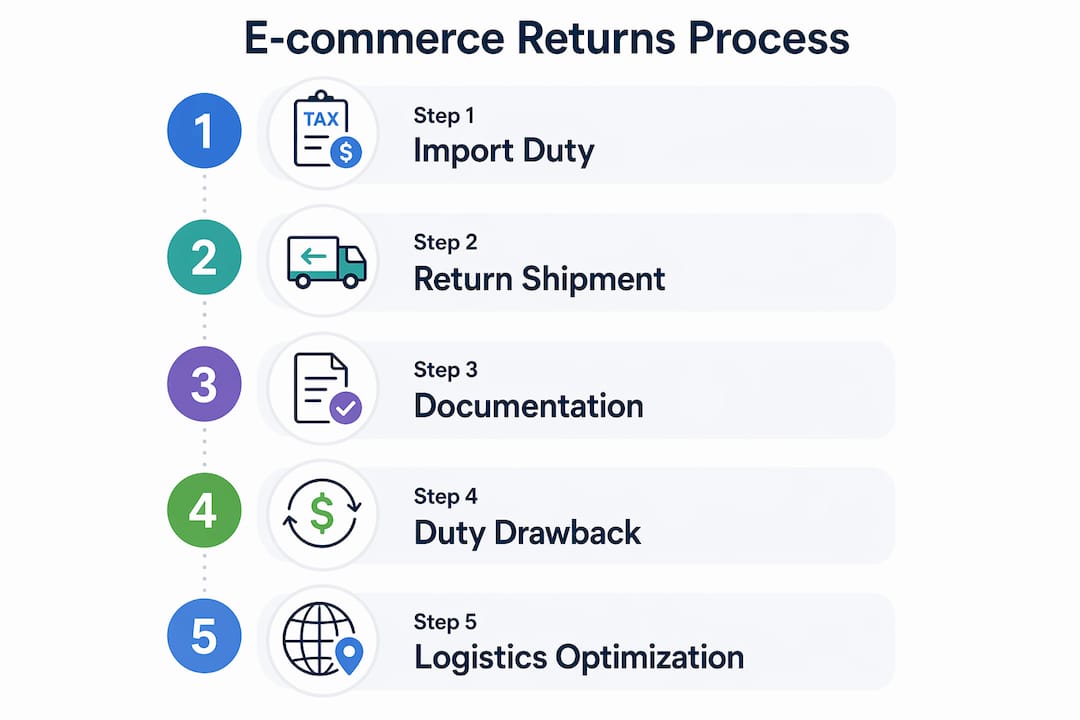
Cross-border return logistics trigger two separate customs events: the original import and the return shipment. Both carry potential duty liability, which is why understanding duty recovery mechanisms is the first step toward protecting your margins.
Duty drawback is the primary recovery tool. Under 19 U.S.C. § 1313©, US exporters can recover up to 99% of duties paid on rejected or returned merchandise, provided they submit strict documentation linking the original import, the return, and proof of re-export. The EU equivalent operates under UCC Article 117, which governs Returned Goods Relief (RGR). RGR applies when goods are re-imported into the EU within three years of original export, and it exempts those goods from customs duties on re-entry, provided the importer can prove the goods were originally exported from the EU.
The documentation requirements for a successful claim are non-negotiable. A complete filing must include:
- The original import declaration showing duties paid
- A commercial invoice for the return, explicitly marked “Returned Goods”
- Proof of re-export, such as a bill of lading or airway bill
- Evidence linking the returned item to the original import record
Processing timelines run 3 to 6 months in both the US and EU. That delay has real cash flow implications for retailers processing high volumes of returns. Canada operates a similar remission process under the Customs Act, while the UK post-Brexit maintains its own RGR framework aligned with pre-EU-exit rules.
The critical limitation most merchants miss: administrative costs can exceed the refund value for low-value items. Hiring a customs broker to file a drawback claim on a $15 returned item rarely makes financial sense. Duty recovery becomes viable at scale, which is why automation and consolidation strategies matter so much.
Pro Tip: Set a minimum duty threshold, typically $50 or more in duties paid, before initiating a drawback claim. Below that threshold, broker fees will consume the recovery.
How do Incoterms and return policies affect customs responsibilities?
The shipping terms you set on outbound orders determine who bears customs liability when goods come back. This is one of the most misunderstood cost drivers in cross-border return logistics.
Under DDP (Delivered Duty Paid), the seller pays all import duties and taxes on the outbound shipment. When the customer initiates a return under DDP terms, the seller also becomes the importer of record for the return shipment. That creates a specific obligation: the return must be declared as “Returned Goods” to avoid being treated as a new taxable import. Failure to label correctly triggers the “double duty” problem, where customs charges import duties a second time on goods that already cleared once.
DAP (Delivered at Place) and DDU (Delivered Duty Unpaid) shift the original duty burden to the buyer. On returns under these terms, the customs responsibility depends on who provides the return label. When the merchant provides the label, they take on importer-of-record status for the return, regardless of the original Incoterm. That shift in responsibility catches many retailers off guard.
Key practices to protect your position:
- Always mark return shipment documentation explicitly as “Returned Goods” with the original import entry number where available
- Include the original purchase date and invoice reference on all return paperwork
- Communicate clearly to customers which party is responsible for return shipping costs before purchase
- Avoid applying domestic return policies to international orders, since return shipping and customs costs can easily exceed the item’s value
Per industry practice, requiring customers to cover return shipping on international orders is standard. Absorbing that cost unconditionally on cross-border sales is a margin decision that requires careful modeling, not a default customer service position.
Pro Tip: Build a returns clause into your international terms and conditions that specifies the Incoterm, who pays return shipping, and the documentation the customer must include. This single step prevents the majority of double-duty disputes.
What logistics strategies reduce costs for international returns?
Optimizing the physical movement of returned goods is as important as the customs paperwork. The two most effective structural approaches are regional consolidation hubs and bulk return shipments.
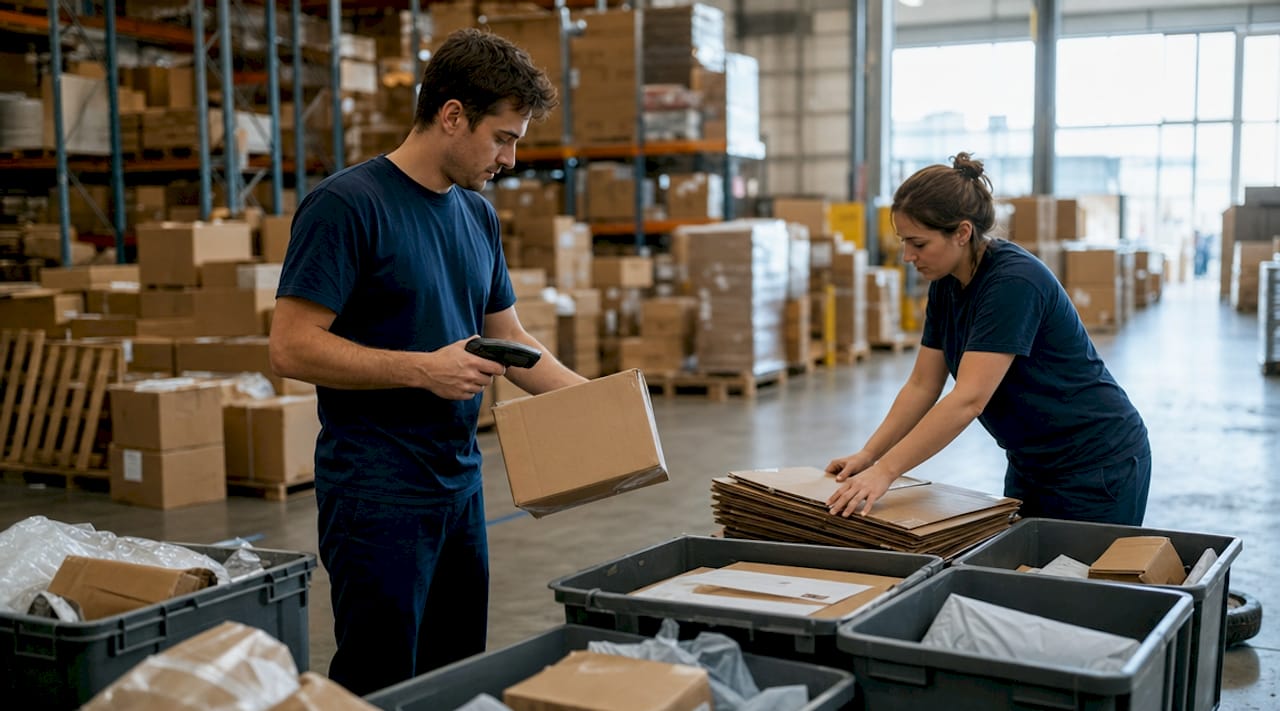
Regional consolidation hubs vs. direct international returns
| Approach | Cost profile | Customs complexity | Best for |
|---|---|---|---|
| Direct international return | High per-unit shipping cost | Each return is a separate customs event | Low-volume, high-value items |
| Regional consolidation hub | Lower per-unit cost at volume | Single bulk customs clearance | High-volume, lower-value items |
| 3PL with local hub | Shared infrastructure cost | Managed by partner | Mid-market retailers scaling internationally |
Using regional consolidation hubs reduces both logistics costs and customs complexity by aggregating individual returns within the destination country before shipping them back in bulk. A retailer selling into Germany, for example, can route all German returns to a Frankfurt consolidation point, then ship one weekly pallet back to the US origin warehouse. That single bulk shipment generates one customs entry, one duty drawback claim, and one set of documentation.
Accurate HS code management is the other non-negotiable. Customs authorities are increasing scrutiny to prevent returned goods from being misclassified as new taxable imports. If your product data is inconsistent across outbound and return shipments, customs will treat the return as a new import and charge duties accordingly. Every SKU in your catalog needs a consistent, accurate HS code applied at the product level, not assigned manually at the time of shipping.
Technology integration closes the loop. Platforms like DutyPilot connect with e-commerce and shipping systems to identify eligible returns automatically and submit customs claims without manual intervention. Per DutyPilot’s data, automation can boost recovery rates by up to 80% compared to manual filing. For retailers processing more than 200 international returns per month, that difference is material. Worldwideexpress supports this kind of integration through its logistics services infrastructure, connecting customs brokerage with freight forwarding to reduce the administrative gap between return receipt and duty recovery.
Pro Tip: Audit your HS code library before peak season. A single misclassified code applied to thousands of outbound shipments creates a compounding documentation problem when those items start coming back.
What 2026 regulatory changes affect international returns?
Two major regulatory shifts took effect in 2025 and 2026 that fundamentally change the cost structure of international e-commerce returns.
US de minimis elimination
The US eliminated the $800 de minimis exemption on August 29, 2025. Every shipment entering the US now faces import duty assessment regardless of value. For e-commerce retailers receiving returned goods from US customers, this change has limited direct impact since returns from the US are outbound. But for retailers shipping into the US who previously relied on de minimis to avoid duty on low-value outbound orders, the elimination means higher landed costs and a stronger case for duty drawback on returns.
EU low-value threshold expiration
The EU’s €150 duty-free threshold expired on July 1, 2026. The replacement framework introduces a minimum €3 customs duty on all low-value parcels entering the EU. The table below summarizes the key changes:
| Regulation | Previous rule | 2026 rule | Impact on returns |
|---|---|---|---|
| EU duty-free threshold | €150 exemption | Minimum €3 duty on all parcels | All EU returns now carry duty liability |
| US de minimis | $800 exemption | No exemption; all shipments dutiable | Higher compliance burden on US imports |
| HS code accuracy | Moderate enforcement | Strict scrutiny on all low-value parcels | Misclassification risk increases significantly |
The EU change also introduces handling fees on low-value parcels processed through customs. VAT treatment remains complex: returned goods are generally VAT-exempt on re-import, but the administrative process for claiming that exemption varies by member state. Retailers selling into France, Germany, and the Netherlands face different local procedures despite the unified EU framework.
The practical implication: duty recovery on EU returns is now worth pursuing even for lower-value items, because the €3 minimum duty applies universally. Retailers who previously ignored duty drawback for sub-€150 shipments now have a financial reason to build that process. Worldwideexpress’s customs brokerage services are structured to handle exactly this kind of volume-driven compliance work.
Key takeaways
Managing e-commerce returns and customs in 2026 requires duty recovery processes, accurate HS code management, and logistics consolidation to protect margins on international sales.
| Point | Details |
|---|---|
| Duty recovery is not automatic | File drawback claims under 19 U.S.C. § 1313© or EU UCC Article 117 with complete documentation to reclaim up to 99% of duties. |
| Label returns correctly | Mark all return shipments as “Returned Goods” with original import references to avoid double-duty charges. |
| Consolidate returns at regional hubs | Bulk returns through local consolidation points reduce per-unit shipping costs and simplify customs clearance. |
| 2026 regulations changed the math | The EU’s €3 minimum duty and US de minimis elimination make duty recovery viable for lower-value shipments than before. |
| Automate where volume justifies it | Platforms like DutyPilot can increase duty recovery rates by up to 80% for retailers processing high return volumes. |
What most retailers get wrong about international returns
I’ve watched merchants spend months building out beautiful customer-facing return portals while completely ignoring the customs side of the equation. The portal looks great. The duty liability quietly compounds in the background.
The documentation gap is where most operations fall apart. Retailers assume that because they paid duties on the outbound shipment, the return is automatically duty-free. It is not. The exemption requires proof, and that proof must be filed correctly and on time. I’ve seen six-figure duty recovery opportunities expire because no one tracked the three-year RGR window in the EU.
The other underestimated factor is the Incoterm trap. A retailer switches from DAP to DDP to improve customer experience, which is a legitimate business decision. But they don’t update their return documentation procedures to reflect that they are now the importer of record on returns. The first time a batch of returns clears customs as new imports, the double-duty bill arrives and no one knows why.
My honest recommendation: treat customs duty recovery as a finance function, not a logistics function. Assign ownership, set recovery thresholds, and audit your HS code library at least twice a year. The retailers who do this consistently recover margin that funds their next market expansion. The ones who don’t are effectively subsidizing their customers’ returns.
— Ian
How Worldwideexpress supports your returns and customs operations
Worldwideexpress brings customs brokerage, freight forwarding, and reverse logistics under one operational framework, which matters when you are managing the documentation chain from return receipt to duty recovery. Their team handles customs clearance, HS code compliance, and import documentation across US and international lanes, reducing the administrative burden that causes most duty recovery claims to fail or expire. For retailers scaling international sales in 2026, their freight forwarding guide outlines how to structure cross-border logistics for both outbound and return shipments. If you are dealing with the EU’s new minimum duty rules or the post-de-minimis US environment, contact Worldwideexpress for a tailored customs brokerage and returns logistics assessment.
FAQ
What is duty drawback for e-commerce returns?
Duty drawback is a US customs provision under 19 U.S.C. § 1313© that allows retailers to recover up to 99% of import duties paid on goods that are subsequently returned and re-exported. Claims require original import declarations, proof of duty payment, and proof of re-export.
How do I avoid double duty on international returns?
Mark all return shipments explicitly as “Returned Goods” on customs documentation and include the original import entry number. When the merchant provides the return label, they become the importer of record and must file correctly to prevent customs from treating the return as a new taxable import.
What changed in EU customs rules for e-commerce in 2026?
The EU’s €150 duty-free threshold expired July 1, 2026, replaced by a minimum €3 customs duty on all low-value parcels. Retailers shipping into the EU now face duty liability on every shipment, making accurate HS codes and duty recovery processes more financially significant than before.
How long does a duty drawback claim take to process?
Duty drawback and remission claims typically take 3 to 6 months to process in both the US and EU. Retailers should factor this timeline into cash flow planning and maintain complete documentation archives for at least three years to support RGR claims.
Should I use a 3PL for international e-commerce returns?
Using a third-party logistics provider with regional consolidation hubs reduces per-unit return costs and simplifies customs processing by aggregating individual returns into bulk shipments. This approach is most cost-effective for retailers processing more than 100 international returns per month.
Recommended
- Top e-commerce shipping strategies for logistics success 2026 – Worldwide Express, Inc.
- Avoid costly international shipping mistakes in 2026 – Worldwide Express, Inc.
- B2B E-Commerce Logistics: Strategies for 2026 Success – Worldwide Express, Inc.
- Understanding freight forwarding: a 2026 guide – Worldwide Express, Inc.