TL;DR:
- An export declaration is a mandatory document submitted to customs that details goods or services being exported. Accurate and timely filing using the correct system ensures compliance and prevents delays, fines, or shipment seizures. The exporter of record maintains legal responsibility for declaration accuracy, regardless of third-party involvement or errors.
An export declaration is the mandatory formal statement submitted to customs authorities that details the goods or services you intend to export. Known formally as a customs export form or export documentation filing, it serves three simultaneous functions: it feeds national trade statistics, triggers regulatory screening, and creates the legal record that protects you if a shipment is ever questioned. Businesses that treat this document as a formality rather than a compliance instrument routinely face delays, fines, and shipment seizures. Getting it right from the start is the only acceptable standard.
What is an export declaration and when is it required?
An export declaration is required any time goods or services cross an international border above specified value thresholds or to controlled destinations. The filing requirement is not universal in its form. It varies by country, shipment type, and the nature of what you are exporting.
The table below shows the most common declaration types by region and export category:
| Declaration Type | Region / System | Applies To |
|---|---|---|
| Shipper’s Export Declaration (SED) | United States (legacy) | Physical goods, now replaced by AES |
| Automated Export System (AES) filing | United States | All commercial goods electronically |
| Canadian Export Reporting System (CERS) | Canada | Most commercial goods exports |
| Shipping Bill | India | Physical goods via sea or air |
| SOFTEX Form | India | Software and IT service exports |
| Export Declaration Form (EDF) | General international use | Goods and project exports |
The United States requires advance electronic export data submission through the Automated Export System (AES), which is the system of record for all transport modes. Canada replaced its paper-based system with CERS, a fully electronic portal designed to reduce manual errors and improve data accuracy.
Service exports follow different rules. India’s Reserve Bank of India (RBI) mandates that service export declarations be submitted within 30 days from the end of the invoice month under its 2026 regulations. That 30-day window is tight for businesses that invoice on rolling cycles, so calendar-based tracking is not optional. For small exporters shipping below certain value thresholds to low-risk destinations, some jurisdictions waive the filing requirement entirely. Check the specific rules for your destination country before assuming an exemption applies.
What documents and information must you prepare?
Accurate export documentation starts well before you log into any filing portal. The core documents required for most physical goods shipments include:
- Commercial invoice: Shows the buyer, seller, goods description, quantity, and declared value.
- Packing list: Details the physical contents of each package, including weights and dimensions.
- Shipping bill or bill of lading: Issued by the carrier and required for customs clearance.
- Export license: Required for controlled goods such as dual-use technology, defense articles, or sanctioned-destination shipments.
- Harmonized System (HS) tariff code: A standardized numeric code classifying your goods for duty and statistical purposes.
Beyond documents, the export declaration form itself captures item description, declared value, consignee details, and shipment specifics. Every field matters. Customs authorities use this data to assess risk, calculate duties, and enforce trade controls.
Service exports require a different documentation set. SOFTEX filings in India, for example, require software export invoices and project completion certificates rather than packing lists. The documentation gap between goods and services catches many exporters off guard when they expand into consulting, software, or engineering service exports.

One often overlooked risk is relying entirely on data supplied by freight forwarders or consignees without verification. Exporters should proactively verify data accuracy even when third parties prepare the documents, because the legal liability stays with the exporter of record regardless of who typed the form.
Pro Tip: Cross-check your HS tariff code against both the U.S. Schedule B and the destination country’s import tariff schedule. A code that is correct for export purposes may trigger a different duty rate or import restriction at the destination.
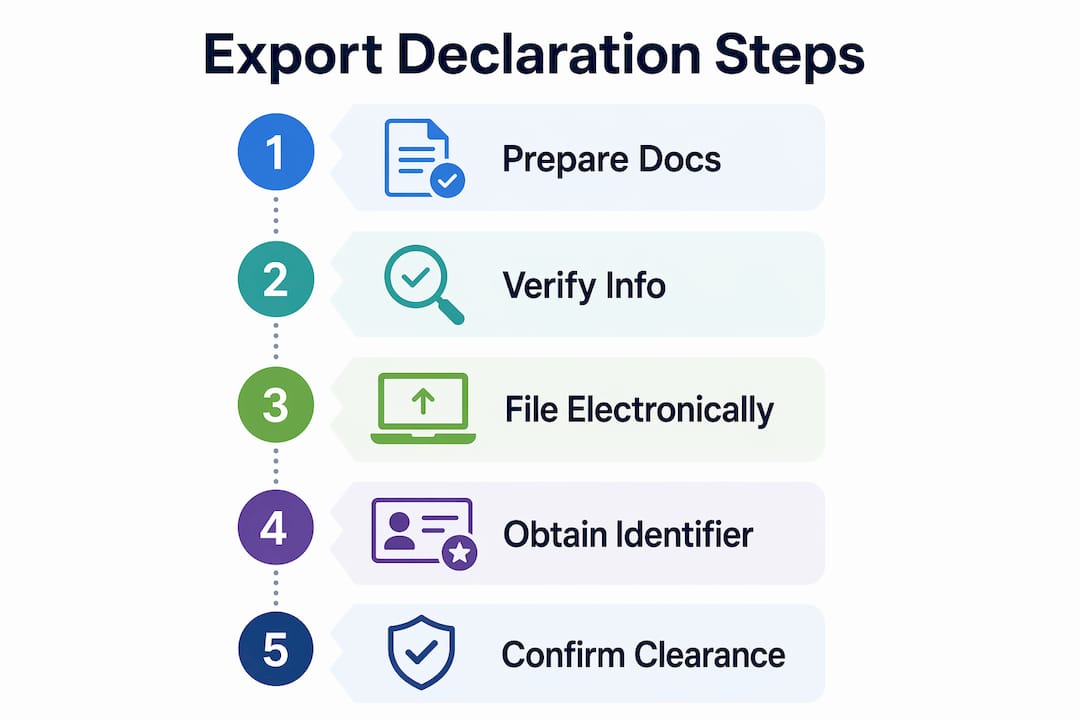
How to file an export declaration: step-by-step
Filing a customs export form correctly requires a defined sequence. Skipping steps or reversing the order creates errors that are expensive to correct after submission.
- Gather all required documents before opening any portal. Missing a commercial invoice or HS code mid-filing forces you to exit and restart, which can create duplicate draft records.
- Classify your goods using the correct HS tariff code. Misclassification is the single most common reason declarations are flagged for review.
- Determine your filing system. U.S. exporters file through AES. Canadian exporters use CERS. Indian service exporters use the SOFTEX route via ICEGATE or authorized banks.
- Enter all mandatory fields in the portal. AES requires the Employer Identification Number (EIN), Schedule B number, value, quantity, and ultimate consignee details.
- Run a pre-submission check. CERS provides automated data validation that flags inconsistencies before the record is transmitted. Use it.
- Submit and retain the confirmation number. In the U.S., AES returns an Internal Transaction Number (ITN). The ITN must appear on the bill of lading before the shipment departs.
- Correct errors immediately. Most systems allow amendments before the shipment clears. Post-departure amendments are possible but attract scrutiny.
The table below summarizes the primary filing systems by country:
| Country | Filing System | Key Identifier Issued |
|---|---|---|
| United States | AES (via ACE portal) | Internal Transaction Number (ITN) |
| Canada | CERS | Export Declaration Number (EDN) |
| India (goods) | ICEGATE / Shipping Bill | Shipping Bill Number |
| India (services) | SOFTEX via RBI | SOFTEX Form Number |
Freight forwarders can file on your behalf, and many exporters use this route for complex shipments. The role of freight forwarders in global shipping includes managing documentation, but it does not transfer your legal responsibility. The exporter of record is legally liable for declaration accuracy regardless of third-party involvement. That is not a technicality. Enforcement agencies have assessed penalties against exporters whose forwarders made errors the exporter never caught.
Modern customs authorities also use machine-learning-based risk assessment to flag shipments for inspection. Declarations with inconsistent data patterns, unusual value-to-weight ratios, or mismatched HS codes draw automated scrutiny. Accuracy is your best defense against that screening.
Pro Tip: File your AES declaration at least one hour before departure for truck shipments and two hours before for air. Late filings generate violations that accumulate into enforcement actions even when the underlying goods are fully compliant.
What compliance mistakes do exporters most often make?
Export compliance failures cluster around a predictable set of errors. Recognizing them in advance is far cheaper than correcting them after a penalty notice arrives.
- Misclassifying goods: Using an approximate HS code instead of the correct one is the most frequent error. Customs authorities treat misclassification as either negligence or fraud depending on the pattern.
- Incomplete data entries: Leaving fields blank or entering “various” for item descriptions triggers manual review and delays clearance.
- Failing to validate third-party data: When a freight forwarder or consignee supplies shipment details, many exporters accept them without review. That is a compliance gap.
- Missing regulatory timelines: India’s 30-day RBI deadline for service exports and AES pre-departure filing windows are firm. Missing them generates violations even when the goods themselves are fully legal.
- Narrow denied party screening: Denied party screening must extend beyond the buyer to every entity in the transaction chain, including freight forwarders, banks, and ship-to parties. Screening only the end buyer misses the most common sanctions exposure points.
- No internal compliance program: Enforcement agencies including OFAC and BIS treat well-documented compliance programs as primary mitigating factors when calculating penalties. Companies without one receive no credit for good intentions.
“A well-rounded export compliance program with training, auditing, and risk management reduces legal and financial risks.” — Building an Export Compliance Program: A Practical Guide for US Businesses
The practical implication is clear. An internal compliance program is not overhead. It is insurance that pays out when something goes wrong, and something eventually goes wrong in every active export operation. Periodic audits, written procedures, and staff training are the three components that enforcement agencies look for first. Review your export compliance essentials regularly to stay current with regulatory changes.
Key Takeaways
An accurate export declaration, filed on time through the correct system, is the single most effective action an exporter can take to avoid penalties, delays, and enforcement scrutiny.
| Point | Details |
|---|---|
| Know your filing system | U.S. exporters use AES, Canadian exporters use CERS, and Indian service exporters use SOFTEX via ICEGATE. |
| Verify all third-party data | The exporter of record is legally liable for declaration accuracy even when a freight forwarder prepares the filing. |
| Meet all filing deadlines | India’s RBI mandates a 30-day submission window for service exports; AES requires pre-departure filing. |
| Screen every transaction party | Denied party screening must cover freight forwarders, banks, and ship-to parties, not just the end buyer. |
| Build a compliance program | OFAC and BIS treat documented compliance programs as mitigating factors when assessing penalties. |
Why accuracy in export declarations is non-negotiable
The part of export compliance that most businesses underestimate is the accountability gap between who prepares the paperwork and who owns the legal risk. I have seen exporters assume that handing documents to a freight forwarder transfers responsibility. It does not. The exporter of record signs off on the declaration, and that signature carries full legal weight regardless of who typed the data.
The most effective approach I have observed is treating the export declaration as an internal audit checkpoint, not a shipping formality. That means assigning a specific person to verify HS codes, cross-check declared values against invoices, and confirm that every party in the transaction has cleared denied party screening. It takes an extra 30 minutes per shipment. It saves weeks of enforcement correspondence.
Denied party screening is where I see the widest gap between what companies think they do and what they actually do. Screening the buyer is standard practice. Screening the freight forwarder, the bank, and the intermediate consignee is not. That gap is exactly where sanctions violations occur. The 2026 shipping regulations for SMEs reinforce this point, noting that smaller exporters face the same screening obligations as large corporations.
Building a compliance program does not require a legal department. It requires written procedures, a training schedule, and a quarterly audit. Those three elements are what enforcement agencies look for when they decide whether a violation was negligent or willful. The difference in penalty amounts is substantial. Start with the step-by-step export guide and build from there.
— Ian
How Worldwideexpress supports your export documentation
Worldwideexpress brings deep expertise in customs brokerage and international freight forwarding to exporters who need reliable documentation support. Whether you are filing your first export declaration or managing a high-volume shipping program, the team at Worldwideexpress handles the complexity of customs clearance, HS code classification, and compliance verification.
Their logistics services cover the full export process from document preparation through customs clearance and final delivery. Worldwideexpress works across air, ocean, and ground transport, giving exporters a single point of contact for shipments to any destination. For businesses that need to reduce filing errors, meet tight regulatory deadlines, and maintain clean compliance records, Worldwideexpress offers the experience and systems to make that happen consistently. Contact Worldwideexpress to discuss a tailored export logistics solution for your operation.
FAQ
What is an export declaration?
An export declaration is a mandatory formal statement submitted to customs authorities that details the goods or services being exported, including their value, quantity, classification, and consignee information.
When is an export declaration required?
A declaration is required when goods exceed specified value thresholds, are shipped to controlled destinations, or fall under regulated product categories. Filing requirements vary by country and export type.
What is the Automated Export System (AES)?
AES is the U.S. system of record for electronic export data, required for all commercial goods shipments across all transport modes, per U.S. Customs and Border Protection rules.
Can a freight forwarder file the export declaration for me?
Yes, a freight forwarder can file on your behalf, but the exporter of record remains legally liable for the accuracy of all information submitted, regardless of who prepares the filing.
What happens if I make an error on my export declaration?
Errors can be amended in most systems before the shipment departs. Post-departure corrections attract regulatory scrutiny, and repeated errors can trigger formal enforcement action from agencies like OFAC or BIS.
Recommended
- Understanding Export Licenses: A 2026 Compliance Guide – Worldwide Express, Inc.
- Export compliance essentials: Key regulations and best practices – Worldwide Express, Inc.
- Step-by-step guide to exporting goods: compliance to shipment – Worldwide Express, Inc.
- Master the Export Documentation Process in 2025 – Worldwide Express, Inc.