TL;DR:
- Express shipping offers faster delivery options such as overnight and same-day services, with notable carriers like DHL, FedEx, and UPS providing 1–3 day international options. Businesses must carefully select service tiers, negotiate clear SLAs, and control costs by optimizing fulfillment strategies, including regional inventory and micro-fulfillment centers. Speed alone is insufficient; integrating proper infrastructure, real-time tracking, and understanding carrier limitations are essential for a successful shipping strategy.
Express shipping is defined as a premium delivery service that guarantees significantly faster transit times than standard shipping, typically delivering packages within 1–3 business days or less. Providers like DHL Express, FedEx, UPS, Amazon, and Walmart have built entire service tiers around this demand. For e-commerce retailers and businesses, fast delivery is no longer a differentiator. It is a baseline expectation. This guide breaks down every service type, carrier option, cost factor, and fulfillment strategy you need to make smarter shipping decisions in 2026.
What is express shipping and which service types exist?
Express shipping covers multiple service tiers built around urgency, each with distinct speed and cost trade-offs. Understanding the differences prevents costly mismatches between what your customer expects and what you actually deliver.
The main service types are:
- Overnight shipping: Delivers the next business day, typically by end of day or by 10:30 a.m. for premium options. USPS Priority Mail Express and FedEx First Overnight fall into this category. Best for urgent documents, medical supplies, or high-value goods.
- Next day delivery: Functionally similar to overnight but sometimes with a later cutoff window. UPS Next Day Air and DHL Express 9:00 are standard examples.
- 2-day express: Balances speed and cost for most e-commerce use cases. Amazon Prime’s 2-day promise made this the standard consumer expectation.
- Same day shipping: Available in major metro areas through carriers like FedEx SameDay and regional courier networks. Costs are significantly higher but customer satisfaction scores reflect the premium.
- Sub-hour delivery: The newest tier, driven by Amazon Now and Walmart’s 30-minute delivery expansion. Requires localized inventory and dedicated driver networks.
Pro Tip: Match the service tier to the actual urgency, not the customer’s preference. Offering free 2-day shipping on low-margin products erodes profit faster than a return rate spike. Build a tiered checkout option so customers self-select and pay accordingly.
How do major carriers compare for express shipping?
Carrier selection is one of the most consequential decisions a logistics manager makes. DHL, UPS, and FedEx all offer 1–3 business day international express delivery, but they differ meaningfully in hub routing, lane performance, and customs handling.

| Carrier | Speed | Coverage | Money-Back Guarantee | Key Strength |
|---|---|---|---|---|
| DHL Express Worldwide | 1–3 business days | 220+ countries | Yes, on eligible U.S. lanes | International reach, priority customs |
| FedEx Express | 1–3 business days | 220+ countries | Yes, with exclusions | Domestic reliability, dense U.S. network |
| UPS Worldwide Saver | 1–3 business days | 220+ countries | Yes, with exclusions | B2B freight, strong SLA history |
| USPS Priority Mail Express | 1–2 business days | Domestic U.S. only | Yes, limited | Cost efficiency for small parcels |
| Amazon Now | Under 30 minutes | Select U.S. metros | No formal guarantee | Ultra-fast, localized fulfillment |
DHL Express Worldwide commits to end-of-day delivery with priority customs clearance across more than 220 countries. That global footprint makes it the strongest option for businesses with heavy international volume. FedEx and UPS match that country count but differ on specific lane performance, particularly in Asia-Pacific and Latin America corridors.
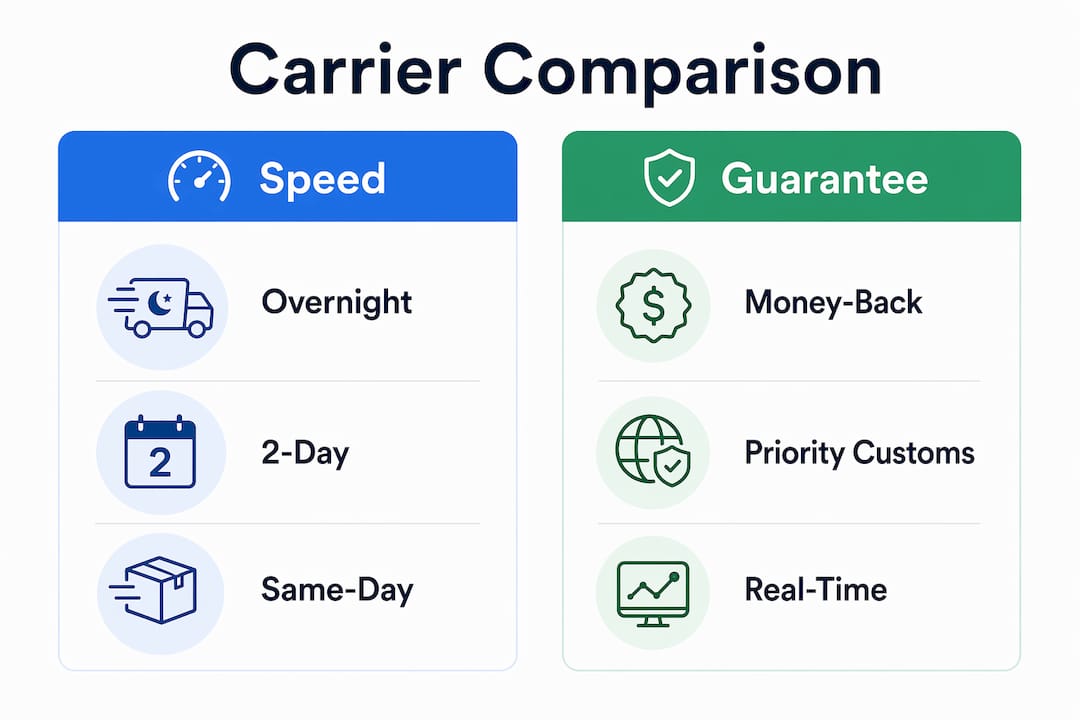
For domestic ultra-fast delivery, Amazon Now and Walmart have separated themselves from traditional carriers entirely. Their model depends on localized inventory rather than carrier speed. That distinction matters when you are building a fulfillment strategy, not just selecting a shipping label.
Pro Tip: Do not assume the carrier with the best domestic rates performs equally well on international lanes. Request lane-specific transit data from your account rep before committing to a contract. A carrier that excels on U.S.-to-Germany routes may underperform on U.S.-to-Brazil shipments.
What cost factors drive express shipping pricing?
The label price is rarely the total cost. Landed cost includes base shipping rates plus customs duties, brokerage fees, taxes, fuel surcharges, and remote area fees. Businesses that evaluate only the base rate routinely underestimate total expenditure on international express shipments.
The core pricing components to track are:
- Base rate: Determined by weight, dimensions, origin, and destination. Dimensional weight (DIM weight) often applies, meaning a large but light box costs more than its actual weight suggests.
- Fuel surcharges: Adjusted weekly or monthly by most carriers. These can add 15–25% to the base rate depending on market conditions.
- Remote area fees: Applied when the delivery address falls outside a carrier’s standard service zone. DHL, FedEx, and UPS all publish remote area surcharge lists, and they are longer than most shippers expect.
- Customs and brokerage fees: For international shipments, these are non-negotiable costs. Priority customs clearance, offered by DHL Express, reduces delay risk but adds to the invoice.
- Delivery failure costs: Missed deliveries, address corrections, and redelivery attempts add up quickly. These are rarely factored into initial cost models.
Money-back guarantees for express shipments frequently exclude delays caused by weather, customs holds, strikes, and force majeure events. That exclusion list is broader than most businesses realize. Negotiating clear SLA terms with defined accountability windows is more reliable than depending on a standard retail guarantee.
Pro Tip: Ask your carrier for a full surcharge schedule before signing any volume agreement. Fuel surcharges and remote area fees are the two most common sources of invoice shock for businesses scaling their express shipping volume.
How are fulfillment strategies evolving to meet express demand?
Speed expectations have outpaced what traditional carrier networks can deliver on their own. Quick commerce is the strategic response: companies are repositioning inventory closer to customers and building fulfillment infrastructure designed for 30-minute to 1-hour delivery windows, not next-day promises.
The evidence is concrete. Amazon Now delivers in under 30 minutes across dozens of U.S. cities using dark stores and on-demand Flex drivers. That model bypasses the carrier network entirely. Walmart has matched that ambition: 26% of Walmart’s express deliveries now arrive in 30 minutes or less across 33 U.S. markets, with a $10 specialized delivery fee for Walmart+ members.
For e-commerce retailers not operating at Amazon or Walmart scale, the practical implications are:
- Micro-fulfillment centers: Smaller, strategically located warehouses in urban areas reduce last-mile distance. Companies like Gopuff have built their entire model around this approach.
- Integrated tracking: Real-time express shipping tracking visibility is now a customer expectation, not a premium feature. Carriers that offer live GPS updates reduce inbound customer service contacts significantly.
- Inventory positioning: Stocking high-velocity SKUs at regional hubs rather than a single national distribution center is the most direct way to cut transit time without upgrading to a faster carrier tier.
- On-demand driver networks: Partnering with local courier platforms extends same day shipping capability without building proprietary infrastructure.
The shift from shipping as a cost center to shipping as a strategic differentiator is the defining logistics trend of 2026. Businesses that treat fulfillment speed as a product feature, not a back-office function, are capturing measurable gains in repeat purchase rates and customer lifetime value.
How can businesses optimize express shipping operations?
Selecting the right carrier is step one. Building a repeatable, cost-controlled process around urgent package delivery is the harder and more valuable work. These steps create a reliable foundation:
- Audit your current carrier mix. Identify which lanes have the highest delay rates and compare them against carrier performance data. Use this to justify renegotiating terms or switching providers on underperforming routes.
- Negotiate SLA terms explicitly. Standard service agreements favor the carrier. Push for defined transit time commitments, clear escalation procedures, and financial accountability for failures outside the excluded categories.
- Integrate real-time tracking into your customer experience. Proactive delivery notifications reduce customer anxiety and cut “where is my order” contacts by a measurable margin. Most major carriers offer API-based tracking feeds.
- Prioritize customs clearance for international shipments. Customs delays are the single most common cause of express shipment failures on international lanes. Working with a licensed customs clearance partner reduces that risk significantly. Understanding how to avoid customs delays is as important as selecting the right carrier.
- Review money-back guarantee exclusions annually. Carrier policies change. What was covered last year may be excluded today. Build this review into your annual carrier contract cycle.
- Use commercial rate platforms. Businesses shipping at volume qualify for discounted commercial rates that are substantially lower than retail pricing. Platforms that aggregate carrier rates give you leverage without requiring individual volume commitments to each carrier.
Pro Tip: Consolidate your express shipping volume with two or three preferred carriers rather than spreading it across five or six. Volume concentration gives you negotiating leverage and simplifies your tracking and billing reconciliation.
Key takeaways
Express shipping delivers competitive advantage only when businesses match service tiers to actual urgency, control landed costs, and build fulfillment infrastructure that supports the delivery promises they make to customers.
| Point | Details |
|---|---|
| Service tier selection | Match overnight, 2-day, or same-day options to urgency and margin, not just customer preference. |
| Carrier lane performance | DHL, FedEx, and UPS differ by route; request lane-specific data before committing to a contract. |
| Landed cost accuracy | Factor in fuel surcharges, remote area fees, and customs costs beyond the base shipping rate. |
| Fulfillment positioning | Micro-fulfillment centers and regional inventory reduce transit time more reliably than carrier upgrades. |
| SLA negotiation | Standard money-back guarantees exclude weather, customs, and force majeure; negotiate explicit accountability terms. |
Why speed alone won’t save your shipping strategy
The businesses I see struggle most with express shipping are not the ones that chose the wrong carrier. They are the ones that treated speed as the only variable worth optimizing. Speed without cost control is a margin problem. Speed without inventory positioning is a promise you cannot keep. And speed without real-time tracking visibility is a customer service disaster waiting to happen.
What actually works is treating express delivery as a system, not a service. The carriers are one component. Your warehouse locations, your SKU velocity data, your customs documentation process, and your customer communication cadence are equally important. Amazon and Walmart did not win on shipping speed because they found a faster carrier. They won because they rebuilt their entire fulfillment infrastructure around the delivery promise.
For most e-commerce retailers, the practical starting point is not sub-hour delivery. It is getting 2-day shipping right, consistently, with accurate tracking and clean customs documentation on international orders. That foundation is what earns customer trust. The ultra-fast tiers come later, once the fundamentals are solid.
One more thing worth saying plainly: read the fine print on every money-back guarantee before you build it into your customer-facing SLA. Carriers exclude far more than most businesses realize, and discovering that exclusion after a high-profile delivery failure is a painful lesson. Negotiate before you commit, not after.
— Ian
How Worldwideexpress supports your express shipping needs
Worldwideexpress specializes in express and expedited shipping solutions built specifically for businesses managing complex international and domestic delivery requirements.
Worldwideexpress brings together carrier relationships, customs brokerage expertise, and real-time tracking tools under one platform, so your team spends less time managing exceptions and more time growing the business. Whether you need priority customs clearance on international lanes or a reliable logistics services partner for high-volume express shipments, Worldwideexpress has the infrastructure and experience to deliver. Explore the full range of international shipping solutions and find the right fit for your operation.
FAQ
What is express shipping, exactly?
Express shipping is a premium delivery service that guarantees faster transit times than standard options, typically 1–3 business days or less. Service tiers range from overnight and next day delivery to same day and sub-hour options depending on the carrier and location.
How does express shipping tracking work?
Most major carriers including DHL Express, FedEx, and UPS provide real-time tracking through online portals and API feeds. Businesses can integrate these feeds directly into their customer-facing order management systems for automated delivery notifications.
What are typical overnight shipping rates?
Overnight shipping rates vary by carrier, package weight, and destination. Fuel surcharges, dimensional weight calculations, and remote area fees all affect the final invoice. Commercial accounts with volume commitments receive significantly lower rates than retail pricing.
Why do money-back guarantees often fail to pay out?
Money-back guarantees exclude delays caused by weather, customs holds, strikes, and force majeure events. These exclusions cover a large share of real-world delay scenarios, which is why negotiating explicit SLA terms matters more than relying on standard guarantee language.
How does same day shipping differ from next day delivery?
Same day shipping delivers within hours of order placement, typically within a single metro area using local courier networks or micro-fulfillment centers. Next day delivery uses standard carrier networks and guarantees arrival by the following business day, with broader geographic coverage but longer lead times.
Recommended
- Top e-commerce shipping strategies for logistics success 2026 – Worldwide Express, Inc.
- Master Ecommerce International Shipping in 5 Steps – Worldwide Express, Inc.
- E-Commerce Returns and Customs: A 2026 Retailer Guide – Worldwide Express, Inc.
- B2B E-Commerce Logistics: Strategies for 2026 Success – Worldwide Express, Inc.