TL;DR:
- Freight classification errors in LTL shipping lead to significant cost increases and compliance issues.
- Adopting automated AI tools, precise measurements, and cross-departmental coordination can reduce reclassification risks and costs.
Freight classification challenges are the leading cause of unexpected cost increases in less-than-truckload (LTL) shipping, directly threatening compliance and budget control for logistics teams. The formal framework behind these challenges is the National Motor Freight Classification (NMFC) system, maintained by the National Motor Freight Traffic Association (NMFTA). Getting a shipment’s class wrong triggers reclassification fees of $30–$75 plus rate increases of 20–50% per shipment. For mid-size shippers, classification errors add 5–10% in avoidable freight spend annually. With NMFC updates reshaping the rules in 2025 and 2026, the cost of getting this wrong has never been higher.
What causes freight classification errors and higher costs?
The NMFC system assigns every shipment a class based on four core characteristics: density, stowability, handling, and liability. Each factor carries weight in the final class assignment, and a mistake in any one of them can push a shipment into a higher, more expensive class.
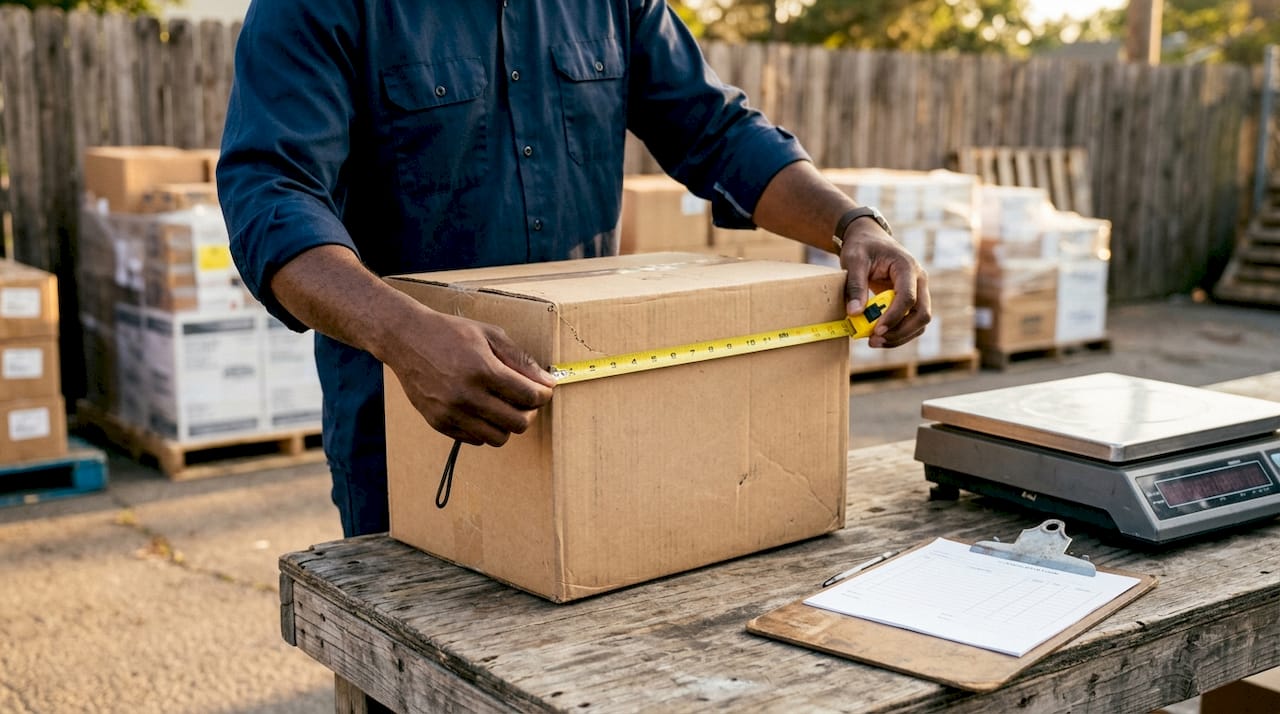
Density is the most frequently mishandled factor. It is calculated by dividing a shipment’s weight by its cubic volume. Shippers who estimate pallet dimensions instead of measuring them precisely create density figures that do not match what carriers find at the terminal. Inaccurate dimensions and weight are the most common triggers for carrier-initiated reclassification.
Stowability refers to how easily a shipment fits alongside other freight in a trailer. Odd-shaped items, hazardous materials, or oversized loads that cannot be stacked face higher classes. Handling covers the labor and equipment required to move a shipment. Fragile goods or items requiring special equipment receive higher handling scores. Liability reflects the risk of damage or theft, which is why high-value electronics consistently land in higher freight classes than bulk commodities.
The financial consequences of getting these factors wrong are direct and immediate. Carriers enforce strict pricing discipline in 2026 regardless of market conditions. A single reclassified pallet can wipe out the margin on an entire shipment.
Common error types include:
- Estimated rather than measured pallet dimensions
- Incorrect total weight that excludes packaging materials
- Vague commodity descriptions on the Bill of Lading that do not match NMFC catalog entries
- Applying a single class to a mixed-freight shipment without itemizing each commodity
- Using outdated NMFC codes that no longer reflect current commodity definitions
Pro Tip: Use a certified floor scale and a tape measure for every shipment. Calculate density yourself before submitting the Bill of Lading. Carriers will do the same at the terminal, and their number is the one that counts.
How are 2025–2026 NMFC updates changing classification?
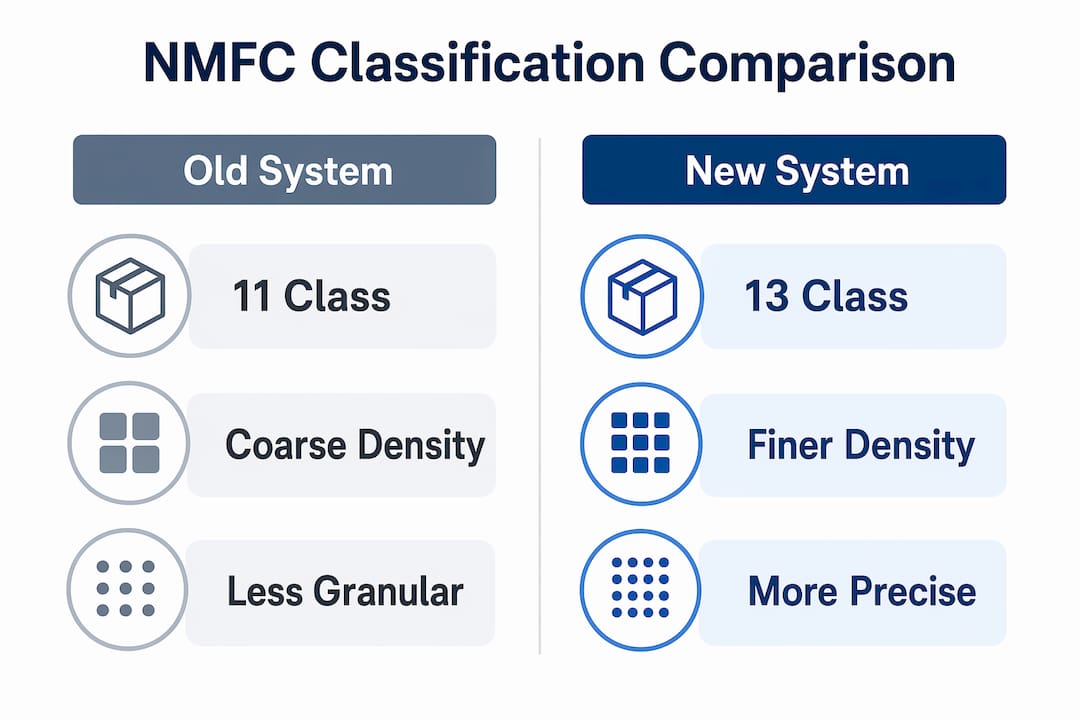
The NMFTA introduced its most significant structural change in years starting July 2025. A new 13-class density scale replaced the previous 11-class system, affecting approximately 2,000 commodities. That change means shippers who previously classified freight accurately may now be using the wrong class simply because the scale shifted beneath them.
The 13-class system creates finer density breakpoints. A shipment that previously fell cleanly into one class may now sit at the boundary between two classes under the new scale. That ambiguity creates disputes and increases the likelihood of carrier reclassification during terminal inspection.
The table below illustrates how the structural shift affects classification decisions:
| Classification Criteria | Old 11-Class System | New 13-Class System (2025+) |
|---|---|---|
| Number of density tiers | 11 | 13 |
| Density breakpoints | Broader ranges | Finer, more precise intervals |
| Commodities affected | Subset of catalog | ~2,000 commodities updated |
| Pricing accuracy | Lower granularity | Higher granularity |
| Reclassification risk | Moderate | Higher during transition period |
Mixed freight shipments face additional pressure from proposed revisions to NMFTA Rule 640. Rule 640 revisions may change how carriers rate mixed loads and increase scrutiny during inspections. Shippers who move pallets containing multiple commodity types without clear itemization are most exposed to this risk.
Adapting to these changes requires more than updating a spreadsheet. Shippers need to audit every commodity description in their system against the current NMFC catalog, verify that density calculations reflect the new breakpoints, and confirm that their transportation management system (TMS) has been updated with the 2025 tariff changes.
Pro Tip: Download the current NMFC tariff update directly from the NMFTA website and cross-reference your top 20 most-shipped commodities against the new density tiers. Catching one misaligned class in that group can save thousands of dollars per quarter.
What solutions help shippers overcome classification problems?
Manual classification processes carry inherent risk. A shipping coordinator working from memory or an outdated reference sheet will produce inconsistent results. The gap between manual and automated approaches has widened considerably in 2026.
AI-powered classification tools now offer three capabilities that manual processes cannot match: real-time density calculation using entered dimensions and weight, smart commodity matching that maps product descriptions to the correct NMFC code, and invoice audit workflows that flag discrepancies between the class on the Bill of Lading and the class a carrier is likely to assign. These tools do not eliminate human judgment, but they catch the mechanical errors that account for the majority of reclassification events.
The practical benefits are measurable. Shippers using automated classification report fewer carrier disputes, faster invoice reconciliation, and more predictable freight spend. The freight classifications guide from Worldwideexpress provides a detailed breakdown of how these tools integrate with existing shipping workflows.
Best practices for improving classification accuracy include:
- Standardize measurement procedures across all shipping locations using the same tools and methods
- Maintain a live commodity library that maps each product SKU to its verified NMFC code and class
- Audit freight invoices weekly to catch reclassification patterns before they compound
- Require carriers to provide written documentation for every reclassification, including the density measurement they recorded
- Update your TMS or freight software immediately after each NMFC tariff revision
Pro Tip: Build a reclassification log. Track every instance by commodity, carrier, and terminal location. Patterns in that log reveal whether the problem is a measurement process issue, a commodity description issue, or a carrier-specific inspection practice.
How can businesses apply best practices for compliance and cost control?
The most persistent source of freight classification issues is not ignorance of the rules. It is organizational misalignment. Cross-departmental friction between finance, shipping, and engineering teams leads to incorrect class codes on Bills of Lading, which then trigger automated carrier flags and reclassifications. Finance teams that set freight budgets without input from shipping coordinators create pressure to understate shipment weight. Engineering teams that redesign packaging without notifying logistics can change a product’s density class overnight.
The following comparison shows where most organizations go wrong and what the corrected practice looks like:
| Common Pitfall | Recommended Practice |
|---|---|
| Estimating dimensions at the dock | Measure every shipment with calibrated tools before creating the BOL |
| Using last year’s NMFC codes | Audit commodity codes against the current NMFC tariff each quarter |
| Siloed shipping and finance teams | Hold monthly cross-functional reviews of freight spend and reclassification data |
| Accepting reclassification without review | Request carrier inspection documentation and dispute errors in writing within 30 days |
| Inconsistent packaging across facilities | Standardize packaging specs and update density calculations when packaging changes |
Dispute handling deserves specific attention. When a carrier reclassifies a shipment at the terminal, shippers have the right to challenge that decision. The process requires documentation: the original Bill of Lading, the shipper’s own density calculation with supporting measurements, and the carrier’s written reclassification notice. A well-documented dispute, submitted promptly, succeeds more often than shippers expect.
Follow these steps to build a dispute-ready classification process:
- Record the weight and dimensions of every shipment at the time of pickup, not at the time of booking.
- Attach a product specification sheet to the Bill of Lading for any commodity with a history of reclassification.
- Confirm that the commodity description on the BOL matches the exact language in the NMFC catalog.
- File disputes in writing within the carrier’s stated dispute window, typically 30 days from invoice date.
- Escalate unresolved disputes through the NMFTA’s formal dispute resolution process when carrier-level resolution fails.
Accurate bill of lading practices are the single most effective defense against reclassification. Every error on that document is an open invitation for a carrier to reassign the class.
Key takeaways
Freight classification accuracy depends on precise measurement, current NMFC knowledge, and cross-functional coordination between shipping, finance, and engineering teams.
| Point | Details |
|---|---|
| Four classification factors | Density, stowability, handling, and liability all determine the final freight class. |
| Reclassification costs are steep | Expect $30–$75 in fees plus 20–50% rate increases per reclassified shipment. |
| 2025 NMFC changes affect ~2,000 commodities | The new 13-class density scale requires a full audit of existing commodity codes. |
| AI tools reduce mechanical errors | Automated classification platforms catch density and commodity description mismatches before submission. |
| Organizational alignment prevents errors | Monthly cross-functional reviews of freight spend reduce BOL errors caused by siloed teams. |
The classification problem nobody talks about enough
I have spent years watching logistics teams treat freight classification as a clerical task. That framing is the root of most of the expensive surprises I see on freight invoices.
The NMFC system is not a simple lookup table. It is a pricing framework that carriers enforce with financial consequences. The 2025 shift to a 13-class density scale is a good example of how the rules evolve in ways that catch even experienced shippers off guard. A commodity that was correctly classified in 2024 may now sit in the wrong class, not because anyone made a mistake, but because the breakpoints moved.
What I find genuinely encouraging is the maturity of AI-powered classification tools available in 2026. These platforms do not just automate a lookup. They flag anomalies, audit invoices, and surface patterns that a human reviewer would miss across hundreds of shipments per week. The shippers who adopt them early gain a real cost advantage over those still relying on manual processes.
The harder problem is organizational. Finance teams that do not understand density calculations will keep setting budgets that pressure shipping coordinators to cut corners on measurement. That dynamic produces reclassification fees far more reliably than any technical error. The fix is not a new software tool. It is a monthly meeting where freight spend data is reviewed by people from every department that touches a shipment.
Classification accuracy is a team sport. The shippers who treat it that way spend less and dispute less.
— Ian
How Worldwideexpress supports your freight operations
Freight classification errors cost shippers real money, and the 2025–2026 NMFC changes have raised the stakes for every logistics team managing LTL shipments. Worldwideexpress brings deep expertise in freight forwarding, compliance documentation, and supply chain management to help businesses stay ahead of these challenges.
Whether you are adapting to the new 13-class density scale, managing mixed freight under revised Rule 640 guidelines, or building a dispute-ready classification process, Worldwideexpress offers tailored logistics solutions designed for businesses that cannot afford classification surprises. Explore the freight forwarding 2026 guide to see how expert support translates directly into lower freight costs and fewer compliance headaches. For a broader view of available services, the logistics services overview covers the full range of support Worldwideexpress provides.
FAQ
What are freight classification challenges in LTL shipping?
Freight classification challenges are errors or disputes in assigning the correct NMFC class to a shipment, which directly affect the price a carrier charges. The NMFTA system uses density, stowability, handling, and liability to determine class, and mistakes in any factor trigger reclassification fees.
How do i classify freight accurately under the new 2025 NMFC rules?
Measure shipment dimensions and weight precisely, then calculate density and match it against the updated 13-class density scale introduced by the NMFTA in July 2025. Cross-reference your commodity description against the current NMFC tariff catalog to confirm the correct class before submitting the Bill of Lading.
What does a freight reclassification fee cost?
Standard LTL reclassification fees range from $30 to $75 per shipment, plus a 20–50% increase on the shipment rate. Mid-size shippers who do not address classification errors systematically can see freight spend rise by 5–10% annually.
How does AI help reduce freight classification errors?
AI-powered tools automate density calculation, match commodity descriptions to NMFC codes in real time, and run invoice audits to flag discrepancies before a carrier inspects the shipment. These capabilities catch the mechanical errors that account for most reclassification events.
How should i dispute a carrier reclassification?
Document your original measurements, attach the carrier’s written reclassification notice, and submit a formal dispute in writing within 30 days of the invoice date. If the carrier-level dispute fails, the NMFTA offers a formal resolution process for unresolved classification disagreements.
Recommended
- Freight Classifications Guide for Importers and Exporters – Worldwide Express, Inc.
- Global Shipping 2026: 72% Face Tariff Volatility – Worldwide Express, Inc.
- Global Shipping Regulations Update: 2026 Compliance Guide – Worldwide Express, Inc.
- Avoid costly international shipping mistakes in 2026 – Worldwide Express, Inc.