TL;DR:
- A freight broker is a licensed intermediary that connects shippers with carriers for transportation, while a 3PL manages broader supply chain functions like warehousing and order fulfillment. Choosing the right partner depends on specific logistics needs, with brokers suited for irregular shipments and 3PLs for ongoing supply chain operations. Many businesses use both providers simultaneously to optimize efficiency and flexibility in their logistics.
A freight broker is a licensed intermediary that connects shippers with carriers for individual freight movements, while a third-party logistics provider (3PL) manages broader supply chain functions including warehousing, inventory, and order fulfillment. The freight broker vs 3PL distinction matters because choosing the wrong partner adds cost, slows shipments, and creates operational gaps. Companies like ShipFusion and ULS Freight represent the spectrum of services available, from pure brokerage to full 3PL solutions. Understanding where each model starts and stops is the first step toward building a supply chain that actually performs.
What is the difference between a freight broker and a 3PL?
A freight broker is an asset-light intermediary focused entirely on transportation coordination. Brokers do not own trucks or equipment. They connect shippers with qualified carriers, negotiate rates, and manage shipment progress from pickup to delivery.

A 3PL operates at a fundamentally different scope. 3PLs provide warehousing, order fulfillment, inventory management, and sometimes own transportation assets. Where a broker handles a single transaction, a 3PL integrates into your ongoing operations and assumes responsibility for multiple supply chain functions simultaneously.
The simplest way to frame it: a freight broker solves a transportation problem. A 3PL solves a supply chain problem. Both roles are legitimate and valuable. The question is which problem you actually need solved.
One important legal nuance applies here. 3PLs that arrange transportation using outside carriers must hold FMCSA freight broker authority, the same license required of standalone brokers. The 3PL label describes the scope of the relationship, not a licensing exemption. Any provider arranging freight with third-party carriers is legally a broker under FMCSA rules, regardless of what they call themselves.
What services do freight brokers provide compared to 3PLs?
Freight brokers focus on connecting shippers and carriers for freight movement, typically on transactional and spot-market loads. Their core services include:
- Carrier sourcing and vetting: Brokers maintain networks of pre-screened carriers and match loads to available capacity.
- Rate negotiation: Brokers access competitive market rates that individual shippers rarely achieve on their own.
- Shipment tracking and communication: Brokers manage the flow of information between shipper and carrier throughout transit.
- Compliance and insurance verification: Brokers confirm carrier credentials, operating authority, and cargo insurance before tendering a load.
- Risk mitigation: Experienced brokers reduce risk beyond cost savings by ensuring carrier compliance and preventing costly errors.
3PLs cover all of the above when they arrange transportation, plus a much wider set of functions. A full-service 3PL manages receiving, storage, pick and pack, returns processing, freight forwarding, and supply chain reporting. Providers like ShipFusion handle the entire post-purchase journey for e-commerce brands, from the moment inventory arrives at their warehouse to the moment a package reaches a customer’s door.
Pro Tip: Ask any potential logistics partner whether they hold active FMCSA broker authority before signing a contract. If they arrange freight with outside carriers and cannot produce that license, you carry the legal exposure.
The asset ownership distinction also matters. Freight brokers own no physical assets. Some 3PLs own warehouses, trucks, and equipment, which gives them more control over service quality but also means their pricing reflects those fixed costs. Asset-light 3PLs, by contrast, operate more like brokers on the transportation side while managing physical fulfillment operations.
How do freight broker and 3PL business models and contracts differ?
The commercial structure of each model is as different as the services themselves. Understanding this before you sign anything saves significant time and money.
-
Transaction vs. relationship: Freight brokers operate transactionally, moving one load at a time without long-term commitments. You call when you need a shipment moved. There is no ongoing obligation on either side.
-
Contract length: 3PLs typically work under extended contracts, often one to three years, that integrate them into your daily operations. They take on inventory, staff time, and systems investment on your behalf, which requires contractual protection for both parties.
-
Pricing transparency: Broker pricing is straightforward. You pay a margin on the freight rate, and the transaction closes. 3PL pricing involves setup fees, monthly minimums, per-unit storage charges, pick-and-pack fees, and outbound shipping costs. Total cost of ownership requires careful modeling before committing.
-
Flexibility: Brokers offer maximum flexibility. You can use multiple brokers simultaneously and switch without penalty. 3PL relationships are stickier. Migrating inventory and fulfillment operations to a new provider takes months and carries real transition costs.
-
Operational integration: 3PLs connect to your order management system, e-commerce platform, and inventory software. That integration creates efficiency but also dependency. Brokers require no system integration at all.
The right model depends on what you need from a partner. If you ship irregularly or want to test carriers without commitment, a broker fits. If you need someone to run your warehouse and ship your orders every day, a 3PL is the answer.
What are the advantages and limitations of freight brokers vs 3PLs?
The choice between these two models is not about which is better. It is about which fits your current logistics maturity and operational needs.
| Factor | Freight Broker | 3PL |
|---|---|---|
| Speed to start | Fast, often same day | Slower, requires onboarding |
| Contract commitment | None, transactional | Extended, typically 1–3 years |
| Services covered | Transportation only | Warehousing, fulfillment, freight |
| Cost structure | Per-shipment margin | Multi-component monthly fees |
| Flexibility | High | Lower once integrated |
| Operational depth | Low | High |
| Best for | Spot loads, occasional freight | Ongoing fulfillment and supply chain |
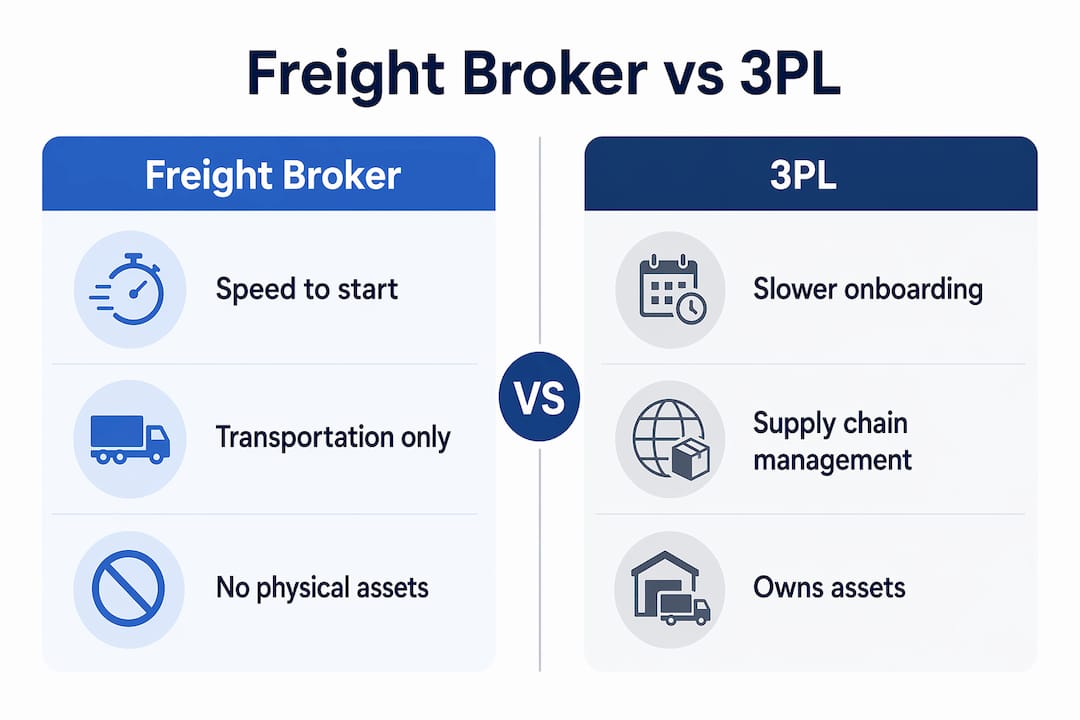
Freight broker benefits are clearest for businesses with irregular shipping needs. A manufacturer moving seasonal overstock, a retailer filling a one-time import order, or a startup testing new markets all benefit from broker flexibility. Brokers negotiate rates and manage shipment progress in ways that reduce both cost and administrative burden for shippers who lack dedicated logistics staff.
The advantages of 3PL solutions show up most clearly at scale. 3PLs integrate into client operations, managing inventory accuracy and order fulfillment with a level of operational responsibility that brokers simply do not provide. For a growing e-commerce brand shipping hundreds of orders daily, a 3PL removes the need to lease warehouse space, hire fulfillment staff, and manage carrier relationships independently.
Pro Tip: Hidden costs like improper shipment preparation and accessorial fees often exceed the freight rate itself. A good broker reduces these costs by catching classification errors and packaging issues before the carrier does.
The limitation of brokers is scope. They do not touch your inventory, your warehouse, or your fulfillment process. The limitation of 3PLs is commitment. Once your inventory lives in their facility and your systems connect to theirs, switching is expensive and disruptive.
How to choose between a freight broker and a 3PL for your business
The right choice follows directly from an honest assessment of your logistics operation. Work through these criteria before contacting any provider:
- Shipment volume and frequency: If you ship fewer than 50 loads per month or ship irregularly, a freight broker delivers better value. If you ship daily or manage ongoing inventory, a 3PL makes more sense.
- Warehousing and fulfillment needs: If you need storage, pick-and-pack, or returns management, only a 3PL covers those functions. A broker cannot help here.
- Internal logistics capability: Companies with dedicated logistics staff can manage carrier relationships and use brokers effectively. Companies without that staff benefit from the operational depth a 3PL provides.
- Supply chain complexity: Cross-border shipments, multiple origin points, and complex routing favor a 3PL or a provider like Worldwideexpress that combines freight brokerage and forwarding under one roof.
- Total cost of ownership: Administrative burden and error costs are part of your logistics spend, not just freight rates. A partner that reduces classification errors, accessorial charges, and manual tracking work lowers your real cost even if their rate appears higher.
- Red flags to watch for: Avoid any broker or 3PL that cannot produce proof of FMCSA authority, carrier insurance certificates, or client references. Vague pricing and no written service level agreements are equally serious warning signs.
For many mid-sized businesses, the answer is not either-or. A freight broker handles spot loads and overflow capacity while a 3PL manages core fulfillment. That hybrid approach is common and works well when both partners are clearly scoped. You can also learn more about choosing the right broker partner before making any commitment.
Key Takeaways
Freight brokers handle transportation transactions while 3PLs manage ongoing supply chain operations, and choosing between them requires matching the provider’s scope to your actual logistics needs.
| Point | Details |
|---|---|
| Broker vs 3PL scope | Brokers arrange freight; 3PLs manage warehousing, fulfillment, and supply chain functions. |
| FMCSA licensing applies to both | Any provider arranging freight with outside carriers must hold FMCSA broker authority. |
| Contract structure differs | Brokers work transactionally; 3PLs require extended contracts with operational integration. |
| Total cost of ownership | Factor in administrative burden and error costs, not just freight rates, when comparing providers. |
| Hybrid approaches work | Many businesses use brokers for spot loads and a 3PL for core fulfillment simultaneously. |
Why the broker vs 3PL debate misses the real question
The logistics industry frames this as a competition, but the more useful question is: what does your operation actually need right now? I have seen businesses lock into expensive 3PL contracts before they had the volume to justify them, paying monthly minimums for warehouse space they barely used. I have also seen companies rely on spot brokers for years past the point where a 3PL would have cut their per-unit fulfillment cost significantly.
The misconception I encounter most often is that freight brokers are just rate-shopping tools. That undersells what a skilled broker actually does. True broker value lies in risk reduction and compliance management, not just finding the cheapest carrier. A broker who catches a freight classification error before the carrier does saves you more than the margin they earn on the load.
My practical advice: map your shipment frequency and your internal staff capacity before talking to any provider. If your team spends more than a few hours per week on carrier calls, tracking, and claims, you are already paying for logistics management through lost productivity. That cost belongs in your total cost of ownership calculation. A supply chain visibility partner who reduces that drag pays for themselves quickly.
The best freight brokerage relationships and the best 3PL relationships share one trait: clear scope. Both sides know exactly what the partner is responsible for and what remains in-house. Ambiguity on that boundary is where costs and frustrations accumulate.
— Ian
Worldwideexpress: freight brokerage and 3PL solutions in one place
Worldwideexpress combines freight brokerage, freight forwarding, warehousing, and supply chain management under one platform, which removes the coordination gap that appears when businesses use separate providers for each function.
For business owners and logistics managers who need both transportation coordination and broader supply chain support, Worldwideexpress offers integrated logistics services built for cross-border and domestic shipping. The platform covers customs brokerage, air and ocean freight, trucking, and cargo insurance, giving you a single point of contact for complex shipping needs. Whether you are moving a single spot load or managing ongoing international fulfillment, Worldwideexpress structures its services around your actual volume and operational requirements rather than a one-size-fits-all contract.
FAQ
What is a freight broker, exactly?
A freight broker is a licensed intermediary that connects shippers with carriers to move freight, operating under FMCSA broker authority. Brokers do not own trucks and work on a transactional basis, earning a margin on each shipment arranged.
Do 3PLs need a freight broker license?
Yes. Any 3PL that arranges transportation using outside carriers must hold FMCSA freight broker authority, the same license required of standalone brokers. The 3PL designation describes the relationship scope, not a licensing exemption.
When should a business use a freight broker instead of a 3PL?
A freight broker is the better choice for irregular shipments, spot loads, or businesses without warehousing needs. Companies that ship infrequently or want flexibility without long-term contracts benefit most from freight broker services.
What does a 3PL do that a freight broker cannot?
A 3PL manages warehousing, inventory, order fulfillment, and returns processing, functions that fall entirely outside a freight broker’s scope. For businesses needing end-to-end supply chain management, a 3PL provides the operational depth a broker cannot match.
Can a business use both a freight broker and a 3PL at the same time?
Yes, and many mid-sized businesses do. A common approach uses a 3PL for core daily fulfillment while a freight broker handles overflow capacity, seasonal loads, or specialized lanes that fall outside the 3PL’s network.
Recommended
- What Does a Trucking Broker Do for Logistics? – Worldwide Express, Inc.
- Broker vs Freight Forwarder: Key Differences Explained – Worldwide Express, Inc.
- Freight marketplace trends shaping logistics in 2025 – Worldwide Express, Inc.
- Broker Shipping: How to Choose the Right Partner in 2026 – Worldwide Express, Inc.