TL;DR:
- Managing overseas inventory requires strict compliance, real-time visibility through integrated technology, and clear logistics coordination. Failure to maintain accurate records, define contractual responsibilities, and implement disciplined workflows increases operational risk and costs. Effective management depends on proactive planning, reliable partners, and disciplined execution across all facets of international supply chains.
Managing inventory overseas is one of the most operationally demanding challenges any importer or exporter faces. Between fluctuating customs regulations, multi-currency accounting, and the reality of stock sitting in warehouses you cannot physically inspect, the margin for error is significant. This guide cuts through the complexity by addressing the specific obstacles you are likely dealing with right now, from international stock control and inventory tracking abroad to logistics coordination and legal compliance. You will walk away with concrete strategies you can apply to your overseas supply chain.
Table of Contents
- Key takeaways
- Key challenges in managing inventory overseas
- Technologies and systems for tracking overseas inventory
- Logistics coordination for overseas stock
- Legal and compliance essentials for overseas stock
- Best practices for efficient overseas inventory management
- My honest take on overseas inventory complexity
- How Worldwideexpress supports your overseas operations
- FAQ
Key takeaways
| Point | Details |
|---|---|
| Compliance is non-negotiable | US importers must retain records for 5 years, with penalties reaching $100,000 for willful failure. |
| Technology reduces ambiguity | ERP and WMS systems with GS1 barcode integration give you real-time visibility across multiple overseas locations. |
| DDP contracts need detail | Vague Delivered Duty Paid agreements expose both buyers and sellers to costly delays and disputes at customs. |
| Cycle counts beat full audits | Operationally scheduled cycle counts maintain ongoing accuracy without shutting down warehouse operations. |
| Centralized platforms unify data | Integrated software across currencies and legal entities prevents reconciliation errors in global inventory accounting. |
Key challenges in managing inventory overseas
The complexity of global inventory management does not come from any single problem. It comes from several problems arriving at the same time, often in different languages and time zones.
Customs and regulatory compliance tops the list for most importers. Every country has its own classification rules, duty structures, and documentation requirements. A misclassified product code can trigger delays, fines, or seizure of goods. Staying current across multiple jurisdictions requires either dedicated expertise or a reliable partner with customs brokerage capabilities. Worldwideexpress offers both, but building internal knowledge of the basics is worth the investment regardless.
Multi-currency and multi-ledger inventory valuation is a challenge that trips up even experienced finance teams. When your stock exists in three countries with three different currencies, and each legal entity has its own accounting standards, the reconciliation work becomes substantial. Dual valuation and currency reporting across entities requires deliberate system configuration, not just a spreadsheet workaround.
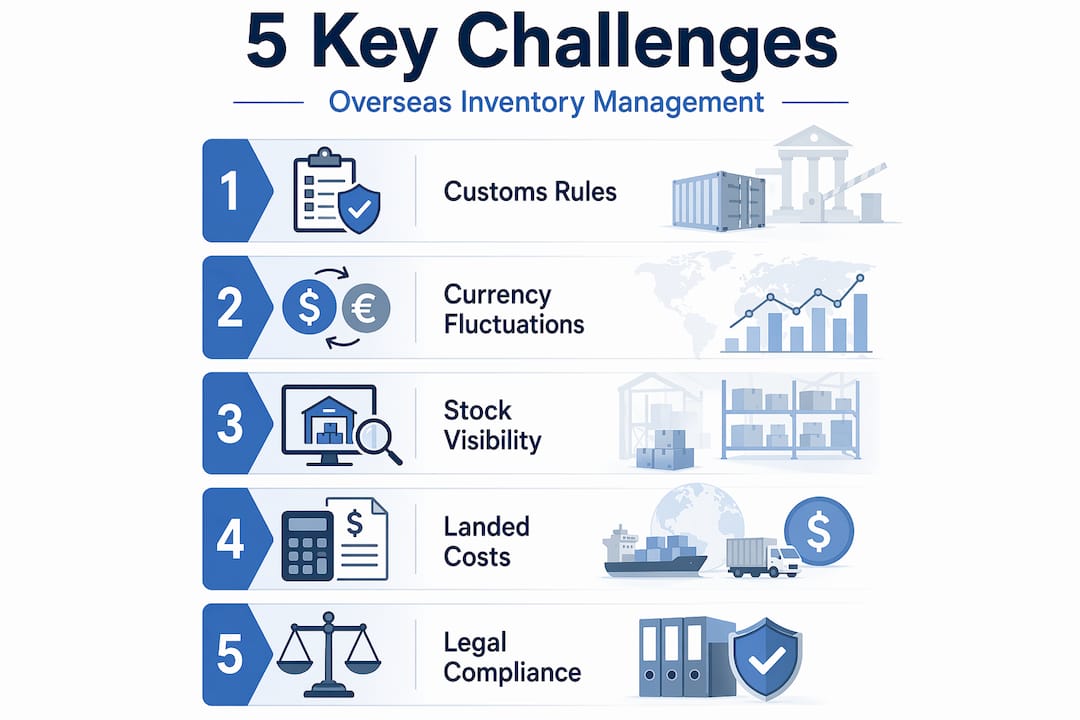
The logistical side of overseas inventory management adds another layer. Coordinating multiple warehouses, freight modes, and carriers means that a delay in one link affects everything downstream. Stockouts at an overseas location can halt production or miss delivery windows. Overstock in the wrong region ties up cash and adds storage costs.
A few of the most common risks you should plan around:
- Stockouts from inaccurate demand forecasting or delayed replenishment
- Overstock accumulation due to poor visibility across warehouse locations
- Customs clearance delays from incomplete or incorrect documentation
- Inventory discrepancies caused by poor tracking systems or inconsistent data entry
- Currency fluctuation impacting landed cost calculations and margin estimates
Pro Tip: Track your landed costs from the start, not after the fact. Include duties, freight, insurance, and local handling fees in every purchase order calculation to avoid margin surprises when goods arrive.
Technologies and systems for tracking overseas inventory
Getting real-time visibility into your international stock control operations is not optional at scale. The right technology stack makes the difference between knowing where your stock is and guessing.
Here are four technology layers that experienced importers rely on:
-
GS1 barcodes and GTIN mapping. Standardized identifiers like Global Trade Item Numbers (GTINs) are foundational for consistent inventory tracking abroad. GS1 barcodes with GTIN mapping allow ERP and WMS platforms to recognize the same product regardless of which warehouse or country it sits in, eliminating the kind of ambiguity that causes ghost stock and reconciliation nightmares.
-
ERP and WMS integration. Enterprise resource planning systems connected to warehouse management software give you a unified view of stock levels, purchase orders, and transfers across borders. Platforms from SAP, Oracle, and Microsoft support automated tax and inventory controls globally, reducing the manual work that opens the door to errors.
-
Cycle counting protocols. Full physical inventory counts are disruptive and expensive. Cycle counting, where you count a rotating portion of your inventory on an ongoing basis, is operationally smarter. Cycle counts designed to avoid overlap with active receiving or picking zones prevent false variances, which are among the most frustrating and misleading data problems in global warehousing.
-
Cross-border tax compliance software. VAT obligations, customs duties, and sales tax rules differ dramatically across markets. Platforms that integrate with ERP systems for global tax compliance automate the determination and reporting processes aligned to local regulations, reducing audit exposure significantly.
Pro Tip: Before selecting any inventory software, confirm it supports item alias mapping across multiple warehouses. Without this, the same SKU in two countries can appear as two different products in your system.
| Technology | Primary benefit | Best for |
|---|---|---|
| GS1 barcode scanning | Consistent product identification | Multi-location global operations |
| ERP/WMS integration | Real-time stock visibility | Large-scale importers with multiple SKUs |
| Cycle counting software | Ongoing accuracy without full shutdowns | High-volume overseas warehouses |
| Tax compliance platforms | Automated VAT and duty reporting | Businesses operating in 3+ jurisdictions |
For teams managing container fleets across multiple depot locations, fleet visibility tools add another dimension of tracking that connects physical asset location with inventory status.
Logistics coordination for overseas stock
Logistics coordination is where cross-border inventory strategies move from planning into execution. Getting it wrong at this stage is costly.

The starting point is understanding Incoterms and what they actually obligate you to do. Delivered Duty Paid (DDP) is the Incoterm that places maximum responsibility on the seller, covering delivery, customs clearance, duty payment, and risk right through to the point of delivery. In practice, DDP requires sellers to clarify unloading responsibilities, documentation handling, and local compliance obligations in the contract. Many importers assume DDP simplifies everything. It does reduce your administrative burden as a buyer, but only when the contract details are airtight.
Working with a qualified freight forwarder and customs broker is not a luxury for businesses managing serious overseas supply chain volume. These partners handle the import documentation, tariff classification, and clearance communication that would otherwise consume your team’s time or expose you to compliance risk.
Key logistics coordination priorities to address:
- Clarify Incoterm responsibilities with every supplier before goods are shipped, not after disputes arise
- Confirm that your customs broker has access to all necessary power of attorney documentation before shipment
- Plan for local unloading, in-country trucking, and last-mile warehousing as distinct cost items in your budget
- Use demand signals from your sales data to balance replenishment across multiple overseas warehouse locations, preventing regional overstock while other locations run short
Choosing the right shipping partner matters enormously here. You can review criteria for selecting reliable partners in this guide on choosing overseas shipping companies before locking in long-term freight relationships.
Legal and compliance essentials for overseas stock
Compliance failures in global inventory management are expensive. Not operationally inconvenient. Genuinely expensive.
US importers are required to retain import records for five years under US regulations, and penalties for willful failure to maintain those records can reach $100,000 or 75% of the item value, whichever is greater. That is not a theoretical risk. It is an audit outcome that catches businesses that assumed informal recordkeeping was sufficient.
Understanding the roles involved in the import process helps clarify where accountability sits:
| Role | Primary responsibility | Key risk if mismanaged |
|---|---|---|
| Importer of Record (IOR) | Customs compliance, duty payment, documentation | Penalties, shipment holds, license revocation |
| Customs Broker | Tariff classification, clearance facilitation | Misclassification, delays |
| Foreign Seller / Exporter | Export documentation, accurate declarations | Trade violations, goods rejected at destination |
| Third-Party IOR Service | Acting as legal importer for foreign sellers | Added cost, reduced control over process |
Third-party importer of record services are a practical option for foreign companies shipping into the US that do not have a legal entity here, particularly following changes to Section 321 de minimis exemptions. They take on customs liability, but they also reduce your direct control, so the relationship requires careful vetting.
Accurate inventory accounting across legal entities is a parallel obligation. Consistent posting across ledgers for transfer orders and valuation methods is not just good accounting practice. In multi-country operations, it is a regulatory requirement in most jurisdictions. Misaligned ledgers create both tax exposure and audit risk.
Staying on top of customs compliance obligations across markets is one area where expert guidance pays dividends. Worldwideexpress publishes a useful overview of customs compliance strategies that applies directly to importers managing stock at multiple international locations.
Best practices for efficient overseas inventory management
Managing remote stock levels effectively comes down to discipline, documentation, and visibility. Here are the practices that consistently separate well-run operations from reactive ones:
- Schedule cycle counts around your warehouse’s operational calendar. Operational scheduling in cycle counting that avoids peak receiving or shipping periods prevents the false variances that undermine your confidence in stock data.
- Always request a full landed cost breakdown from your freight forwarder before finalizing purchase orders. This should include duties, freight charges, insurance, port fees, and local handling. Surprises in landed cost are almost always avoidable with better upfront documentation.
- When operating under DDP terms, specify in writing who handles unloading at the destination and who holds importer of record authorization. Unclear DDP contract terms around these two points are the most common source of delivery delays and disputes in international trade.
- Use an integrated platform that provides centralized visibility across all your overseas entities, currencies, and stock locations. Decentralized data leads to decentralized decision-making, and that is where stockouts and overstock situations quietly accumulate.
- Invest in training for your local warehouse teams on your documentation standards. A well-configured ERP system still depends on humans entering accurate data at the point of receipt. Consistent training across locations closes the gap between system capability and real-world accuracy.
My honest take on overseas inventory complexity
I have spent years watching businesses get tripped up in the same places, and the pattern is consistent. They invest in the technology, pick the right Incoterms, and brief their customs broker, but then let discipline slip on the operational side.
Cycle counting is the clearest example. I have seen operations with excellent WMS platforms that still show inventory variances of 8 to 12 percent at year-end because cycle counts are performed during active receiving windows, contaminating the data. The tool was right. The process was wrong.
My take on DDP is similarly cautious. It sounds clean on paper, but the contracts I have reviewed that caused the most friction were all DDP arrangements where unloading responsibilities were left to interpretation. When a container sits at port because neither party is certain who arranges the drayage, you lose days and money. Specificity in contracts is not legal formality. It is operational protection.
Technology genuinely reduces ambiguity in global inventory management, but only when the underlying workflows are defined before you turn the software on. The businesses that get the most out of their ERP investment are the ones that spent time mapping their processes first.
And compliance is not a cost center. Every importer that I have seen treat record retention and classification accuracy as optional eventually pays a penalty that dwarfs what disciplined compliance would have cost. Invest in it early.
— Ian
How Worldwideexpress supports your overseas operations
Worldwideexpress brings together freight forwarding, customs brokerage, and supply chain expertise specifically designed for businesses managing inventory across borders. Whether you are coordinating multi-country stock replenishment or working through customs clearance on a complex shipment, Worldwideexpress provides the operational support and compliance knowledge to keep your supply chain moving. Explore the full range of logistics services available, including warehousing, air and ocean freight, and customs brokerage. For importers who need specialized support on US entry compliance, Worldwideexpress’s customs brokerage services offer expert classification, documentation review, and clearance facilitation tailored to your trade profile.
FAQ
What records must US importers keep for overseas inventory?
US importers must retain import records for five years from the date of entry. Penalties for willful failure can reach $100,000 or 75% of item value.
What is the best technology for inventory tracking abroad?
ERP and WMS platforms with GS1 barcode integration and GTIN mapping provide the most consistent visibility for international stock control across multiple overseas locations.
How does DDP affect overseas inventory management?
Under DDP, the seller handles customs clearance, duty payment, and risk through delivery. However, vague contract terms around unloading and importer of record authorization frequently cause delays and added costs.
How often should overseas inventory be cycle-counted?
Cycle counts should be scheduled continuously on a rotating basis, avoiding overlap with active receiving or picking windows to prevent false variances in your stock data.
What is an importer of record and when do you need one?
An importer of record is the legal entity responsible for customs compliance and duty payment on imported goods. Foreign sellers without a US legal entity often use third-party IOR services to meet US import requirements.
Recommended
- How to Import Goods: A Step-by-Step Guide for Success – Worldwide Express, Inc.
- Importing from Europe: Step-by-Step U.S. Business Guide – Worldwide Express, Inc.
- Step-by-step guide to exporting goods: compliance to shipment – Worldwide Express, Inc.
- Complete Guide to International Shipping Basics – Worldwide Express, Inc.