TL;DR:
- Shipping delays in 2026 cause significant financial loss and damage to customer trust due to low on-time rates. Businesses must adopt proactive data-driven systems, real-time monitoring, and effective communication strategies to prevent and mitigate delays. Continuous performance measurement and data integration are essential for maintaining logistics reliability amid rising global supply chain disruptions.
Shipping delays cost international businesses more than time. They drain cash, damage supplier relationships, and chip away at customer trust with every missed window. The challenge of shipping delays and solutions has never been more pressing: less than 30% of ocean freight sailings arrive on time as of 2026, and spot rates have climbed sharply in response to supply chain instability. Businesses that treat delays as unavoidable surprises will keep absorbing those costs. Those that build proactive systems around preparation, real-time execution, and continuous data improvement will not.
Table of Contents
- Key takeaways
- Understanding shipping delays and solutions in global logistics
- Preparation: preventing delays before they start
- Execution: responding to delays in real time
- Verification: measuring performance and improving continuously
- Why compliance and data integration are the actual solution
- How Worldwideexpress helps businesses beat shipping delays
- FAQ
Key takeaways
| Point | Details |
|---|---|
| Delays are worsening in 2026 | Ocean freight on-time rates have fallen below 30%, making proactive systems more critical than ever. |
| Data accuracy prevents most delays | EDI ASN errors and documentation mismatches are among the top causes of avoidable customs holds and chargebacks. |
| Technology closes the visibility gap | TMS platforms, AI-powered customs tools, and geofencing reduce dwell time and enable faster exception responses. |
| Compliance is a competitive edge | Businesses that treat compliance as an operational asset rather than a legal burden gain measurable efficiency advantages. |
| Continuous measurement drives improvement | Tracking KPIs like dock-to-stock time and carrier turnaround identifies recurring issues before they become systemic. |
Understanding shipping delays and solutions in global logistics
The numbers tell a hard story. National dry van spot rates are up over 20% year-over-year as of May 2026, driven largely by inventory front-loading and supply chain instability. Businesses are paying more for freight that arrives later than ever. That combination puts serious pressure on margins, inventory planning, and customer commitments.
Root causes worth knowing
The impact of shipping delays spreads well beyond late arrivals. When shipments stall, inventory gaps form. Cash flow tightens because goods sitting in transit or at a port are not generating revenue. Customer satisfaction drops sharply when expected delivery windows are missed without warning, and the downstream effects on brand reputation can outlast the delay itself.
The most common causes cluster around a few persistent problem areas:
- Port congestion at major global hubs, where vessel queues build up faster than berths open
- Documentation errors such as mismatched harmonized system (HS) codes, incomplete commercial invoices, or missing certificates of origin
- Compliance failures tied to regulations like FSMA 204 or customs pre-clearance requirements
- Excessive dwell time at container yards, where freight sits waiting for pickup appointments, labor availability, or gate processing
- Carrier capacity constraints during peak demand periods or following geopolitical disruptions
Dwell time deserves special attention. It refers to the period cargo spends at a terminal, yard, or warehouse beyond the free time window granted by carriers. Every extra day generates demurrage or detention fees, which can reach hundreds of dollars per container per day. Reducing dwell time is therefore not just about speed. It is directly about cost control.
Preparation: preventing delays before they start

Most shipping delays and solutions come down to what businesses do before the cargo moves. Technology and clean data systems are the foundation. Without them, even the best execution strategy falls apart at customs or at the dock.
Technology and data prerequisites
Automated customs clearance software using AI has proven capable of cutting average cross-border delays from 10 days to under 36 hours, with some operations achieving 97% on-time delivery rates. That kind of improvement does not come from working harder. It comes from eliminating the manual classification errors and document mismatches that trigger customs holds in the first place.
EDI 856 Advance Ship Notice (ASN) accuracy is another prerequisite businesses often underestimate. Walmart demands 98% On-Time In-Full compliance, and poor ASN data can trigger penalties up to 3% of invoice value. For any business shipping to major retailers, that is a real financial exposure. The fix is not more careful manual entry. It is generating ASN data directly from warehouse scanning, eliminating re-keying errors entirely.
Here is a preparation checklist businesses should validate before scaling international freight operations:
| Technology or Process | Purpose | Integration Point |
|---|---|---|
| Transportation Management System (TMS) | Centralize carrier management and scheduling | ERP, warehouse execution system |
| EDI ASN generation from scan events | Eliminate data re-entry errors | Warehouse management system |
| AI customs classification tool | Catch HS code errors before submission | Customs brokerage platform |
| Real-time shipment tracking dashboard | Provide end-to-end visibility | Carrier APIs, port data feeds |
| Compliance documentation library | Ensure correct paperwork per trade lane | Customs broker, legal team |
Partnerships matter just as much as software. Working with a customs broker who has data-driven dashboards and established relationships with port authorities gives businesses an early warning layer that no internal tool fully replicates. Reviewing shipment history to identify recurring pain points, such as specific trade lanes with consistent documentation issues or carriers with above-average dwell times, turns historical data into a prevention plan.
Pro Tip: Run a quarterly audit of your top 10 shipping lanes and flag any that show a pattern of customs holds or late arrivals. Address the root cause at the documentation or carrier level before the next shipping cycle begins.
Execution: responding to delays in real time
Preparation reduces the frequency of delays. Execution determines how quickly and effectively businesses contain the ones that still occur. The gap between businesses that absorb delay costs and those that recover from them quickly comes down to how well their execution systems are wired together.
Step-by-step mitigation during transit
Follow this sequence when a delay is identified or anticipated:
- Trigger automated alerts. Configure your TMS or visibility platform to send exception notifications the moment a shipment deviates from its planned route, schedule, or customs status. Waiting for a carrier update costs hours.
- Assess the delay category. Determine whether the issue is documentation-related, carrier-side, port-side, or compliance-triggered. The response path is different for each.
- Engage your customs broker immediately for any customs holds. AI-based pattern matching on shipment data can flag tariff classification errors and mismatched documentation before they escalate into prolonged holds.
- Evaluate alternate routing. For high-priority shipments, assess whether air freight, a different port of entry, or a secondary carrier can recover the timeline.
- Notify the customer proactively. Effective delay communication covers three elements: the cause of the delay, the expected resolution timeline, and any alternative options available to the customer.
- Adjust dock and yard scheduling. Use geofencing to automate dock scheduling and trigger preparation activities as a vehicle approaches, cutting check-in times and reducing dwell at the facility.
Reducing dwell time demands more than speed. Real-time scheduling adjustments and clean handoffs between partners are what actually move cargo faster through yards and warehouses. Cross-docking, where inbound cargo transfers directly to outbound trailers without warehouse storage, is particularly effective for time-sensitive freight when the data and dock coordination are in place. You can explore cargo tracking benefits to understand how real-time visibility integrates across these steps.
Pro Tip: Set exception thresholds in your TMS at 4 hours past planned arrival for ocean freight and 1 hour for air. Earlier alerts give your team enough lead time to act before demurrage clocks start ticking.
Shipping delay customer service strategies deserve as much attention as the operational response. A customer who receives a proactive update explaining the cause and resolution timeline is far less likely to escalate or disengage than one who discovers the delay on their own. Train logistics teams with communication scripts and escalation protocols so responses are consistent, not reactive.
Verification: measuring performance and improving continuously
Executing well on individual shipments is valuable. Building a system that learns from every shipment is what separates leaders in international logistics from everyone else. Ways to prevent shipping delays over the long term depend almost entirely on the quality of post-shipment analysis.
KPIs that reveal what is actually happening
Tracking the right metrics creates an honest picture of where delays originate and which partners, lanes, or processes are consistently underperforming. Focus on:
- Dock-to-stock time: Measures how quickly received freight becomes available in the warehouse. Prolonged times often indicate inspection issues or poor ASN accuracy.
- Carrier on-time performance by lane: Breaks down delay frequency at the carrier and trade-lane level, enabling data-backed renegotiation.
- Dwell time per terminal or yard: Identifies where cargo is sitting longest and why.
- EDI ASN accuracy rate: Tracks the percentage of advance ship notices that are complete, accurate, and transmitted on time.
- Customs hold frequency: Flags trade lanes or document types with above-average clearance issues.
Real-time ASN and order data reduces errors and improves retail compliance scorecards in a measurable way. For businesses supplying major retail chains, EDI compliance scorecards provided by the retailer are one of the clearest external signals of how well internal data systems are performing.
| KPI | Measurement Frequency | Action Trigger |
|---|---|---|
| Ocean freight on-time rate | Weekly | Below 70% triggers carrier review |
| Dwell time per yard | Per shipment | Over 48 hours triggers escalation |
| EDI ASN accuracy | Per shipment cycle | Below 96% triggers data audit |
| Customs hold rate | Monthly | Over 5% triggers documentation review |
| Customer complaint rate on delays | Monthly | Any increase triggers communication audit |
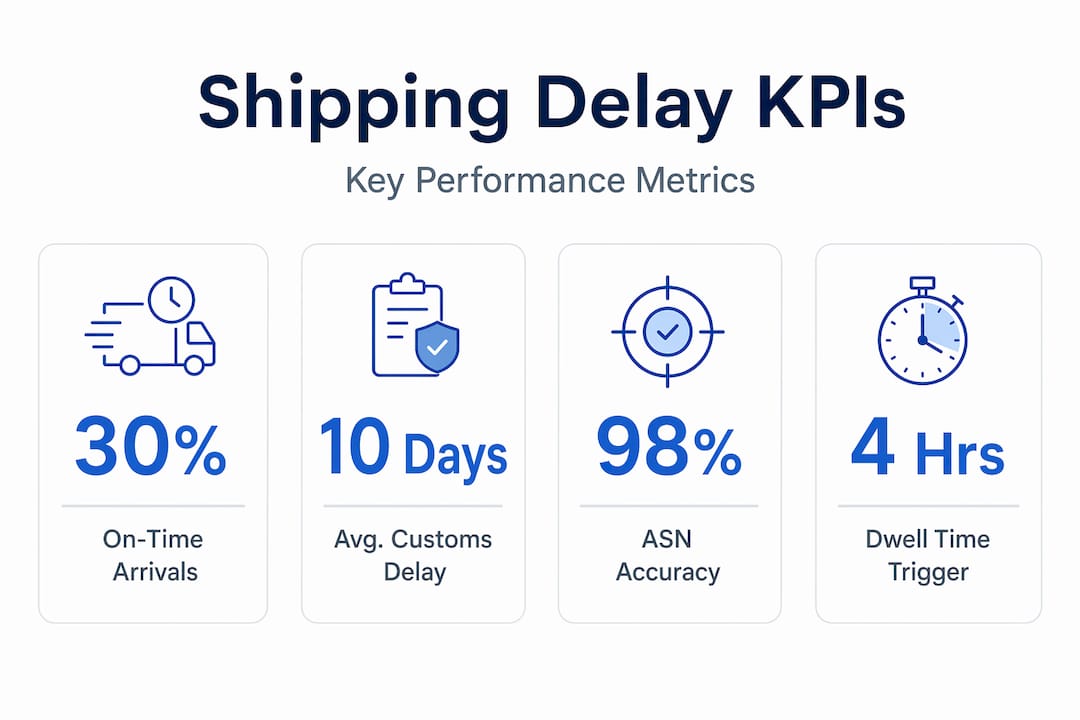
Regular audits of carrier performance, documentation compliance, and customs broker accuracy should feed directly into contract renegotiations and process updates. Treating compliance requirements as active operational projects rather than distant legal deadlines keeps supply chain traceability sharp and delay rates low. Review the freight marketplace trends shaping 2025 and 2026 logistics to benchmark your performance against current industry conditions.
Why compliance and data integration are the actual solution
In my experience working through the challenges that international shippers face, the vast majority of costly delays trace back to two things: manual processes that introduce errors at the worst possible moments, and siloed data systems that cannot communicate with each other in real time.
I have seen businesses invest heavily in carrier relationships and still face chronic delays because their documentation workflows were stuck in spreadsheets and email threads. The carrier is not the problem. The ASN that arrives with mismatched item counts or the wrong HS code is the problem.
What I have found actually works is treating data integration as a logistics asset, not an IT project. When compliance data, warehouse scan events, and carrier tracking feeds flow into a single visible system, problems surface early enough to fix. When they do not, the first signal is often a customs hold or a chargeback. That is a painful and expensive way to find out.
My take for 2026: businesses that want to become shippers of choice need to stop treating compliance as a cost center and start recognizing it as an operational differentiator. Retailers and end customers reward reliability. Reliability is built on accurate data, not good intentions. The technology to achieve this exists and is more accessible than it was even two years ago. The question is whether business leaders will commit to the integration work before the next wave of disruption hits.
— Ian
How Worldwideexpress helps businesses beat shipping delays
Worldwideexpress brings together customs brokerage, freight forwarding, and real-time supply chain tools specifically designed for businesses dealing with the realities of international shipping in 2026. Whether the challenge is clearing customs faster, reducing dwell time at ports, or building the visibility infrastructure needed to catch delays before they compound, Worldwideexpress offers tailored solutions across air, ocean, and trucking lanes.
The freight forwarding services guide is a strong starting point for businesses evaluating how to restructure their approach to international shipments. For those facing recurring customs clearance issues, customs brokerage services from Worldwideexpress provide expert documentation management and compliance support built around reducing holds and accelerating cargo release. Reach out directly to discuss a logistics review tailored to your trade lanes and freight profile.
FAQ
What causes most international shipping delays?
Port congestion, documentation errors, HS code mismatches, and compliance failures are the most frequent causes. Poor EDI ASN data accuracy also triggers costly chargebacks and compliance penalties from major retailers.
How can businesses reduce shipping delays quickly?
Deploying AI-powered customs clearance tools and integrating ASN generation directly with warehouse scanning systems can cut average cross-border delays from days to hours, per available 2026 data.
What is dwell time and why does it matter?
Dwell time is the period cargo spends at a terminal or yard beyond the carrier’s free time window. Excess dwell generates demurrage and detention fees that accumulate rapidly, often reaching hundreds of dollars per container per day.
How should businesses communicate shipping delays to customers?
Effective shipping delay customer service strategies involve notifying customers proactively with three clear pieces of information: the reason for the delay, the expected resolution timeline, and any alternative options available to them.
What KPIs best measure shipping delay performance?
Ocean freight on-time rate, dwell time per terminal, EDI ASN accuracy rate, customs hold frequency, and customer complaint rate on delays are the five metrics that most directly reflect delay management performance.
Recommended
- Troubleshooting shipping delays: strategies that work – Worldwide Express, Inc.
- Why customs clearance delays happen and how to fix them – Worldwide Express, Inc.
- Expedited International Shipping: Fast-Track Your Global Deliveries – Worldwide Express, Inc.
- How to Avoid Customs Delays for Smooth International Shipping – Worldwide Express, Inc.