TL;DR:
- Many logistics teams mistakenly equate carrier portals and spreadsheets with true shipment visibility, but real visibility requires automated, predictive insights. Advanced tools integrate data across multiple sources, providing actionable analytics that enable proactive decision-making and cost reductions. Successful implementation hinges on cleaning data first and selecting platforms aligned with shipment volume and operational complexity.
Most logistics managers assume that having a carrier portal and a spreadsheet constitutes “visibility.” It does not. The gap between basic tracking and genuine shipment visibility tools is where delayed shipments turn into customer disputes, and where reactive teams burn hours chasing updates that should arrive automatically. Fragmented, unstructured data remains the primary barrier to automating supply chain processes, meaning even well-resourced teams regularly operate blind. This guide breaks down what visibility tools actually do, which category fits your operation, and how to avoid the selection mistakes that cost companies months of wasted deployment time.
Table of Contents
- Key Takeaways
- What shipment visibility tools actually are
- How advanced visibility tools improve operations
- Implementation challenges to anticipate
- Selecting the right tool for your operation
- My take on where visibility tools are heading
- How Worldwideexpress supports your visibility goals
- FAQ
Key Takeaways
| Point | Details |
|---|---|
| Data quality comes first | Cleanse and validate fragmented data before expecting automation or AI to deliver value. |
| Tool categories differ significantly | Transportation visibility specialists, control towers, and multi-enterprise networks solve distinct problems. |
| Integrated platforms reduce costs sharply | Moving to a control tower can cut total cost of ownership by 60 to 95% depending on shipment volume. |
| Predictive ETAs outperform raw tracking | Reliable operational planning requires predictive modeling, not just live position data. |
| Match tool scale to your volume | Assess container volume and complexity before committing to a platform category. |
What shipment visibility tools actually are
Supply chain professionals use the phrase “shipment visibility tools” to cover a broad category of software, but the market has splintered considerably. Understanding that segmentation is the first step toward choosing the right solution.
At their core, shipment visibility tools provide location data, status updates, and exception alerts for freight moving through a supply chain. The more capable platforms layer in predictive analytics, carrier performance scoring, and automated exception workflows. Per market segmentation guidance, buyers should categorize their needs across three primary platform types before shortlisting any vendor.
Here is how those categories break down:
- Transportation visibility specialists. Platforms like project44 and FourKites focus on multimodal freight tracking, predictive ETAs, and AI-enabled exception management. They are strongest for shippers with high in-transit tracking needs across ocean, air, and road.
- Control towers. These platforms combine order management, transportation management, and warehouse management into a single interface. They go beyond tracking to provide execution capability, making them suited to operations managing tens of thousands of containers annually.
- Multi-enterprise networks and supplier risk tools. These extend visibility into strategic risk management, connecting supplier performance and planning data with shipment tracking. They matter most when your exposure to supply disruptions spans deep into the supplier base.
The critical distinction between real-time shipment tracking and supply chain visibility software is scope. Real-time tracking tells you where a container is right now. Supply chain visibility software tells you what that location means for your delivery windows, inventory positions, and customer commitments. For organizations involved in international shipping, that broader context is rarely optional.
One more thing worth noting: raw AIS vessel tracking data, the transponder signals ships broadcast, is not sufficient on its own. Predictive ETAs require combining carrier schedules, port congestion data, and predictive modeling to be operationally useful. A tool that only shows you a dot on a map is not a visibility platform. It is a map.
How advanced visibility tools improve operations
The operational case for investing in proper shipment monitoring software is not abstract. The numbers reported from real deployments are striking.
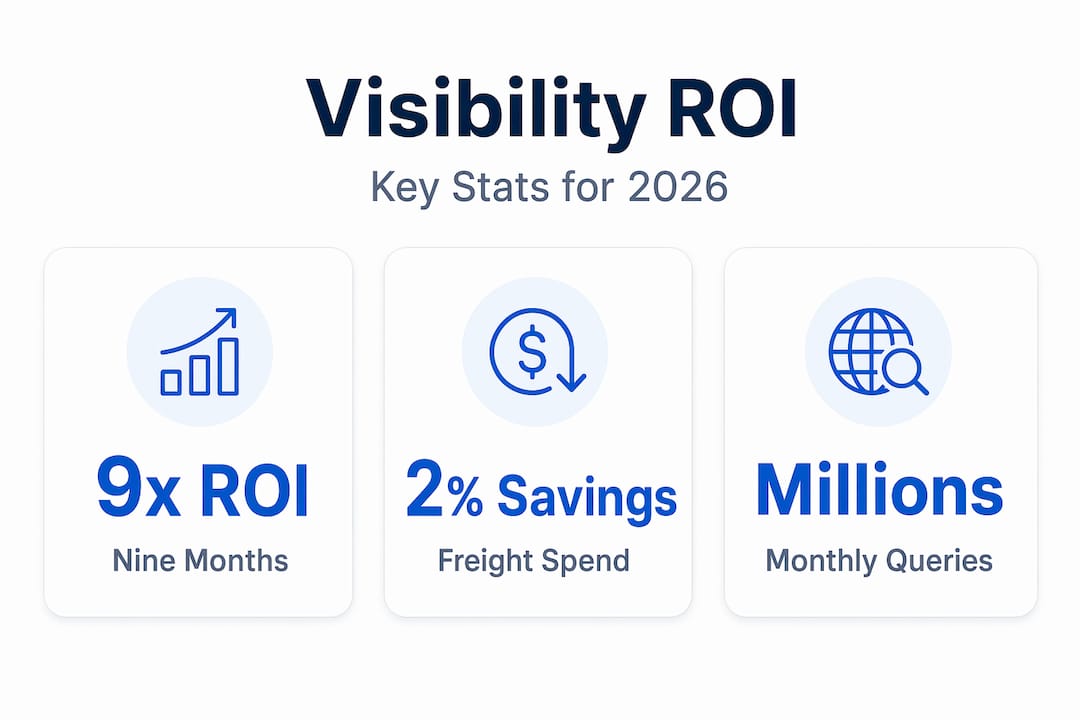
Enterprise shippers using advanced logistics data platforms achieve 9x ROI within nine months and recover 2% of total freight spend. For a company shipping $50 million in freight annually, that recovery alone funds the software investment many times over. The mechanism behind those gains is proactive exception management: catching a port delay before it cascades into an out-of-stock event, rather than scrambling after the fact.
Effective visibility software acts as an operational command center, converting what was a reactive firefighting function into a structured, alert-driven workflow. Teams that previously spent mornings calling carriers for updates now receive automated status reports with flagged exceptions that require human judgment. That shift compresses issue resolution cycles and frees capacity for strategic work.

The cost case for consolidation is equally compelling. Moving from standalone cargo tracking systems to integrated control towers reduces total cost of ownership by 60 to 70% for operations managing 10,000 to 50,000 containers. For larger shippers above 25,000 containers, TCO reductions can reach 95%. Those figures account for eliminating redundant point solutions, reducing manual data reconciliation, and cutting carrier communication overhead.
Pro Tip: Before committing to a new visibility platform, calculate how many standalone tools your team currently uses for tracking, carrier communication, exception handling, and reporting. Every tool with a separate login and data model adds reconciliation cost. That number, multiplied by license fees and labor hours, is your baseline for TCO comparison.
Demand for container tracking has surged significantly since 2021, with Maersk reporting millions of monthly queries to its tracking portal alone. That volume signals a market where shippers across every size tier are prioritizing freight visibility tools as core infrastructure, not optional add-ons.
AI-powered features are also shifting the value proposition substantially. Automated exception prioritization, carrier performance benchmarking, and predictive delay scoring mean that modern supply chain visibility software does not just report what happened. It tells you what is likely to happen next and suggests responses.
Implementation challenges to anticipate
Selecting the right platform is only half the battle. The implementation experience for freight visibility tools is where many organizations stumble, often because they underestimate the data work involved.
Several specific challenges appear repeatedly across deployments:
- Data fragmentation. Carrier data arrives in inconsistent formats. ERP systems hold shipment records that do not map cleanly to tracking events. Port data arrives through separate APIs. Solving the data foundation problem before deployment begins is not optional. Visibility platforms that ingest poor data produce poor visibility.
- Integration complexity. Connecting a new visibility tool to an existing TMS, ERP, or warehouse management system takes time and technical resources. Organizations that skip integration planning end up with parallel systems and duplicate data entry, which defeats the purpose entirely.
- Tool-need mismatch. Selecting a transportation visibility specialist when you actually need a control tower, or vice versa, is a common and expensive mistake. Buyers must clearly define operational needs before shortlisting vendors, not after.
- Overreliance on raw AIS data. Several lower-cost cargo tracking systems sell on the strength of vessel tracking without explaining that raw AIS signals require filtering and enrichment to be operationally reliable.
Pro Tip: Request a structured data audit as part of any vendor evaluation. Ask the vendor to ingest a 90-day sample of your carrier data and show you the error rate, gap rate, and enrichment required before their platform can produce reliable ETAs. That exercise surfaces data quality problems before you sign a contract.
Integration with global freight tracking tools also raises change management considerations. Logistics teams accustomed to checking carrier portals individually will resist new workflows unless the new platform demonstrably saves time from day one. Phased rollouts by trade lane or carrier group tend to perform better than big-bang deployments.
Selecting the right tool for your operation
The selection process becomes considerably more structured once you accept that not all shipment visibility tools are built for the same job. A useful starting framework maps platform type against two axes: shipment volume and operational complexity.
| Platform type | Best for | Container volume | Key features |
|---|---|---|---|
| Transportation visibility specialist | In-transit tracking, exception management | Any volume | Predictive ETAs, multimodal coverage, carrier APIs |
| Integrated control tower | End-to-end execution and tracking | 10,000 and above | OMS, TMS, WMS combined, lower TCO at scale |
| Multi-enterprise network | Supplier risk and extended network visibility | Any volume | Supplier scorecards, risk alerts, planning integration |
For operations moving fewer than 10,000 containers annually, a transportation visibility specialist typically delivers the best ratio of capability to cost. Above that threshold, the math on control towers begins to favor consolidation, particularly given the TCO advantages cited above. Visibility-only platforms often lack execution capabilities, which means larger shippers frequently end up layering additional point solutions on top of their visibility tool, recreating the fragmentation they were trying to escape.
Forward-looking features should carry significant weight in any evaluation. A platform that delivers predictive ETAs based on enriched multi-source data is more operationally useful than one offering only live position updates. Look specifically for: AI-driven exception prioritization, automated carrier communication, configurable alert thresholds by shipment type, and integration depth with your existing ERP or TMS.
Deployment sequencing matters as much as platform selection. The most successful implementations follow a consistent pattern: data audit and cleansing first, carrier API integrations second, user training and workflow design third, and then progressive expansion to additional trade lanes or modes. Organizations that skip the data audit phase typically spend the first three months of deployment troubleshooting data quality issues rather than extracting value from the platform.
Worldwideexpress recommends evaluating supply chain visibility explained as a complementary resource when building your selection criteria, particularly for teams managing complex international trade flows.
My take on where visibility tools are heading
I’ve spent considerable time watching how supply chain teams actually interact with visibility platforms after go-live, and the pattern is instructive. The organizations that extract real value from their shipment visibility tools are not the ones with the most sophisticated platforms. They are the ones that did the unglamorous data work first.
What I’ve observed repeatedly is that teams rush toward AI-driven insights and predictive ETAs, only to discover that their underlying carrier data is inconsistent, their ERP shipment records are 48 hours stale, and their exception alerts fire on phantom events. The technology is not the bottleneck. The data foundation is.
The broader strategic shift worth paying attention to is this: supply chain visibility has become a strategic resilience capability, not just a logistics project. The companies that treated visibility as a resilience investment during recent supply chain disruptions recovered faster, communicated better with customers, and made better inventory decisions under uncertainty. That framing changes how you should present the business case internally.
My advice is to resist the pull of feature maximalism during vendor selection. The platform that integrates cleanly with your existing systems and surfaces reliable, actionable exception data will outperform a technically superior platform that your team cannot trust. Operational readiness and data quality are the multipliers. The technology is the starting point, not the finish line.
— Ian
How Worldwideexpress supports your visibility goals
Worldwideexpress brings together freight forwarding expertise and global logistics infrastructure to help businesses move cargo with confidence. If you are improving your shipment tracking capabilities, pairing them with a freight forwarding partner that understands documentation, customs compliance, and carrier relationships makes a measurable difference in practice. Explore Worldwideexpress’s freight forwarding guide to understand how visibility tools fit within a broader freight management strategy. For businesses managing ocean freight, the ocean freight forwarding steps guide covers end-to-end process alignment. You can also review the full range of logistics services that Worldwideexpress offers to find the right fit for your operation.
FAQ
What are visibility tools for shipments?
Shipment visibility tools are software platforms that provide real-time location tracking, status updates, exception alerts, and predictive ETAs for freight moving through a supply chain. Advanced platforms add AI-driven exception management and integration with ERP, TMS, and warehouse systems.
How do freight visibility tools differ from basic carrier tracking?
Basic carrier tracking shows current shipment status within a single carrier’s system. Freight visibility tools aggregate data across multiple carriers and modes, apply predictive modeling, and surface exceptions before they become delays, giving operations teams a single operational view.
What is the ROI of investing in shipment monitoring software?
Enterprise shippers using advanced logistics data platforms report 9x ROI within nine months and recover approximately 2% of total freight spend through improved exception management and reduced manual processing costs.
When should a company choose an integrated control tower over a visibility-only platform?
Once a company manages more than 10,000 containers annually, integrated control towers typically offer lower total cost of ownership by combining order management, transportation, and warehouse capabilities, eliminating the need for multiple standalone tools.
Why is data quality so critical for supply chain visibility software?
Fragmented and unstructured carrier and shipment data produces unreliable alerts and inaccurate ETAs, regardless of how capable the platform is. Cleansing and validating that data before deployment is the prerequisite for extracting value from any visibility solution.
Recommended
- Supply Chain Visibility: Driving Efficiency in Logistics – Worldwide Express, Inc.
- 6 Key Trends in International Logistics for U.S. Managers – Worldwide Express, Inc.
- Improve Worker Safety in Logistics: Proven Protocols for 2026 – Worldwide Express, Inc.
- Next-gen container tracking: real-time visibility in 2026 – Worldwide Express, Inc.