TL;DR:
- Over 60% of U.S. logistics teams now operate in hybrid or remote models.
- Digital tools and cloud platforms are critical for effective remote logistics coordination.
- Hybrid logistics models improve efficiency, reduce costs, and enhance global supply chain resilience.
Over 60% of U.S. logistics teams now blend remote and on-site work to coordinate international shipments, challenging the long-held assumption that logistics must be managed face-to-face. That shift is accelerating. As global trade complexity grows, logistics managers are discovering that distributed teams, when equipped with the right tools and processes, can actually outperform traditional on-site setups. This article lays out the key trends, roles, technologies, challenges, and measurable outcomes that define effective remote logistics coordination in 2026.
Table of Contents
- The evolution of remote work in logistics
- Core roles and skills for remote logistics success
- Essential technologies for remote logistics coordination
- Challenges and best practices for managing remote global teams
- Success metrics and business outcomes from remote logistics
- Our take: Striking the right remote-physical balance
- Empowering your remote logistics with professional support
- Frequently asked questions
Key Takeaways
| Point | Details |
|---|---|
| Hybrid is the new norm | Most logistics teams blend remote and on-site work to optimize flexibility and control. |
| Tech is mission-critical | Cloud-based platforms and real-time tracking are essential for efficient remote coordination of global shipping. |
| Not all roles go remote | Analytical and planning tasks excel remotely, but roles requiring physical oversight remain in-person. |
| Real results, real savings | Effective remote logistics can reduce costs by more than 30% and boost service levels. |
| Continuous adaptation needed | Balancing technology, process, and people is crucial as logistics evolves further into remote models. |
The evolution of remote work in logistics
Not long ago, the idea of managing freight forwarding or customs brokerage from a home office would have seemed far-fetched. Today, it is standard operating procedure for many international logistics organizations. The shift has been driven by a combination of digital tool maturity, cost pressures, and the cross-border complexity that makes centralized, in-person oversight increasingly impractical.
Hybrid models are prevalent across the sector, with over 60% of U.S. logistics teams working across locations and 39% of global analysts operating in a hybrid format. These are not marginal experiments. They represent a structural change in how logistics organizations operate.
Here is a snapshot of how roles typically break down in modern logistics organizations:
| Role category | Common work model | Key dependencies |
|---|---|---|
| Logistics Analyst | Fully remote | Data access, cloud platforms |
| Transportation Manager | Hybrid | Carrier relationships, system access |
| Customs Broker | Hybrid or remote | Compliance tools, documentation portals |
| Warehouse Supervisor | On-site | Physical inventory, equipment |
| Freight Coordinator | Remote or hybrid | TMS, communication platforms |
“The biggest driver of remote logistics adoption is not convenience. It is the realization that global coordination requires always-on digital infrastructure anyway, so geography becomes less relevant for analytical and coordination roles.”
The business case is compelling. Organizations adopting hybrid models have reported significant cost reductions, including savings on office space and reduced overhead tied to centralized operations. Learning to optimize logistics for global shipping becomes far more achievable when teams are not constrained by geography.
Key drivers behind the shift include:
- Digital maturity: Cloud-based platforms now replicate nearly every workflow that once required physical presence.
- Cost efficiency: Distributed teams reduce real estate costs and allow access to specialized talent globally.
- Cross-border complexity: International logistics demands 24/7 coverage, which distributed teams provide more naturally.
- Resilience: Remote-capable teams recovered faster during supply chain disruptions, reinforcing the hybrid model’s value.
Applying sound remote team management tips early in a logistics organization’s hybrid transition tends to determine whether cost savings materialize or evaporate in coordination inefficiencies.
Core roles and skills for remote logistics success
Not every logistics function translates cleanly to a remote environment. Understanding which roles thrive remotely and which require physical presence is the foundation of a smart hybrid strategy.
Suitable remote roles in logistics include analysts, coordinators, procurement managers, and transportation managers, all requiring strong digital and communication skills. These positions rely heavily on data interpretation, vendor communication, documentation management, and system oversight, activities that digital platforms handle well.
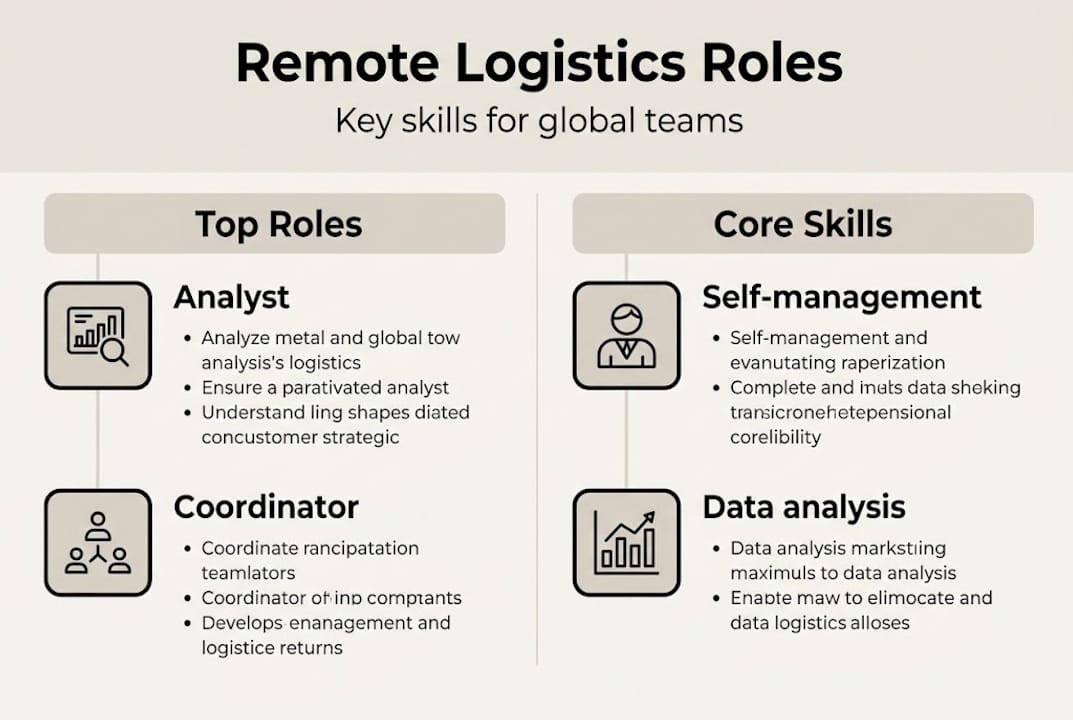
| Role | Remote readiness | Critical digital skills |
|---|---|---|
| Logistics Analyst | High | Data analysis, BI tools, reporting platforms |
| Procurement Manager | High | ERP systems, supplier portals, negotiation tools |
| Freight Coordinator | High | TMS, email management, tracking platforms |
| Transportation Manager | Medium | Carrier systems, compliance tools, scheduling software |
| Warehouse Supervisor | Low | WMS (partially), but physical oversight required |
For logistics professionals making the transition from on-site to remote roles, a structured approach matters. Here is a practical sequence that works:
- Audit current workflows to identify which tasks require physical access versus digital access.
- Map tool requirements for each role and close software gaps before remote transition begins.
- Establish communication protocols including response time expectations, escalation paths, and meeting cadences.
- Train staff on digital fluency covering the platforms, security practices, and documentation standards they will use daily.
- Run a pilot period with clear KPIs before committing to a full remote or hybrid model.
The most effective remote logistics professionals combine data analysis skills with disciplined self-management and a strong command of supply chain management best practices. Self-motivation is not optional. In a distributed environment, there are no hallway check-ins or visual cues that someone is struggling.
Pro Tip: Prioritize roles that generate value through analytical judgment and digital workflows when building your remote team. These roles typically see the steepest productivity gains when freed from commute time and open-office distractions.
For organizations looking to scale, tying remote role design to broader business growth strategies for logistics ensures that hiring and workflow decisions align with long-term operational goals.
Essential technologies for remote logistics coordination
With the right people in the right roles, technology determines whether remote coordination actually works at scale. The platforms logistics teams rely on have matured significantly, and choosing the right stack is a strategic decision.
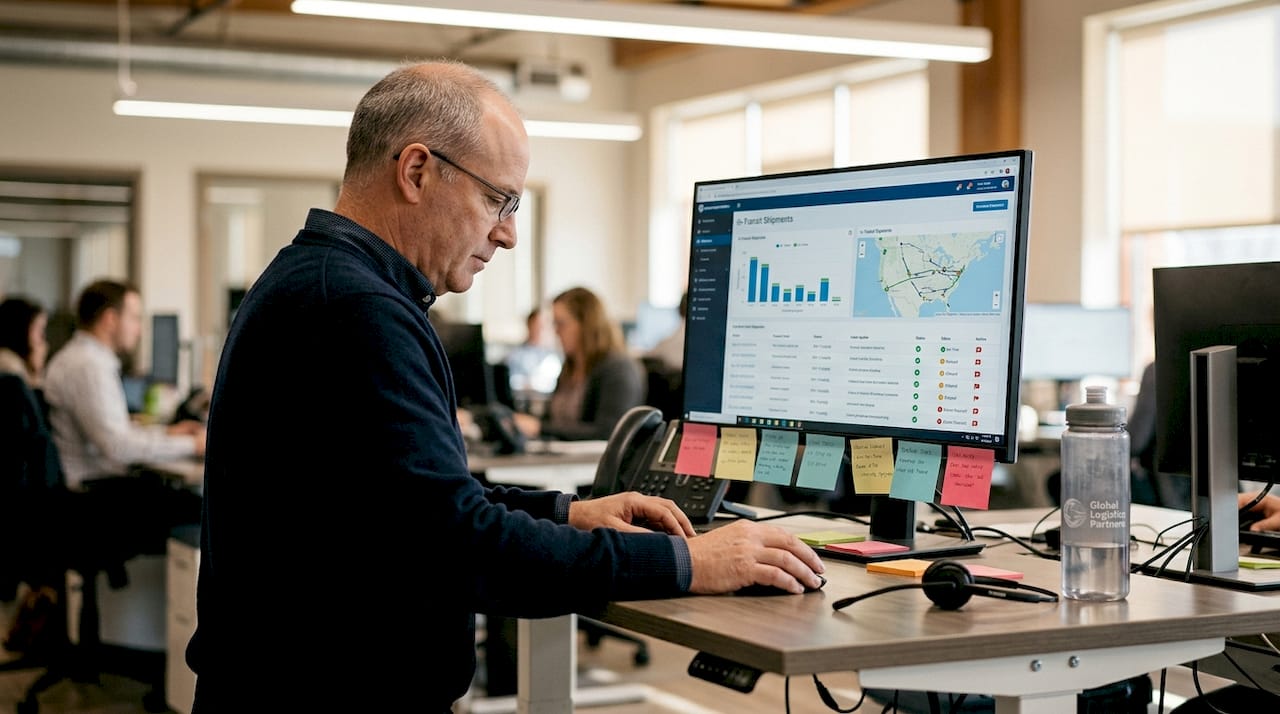
Cloud-based TMS and WMS platforms centralize freight tracking, automate documentation, and enable remote oversight at a level that was simply not possible five years ago. The best platforms do more than digitize paperwork. They create a single source of truth that every team member, regardless of location, can access in real time.
Core technologies for remote logistics teams include:
- Transportation Management Systems (TMS): Automate carrier selection, rate comparison, shipment booking, and documentation.
- Warehouse Management Systems (WMS): Provide inventory visibility and fulfillment tracking without requiring managers to be on the floor.
- Real-time tracking dashboards: Consolidate shipment status across carriers and geographies into a single view.
- Communication suites: Platforms like Microsoft Teams or Slack integrated with logistics workflows keep distributed teams aligned.
- Customs compliance tools: Automate tariff classification, duty calculation, and regulatory document preparation.
Understanding the cargo tracking benefits in a remote context goes beyond convenience. Real-time visibility reduces exception handling time, supports proactive customer communication, and allows managers to intervene before small delays become costly disruptions.
When evaluating platforms, prioritize these features: real-time shipment tracking across carriers, automated compliance checks, unified communication and documentation storage, API integration capabilities, and role-based access controls for data security. Staying current on digital freight forwarding trends helps logistics managers make informed technology investment decisions rather than reactive ones.
For teams managing multiple carriers across regions, global freight tracking tools that aggregate data from disparate systems are particularly valuable. Fragmented visibility is one of the biggest hidden costs in remote logistics.
Pro Tip: Integrate your TMS, WMS, and communication platforms through shared APIs wherever possible. Eliminating manual data re-entry between systems cuts errors dramatically and frees your team to focus on exceptions rather than data transfer.
Challenges and best practices for managing remote global teams
Technology empowers remote coordination, but real-world logistics teams face unique, ongoing challenges that no software fully solves on its own.
The obstacles are well-documented. 62% of U.S. trucking operations rate cybersecurity as a top concern for remote work, while 68% of APAC firms cite tool integration as a primary barrier to effective distributed operations. These are not minor friction points. They represent real risks to shipment visibility, data integrity, and service reliability.
“For distributed logistics teams, the risk is not just operational. A single security breach or integration failure can cascade across global shipment networks within hours.”
The most common challenges remote logistics leaders report include:
- Time zone fragmentation: Decision bottlenecks form when key approvals span multiple time zones without clear async protocols.
- Cybersecurity exposure: Remote access to freight data, carrier portals, and financial systems creates attack surfaces that require layered protection.
- Tool integration gaps: Teams using disconnected platforms waste time on manual data reconciliation and miss real-time exception alerts.
- Communication breakdowns: Without deliberate over-communication, distributed teams experience misaligned priorities and delayed issue escalation.
- Exception handling: Customs delays and disruptions require clear escalation protocols when the team managing them is spread across cities or countries.
Proven strategies for overcoming these challenges include establishing standardized operating procedures for every common scenario, implementing multi-factor authentication and VPN requirements for all system access, scheduling regular cross-time-zone check-ins, and maintaining documented escalation paths that every team member can act on without waiting for a manager.
For time-sensitive issues like regulatory holds or carrier failures, knowing how to optimize freight transit times remotely requires pre-built decision trees, not improvised responses.
Success metrics and business outcomes from remote logistics
Managing remote teams effectively is not just theory. The results speak clearly when organizations measure what matters.
A standout example comes from TransLogix, whose hybrid and AI-assisted model achieved a 31% operational cost reduction while improving service level agreements from 82% to 96%. Office space costs dropped by 35%. Dispatch productivity increased by 22%. These are not marginal gains. They represent a fundamental improvement in how the organization delivers value.
| Metric | Pre-remote baseline | Post-remote result |
|---|---|---|
| Operational cost | Baseline | 31% reduction |
| SLA adherence | 82% | 96% |
| Office space cost | Baseline | 35% reduction |
| Dispatch productivity | Baseline | 22% improvement |
Organizations looking to replicate these outcomes should track the following KPIs for their remote logistics operations:
- Percentage of shipments tracked remotely in real time (target: 95% or above)
- Average exception resolution time measured from alert to corrective action
- SLA adherence rate across carriers and lanes
- Cost per shipment compared against pre-remote baseline
- Team response time to critical alerts outside standard business hours
Digitized coordination is the engine behind these improvements. When freight coordinators can monitor delivery tracking status without being physically present, the speed and accuracy of decision-making improves consistently. Organizations that instrument their remote operations with clear KPIs from the start capture these gains far faster than those that measure performance as an afterthought.
Our take: Striking the right remote-physical balance
The business case for remote logistics is strong, but a clear-eyed view of its limits is equally important. Physical roles like warehousing and on-ground management still require human presence, making full remote unlikely for all functions regardless of how sophisticated the technology becomes.
The most resilient logistics organizations are not fully remote or fully on-site. They are deliberately hybrid, assigning remote work to roles where it adds efficiency and preserving on-site presence where physical judgment, equipment operation, or face-to-face relationship management is genuinely necessary. Comparisons like nearshoring versus offshoring illustrate a similar principle: the optimal model depends on the specific function, not a universal preference.
The practical implication is that logistics leaders should revisit their remote and hybrid configuration regularly, at least annually, as new tools emerge that can digitize processes previously considered impossible to perform remotely. What required an on-site manager in 2022 may be fully automatable in 2026.
Pro Tip: Build a quarterly review process that asks one question: which tasks on the on-site list could now be performed remotely given our current tools? Continuous reassessment is what keeps hybrid logistics models competitive.
Empowering your remote logistics with professional support
Applying these strategies becomes significantly more effective when backed by logistics partners with global infrastructure and integrated digital platforms.
Worldwide Express offers logistics services designed specifically for businesses managing complex international operations, whether your team is in one office or spread across a dozen time zones. From real-time supply chain visibility tools to expert customs brokerage and freight forwarding, the platform is built to support distributed teams who need accurate, fast, and reliable coordination. Explore how international freight shipping solutions from Worldwide Express can help your remote logistics team operate with the confidence and precision that global trade demands.
Frequently asked questions
What logistics roles can be performed fully remotely?
Roles like Logistics Analyst, Procurement Manager, and Transportation Manager can be performed fully remotely when equipped with the right digital tools and processes. Logistics analysts and coordinators are among the most suitable remote roles due to their high digital interaction requirements.
What are the main barriers to remote work in logistics?
Time zone differences, data security risks, tool integration issues, and the need for onsite operations for certain physical tasks are the primary barriers. Notably, 62% of U.S. trucking firms cite cybersecurity as their top concern, while 68% of APAC companies flag tool integration as a significant obstacle.
Which technologies are critical for coordinating remote logistics?
Cloud-based TMS, real-time cargo tracking platforms, and centralized dashboards are the backbone of effective remote logistics. Cloud platforms with real-time tracking and centralized documentation give distributed teams the visibility they need to act decisively.
How does remote work improve logistics outcomes?
Remote work, when managed effectively, reduces operating costs, boosts productivity, and improves service levels across the organization. Data shows 31% lower operational costs, improved SLA performance, and a 22% increase in dispatch productivity are achievable with well-structured remote models.
Is a fully remote logistics operation possible?
While technology enables remote work for analytical and coordination roles, some functions like warehousing and onsite management still require physical presence. Physical roles still require onsite staff despite the significant gains remote models deliver for knowledge-based logistics work.
Recommended
- Remote Team Management Tips for Logistics Leaders – Worldwide Express, Inc.
- How to Optimize Logistics for Efficient Global Shipping – Worldwide Express, Inc.
- Business Networking Strategies for Logistics Managers – Worldwide Express, Inc.
- Optimize international freight transit times: key strategies – Worldwide Express, Inc.
- Guide to relocation logistics: smooth and stress-free moves