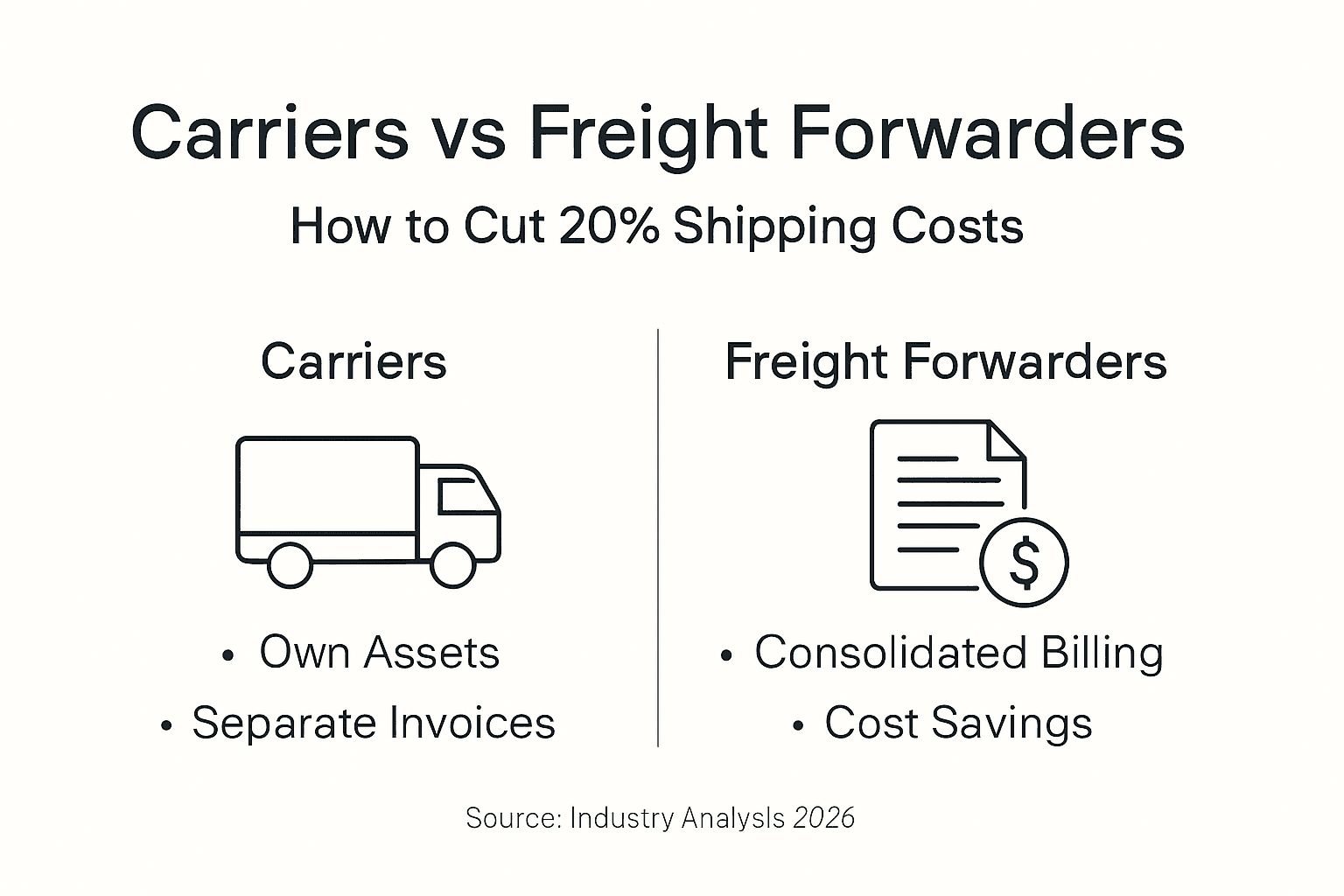
Most logistics managers mistakenly believe freight forwarders own transport assets, a misconception held by 78% of professionals. This confusion leads to poor partner selection and inflated costs. Understanding the distinct roles of carriers and freight forwarders can reduce international shipping expenses by up to 20% while improving compliance and efficiency. This guide clarifies definitions, legal responsibilities, operational differences, and cost structures to help you optimize your supply chain strategy.
Table of Contents
- Introduction To Carriers And Freight Forwarders
- Legal And Regulatory Differences In The U.S.
- Operational Differences And Service Scope
- Cost Structures And Billing Practices
- Common Misconceptions About Carriers And Freight Forwarders
- Choosing The Right Partner For Your Supply Chain
- Summary And Next Steps For Optimizing International Shipping
- Optimize Your Shipping With Expert Freight Forwarding Services
- Frequently Asked Questions
Key Takeaways
| Point | Details |
|---|---|
| Asset Ownership | Carriers own transport assets; freight forwarders coordinate logistics without owning trucks, ships, or planes. |
| Legal Liability | Carriers bear direct cargo liability under the Carmack Amendment; forwarders have limited intermediary liability. |
| Service Scope | Forwarders provide value-added services like customs brokerage, warehousing, and insurance; carriers focus on physical transport. |
| Cost Efficiency | Freight forwarders reduce costs 10-20% through consolidated billing and multi-carrier optimization. |
| Best Use Cases | Choose carriers for simple routes; select forwarders for complex international multi-modal shipments. |
Introduction to Carriers and Freight Forwarders
Carriers directly transport cargo and own the shipping assets like trucks, vessels, and aircraft. They operate under their own authority and bear responsibility for moving goods from origin to destination. Airlines, ocean shipping lines, trucking companies, and rail operators are typical carriers.
Freight forwarders act as intermediaries, coordinating shipments without owning transport assets. They organize logistics, negotiate carrier rates, manage documentation, and ensure compliance. Think of them as orchestrators who select the best carriers and routes for your specific needs.
These distinct roles create complementary functions in international logistics supply chains. Carriers execute the physical movement. Forwarders design and manage the entire shipping strategy, handling paperwork, customs clearance, and problem-solving across multiple countries and transport modes.
Understanding this difference is essential for efficient international shipping. You need reliable carriers for actual transport and experienced forwarders to navigate complex regulations, documentation requirements, and multi-leg coordination. Each serves a specific purpose in moving goods across borders smoothly and legally.
Carrier examples include:
- Ocean shipping lines like Maersk and MSC
- Airlines such as Lufthansa Cargo and FedEx
- Trucking companies providing domestic freight transport
- Rail operators for inland transportation
Freight forwarder services encompass:
- Route planning and carrier selection
- Customs documentation and compliance
- Cargo insurance arrangement
- Warehousing and distribution
- Shipment tracking and problem resolution
The broker vs freight forwarder differences add another layer, but forwarders typically handle international shipments while brokers focus on domestic arrangements. Knowing the role of freight forwarders helps you leverage their expertise for complex international logistics.
Legal and Regulatory Differences in the U.S.
Carriers carry direct cargo liability under the Carmack Amendment, a federal statute governing interstate transportation. If your shipment is lost, damaged, or delayed, the carrier is directly responsible and must compensate you according to their contract terms.
Freight forwarders regulated by FMC with distinct liability and contract roles operate as licensed intermediaries under Federal Maritime Commission oversight for ocean shipments. Their liability is typically limited to their own negligence in arranging transport, not the carrier’s performance. This distinction significantly affects risk management and insurance requirements.
Customs laws assign customs clearance roles primarily to forwarders or brokers, not carriers. U.S. Customs and Border Protection requires licensed customs brokers to handle entry documentation, tariff classification, and duty payments. Most freight forwarders either employ in-house customs brokers or partner closely with brokerage firms to manage this critical compliance function.
Contract structures differ fundamentally. Carriers issue bills of lading that serve as receipts, contracts of carriage, and title documents. Forwarders issue house bills of lading or freight forwarder bills, which are contracts between you and the forwarder, not direct contracts with the underlying carriers.
The Federal Maritime Commission states:
Freight forwarders arrange and facilitate ocean transportation and related services on behalf of shippers, earning compensation through fees or mark-ups on carrier rates, while maintaining fiduciary duties to their clients.
This regulatory framework means forwarders must act in your best interest when selecting carriers and negotiating rates, a legal obligation that carriers don’t bear toward individual shippers. Understanding the customs broker vs freight forwarder relationship clarifies how these roles intersect for compliant international shipping.
Operational Differences and Service Scope
Carriers focus exclusively on physical transport and direct booking. You contact them, book space, deliver cargo to their terminal, and they move it according to their published schedules. They provide basic tracking and handle loading, transport, and unloading.

Freight forwarders handle customs documentation and provide value-added services such as insurance and warehousing. They coordinate multi-leg shipments involving multiple carriers, modes, and countries. This coordination includes documentation preparation, customs clearance, cargo insurance, temporary storage, and final delivery arrangement.
Operational workflow differences:
- Shipment Planning: Carriers offer fixed routes and schedules; forwarders design custom routing based on your timeline, budget, and cargo requirements.
- Documentation: Carriers issue transport documents; forwarders prepare commercial invoices, packing lists, certificates of origin, and customs declarations.
- Problem Resolution: Carriers address transport issues; forwarders manage end-to-end problems including customs holds, documentation errors, and delivery exceptions.
- Communication: Carriers provide basic status updates; forwarders offer proactive monitoring and detailed visibility across all shipment stages.
- Consolidation: Carriers ship individual bookings; forwarders consolidate multiple small shipments to reduce costs and improve efficiency.
The service scope expands significantly with forwarders. They handle cargo insurance procurement, negotiate better rates through volume commitments, manage warehousing and distribution, coordinate door-to-door delivery, and provide supply chain consulting.
Pro Tip: Use forwarders for shipments requiring customs clearance, multiple transport modes, or complex documentation. Their expertise prevents costly delays and compliance penalties that often exceed their service fees.
Choosing a freight forwarder becomes critical when operational complexity increases beyond simple point-to-point transport.
Cost Structures and Billing Practices
Carriers invoice directly for transport services based on weight, volume, distance, and service level. You receive separate invoices from each carrier involved in your shipment. An international move might generate bills from the trucking company, ocean carrier, destination trucking firm, and possibly rail operators.
Freight forwarders can reduce costs by 10-20% through consolidated billing and shipment optimization. They negotiate volume discounts with carriers, consolidate multiple small shipments, and select the most cost-effective routing and mode combinations.
Consolidated billing simplifies accounting. You receive one invoice from your forwarder covering all transport, customs, insurance, and handling charges. This reduces administrative burden and provides clearer cost visibility for budgeting and analysis.
| Cost Component | Carrier Billing | Freight Forwarder Billing |
|---|---|---|
| Transport fees | Direct carrier rates | Negotiated volume rates |
| Documentation | Separate charges | Bundled service fee |
| Customs clearance | Not included | Often included |
| Insurance | Separate purchase | Coordinated coverage |
| Multiple legs | Individual invoices | Single consolidated bill |
| Payment terms | Carrier-specific | Flexible arrangements |
Cost-saving opportunities through forwarders:
- Volume discounts from carrier contracts
- Consolidation reducing per-unit shipping costs
- Efficient routing avoiding unnecessary handling
- Reduced customs delays preventing demurrage charges
- Bulk insurance rates lowering coverage costs
Evaluating cost-effectiveness depends on your shipment profile. For regular high-volume lanes, carriers might offer competitive direct rates. For complex international shipments with multiple modes and customs requirements, forwarders typically deliver better total landed cost.
Pro Tip: Request all-inclusive quotes from forwarders to accurately compare against carrier rates. Hidden fees for documentation, customs, and handling often make direct carrier booking more expensive than it initially appears.
The best freight forwarding services provide transparent pricing and detailed cost breakdowns for informed decision-making.
Common Misconceptions About Carriers and Freight Forwarders
The 78% of professionals wrongly believe freight forwarders own transport assets statistic reveals widespread confusion. This misunderstanding leads to unrealistic expectations and poor partner selection.
Common myths and facts:
- Myth: Freight forwarders own trucks, ships, and planes. Fact: Forwarders contract with carriers who own the assets; they coordinate logistics without owning transport equipment.
- Myth: Carriers handle all customs clearance automatically. Fact: Carriers transport goods; customs clearance requires licensed brokers, typically arranged through freight forwarders.
- Myth: Freight forwarders carry the same liability as carriers. Fact: Carrier liability under Carmack Amendment is direct; forwarder liability is limited to their intermediary role and negligence.
- Myth: Using carriers directly always costs less. Fact: Forwarders often secure better rates through volume discounts and reduce total costs through optimization and consolidation.
- Myth: Freight forwarders only handle ocean shipments. Fact: Modern forwarders coordinate all transport modes including air, ocean, truck, and rail.
- Myth: Carriers provide complete door-to-door service internationally. Fact: Carriers typically operate terminal-to-terminal; forwarders arrange complete door-to-door logistics.
These misconceptions cause logistics managers to select inappropriate partners, resulting in compliance violations, unexpected costs, and shipment delays. Carriers excel at executing transport along their networks. Forwarders excel at designing and managing complex multi-modal international logistics.
Understanding freight forwarder role clarifies that they serve as your logistics expert and advocate, coordinating multiple carriers and services to achieve your shipping objectives efficiently and compliantly.
Choosing the Right Partner for Your Supply Chain
Shipment complexity, regulatory requirements, cost constraints, and service level needs determine whether carriers or freight forwarders best serve your specific situation. Simple domestic shipments often work well with direct carrier booking. Complex international movements benefit from forwarder expertise.
70% of supply chain professionals recommend freight forwarders for complex international multi-modal shipments. Their experience navigating customs regulations, coordinating multiple carriers, and managing documentation reduces risk and improves reliability.
Decision framework for partner selection:
- Assess Shipment Complexity: Single mode and direct route favor carriers; multi-modal and multiple countries favor forwarders.
- Evaluate Regulatory Requirements: Minimal customs documentation supports carrier use; complex compliance needs require forwarder expertise.
- Consider Volume and Frequency: Regular high-volume lanes might justify direct carrier contracts; irregular or varied shipments benefit from forwarder flexibility.
- Analyze Total Landed Cost: Compare all-inclusive forwarder quotes against carrier rates plus separate customs, documentation, and insurance fees.
- Review Service Level Needs: Basic transport and tracking work with carriers; proactive monitoring and problem resolution require forwarders.
- Verify Compliance Capabilities: Ensure your partner handles all required permits, licenses, documentation, and regulatory filings correctly.
Scenarios favoring carriers:
- Domestic shipments within single countries
- High-volume regular lanes with established routing
- Simple point-to-point moves without customs complexity
- Direct relationships with specific carrier services
Scenarios favoring freight forwarders:
- International shipments crossing multiple borders
- Multi-modal transport combining air, ocean, and ground
- Complex customs and regulatory requirements
- Irregular shipping patterns requiring flexible solutions
- Need for value-added services like warehousing and insurance
Regulatory compliance and cost-benefit analysis should drive your decision. Calculate total landed cost including all fees, not just base transport rates. Factor in the value of time saved, compliance assurance, and reduced internal logistics management burden.
Choose a freight forwarder when international complexity, customs requirements, or multi-modal coordination exceed your internal capabilities or direct carrier services.
Summary and Next Steps for Optimizing International Shipping
Carriers own transport assets and bear direct liability for cargo movement. Freight forwarders coordinate logistics as intermediaries without owning equipment, providing expertise in customs, documentation, and multi-modal shipping. Legal frameworks assign different responsibilities and liabilities to each.
Strategic benefits emerge from leveraging both partners effectively. Use carriers for straightforward domestic or single-mode transport. Engage forwarders for complex international shipments requiring customs expertise, multi-carrier coordination, and value-added services.
Ongoing evaluation ensures optimal partner selection:
- Monitor customs clearance times and delay frequencies
- Track total landed costs including all fees and charges
- Measure on-time delivery performance across routes
- Review compliance incident rates and regulatory violations
- Assess service responsiveness and problem resolution speed
Integrate this knowledge into supply chain planning by matching shipment characteristics to partner capabilities. Document decision criteria and evaluate results to refine your selection process. Build relationships with reliable carriers for core lanes and trusted forwarders for complex international movements.
Pro Tip: Establish partnerships with both carriers and freight forwarders to maintain flexibility. Different shipments require different expertise, and having pre-qualified partners in both categories enables quick, informed decisions as shipping needs evolve.
Cost savings of 10-20% through proper partner selection directly improve your bottom line while reducing compliance risk and operational headaches.
Optimize Your Shipping with Expert Freight Forwarding Services
Navigating the carrier versus freight forwarder decision becomes simpler with experienced partners. Worldwide Express specializes in international freight forwarding, customs brokerage, and supply chain optimization tailored for U.S. logistics managers handling complex cross-border shipments.
Our team combines deep regulatory knowledge with carrier relationships to deliver cost-effective, compliant international shipping solutions. We handle customs clearance, documentation, multi-modal coordination, and problem resolution so you can focus on core business operations.
Explore our best freight forwarding services to compare solutions matched to your specific shipping requirements. Our guide to choose a freight forwarder helps you evaluate partners effectively. We also provide comprehensive U.S. customs brokerage services ensuring compliant, efficient border clearance.
Pro Tip: Partnering with specialists reduces compliance risk and delays while often delivering better rates through established carrier relationships and volume discounts.
Frequently Asked Questions
What are the main liabilities of carriers compared to freight forwarders?
Carriers bear direct liability for cargo loss, damage, or delay under the Carmack Amendment for domestic transport and international conventions for cross-border shipments. Freight forwarders have limited liability as intermediaries, typically responsible only for their own negligence in coordinating transport, not for the underlying carrier’s performance.
Can a freight forwarder provide door-to-door service internationally?
Yes, freight forwarders specialize in coordinating complete door-to-door international logistics. They arrange pickup, export customs clearance, international transport via multiple carriers and modes, import customs clearance, and final delivery to your specified destination address.
How does choosing a freight forwarder affect customs clearance times?
Experienced freight forwarders reduce customs clearance times through accurate documentation preparation, proper tariff classification, and established relationships with customs authorities. Their expertise prevents common errors that cause delays, often clearing shipments 30-50% faster than inexperienced shippers attempting direct carrier arrangements.
Are freight forwarders always more cost-effective for international shipments?
Freight forwarders typically reduce costs 10-20% for complex international shipments through volume discounts, consolidation, and optimized routing. However, for simple high-volume regular lanes, direct carrier contracts might offer competitive rates. Total landed cost comparison including all fees determines true cost-effectiveness.
What should I verify when selecting a freight forwarder or carrier?
Verify proper licensing, insurance coverage, industry experience in your specific trade lanes and cargo types, financial stability, technology capabilities for tracking and communication, references from similar customers, and clear service level agreements. For forwarders, confirm customs brokerage capabilities and regulatory compliance expertise.
Recommended
- How to Reduce Shipping Costs: Effective Strategies for 2025 – Worldwide Express, Inc.
- Global Shipping 2026: 72% Face Tariff Volatility – Worldwide Express, Inc.
- Best Freight Forwarding Services – Expert Comparison 2025 – Worldwide Express, Inc.
- How to Choose a Freight Forwarder for Smooth Shipping – Worldwide Express, Inc.