TL;DR:
- Proper documentation and timely reporting are crucial to maximize freight claim recovery.
- Technology and automation significantly improve claim processing speed and success rates.
- Analyzing claim patterns helps prevent future losses and enhances overall logistics performance.
Freight claims are one of the most financially draining pain points for logistics managers handling international shipments. A single mishandled claim can result in thousands of dollars in unrecovered losses, not to mention the compliance headaches that follow. Missed deadlines, incomplete paperwork, and failure to document exceptions on delivery receipts are among the most common reasons businesses lose out on legitimate compensation. The good news is that a structured, well-documented approach to freight claim management can dramatically improve recovery rates and keep cross-border operations running without costly disruptions.
Table of Contents
- What you need before filing a freight claim
- Step-by-step process to file and manage a freight claim
- Common reasons claims are denied (and how to avoid them)
- Expert strategies and technology for efficient freight claim management
- Our take: What most guides miss about freight claims
- Connect to expert solutions for claim management
- Frequently asked questions
Key Takeaways
| Point | Details |
|---|---|
| Document promptly | Detailed records and photos at delivery drastically increase chances of successful claims. |
| Meet deadlines | Strict time windows exist for filing claims; missing them is a top reason for denial. |
| Avoid common mistakes | Incomplete paperwork and lack of clear exception notes on receipts cause most claim failures. |
| Leverage automation | Digital claim platforms cut processing time in half and improve recovery rates for global trade. |
| Prevent future losses | Analyzing recurring patterns and claim outcomes helps strengthen logistics and minimize repeat issues. |
What you need before filing a freight claim
After understanding the overall importance, the next step is getting your materials and documents ready. Filing a freight claim without the right documentation is like showing up to a customs inspection without your paperwork. It rarely ends well.
According to established best practices, freight claim management involves a structured process: immediate inspection and documentation upon delivery, gathering required documents including the bill of lading (BOL), proof of delivery (POD), photos, and invoices. Missing even one of these elements can delay or derail a claim entirely.
Here is what every logistics manager should have ready before submitting a claim:
- Bill of lading (BOL): The foundational shipping contract that identifies the cargo, origin, and destination.
- Proof of delivery (POD): Confirms the shipment arrived and documents any exceptions noted at delivery.
- Commercial invoices: Establishes the declared value of the goods for compensation calculation.
- Photographs of damage: Clear, timestamped images taken immediately upon receipt.
- Item descriptions and packing lists: Details on what was shipped, quantities, and packaging standards used.
- Carrier correspondence: Any written communication with the carrier relevant to the shipment.
Timing is just as critical as documentation. For US domestic trucking, the Carmack Amendment gives shippers 9 months to file a freight claim. Under COGSA (Carriage of Goods by Sea Act), visible damage on ocean shipments must be reported within 3 days of delivery. Missing these windows almost guarantees denial.
| Shipment type | Filing deadline | Governing rule |
|---|---|---|
| US domestic trucking | 9 months | Carmack Amendment |
| Ocean freight (visible damage) | 3 days | COGSA |
| Ocean freight (concealed damage) | Varies by carrier | Carrier contract terms |
| Air freight | 14 days (typical) | Warsaw/Montreal Convention |
For those new to the process, the step-by-step claim process and guidance on filing shipment insurance claims are excellent resources to review before your first submission.
Pro Tip: Inspect all shipments before signing the delivery receipt. If damage is visible, write specific exceptions directly on the receipt before the driver leaves. A signature without exceptions is treated as acceptance of undamaged goods.
Step-by-step process to file and manage a freight claim
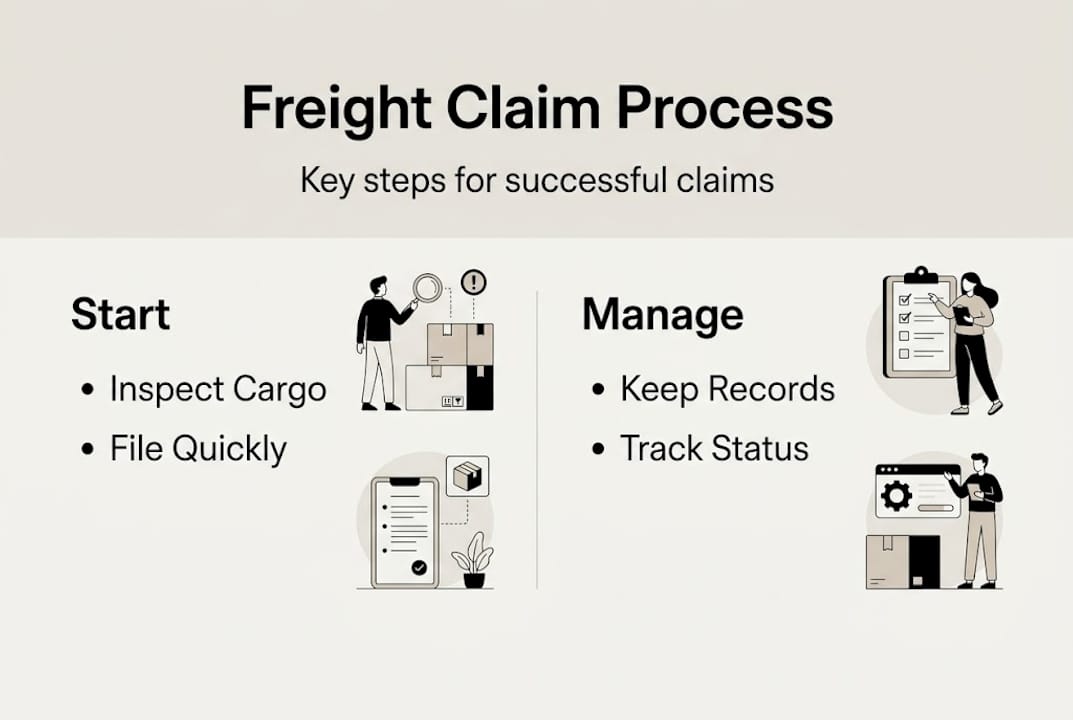
With all required documentation gathered, here is how the actual claim process unfolds, step by step. The freight claim process involves immediate inspection and documentation upon delivery, prompt filing within strict deadlines, follow-up, negotiation if denied, and recording outcomes for future reference.
- Inspect and document at delivery. As soon as freight arrives, examine all packages. Note any damage or shortage on the delivery receipt before signing.
- Notify the carrier in writing. Send written notice to the carrier as soon as possible, citing the shipment details and nature of the loss or damage.
- Compile your claim package. Assemble the BOL, POD, photos, invoices, packing lists, and any carrier correspondence into a single organized submission.
- Submit the claim formally. File the claim directly with the carrier through their designated claims portal or via certified mail to create a paper trail.
- Track and follow up proactively. Monitor claim status and follow up in writing if no response arrives within 30 days. Persistent follow-up signals professionalism and urgency.
- Negotiate if denied. If the carrier denies the claim, review the denial reason carefully. Provide additional documentation or escalate through your insurer’s subrogation process.
- Record the outcome. Document the final settlement, all correspondence, and any lessons learned for your internal compliance records.
| Stage | Key action | Target timeline |
|---|---|---|
| Inspection | Document exceptions on POD | At delivery |
| Notification | Written notice to carrier | Within 24 to 48 hours |
| Submission | Complete claim package filed | Within 30 days |
| Follow-up | Written inquiry on status | Every 30 days |
| Resolution | Settlement or appeal | 60 to 120 days |
Strategies for optimizing global shipping often include building claims management into the standard operating procedure, which reduces scramble time and improves documentation quality from the start.

Pro Tip: Create a shared digital folder for every shipment the moment it departs. Include the BOL, commercial invoice, and packing list so that if a claim arises, all materials are already organized and accessible.
Common reasons claims are denied (and how to avoid them)
Even with the right process, claims can be denied. Knowing why denials happen is the first line of defense. The most common denial triggers, per industry research, include missed deadlines, incomplete documentation, no exceptions noted on the delivery receipt, shipper packaging fault, and concealed damage not reported promptly.
Here are the most frequent denial pitfalls and how to avoid each one:
- Missing deadlines. Carriers are legally permitted to deny claims filed outside the governing window. Use calendar alerts tied to every shipment delivery date.
- No exceptions on the delivery receipt. Signing without noting damage is the single fastest way to lose a claim. Always inspect before signing.
- Incomplete documentation. A claim missing photos, invoices, or the BOL will almost certainly be rejected. Use a documentation checklist for every submission.
- Packaging deficiency. If the carrier argues the shipper’s packaging caused the damage, they can shift liability. Use packaging that meets or exceeds carrier requirements and document it.
- Concealed damage reported too late. Damage discovered after delivery must still be reported promptly. Most carriers require notice within 5 to 15 days for concealed loss.
“The carrier is not your advocate in a claim. Every procedural error you make becomes a legitimate reason for them to reduce or deny your recovery. Documentation is your only leverage.”
Understanding your coverage options also matters enormously here. Reviewing available freight insurance options before a loss occurs, and understanding cargo insurance basics, gives logistics managers a critical backstop when carrier liability falls short.
Pro Tip: Never accept a denial without requesting the carrier’s written explanation. Denial letters often cite procedural issues that can be corrected and resubmitted, especially if new supporting evidence is available.
Expert strategies and technology for efficient freight claim management
Once common errors are avoided, the next step is leveraging technology and expert strategies for even better results. Modern freight claim management has moved well beyond spreadsheets and paper files.
Automation and digital tools are now transforming how businesses handle claims at scale. Per industry data, automation reduces processing time by 50% and boosts recovery rates by ensuring complete, consistent data is submitted every time. For international businesses managing claims under varying regulatory systems, this is not just convenient. It is essential.
Key strategies worth adopting include:
- Robotic process automation (RPA). RPA tools centralize claim data, enforce filing deadlines through automated alerts, and generate standardized documentation packages with minimal manual input.
- Digital claim templates. Pre-built forms ensure that every required field is completed before submission, reducing the risk of rejection due to missing information.
- Telematics and GPS tracking. Real-time shipment data creates a verifiable chain of custody, which is invaluable evidence when a carrier disputes where or when damage occurred.
- Pattern analytics. Tracking claim data over time reveals recurring damage routes, packaging weaknesses, or carrier performance issues that allow businesses to take preventive action.
- Ad valorem declarations. For high-value shipments, declaring full cargo value on the BOL (paying a slightly higher freight rate) unlocks carrier liability beyond standard limits.
- Subrogation through insurers. When a carrier denies or underpays a claim, your cargo insurer can pursue the carrier on your behalf through subrogation, recovering losses you might otherwise absorb.
The data on automation is striking. Expert analysis confirms that centralizing data via RPA, enforcing deadlines automatically, and using telematics to support claims leads to measurably improved recovery outcomes. Monitoring freight marketplace trends also helps businesses stay ahead of regulatory shifts that affect claim rules across different trade lanes.
Statistic callout: Automation tools reduce freight claim processing time by 50%, according to claims management research, while simultaneously increasing recovery rates through complete, verifiable documentation.
Our take: What most guides miss about freight claims
Most freight claim guides focus on the mechanics of filing and stop there. What they rarely address is the compounding cost of not analyzing your claim history. Every denied or underpaid claim is a data point. Grouped together, those data points reveal patterns: which carriers perform poorly on specific lanes, which packaging configurations fail under certain conditions, which routes generate the most concealed damage reports.
In cross-border shipping, where regulations vary by country and transit mode, understanding whether you are working with a freight forwarder vs carrier and how liability shifts between them is knowledge that changes your entire claims strategy. Automation is not just a time-saver here. It is the infrastructure that makes pattern analysis possible at scale.
The businesses that recover the most from freight claims are not necessarily the ones filing the most. They are the ones investing as much in prevention and post-claim analysis as in the filing process itself. That shift in mindset is where the real operational advantage lives.
Connect to expert solutions for claim management
Having learned the process and expert insights, finding the right support can make all the difference in outcomes.
Worldwide Express offers a full suite of solutions designed for businesses that need reliable, compliant international logistics support. From US customs brokerage services that keep your shipments moving through complex regulatory environments, to tailored cargo insurance coverage that protects your goods against loss and damage, the tools and expertise are already in place. For businesses building or refining their international logistics strategy, the freight forwarding guide is a strong starting point for understanding how all the pieces fit together.
Frequently asked questions
What is a freight claim and when should I file one?
A freight claim is a formal request for compensation from a carrier due to lost, damaged, or delayed cargo. Per established claims management guidance, file as soon as damage or loss is discovered at delivery to maximize your recovery chances.
What documentation is needed for a freight claim?
Required documents typically include the bill of lading, proof of delivery, commercial invoices, item descriptions, and timestamped photos of damage. The complete document list ensures no critical evidence is missing from your submission.
How long does a company have to file a freight claim?
US trucking under the Carmack Amendment allows 9 months to file, while COGSA requires visible ocean damage to be reported within 3 days of delivery. Air freight typically follows the Warsaw or Montreal Convention timeline of 14 days.
Why are freight claims often denied?
The most common reasons include missed deadlines, incomplete records, and failing to note damage exceptions on the delivery receipt before signing. Packaging deficiencies and late reporting of concealed damage also rank among the top denial triggers.
How can technology help with freight claim management?
Automation tools reduce claim processing time by 50% while improving recovery rates through consistent, complete data submissions. For international operations managing claims under multiple regulatory frameworks, automation is an operational necessity, not just a convenience.
Recommended
- Master the Freight Claim Process: A Step-by-Step Guide – Worldwide Express, Inc.
- How to file shipment insurance claims: 2026 guide – Worldwide Express, Inc.
- Master International Freight Shipping for Successful Trade – Worldwide Express, Inc.
- How to Choose a Freight Forwarder for Smooth Shipping – Worldwide Express, Inc.
- Master the commercial relocation process: your complete guide