Many import/export managers mistakenly assume international courier and freight services are interchangeable options for moving goods across borders. This confusion leads to costly logistics errors, including overpaying for small shipments or delaying large orders with the wrong service choice. Understanding the fundamental differences between these shipping methods is essential for efficient logistics planning. This guide clarifies when to use courier services for speed-sensitive parcels versus freight solutions for bulk shipments, helping you optimize costs, delivery times, and operational efficiency. You’ll learn practical decision criteria based on shipment characteristics, urgency requirements, and budget constraints to make confident shipping choices.
Table of Contents
- Understanding International Courier Services
- Exploring International Freight Services
- Comparing International Courier And Freight Services
- Choosing The Right Service For Your Business Needs
- Optimize Your Shipping With Worldwide Express Logistics Services
- Frequently Asked Questions
Key takeaways
| Point | Details |
|---|---|
| Service characteristics | Courier handles small, urgent parcels with door-to-door delivery while freight manages large, bulk shipments through complex logistics networks. |
| Speed differences | Courier typically delivers within 1-5 days internationally while freight can take 7-45 days depending on mode and route. |
| Cost structure | Courier charges higher per-pound rates but freight offers better economies of scale for shipments exceeding 150 pounds. |
| Best use cases | Choose courier for time-sensitive documents and samples under 150 pounds; select freight for palletized goods, machinery, or bulk inventory. |
| Decision criteria | Evaluate shipment weight, dimensions, delivery urgency, destination accessibility, and total landed cost before selecting a service. |
Understanding international courier services
Expedited international shipping prioritizes speed and handles small, time-sensitive packages typically box or parcel sized. These services excel at moving documents, product samples, prototypes, and small merchandise shipments that need to reach international destinations quickly. Most courier providers impose weight limits between 70-150 pounds per package and dimensional restrictions that prevent oversized items.
Courier services deliver comprehensive door-to-door solutions that simplify international shipping logistics. Your package gets picked up from your facility, transported through the courier’s dedicated network, cleared through customs using streamlined procedures, and delivered directly to the recipient’s address. This end-to-end service eliminates the need for you to coordinate multiple logistics partners or arrange separate pickup and delivery.
Pricing for courier services reflects the premium speed and convenience they provide. Carriers calculate rates based on actual or dimensional weight (whichever is greater), shipping distance, service level selected, and any special handling requirements. Express options commanding premium prices can deliver packages internationally within 24-72 hours, while standard courier services typically complete deliveries in 3-5 business days at lower rates.
The courier shipping process follows these straightforward steps:
- Package your items securely and prepare commercial invoices with accurate product descriptions and values.
- Schedule pickup through the courier’s online platform or customer service, providing shipment details and customs documentation.
- Courier collects the package and processes it through their sorting facility, applying tracking labels and scanning for visibility.
- Package moves through the international transportation network via dedicated air cargo capacity.
- Customs clearance occurs using the courier’s brokerage services and your provided documentation.
- Final delivery to the recipient’s address with signature confirmation and delivery notification.
Ideal courier scenarios include sending contract documents requiring signatures within days, shipping product samples to potential clients for immediate review, delivering replacement parts to minimize equipment downtime, or fulfilling small e-commerce orders where customers expect rapid delivery. The service shines when speed justifies the higher per-pound cost and when shipment size fits within courier limitations.
Pro Tip: Always provide detailed, accurate customs documentation with courier shipments to avoid clearance delays that negate the speed advantage you’re paying for.
Exploring international freight services
Freight shipping optimizes large, bulk shipments with flexible transit times and superior cost efficiency for high-volume movements. This service category handles everything from palletized goods and machinery to full container loads and oversized equipment that exceed courier capacity limits. Freight becomes the practical choice once shipments surpass 150 pounds or require specialized handling equipment.

International freight operates through multiple transportation modes, each offering distinct advantages. Ocean freight provides the most economical option for non-urgent, high-volume shipments, moving goods in containers across established shipping lanes. Air freight balances speed and capacity, delivering larger shipments faster than ocean but slower than courier services. Rail freight serves specific continental trade corridors efficiently, while trucking handles the critical first-mile pickup and last-mile delivery segments.
The complexity of freight logistics requires coordination across multiple partners and touchpoints. Your shipment moves from your facility to a freight terminal, gets consolidated with other cargo, transfers between transportation modes, clears customs at the destination country, and finally reaches the consignee through local delivery services. Each handoff introduces additional handling, documentation requirements, and potential delay points that demand careful management.
Freight pricing structures differ fundamentally from courier rates. Carriers quote based on shipment volume (measured in cubic meters or container capacity), actual weight, transportation mode selected, origin and destination points, and current market conditions affecting capacity availability. Ocean freight typically charges per container (20-foot or 40-foot) or per cubic meter for less-than-container-load shipments. Air freight uses chargeable weight calculations similar to couriers but at lower per-pound rates for larger volumes.
The international freight shipping process involves these essential steps:
- Request quotes from freight forwarders or carriers, specifying shipment details, preferred mode, and timing requirements.
- Book space with your selected provider and receive booking confirmation with shipment reference numbers.
- Prepare cargo for transport through proper packaging, palletizing, and securing to prevent damage during handling.
- Complete extensive documentation including commercial invoices, packing lists, bills of lading, certificates of origin, and any required permits.
- Arrange pickup or deliver cargo to the designated freight terminal by the cutoff deadline.
- Track shipment progress through ocean vessel schedules or air waybill updates as cargo moves internationally.
- Coordinate customs clearance at destination using a licensed customs broker who handles duty payments and compliance verification.
- Arrange final delivery from the destination port or airport to the consignee’s facility.
Freight services suit scenarios like importing bulk raw materials for manufacturing, exporting large equipment orders, restocking international warehouse locations, or moving seasonal inventory in advance of peak selling periods. The longer transit times require planning ahead but deliver substantial cost savings compared to courier rates for equivalent weights.
Pro Tip: Start freight planning at least 30-45 days before you need goods delivered to account for booking lead times, ocean transit duration, customs processing, and potential delays without disrupting your operations.
Comparing international courier and freight services
Understanding how courier compares to freight forwarder services helps you match shipping methods to specific business needs. Courier delivers faster but costs more per unit weight, while freight provides cost-effective solutions for large shipments despite slower transit. This fundamental tradeoff shapes most logistics decisions for international movements.
| Attribute | International Courier | International Freight |
| — | — |
| Typical speed | 1-5 business days | 7-45 days depending on mode |
| Cost structure | Higher per-pound rates | Lower per-pound rates for volume |
| Shipment size | Under 150 pounds typically | 150+ pounds to full containers |
| Delivery type | Door-to-door with tracking | Terminal-to-terminal or door-to-door |
| Customs handling | Simplified broker services included | Requires dedicated customs broker |
| Ideal use cases | Urgent documents, samples, small parcels | Bulk goods, equipment, inventory |
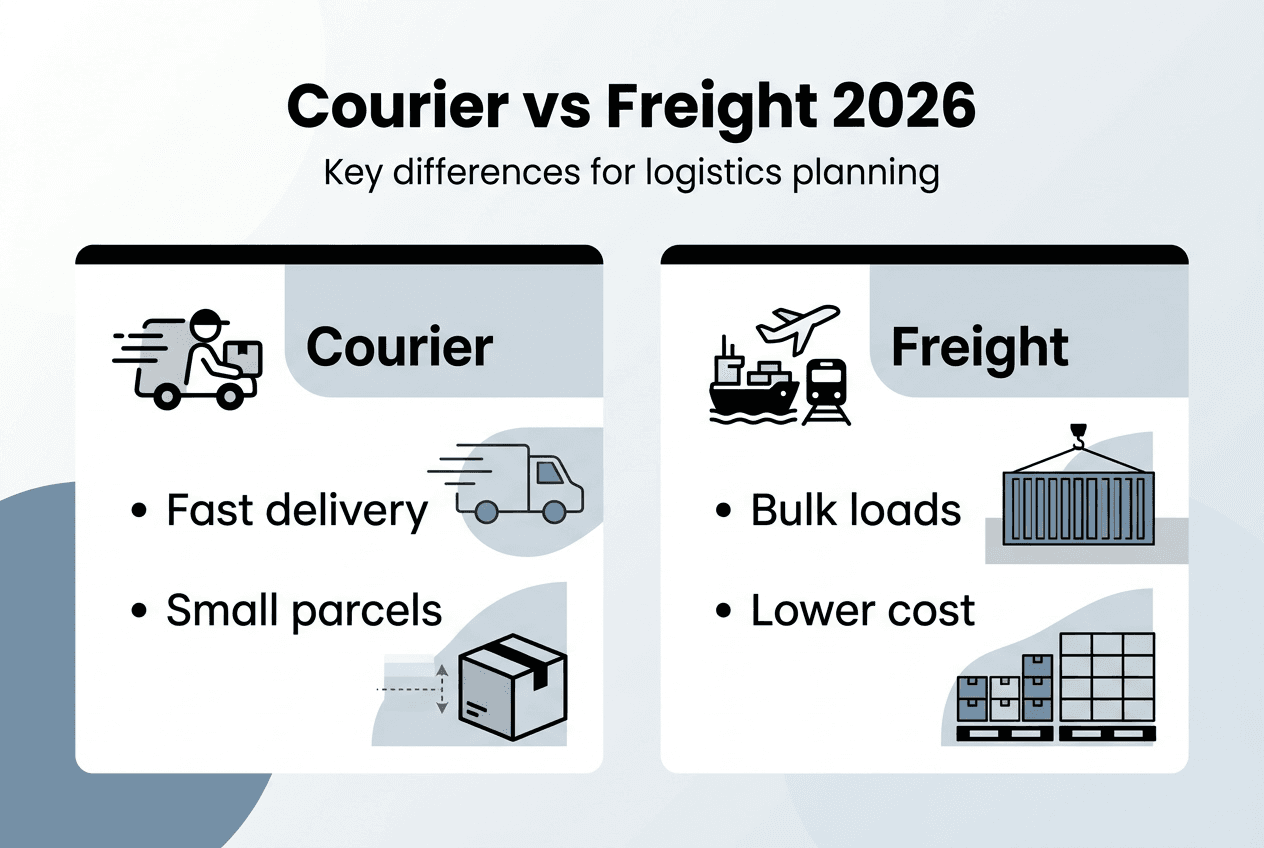
Courier advantages include unmatched speed for international delivery, simplified booking and tracking processes, integrated customs clearance that reduces your administrative burden, and reliable door-to-door service that eliminates coordination hassles. These benefits make courier services invaluable when time-sensitive needs justify premium pricing or when shipment size naturally fits courier parameters.
Courier limitations become apparent with larger shipments where per-pound costs multiply quickly, dimensional weight calculations that penalize bulky items, size and weight restrictions that exclude many industrial goods, and limited flexibility for specialized handling requirements like temperature control or hazardous materials.
Freight advantages shine through dramatically lower per-pound costs for shipments exceeding 150 pounds, ability to handle virtually any size or weight cargo, flexible mode options that let you optimize for cost versus speed, and specialized services for oversized equipment, refrigerated goods, or dangerous materials. Freight also accommodates complex shipping needs like consolidating multiple suppliers’ goods into one container.
Freight limitations include significantly longer transit times that require advance planning, complex logistics involving multiple handoffs and partners, extensive documentation requirements demanding careful preparation, and potential for delays at ports, customs, or during final delivery that can disrupt tight schedules.
Common mistakes in choosing shipping methods include selecting courier for heavy items without comparing freight quotes, assuming freight is always cheaper without considering total landed costs including duties and delays, overlooking dimensional weight penalties that inflate courier costs, and failing to plan far enough ahead to use cost-effective freight options. Managers also frequently forget to factor in customs clearance complexity, which varies significantly between services.
Successful logistics planning requires evaluating each shipment individually rather than defaulting to one service type. Consider how choosing the right forwarder impacts your total costs and delivery reliability. Compare actual quotes for your specific shipment parameters, factor in the value of faster delivery against cost savings from slower freight, and assess how delivery timing aligns with your operational needs. Understanding international shipping solutions available helps you make informed tradeoffs.
Choosing the right service for your business needs
Making optimal shipping decisions requires systematic evaluation of shipment characteristics against service capabilities. Your choice depends on urgency, size, destination, and budget considerations that vary with each international movement. Follow this decision framework to select confidently:
- Calculate total shipment weight and dimensions to determine if it falls within courier limits or requires freight capacity.
- Assess delivery urgency by working backward from when goods must arrive and comparing against typical transit times for each service.
- Obtain quotes from both courier and freight providers for your specific shipment to compare actual costs rather than assumptions.
- Factor in total landed costs including shipping rates, customs duties, taxes, insurance, and any storage or demurrage fees.
- Evaluate destination accessibility since remote locations may have limited courier service or require freight with extended final delivery.
- Consider shipment value and insurance requirements since high-value goods may warrant faster courier service despite higher costs.
- Review any special handling needs like temperature control, hazardous materials certification, or security requirements that limit service options.
Cost optimization strategies help you maximize shipping efficiency without compromising delivery reliability. Consolidate multiple small shipments into larger freight movements when timing permits, negotiate volume discounts with carriers based on your annual shipping patterns, use slower freight services for non-urgent replenishment while reserving courier for emergencies, and optimize packaging to minimize dimensional weight penalties. Consider establishing distribution centers in key markets to reduce international shipping frequency and costs.
Compliance considerations demand attention regardless of service type selected. Verify that product classifications and declared values are accurate to avoid customs delays and penalties, ensure all required certificates and permits accompany shipments, understand destination country import restrictions that may prohibit certain goods, and maintain proper record keeping for audit purposes. Insurance coverage deserves evaluation based on shipment value and risk tolerance, with courier services typically offering basic coverage and freight requiring separate cargo insurance policies.
Pro Tip: Develop hybrid logistics strategies that combine courier speed for critical components with freight economy for bulk materials, giving you flexibility to optimize each shipment individually while maintaining operational efficiency across your supply chain.
Seasonal considerations affect service selection since peak shipping periods like holiday seasons create capacity constraints and rate increases for both courier and freight services. Plan major freight movements during off-peak periods when possible, secure space commitments early during high-demand seasons, and maintain buffer inventory to avoid forced courier shipments when freight capacity tightens. Understanding carrier capacity cycles helps you streamline shipping operations and control costs.
Technology integration enhances decision making through visibility tools that track shipments across both courier and freight networks, analytics platforms that identify cost-saving opportunities in your shipping patterns, and automation that streamlines documentation preparation and customs compliance. Modern logistics management systems let you compare service options, generate required paperwork, and monitor deliveries from a unified interface regardless of carrier or service type selected.
Optimize your shipping with worldwide express logistics services
Navigating international courier and freight decisions becomes simpler with expert guidance tailored to import/export operations. Worldwide Express delivers comprehensive logistics services that combine courier speed when you need it with freight economy for bulk movements. Our team helps you evaluate each shipment against the decision criteria outlined here, securing competitive rates and reliable service across global networks.
Whether you need to master freight shipping complexities or streamline courier operations, our specialists provide the expertise and carrier relationships that reduce costs and prevent delays. We handle customs brokerage, documentation preparation, cargo insurance, and end-to-end tracking so you can focus on core business activities. Contact us to discuss how customized shipping solutions and advanced logistics tools can transform your international operations. Our experience across industries helps you avoid common pitfalls while optimizing for your specific operational requirements and budget constraints.
Frequently asked questions
What factors determine whether to use international courier or freight?
Shipment weight and dimensions provide the starting point, with items under 150 pounds typically suiting courier services while heavier cargo requires freight capacity. Delivery urgency matters significantly since courier delivers in days while freight takes weeks. Cost sensitivity influences the decision because courier charges premium rates for speed while freight offers economies of scale. Destination accessibility affects service availability, and special handling needs like temperature control may limit options to specialized freight providers.
How does shipment size influence the choice between courier and freight?
Small, lightweight packages under 70 pounds fit naturally within courier parameters and benefit from their streamlined processes. Medium shipments between 70-150 pounds require careful cost comparison since courier dimensional weight penalties may make freight more economical despite smaller size. Large shipments exceeding 150 pounds almost always favor freight due to dramatically lower per-pound rates. Understanding these thresholds prevents costly mistakes where managers default to familiar courier services for shipments that would ship more economically via freight.
What are the typical delivery times for international courier versus freight?
International courier services complete most deliveries within 1-5 business days depending on origin, destination, and service level selected. Express courier options can achieve 24-48 hour delivery between major commercial centers at premium prices. Freight transit times vary widely by mode, with air freight requiring 7-14 days, ocean freight taking 20-45 days, and rail or truck freight falling somewhere between depending on distance. These timeframes include customs clearance and final delivery, though delays can extend actual delivery dates.
Is international courier more expensive than freight shipping?
Courier services charge significantly higher per-pound rates, often 3-5 times freight costs for equivalent weights. However, for small shipments under 50 pounds, the absolute cost difference may be minimal while delivery speed advantage is substantial. Freight becomes dramatically more economical as shipment size increases, with cost per pound dropping as volume grows. Total landed cost comparison must include customs duties, insurance, potential storage fees, and the business impact of faster versus slower delivery to determine true cost effectiveness.
Can businesses combine courier and freight services for better logistics?
Hybrid approaches deliver optimal results by matching each shipment to the most appropriate service type. Use courier for urgent components, critical spare parts, or time-sensitive documents while shipping bulk inventory, raw materials, and non-urgent replenishment via freight. This strategy maximizes cost efficiency without sacrificing operational flexibility. Many successful import/export operations maintain relationships with both courier and freight providers, selecting dynamically based on each shipment’s specific requirements rather than committing exclusively to one service category.
Recommended
- Understanding freight forwarding: a 2026 guide – Worldwide Express, Inc.
- Carrier vs Freight Forwarder: Cut 20% Shipping Costs 2026 – Worldwide Express, Inc.
- Air Freight vs Sea Freight: Complete Guide for 2025 – Worldwide Express, Inc.
- Freight transportation modes: optimize shipping in 2026 – Worldwide Express, Inc.
- Lieferung bei lampenonline