TL;DR:
- Correct product classification and documentation are crucial to avoid costly fines and delays in tech exports.
- Automating compliance tasks significantly reduces errors and costs while speeding up customs clearance.
- Proactive, integrated systems for trade regulation, logistics, and cost management enable scalable international growth.
A single misclassified shipment of AI accelerator chips once cost a mid-sized electronics exporter over $200,000 in fines, detained cargo, and lost contracts before the product ever reached its destination. That scenario plays out more often than most businesses realize. Exporting technology products sits at the intersection of strict regulatory law, complex logistics, and intense cost pressure. One misstep in classification, documentation, or carrier selection can trigger customs holds, legal penalties, or permanent market bans. This guide walks through every critical stage, from regulatory compliance and document preparation to logistics automation and cost reduction, so your technology exports move fast, clean, and profitably.
Table of Contents
- Understand export controls and product classification
- Prepare export documents and compliance checks
- Integrate logistics and automation tools
- Reduce costs and optimize your export workflow
- Our perspective: What most exporters overlook
- Export smarter: Tap expert logistics and compliance support
- Frequently asked questions
Key Takeaways
| Point | Details |
|---|---|
| Classify products accurately | Correctly identifying your product under EAR or ITAR prevents costly missteps and delays. |
| Prepare thorough documentation | Complete, accurate export documents are essential for smooth border clearance and compliance. |
| Use logistics automation | Integrating software with logistics and customs saves time and cuts admin costs by up to 80%. |
| Optimize for cost savings | Tuning HS codes, Incoterms, and using FTAs can reduce duties and increase your margin. |
| Treat compliance as a system | Linking regulation, logistics, and cost management yields better results than focusing on one area alone. |
Understand export controls and product classification
Now that you’ve seen what’s at stake, let’s start by demystifying the regulations and categorizing your technology products correctly.
U.S. technology exports operate under two primary regulatory frameworks. U.S. technology products are primarily regulated under the Export Administration Regulations (EAR) for dual-use items and the International Traffic in Arms Regulations (ITAR) for defense articles. EAR is administered by the Bureau of Industry and Security (BIS), while ITAR falls under the State Department’s Directorate of Defense Trade Controls (DDTC). Knowing which framework applies to your product is the first decision that shapes everything downstream.
Classification is the backbone of export compliance. Every technology product must be assigned an Export Control Classification Number (ECCN) under EAR or listed on the United States Munitions List (USML) under ITAR. Product classification using ECCN or USML is foundational, and the de minimis rule and Foreign Direct Product (FDP) rule further extend U.S. controls to foreign-made goods containing American technology or software above certain thresholds. For example, an AI chip manufactured in Taiwan but designed with U.S. software may still require a U.S. export license.
Here is a quick-reference table for the two frameworks:
| Feature | EAR (Dual-Use) | ITAR (Defense) |
|---|---|---|
| Governing body | BIS (Commerce Dept.) | DDTC (State Dept.) |
| Classification system | ECCN | USML |
| Typical products | AI chips, encryption software, sensors | Military electronics, weapons systems |
| License requirement | Varies by ECCN and destination | Generally required |
| Penalties for violation | Up to $1M per violation | Up to $1M and criminal charges |
For technology exporters, dual-use electronics are especially tricky. Items like high-performance graphics processing units (GPUs), advanced semiconductors, and certain cybersecurity tools may have both commercial and military applications, making accurate ECCN assignment critical. The BIS product classification guidance provides detailed criteria for high-performance computing products.
Two edge cases deserve special attention. First, deemed exports: sharing controlled technology or source code with a foreign national inside the United States is legally treated the same as physically exporting that item. Second, embargoed destinations such as Iran, North Korea, Cuba, and Syria are subject to near-total restrictions regardless of product type.
Key classification steps for tech exporters:
- Identify whether your product is EAR or ITAR controlled
- Assign the correct ECCN or confirm USML listing
- Check the de minimis and FDP thresholds for foreign-made variants
- Screen end-users and destinations against the Denied Parties List
- Determine if a license is required or if a license exception applies
Pro Tip: If you are unsure of your product’s ECCN, submit a classification request to BIS. A formal determination protects you legally and speeds up future shipments. Reviewing export compliance essentials can also help your team build a repeatable internal process.
Prepare export documents and compliance checks
With your product classified, your next step is to gather the right documents and build strong compliance habits.

Documentation errors are the leading cause of customs delays for technology shipments. Essential export documentation includes the Commercial Invoice, Bill of Lading or Air Waybill, Packing List, Certificate of Origin, Harmonized System (HS) codes, and any required export licenses. Missing or inaccurate entries on any one of these documents can freeze a shipment at the border for days or weeks.
Required documents for technology exports:
- Commercial Invoice: Must include product description, ECCN, value, and end-user details
- Bill of Lading / Air Waybill: Carrier-issued transport contract and receipt
- Packing List: Itemized breakdown of contents, weights, and dimensions
- Certificate of Origin: Confirms manufacturing country for tariff and FTA purposes
- HS Code: Determines duty rate and import controls at destination
- Export License (if required): BIS or DDTC-issued authorization for controlled items
Beyond assembling documents, exporters need a structured compliance check process. The US Commercial Service offers guidance on building compliance programs, including restricted party screening and license determination workflows.
Incoterms (International Commercial Terms) also shape your risk and cost exposure. The table below compares two common choices for technology exporters:
| Incoterm | Who pays duty | Who bears risk | Best for |
|---|---|---|---|
| DAP (Delivered at Place) | Buyer | Seller until delivery | Experienced buyer markets |
| DDP (Delivered Duty Paid) | Seller | Seller end-to-end | Consumer-facing or new markets |
DAP keeps your upfront costs lower but shifts duty responsibility to the buyer, which raises the risk of shipment refusal if duties are unexpectedly high. DDP gives you full control and typically improves conversion rates in new markets, though it requires you to manage foreign customs clearance. Reviewing customs compliance tips can help you decide which Incoterm fits each market.
HS code optimization is another underused lever. Assigning the most accurate HS code, rather than defaulting to a broad category, can reduce duty rates significantly and qualify shipments for preferential trade agreement treatment.
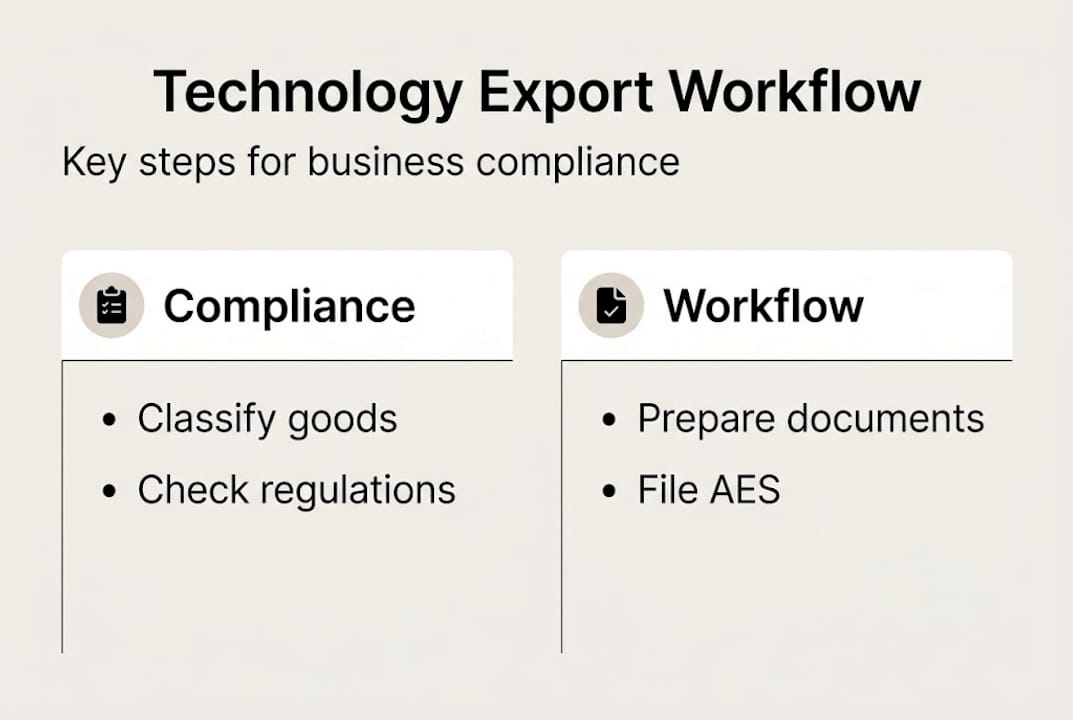
Pro Tip: Build a pre-shipment checklist that includes a restricted party screen, license determination, HS code verification, and Incoterm confirmation. Running this check before every shipment, not just new products, catches errors before they become expensive. The step-by-step export guide offers a practical framework for structuring that process.
Integrate logistics and automation tools
Once your paperwork is handled, the next evolution is integrating logistics technology to future-proof your export process.
Manual export processes do not scale. As shipment volumes grow, so does the probability of human error in AES (Automated Export System) filings, restricted party screening, and customs declarations. Logistics automation addresses this directly.
Here is a step-by-step approach to integrating your logistics and compliance systems:
- Audit your current workflow. Map every manual touchpoint from order creation to customs clearance.
- Select a compliance software platform. Look for tools that handle AES filing, ECCN classification, restricted party screening, and license management in one interface.
- Connect your ERP system. Integrate your enterprise resource planning (ERP) software with your compliance platform so product data, customer records, and transaction details flow automatically.
- Link carrier APIs. Connect your preferred carriers so shipping labels, tracking data, and customs declarations generate automatically from order data.
- Set up automated screening triggers. Configure your system to flag any order involving a denied party, embargoed destination, or license-required ECCN before it reaches the warehouse.
- Test with a pilot shipment batch. Run 20 to 30 shipments through the integrated system before full deployment to catch configuration errors.
The payoff is significant. Logistics automation tools for tech exports, including AES filing and restricted party screening, can reduce administrative costs by up to 80%. That figure reflects both labor savings and the avoided cost of compliance violations.
Hybrid logistics, pairing a third-party logistics provider (3PL) with in-house customs expertise, adds another layer of resilience. A 3PL with technology export experience brings pre-negotiated carrier rates, bonded warehouse access, and customs broker relationships that most exporters cannot replicate independently.
“The businesses that scale their exports fastest are not the ones with the largest compliance teams. They are the ones whose systems do the heavy lifting automatically, freeing people to focus on strategy and relationships.”
The Automated Export System is a mandatory filing requirement for most U.S. exports valued over $2,500 per Schedule B number. Automating this filing eliminates a persistent source of errors and penalties. Pairing AES automation with AI shipping automation tools further accelerates clearance times and reduces carrier costs through dynamic route optimization.
Reduce costs and optimize your export workflow
Integrated logistics and compliance save time, but the final competitive edge comes from lowering landed costs and boosting workflow efficiency.
Consider a real-world example. An e-commerce technology exporter reduced customs duties by 30% through HS code optimization, a strategic Incoterms shift, and Free Trade Agreement (FTA) utilization. The same company found that compliance software cuts duty costs by up to 80% when combined with automated classification and FTA preferential rate claims. These are not marginal gains. They represent a structural cost advantage over competitors still managing exports manually.
FTAs are one of the most underused tools in the tech exporter’s toolkit. The U.S. maintains FTAs with 20 countries, including South Korea, Singapore, and Israel, which are major technology import markets. Qualifying products under these agreements can reduce or eliminate import duties at destination, directly improving your price competitiveness.
Incoterm selection also drives measurable cost differences. DAP shifts duty burden to the buyer with a higher shipment refusal risk, while DDP yields better control and conversion rates in consumer-facing markets. Choosing the wrong Incoterm for a given market can quietly erode margins on every shipment.
Top cost-saving actions for technology exporters:
- Audit all HS codes annually and reclassify where more accurate codes carry lower duty rates
- Map your top 10 export destinations against active U.S. FTAs and claim preferential rates
- Switch from DAP to DDP for high-refusal-risk markets to protect revenue
- Use compliance software to automate duty drawback claims on re-exported goods
- Consolidate shipments where possible to reduce per-unit freight costs
- Negotiate volume-based rates with carriers using your annual shipment data
Pro Tip: Choose your Incoterm based on the buyer’s sophistication and the market’s customs infrastructure. In markets with unreliable customs agencies, DDP protects you from delays caused by an inexperienced importer. In established B2B markets, DAP keeps your cash flow healthier. Resources on how to reduce shipping costs and lower container shipping rates can sharpen your carrier negotiation strategy further. For a broader view, optimize global shipping practices can help you build a cost-efficient, scalable export model.
Our perspective: What most exporters overlook
Most technology exporters treat compliance as a reactive function. They build a process after the first penalty, hire a compliance officer after the first license violation, and invest in automation after the first costly delay. That sequence is expensive and avoidable.
The exporters who consistently outperform their peers treat compliance, logistics, and cost strategy as one unified system, not three separate departments. Early risk assessment, conducted before entering a new market or launching a new product line, surfaces classification issues, license requirements, and duty exposure before they become crises. That proactive posture also creates leverage in international negotiations, since a business that knows its landed cost precisely can price more aggressively and win contracts that reactive competitors cannot.
Tight software and carrier integration beats manual heroics every time. No compliance team, regardless of how talented, can screen thousands of transactions per day with zero errors. Systems can. Investing in advanced compliance practices and the right technology stack is not overhead. It is a growth enabler that compounds in value as your export volumes scale.
Export smarter: Tap expert logistics and compliance support
Ready to stop worrying about compliance and focus on growth? Here’s where to get hands-on help.
Worldwide Express connects technology exporters with the compliance infrastructure, carrier networks, and customs expertise needed to move products across borders without costly surprises. From document preparation and AES filing to restricted party screening and bonded warehousing, the platform is built for businesses that cannot afford to learn compliance through trial and error.
Whether you need end-to-end logistics services for high-value technology shipments, a deeper understanding of freight forwarding through the freight forwarding guide, or dedicated customs brokerage services to manage classification and clearance, Worldwide Express delivers tailored solutions that protect your margins and your reputation in every market you serve.
Frequently asked questions
What are the main regulations controlling technology exports?
U.S. technology products are primarily regulated under EAR for dual-use goods and ITAR for defense articles, each administered by separate federal agencies with distinct licensing requirements.
Which documents are essential for exporting technology products?
Essential export documentation includes a commercial invoice, bill of lading or air waybill, packing list, certificate of origin, HS code, and any required export licenses specific to your product’s classification.
How can automation help with tech export compliance?
Customs automation tools can reduce administrative costs by up to 80% while minimizing human error in AES filings, restricted party screening, and license determination workflows.
What is the best way to reduce export shipping costs?
Optimize HS codes for accurate duty rates, leverage applicable FTAs, select Incoterms strategically based on market risk, and use HS optimization and Incoterm shifts proven to cut costs by up to 30%.
What is a deemed export and why does it matter?
A deemed export is the transfer of controlled technology or technical data to a foreign national inside the United States, subject to the same licensing rules as a physical export to that person’s home country.
Recommended
- Step-by-step guide to exporting goods: compliance to shipment – Worldwide Express, Inc.
- Master Exporting Food Products: A Step-by-Step Approach – Worldwide Express, Inc.
- Master the Export Documentation Process in 2025 – Worldwide Express, Inc.
- How to Import Goods: A Step-by-Step Guide for Success – Worldwide Express, Inc.