TL;DR:
- An importer number is mandatory for U.S. customs clearance and links shipments to legal compliance.
- Proper documentation and accurate application via CBP Form 5106 ensure quick assignment of the importer number.
- Working with licensed customs brokers reduces errors, delays, and ensures ongoing record maintenance.
Without a valid importer number, your shipment does not clear U.S. customs. Full stop. Goods get held, returned, or even seized, and the clock on storage fees starts immediately. For businesses moving products across U.S. borders, this single identifier is the difference between a smooth delivery and an expensive border standoff. This guide breaks down exactly what the importer number is, what documents you need, how to complete and submit CBP Form 5106, and how to maintain your record so your importing operations never hit an unnecessary wall.
Table of Contents
- What is an importer number and why do you need one?
- What you need before applying: Requirements and documentation
- Step-by-step: How to apply for an importer number
- After submission: Verification, maintenance, and common pitfalls
- Special cases and FAQs: Non-resident importers, rejections, and urgent shipments
- Why smart importers use customs brokers for importer number applications
- Get expert support for your importer number and seamless U.S. customs clearance
- Frequently asked questions
Key Takeaways
| Point | Details |
|---|---|
| Importer number is essential | No U.S. import shipments clear customs without a valid importer number tied to your business. |
| Application is quick | Applicants who provide accurate information via Form 5106 usually receive their importer number in two business days. |
| Error prevention matters | Most delays or voided numbers are due to mismatched or incorrect tax IDs, easily avoided by double-checking details. |
| Updates are mandatory | You must update your importer record within 30 business days of any business changes to avoid shipment issues. |
What is an importer number and why do you need one?
Before you dive into how to apply, it’s crucial to understand what the importer number is and why it’s mandatory for doing business across U.S. borders.
The importer of record basics concept sits at the heart of U.S. trade compliance. Per CBP Form 5106, “the importer number, also known as Customs Assigned Importer Number (CAIN) or Importer of Record (IOR) number, is a unique identifier issued by U.S. Customs and Border Protection (CBP) for businesses and individuals importing goods into the US.” Every shipment entry filed with CBP requires this number. Without it, there is no legal pathway for your goods to enter U.S. commerce.
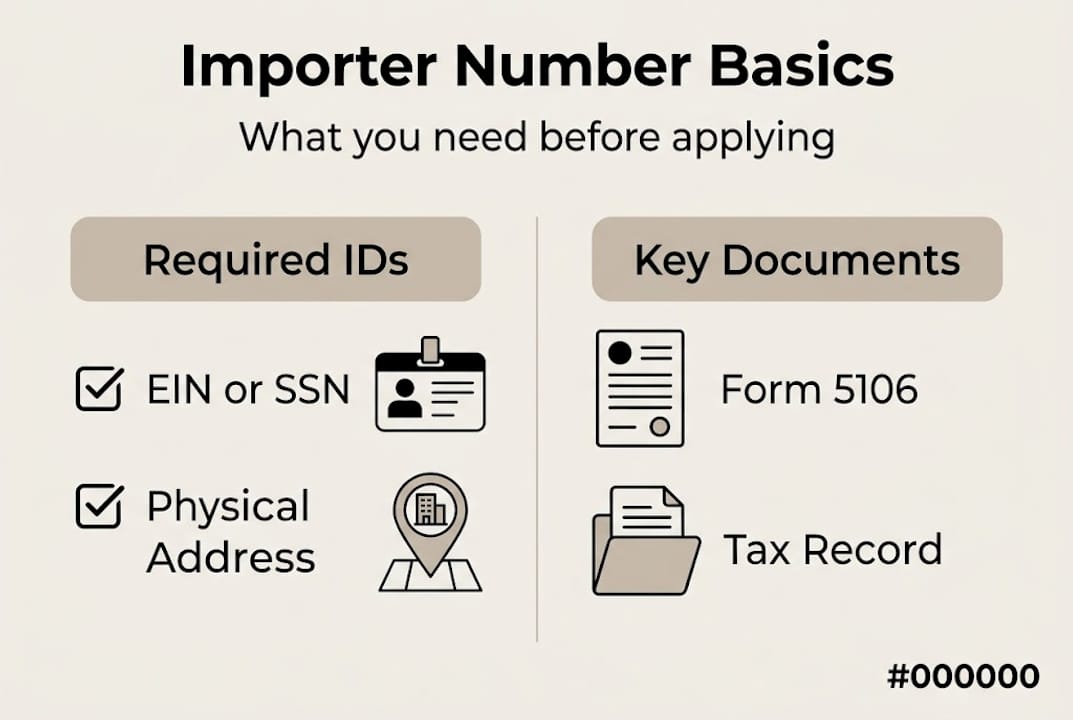
For U.S.-based businesses, this identifier typically mirrors your IRS Employer Identification Number (EIN) or, for sole proprietors, your Social Security Number (SSN). Non-resident importers who lack either of those receive a CAIN directly from CBP. The legal framework is not informal. The requirement is mandated by law) under 19 CFR 24.5 and 19 USC 4320, which established the centralized importer database CBP maintains today.
Here is a quick reference for identifier types by importer category:
| Importer type | Identifier used | Issued by |
|---|---|---|
| U.S. corporation or LLC | EIN | IRS |
| U.S. sole proprietor | SSN or EIN | IRS |
| Non-resident individual or business | CAIN | CBP |
| Partnership with EIN | EIN | IRS |
Border delays are not just inconvenient. They are expensive. Storage fees, missed delivery windows, and disrupted supply chains compound quickly. Think of the importer number as your customs passport. You can reference import licensing authority for more context on federal licensing obligations that run alongside this requirement.
“No import clearance is possible without a valid importer number on record with CBP. The cost of non-compliance extends far beyond paperwork.”
What you need before applying: Requirements and documentation
Having established its role and importance, next is preparing everything you need to apply seamlessly.
The application is submitted via CBP Form 5106, officially titled the “Create/Update Importer Identity Form.” It collects your business name, physical address, contact details, business type, and tax ID. Getting these details wrong is the number one reason applications stall.
Here is what to gather before you start, broken down by business type:
- U.S. corporation or LLC: Legal business name exactly as registered with the IRS, EIN, principal business address, contact name, phone, and email
- Sole proprietor: Full legal name, SSN or EIN, home or business address, contact details
- Non-resident importer: Passport or government-issued ID, foreign business registration documents, foreign address, and contact information (CBP will assign a CAIN)
- Partnership: Partnership EIN, legal entity name, address, authorized contact
A critical detail worth emphasizing: your tax ID must match IRS records exactly. Even a single character difference between your submitted EIN and the IRS-registered version can trigger a processing delay or a verification failure. Review your IRS confirmation letter (CP 575 or 147C) before you fill out a single field.

Pro Tip: If you are unsure whether your EIN is active and correctly formatted in the IRS system, call the IRS Business & Specialty Tax Line at 1-800-829-4933 to confirm before submitting your Form 5106.
Understanding your importer responsibilities goes hand in hand with gathering the right documents. The cleaner your application, the faster your number is assigned.
Step-by-step: How to apply for an importer number
With documents ready, you’re set to tackle the application process. Let’s break down each step clearly.
- Download or access Form 5106. Get the current version directly from CBP’s website. Older versions may be rejected.
- Complete all required fields. Enter your legal business name, tax ID (EIN, SSN, or foreign equivalent), physical address, contact name, phone, and business type code.
- Choose your submission method. You can file electronically through a licensed customs broker using the Automated Broker Interface (ABI) or the ACE Secure Data Portal, or you can submit manually by emailing or scanning the completed form to the appropriate CBP Center of Excellence.
- Review before sending. Double-check every field, especially the EIN or SSN, the legal business name spelling, and the address format.
- Submit and await confirmation. CBP will notify you of your assigned number. Processing time is approximately 2 business days for correctly submitted Form 5106.
Comparing submission methods helps you pick the right path:
| Submission method | Processing speed | Error risk | Best for |
|---|---|---|---|
| Electronic via ABI/ACE (broker) | Fastest (often same day) | Low (broker validates) | Businesses with time-sensitive shipments |
| Manual email/scan to CBP | 1 to 2 business days | Higher (self-verified) | Straightforward first-time applicants |
When it comes to broker involvement, the advantages are clear for most importers. A licensed broker files via ABI or ACE and can catch errors before submission, which is especially valuable for businesses new to U.S. importing. Review your options on choosing a customs broker and the self-filing vs broker comparison before deciding.
Pro Tip: Triple-check your EIN or SSN, your legal business name, and your physical address against source documents. Those three fields cause the vast majority of processing delays and rejection notices.
After submission: Verification, maintenance, and common pitfalls
Application done, but your importer number isn’t “set and forget.” Here’s how to ensure uninterrupted importing and fix issues proactively.
Once CBP processes your Form 5106, you receive your importer number by email or through your broker. From that point forward, the number is yours indefinitely. There is no expiration date. However, that permanence comes with an ongoing obligation: keeping your record accurate.
Per CBP guidance, updates are required within 30 business days of any change to your business name, address, ownership, or contact information. Missing that window risks triggering holds on your import entries.
Your record can also be voided under specific circumstances. Causes for voiding include duplicate records, unverifiable SSN or EIN, no response to CBP requests, undeliverable mail to your registered address, or a requested void. Reactivation requires resubmitting Form 5106 along with supporting proof such as an IRS EIN confirmation letter or SSN card.
Key maintenance and troubleshooting actions:
- Update your Form 5106 within 30 business days any time your business details change
- Keep your registered mailing address current to avoid CBP mail returns
- Respond promptly to any CBP verification request to avoid administrative voids
- If voided, resubmit Form 5106 with documentation confirming your EIN or SSN
- Work with your updating importer records process regularly, especially after mergers, rebranding, or relocations
“Failure to update your importer record is one of the most avoidable causes of customs holds. A 30-day window sounds generous, but supply chains move fast. Build the update into your business change checklist.”
Special cases and FAQs: Non-resident importers, rejections, and urgent shipments
Some businesses face extra complications. Here’s what to know and do for edge cases and emergencies.
For non-U.S. residents or foreign-incorporated businesses without an EIN or SSN, the process is straightforward in theory but requires extra patience. CBP assigns a CAIN for import filings when no U.S. tax ID exists. You submit Form 5106 with your foreign business registration documents, foreign address, and a valid government ID. CBP reviews and assigns a numeric CAIN that serves the same function as an EIN-based importer number.
If your application is rejected or your number is voided:
- Request a written explanation from CBP identifying the specific error
- Correct the flagged information, referencing your original IRS or government documents
- Resubmit Form 5106 with supporting documentation attached
- Contact your local CBP port of entry if the situation is time-sensitive
For urgent shipments at risk of being held:
- Notify your customs broker immediately and provide all corrected information
- Contact the CBP Center of Excellence handling your entry to explain the situation
- If you are working with a broker, ensure a CBP power of attorney is already in place so they can act on your behalf without additional delays
Pro Tip: Pre-authorize your broker with a CBP Power of Attorney before your first shipment, not after a crisis. It allows your broker to file corrections, respond to CBP inquiries, and expedite processing on your behalf without waiting for your signature in the middle of an urgent situation.
The broker role in compliance becomes especially critical in these edge-case moments when every hour counts.
Why smart importers use customs brokers for importer number applications
Having covered the full process, let’s consider the real value of relying on trade professionals.
The Form 5106 looks straightforward. It often is, until it isn’t. The most common failures, mismatched tax IDs, wrong business type codes, outdated addresses, and unsigned forms, are all easily prevented with professional oversight. As noted by voided importer record guidance, using a customs broker to file via ABI or ACE significantly reduces error rates, and verifying your tax ID against IRS records before submission is the single most important step for preventing verification failures.
Seasoned importers don’t view customs brokerage as overhead. They view it as operational insurance. A rejected or voided importer number can delay a shipment by days. In industries where inventory timing affects production schedules or retail seasons, that delay carries a real financial cost that dwarfs any broker service fee.
The businesses that streamline the process most effectively are those that engage a licensed broker from day one, giving them full visibility into the application and the authority to act fast when circumstances change. That is not a shortcut. That is strategy.
Get expert support for your importer number and seamless U.S. customs clearance
When you’re ready for the next step, professional help makes all the difference.
Navigating the importer number application process correctly the first time saves you from costly delays, voided records, and held shipments. Worldwide Express connects businesses with licensed customs brokers who handle Form 5106 submissions, compliance checks, and full-service customs clearance with precision.
Whether you’re applying for the first time, managing an urgent shipment, or updating an existing importer record, our team is ready to support you. Explore our customs brokerage services to see the full scope of what we offer. Learn more about what customs brokers do and how they protect your import operations. For a full picture of our global shipping solutions, start here and let’s build a smoother path to U.S. market access.
Frequently asked questions
How long does it take to get an importer number after applying?
Most importer numbers are assigned by CBP within two business days after a complete and correct Form 5106 application is received. Errors or missing information will extend that timeline.
Do I need an EIN or SSN for an importer number?
U.S. residents need an EIN or SSN to apply. Non-resident importers without either are assigned a CAIN directly by CBP based on their foreign identity documents.
What happens if my importer number gets voided?
You must resubmit Form 5106 with corrected information and supporting proof. Per CBP voided record guidance, acceptable documents include an IRS EIN confirmation letter or a Social Security card.
Is there a cost to apply for an importer number?
CBP does not charge a fee for processing Form 5106. If you use a licensed customs broker to file on your behalf, their service fee applies separately.
Recommended
- Mastering Your Export License Application Process – Worldwide Express, Inc.
- How to Import Goods: A Step-by-Step Guide for Success – Worldwide Express, Inc.
- Importing from Europe: Step-by-Step U.S. Business Guide – Worldwide Express, Inc.
- Entry Summary 7501 in U.S. Imports: Ensuring Compliance – Worldwide Express, Inc.