TL;DR:
- Missing or inaccurate shipping documents cause delays, customs holds, and increased costs for importers and exporters.
- Proper preparation, cross-checking details, and implementing automated validation are essential to ensure smooth customs clearance.
Missing a single document can put your entire shipment on hold. For importers and exporters, a solid shipping documentation checklist is not a formality. It is the difference between smooth customs clearance and a costly, reputation-damaging delay. Incomplete cargo declarations cause 87% of customs shipment delays, and errors as small as a mismatched unit count can add five or more days and hundreds in storage fees. This guide breaks down every document you need, how to prepare each one correctly, and how to verify your paperwork before your cargo ever leaves the dock.
Table of Contents
- Key takeaways
- Your shipping documentation checklist: the core documents
- How to prepare and verify documents accurately
- Common mistakes that cause holds and delays
- Final pre-shipment checklist and best practices
- Why documentation diligence is your competitive edge
- How Worldwideexpress simplifies your shipping documentation
- FAQ
Key takeaways
| Point | Details |
|---|---|
| Document accuracy drives clearance | Even minor discrepancies in declared quantities or values trigger customs holds that cost days and money. |
| Core documents apply universally | Every international shipment needs a commercial invoice, packing list, and bill of lading or air waybill as a baseline. |
| Filing timing matters as much as content | Advance filings like ISF must be submitted at least 24 hours before vessel loading, not at departure. |
| Cross-checking prevents costly rework | Matching details across all documents before submission stops the majority of customs rejections. |
| Automation reduces human error significantly | Automated validation tools reduce documentation errors by up to 80%, preventing most shipment holds. |
Your shipping documentation checklist: the core documents
Every successful international shipment rests on a set of foundational documents. Skipping or incorrectly preparing any one of them is what separates a shipment that clears in hours from one that sits in a customs examination facility for a week.
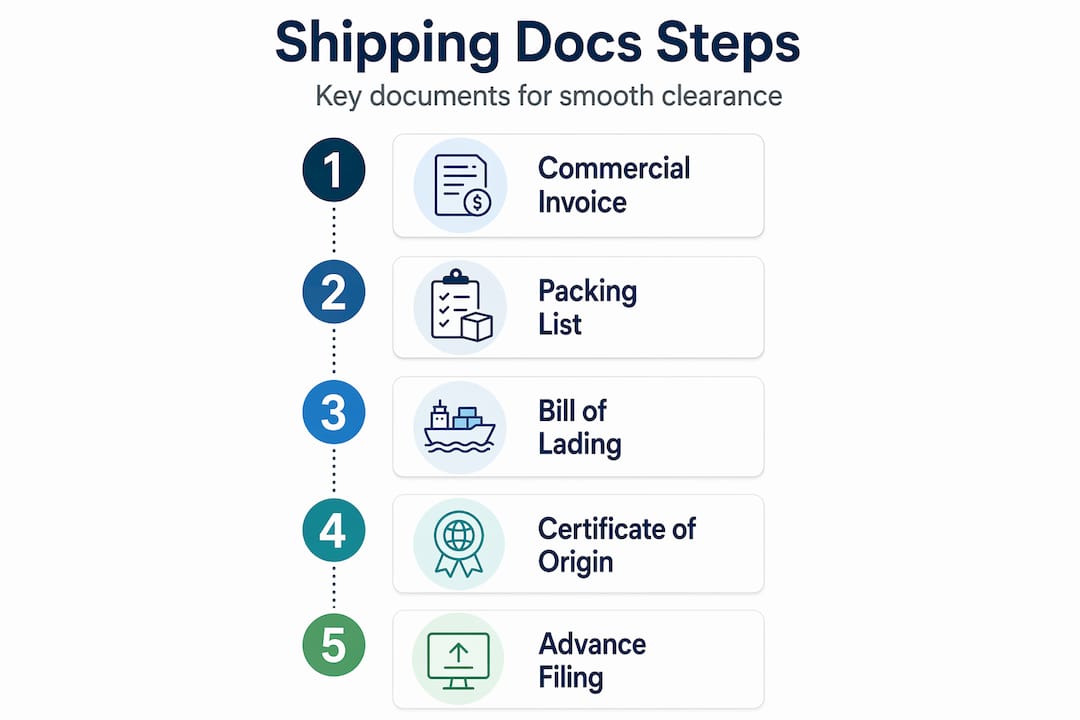
Commercial invoice
The commercial invoice is the single most important document in your export documentation checklist. It defines the shipment value, identifies the buyer and seller, specifies the Incoterms, and determines how customs authorities calculate duties. Per international shipping documentation guidance, errors on the commercial invoice frequently cause major downstream customs issues, including reclassification, audits, and outright holds.
Packing list
The packing list is the physical companion to your invoice. It details every item in every box or pallet: dimensions, weights, quantities, and packaging type. Carriers use it for handling decisions, and customs officers use it to verify that what is declared matches what is physically present. Discrepancies between the packing list and the invoice are one of the fastest ways to attract a customs examination.
Bill of lading and air waybill
The bill of lading functions simultaneously as a contract of carriage, a receipt for the goods, and a document of title. For air freight, the air waybill serves the same contractual purpose but is non-negotiable. Both documents legally link the shipper, carrier, and consignee, and both are required to release cargo at the destination port or airport.

Certificate of origin
Many trade agreements grant preferential duty rates, but only when the certificate of origin is correctly completed and submitted. Incorrect origin statements do not just result in lost duty savings. They can trigger audits and denied benefits that affect future shipments as well.
Cargo declarations and advance filings
Advance electronic filings are time-sensitive and non-negotiable. The Importer Security Filing (ISF) in the United States must be submitted at least 24 hours before a vessel loads at the foreign port. The Entry Summary Notification (ENS) applies for EU-bound cargo. Missing these deadlines draws immediate customs scrutiny.
Below is a reference table covering the essential shipping documents importers and exporters encounter most often.
| Document | Primary use | Required by | Typical timing |
|---|---|---|---|
| Commercial invoice | Customs valuation and duty calculation | Customs authority | Before shipment departure |
| Packing list | Cargo verification and carrier handling | Carrier and customs | Before shipment departure |
| Bill of lading / Air waybill | Contract of carriage and title | Carrier | At booking confirmation |
| Certificate of origin | Preferential duty treatment | Customs authority | Before departure |
| ISF / ENS filing | Advance cargo declaration | Customs authority | 24 hours before vessel loading |
| Dangerous goods declaration | Regulated cargo compliance | Carrier and authority | Before booking acceptance |
| Cargo insurance certificate | Liability coverage evidence | Importer or bank | Before departure |
Pro Tip: If your commodity falls under any regulatory category, such as food, chemicals, textiles, or controlled items, build a secondary checklist for permits, licenses, and phytosanitary or fumigation certificates specific to the destination country.
How to prepare and verify documents accurately
Getting the paperwork right is a process, not a one-time task. Here is a step-by-step approach that experienced freight teams use to keep shipments moving.
-
Gather verified shipment data first. Collect accurate quantities, weights, HS codes, values, and complete consignee details before touching any document template. Using estimated figures because the final numbers are not yet available is a leading cause of mismatches that require costly amendments later.
-
Confirm your HS codes independently. HS code errors are among the top documentation mistakes triggering customs holds and reclassification requests. Cross-reference codes against the official tariff schedule of both the export and import country before filing.
-
Submit advance cargo declarations on schedule. Electronic submission systems like ACE in the US and CHIEF/CDS in the UK validate filings in real time, rejecting incomplete declarations instantly. Plan for that validation window. Do not wait until the last hour before the cutoff.
-
Cross-check all core documents against each other. The product descriptions, quantities, and values on your commercial invoice, packing list, and bill of lading must match exactly. A single mismatched weight or a slightly different product description across documents is enough to trigger a customs examination.
-
Handle regulated or hazardous goods separately. Dangerous goods declarations follow International Maritime Dangerous Goods (IMDG) or IATA regulations depending on the mode. These documents must be completed by a certified dangerous goods specialist, and the carrier must accept them before booking confirmation.
-
Coordinate across all parties before final submission. The exporter, freight forwarder, customs broker, and carrier each hold a piece of the documentation puzzle. Establish a shared document checklist that all parties can access and sign off on. Miscommunications at this stage are where the most expensive delays originate.
-
Run automated validation before submission. Automated validation tools that check HS codes, weights, and values before submission reduce documentation errors by 80%. Most freight management platforms include this feature. Use it every time, not just for high-value shipments.
Pro Tip: Build a master document template for your most common shipping lanes. Pre-populating the recurring details, such as your company information, standard Incoterms, and banking references, cuts preparation time and eliminates the transcription errors that come from typing the same fields repeatedly.
Common mistakes that cause holds and delays
Even experienced trade teams make documentation mistakes. The pattern is usually predictable, which means it is also preventable.
The most frequent errors customs officers catch include:
- Vague or inconsistent product descriptions that do not match HS codes
- Declared quantities that differ from the packing list or the physical count
- Incomplete consignee contact information, particularly missing tax ID numbers in markets like Brazil or the EU
- Incoterms listed on the invoice that contradict the freight terms on the bill of lading
- Missing or expired certificates when the commodity requires them
- Cargo declarations with mismatched container numbers or seal numbers
Delivery instruction errors account for 23% of international logistics delays. Containers stall at terminals when dock appointments are missing, unloading requirements are unclear, or the receiving contact cannot be reached. Effective delivery instructions must specify recipient details, timing protocols, and handling requirements without ambiguity.
“Missing dock appointments and unclear unloading requirements are the main causes of containers stalling at terminals for days.” — DocShipper
When a document error surfaces after submission, act quickly. Most customs systems allow amendments, but the window is narrow. For export declarations, contact your customs broker immediately and file a correction before the cargo is examined. Post-examination amendments carry heavier penalties and can trigger mandatory inspections on future shipments. Knowing the difference between a cargo declaration, which is filed by the carrier, and a customs entry declaration, which is filed by the importer or their broker, helps you direct the correction to the right party without losing time.
Final pre-shipment checklist and best practices
Use this checklist before every international shipment. Print it, share it with your logistics team, and build it into your standard operating procedure.
Ocean freight checklist:
- Commercial invoice (values, Incoterms, buyer/seller details confirmed)
- Packing list (weights, dimensions, quantities matching invoice)
- Bill of lading (shipper, consignee, notify party, and cargo description verified)
- ISF filing submitted at least 24 hours before vessel loading
- Certificate of origin (if preferential duty treatment applies)
- Cargo insurance certificate
- Dangerous goods declaration (if applicable, carrier pre-approved)
- Delivery instructions with full consignee contact and dock appointment confirmed
Air freight checklist:
- Commercial invoice
- Air waybill (shipper and consignee details confirmed)
- Packing list
- Airway security declaration
- Shipper’s letter of instruction
- Applicable permits or licenses for controlled goods
Land freight (cross-border) checklist:
- Commercial invoice and packing list
- PAPS or PARS number (for US-Canada cross-border)
- NAFTA/USMCA certificate of origin if claiming preferential rates
- Delivery instructions with driver and facility contact confirmed
| Mode | Advance filing requirement | Key timing |
|---|---|---|
| Ocean | ISF (US) / ENS (EU) | 24 hours before vessel loading |
| Air | Advance cargo information | 4 hours before departure (US) |
| Land | Electronic manifest | 30 minutes to 1 hour before arrival |
| All modes | Export declaration | Before cargo leaves origin country |
Pro Tip: Working with a licensed customs broker who uses automated compliance tools gives you a real-time second opinion on every document before submission. The fee is minor compared to the cost of a single customs exam or storage hold.
For additional guidance on how thorough documentation prevents costly holds, the Worldwideexpress resource on avoiding customs delays is worth bookmarking as a standing reference.
Why documentation diligence is your competitive edge
I have seen companies lose contracts because a shipment sat in customs for ten days on a documentation technicality that a ten-minute review would have caught. That is not just frustrating. It is preventable, and it changes how buyers perceive your reliability.
In my experience, the businesses that treat their shipping paperwork guide as a living process rather than a one-time administrative burden consistently outperform their peers on delivery timelines and customs clearance rates. They build templates, they train teams, and they invest in relationships with freight forwarders and customs brokers who know the destination markets. That investment pays back on every shipment.
The shift toward electronic filing systems has raised the bar significantly. Real-time validation means errors are caught earlier, but it also means there is less room for last-minute corrections. The companies that are thriving right now are those who built documentation accuracy into their pre-shipment workflows before the electronic filing mandates tightened.
My advice: treat your export documentation checklist as a competitive asset. Share it across departments, update it when regulations change, and never assume that a repeat lane means you can skip the verification step. Regulations update, product descriptions evolve, and one outdated HS code can undo months of smooth trade. The diligence you put in up front is what keeps your supply chain moving when everyone else’s is stalled.
— Ian
How Worldwideexpress simplifies your shipping documentation
Managing a complete shipping documentation checklist across multiple markets, carriers, and regulatory environments is a significant operational burden. Worldwideexpress is built to take that burden off your team’s plate.
As a full-service logistics and freight forwarding partner, Worldwideexpress handles customs brokerage, export documentation preparation, advance electronic filings, and compliance checks as part of its logistics services for importers and exporters. The team integrates with electronic filing systems including ACE and supports both ocean and air freight documentation workflows across global trade lanes.
For businesses looking to sharpen their overall freight strategy, the international freight shipping guide at Worldwideexpress offers practical frameworks for managing documentation alongside carrier selection, customs compliance, and supply chain visibility.
Whether you are handling a single cross-border shipment or managing high-volume import and export operations, Worldwideexpress provides the expertise to reduce documentation errors, prevent customs holds, and keep your cargo moving on schedule. Fewer delays mean lower costs, stronger supplier and buyer relationships, and a logistics operation your business can genuinely count on.
FAQ
What documents are needed for shipping internationally?
Every international shipment requires a commercial invoice, packing list, and a bill of lading or air waybill as a baseline. Additional documents such as a certificate of origin, ISF filing, and commodity-specific permits depend on the destination country and the nature of the goods.
What is an ISF filing and when is it due?
The Importer Security Filing (ISF) is a mandatory advance cargo declaration for ocean freight entering the United States. It must be submitted at least 24 hours before the vessel loads at the foreign port, not at departure.
How do HS code errors affect customs clearance?
Incorrect HS codes trigger reclassification requests from customs authorities, which can delay shipments significantly and result in reassessed duties. They are among the top documentation errors that cause customs holds.
Can shipping documents be amended after submission?
Yes, most customs systems allow amendments after initial submission, but the window is narrow. Filing a correction before a customs examination begins results in far lighter consequences than an amendment filed after an inspection is triggered.
What causes delivery instruction errors and how can they be avoided?
Incomplete delivery instructions account for nearly a quarter of shipment delays, most often because dock appointments are missing or unloading requirements are unclear. Always include the full receiving contact, scheduled appointment time, and any facility-specific handling requirements in your delivery instructions.
Recommended
- Master Export Shipping Documentation for Success – Worldwide Express, Inc.
- 8 Packing List Essentials for International Trade Success – Worldwide Express, Inc.
- Master International Freight Shipping for Successful Trade – Worldwide Express, Inc.
- Master the Export Documentation Process in 2025 – Worldwide Express, Inc.