TL;DR:
- An export declaration form, known as EEI, must be filed through AES before exporting goods from the U.S. depending on commodity value and type. The USPPI is legally responsible for accurate filing and retaining records for five years, while common errors include misclassification and missing ITN documentation. Proper classification and compliance integration into pre-shipment workflows help prevent delays and penalties.
An export declaration form, formerly known as Electronic Export Information (EEI), is the required legal filing that U.S. businesses must submit through the Automated Export System (AES) before exporting goods internationally. The EEI filing threshold applies per Schedule B commodity number, meaning any single commodity line valued above $2,500 triggers a mandatory filing. Shipments requiring export licenses from agencies like the Bureau of Industry and Security (BIS) must file regardless of value. The U.S. Census Bureau and Customs and Border Protection (CBP) jointly enforce these requirements under the Foreign Trade Regulations (FTR), and non-compliance carries civil and criminal penalties.
When does an export declaration form need to be filed?
The filing obligation is more specific than most businesses expect. The EEI requirement applies per Schedule B number, not per total shipment value. A shipment with three commodity lines could trigger filing on just one of them if that single line exceeds $2,500, while the others fall below the threshold.
Several categories require filing regardless of value:
- Licensed goods: Any shipment subject to an export license from BIS or another federal agency requires EEI filing, even if the goods are worth $10.
- Used self-propelled vehicles: Cars, trucks, and similar vehicles always require an export declaration, no exceptions.
- Shipments to most destinations: The standard value threshold applies globally, with one notable carve-out.
- Canada exemption: Most shipments to Canada are exempt from EEI filing. The exemption does not apply to licensed goods or used vehicles.
A shipment is defined as all goods exported by one U.S. Principal Party in Interest (USPPI) to one consignee on one conveyance on the same day. The value threshold calculation applies per commodity line within that shipment, not to the combined total. That distinction catches many exporters off guard.
The USPPI is the U.S. entity that receives the primary benefit of the export transaction. The USPPI holds ultimate legal responsibility for EEI accuracy, even when an authorized agent or freight forwarder files on their behalf. Delegating the filing does not transfer the legal obligation.

What data fields are required to complete the EEI accurately?
Completing the export declaration requires assembling a specific set of data before you ever log into AES. Missing or incorrect fields cause immediate system rejections. The following elements are required for every standard filing:
- USPPI details: Full legal name, Employer Identification Number (EIN), and U.S. address.
- Ultimate consignee information: Name and address of the foreign party receiving the goods.
- Schedule B number: The 10-digit commodity classification code that determines duty rates and controls.
- Commodity description: A specific, accurate description of the goods. “Electronic parts” is not acceptable. “Printed circuit board assemblies for industrial control systems” is.
- Shipment value: The selling price or fair market value of the goods in U.S. dollars.
- Quantity and unit of measure: Must match the unit specified under the Schedule B classification.
- Gross weight: Total weight of the shipment including packaging.
- Export license code or exception: Required when goods are controlled. License exceptions must be documented with the correct symbol per BIS regulations.
- Port of export: The U.S. port where the goods will depart.
- Mode of transportation: Air, vessel, truck, rail, or other.
- Country of ultimate destination: Where the goods will ultimately be consumed or used.
- Routed export transaction indicator: Identifies whether the foreign buyer controls the logistics.
- Hazardous material indicator: Required for dangerous goods subject to additional regulations.
After a successful submission, AES generates an Internal Transaction Number (ITN). The ITN is the legal proof of filing. It is an alphanumeric code that must appear on the bill of lading or air waybill before carriers can legally load the cargo. Without it, shipments are held at port.
Pro Tip: Use the U.S. Census Bureau’s Schedule B Search Engine to verify your commodity code before filing. A misclassified code is the single most common cause of EEI rejection and port delays.
What are the most common mistakes on export declaration forms?
Misclassification of goods is the leading cause of filing rejections and shipment delays. Exporters often use broad or generic descriptions that do not match any Schedule B code, or they select a code that looks right but applies to a different product category. The consequences range from a rejected filing to a cargo hold at the port of departure.
The most frequent errors fall into a predictable pattern:
- Incorrect Schedule B number. Selecting a code based on a product’s name rather than its technical specifications. Always verify using the official Schedule B lookup tool, not internal product catalogs.
- Failure to identify export license requirements. Exporters assume their goods are not controlled without checking the Commerce Control List (CCL) or the U.S. Munitions List (USML). Licensed goods require EEI filing at any value.
- Missing ITN on shipping documents. The ITN must be on the bill of lading or air waybill. Omitting it means the carrier cannot legally load the shipment.
- Incomplete USPPI or consignee information. A missing EIN or an abbreviated address causes immediate system rejection.
- Assuming the freight forwarder owns the compliance risk. The USPPI remains responsible for EEI accuracy even when an agent files on their behalf. Oversight is not optional.
- Incorrect shipment value. Reporting the invoice value when the FTR requires the selling price or fair market value at the U.S. port of export creates a discrepancy that auditors flag.
Pro Tip: Build a pre-filing checklist that mirrors the AES data fields. Run through it before every submission, and assign a second reviewer for shipments involving controlled goods or export licenses.
Businesses that treat export compliance as a one-time setup rather than an ongoing process accumulate errors over time. Regulations change, product lines expand, and new destinations may trigger new license requirements. Regular internal audits of your export compliance checklist catch drift before it becomes a violation.
How do you file the export declaration electronically through AES?
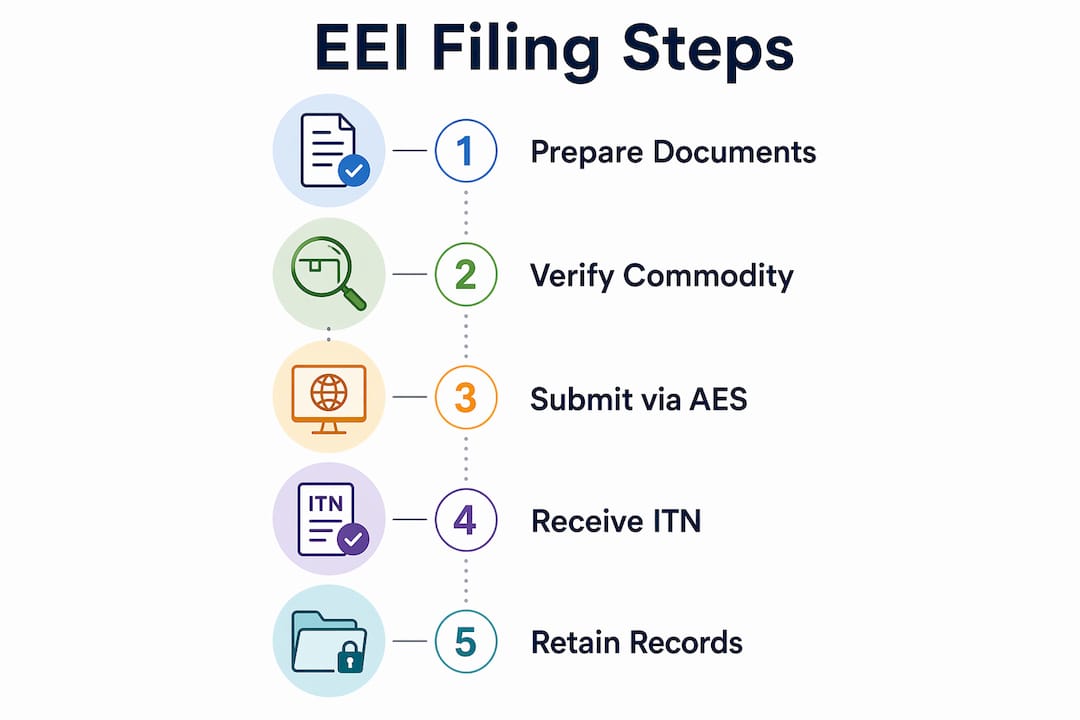
The AES is the U.S. government’s electronic system for collecting export trade data. Every EEI filing goes through AES, either directly or through integrated commercial software. The process follows a clear sequence:
- Choose your filing method. AESDirect is the free government portal operated by the U.S. Census Bureau. Commercial AES filing software integrates with enterprise resource planning systems and automates data mapping for high-volume exporters. Both submit EEI electronically and generate real-time validation responses.
- Enter all required data fields. Complete every mandatory field accurately. AES validates data immediately upon submission and returns error messages for any field that fails validation.
- Correct errors before resubmitting. AES error codes identify the specific field causing rejection. Address each error, then resubmit. Do not attempt to load cargo before receiving a clean ITN.
- Receive and record the ITN. A successful submission generates the ITN. Record it immediately and transmit it to your carrier and freight forwarder for inclusion on shipping documents.
- Retain records for five years. EEI record retention is required for five years from the export date. This includes the filing itself, the power of attorney if an agent filed, and all supporting documentation.
Working with an authorized agent or freight forwarder speeds up the process for businesses without in-house AES expertise. The agent files under a power of attorney, but the USPPI must review filings for accuracy. Understanding export license requirements before engaging an agent prevents miscommunication about controlled goods. Logistics payment processing platforms that handle freight documentation, such as those used in the logistics payment industry, increasingly integrate compliance data to reduce manual errors across the shipping chain.
Key Takeaways
Accurate EEI filing through AES is the legal foundation of U.S. export compliance, and the USPPI bears full responsibility for every data field regardless of who submits the filing.
| Point | Details |
|---|---|
| Filing threshold is per commodity line | Each Schedule B number over $2,500 triggers EEI filing, not the shipment total. |
| Licensed goods always require filing | Export license obligations apply at any shipment value, with no minimum threshold. |
| The ITN is legally required for loading | Carriers cannot load cargo without the ITN on the bill of lading or air waybill. |
| USPPI retains compliance responsibility | Delegating filing to a freight forwarder does not transfer legal accountability. |
| Records must be kept for five years | Retain all EEI filings and supporting documents from the date of export. |
What I’ve learned from watching exporters get this wrong
Export compliance looks straightforward on paper. In practice, the errors that cost businesses the most are rarely technical. They are organizational. A company hires a freight forwarder, hands over the paperwork, and assumes the compliance obligation moves with it. It does not. The USPPI is always on the hook, and auditors know exactly where to look.
The second pattern I see repeatedly is the commodity classification problem. Exporters classify goods based on what a product is called internally, not what it actually is under the Schedule B system. A “sensor module” might be a simple thermometer or a controlled dual-use item. The description on your invoice does not determine your filing obligation. The technical specifications do.
What actually works is building compliance into the pre-shipment workflow, not treating it as a documentation step at the end. That means classifying goods before they are sold, checking the Commerce Control List before quoting international customers, and verifying ITN transmission before the truck leaves the warehouse. Early coordination between the exporter, the freight forwarder, and the carrier eliminates most of the delays I have seen at ports.
The FTR and AES procedures do change. BIS updates the Commerce Control List regularly, and license exception rules shift with trade policy. Businesses that stay current on those updates avoid surprises. Those that do not find out about changes at the worst possible moment, when cargo is sitting at a port.
— Ian
How Worldwideexpress supports your export documentation needs
Export documentation errors are expensive. Worldwideexpress brings deep expertise in customs brokerage, AES filing support, and international freight forwarding to help businesses get shipments moving without compliance delays.
Worldwideexpress handles the full range of export logistics services that businesses need to stay compliant, from documentation review and EEI filing coordination to cargo insurance and global tracking. Whether you ship by air, ocean, or truck, the team at Worldwideexpress builds a documentation process around your specific commodity types, destinations, and license obligations. Reach out to Worldwideexpress to get a freight quote and put a compliant export workflow in place before your next shipment.
FAQ
What is an export declaration form in the U.S.?
An export declaration form is the Electronic Export Information (EEI) filed through the Automated Export System (AES) before a shipment departs the U.S. It is required for most commercial exports and is enforced by the U.S. Census Bureau and CBP under the Foreign Trade Regulations.
When is EEI filing required?
EEI filing is required when a single Schedule B commodity line in a shipment exceeds $2,500, when goods require an export license regardless of value, or when used self-propelled vehicles are being exported.
What is an ITN and why does it matter?
The Internal Transaction Number (ITN) is the alphanumeric proof-of-filing code generated by AES after a successful EEI submission. Carriers are legally prohibited from loading cargo without the ITN on the bill of lading or air waybill.
Who is responsible for EEI accuracy when a freight forwarder files?
The USPPI remains legally responsible for EEI accuracy even when an authorized freight forwarder or agent submits the filing. Delegating the task does not transfer the compliance obligation.
How long must EEI records be retained?
EEI filings and all related documentation must be retained for five years from the date of export, including any power of attorney issued to an authorized filing agent.
Recommended
- Export Declaration: A Compliance Guide for Exporters – Worldwide Express, Inc.
- Master the Export Documentation Process in 2025 – Worldwide Express, Inc.
- Understanding Export Licenses: A 2026 Compliance Guide – Worldwide Express, Inc.
- Export compliance essentials: Key regulations and best practices – Worldwide Express, Inc.