TL;DR:
- The export process involves detailed steps including documentation, licensing, and customs clearance to ensure legal shipment across borders. Proper compliance with filing requirements, accurate records, and timely procedures prevent delays, penalties, or shipment holds. Building a solid export compliance system is essential for successful international trade and ongoing regulatory adherence.
The export procedure in international business is the formal, step-by-step process companies follow to legally ship goods across borders, covering documentation, compliance checks, and customs clearance. Getting this process right is not optional. U.S. Customs and Border Protection, the Census Bureau, and the Automated Export System (AES) all play direct roles in enforcing these requirements. A single missed filing or incorrect document can hold a shipment at port, trigger a government audit, or result in export privileges being revoked. Businesses that treat export procedure as a back-office formality quickly discover it is actually the foundation of every successful international transaction.
What are the essential steps in the export procedure?
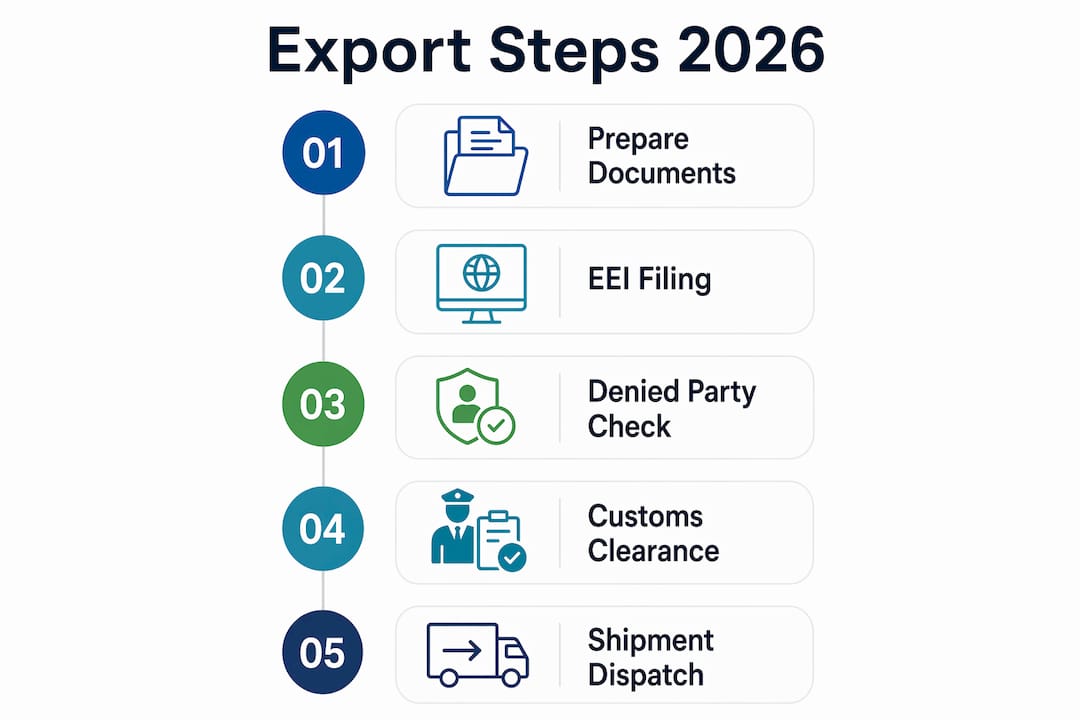
The export process follows a clear sequence. Skipping or rushing any step creates compliance risk downstream.
-
Assess export readiness. Confirm your product can legally be exported and that your business has the operational capacity to fulfill international orders. This includes reviewing your supply chain, pricing, and target market regulations.
-
Register and obtain required licenses. Most businesses need an Importer-Exporter Code or equivalent registration. Only about 5% of U.S. exports require a specific export license, but determining whether yours does requires screening your product against export control lists maintained by agencies like the Bureau of Industry and Security (BIS). That small percentage still represents thousands of shipments annually, so the check is non-negotiable.
-
Classify and value your product. Assign the correct Harmonized System (HS) code and declare an accurate transaction value. Both figures drive duty calculations and determine which regulations apply.
-
Prepare your shipment documents. Core export documents include the commercial invoice, packing list, and bill of lading or air waybill. Additional certificates such as a certificate of origin or phytosanitary certificate may be required depending on the product and destination country.
-
File Electronic Export Information (EEI) through AES. EEI filing is mandatory for most U.S. commercial exports valued over $2,500 or requiring an export license. The AES system returns an Internal Transaction Number (ITN) upon successful filing.
-
Obtain the ITN and authorize loading. Carriers cannot legally move goods without a valid ITN or an approved exemption citation. This number is your legal proof of export clearance.
-
Complete customs clearance and load the shipment. Customs officers may inspect the cargo before authorizing departure. Once cleared, the shipment loads and departs.
-
Retain records for five years. U.S. law requires exporters to keep invoices, shipping documents, and EEI filing proofs for five years after the export date.
Pro Tip: Build your document checklist before you book the shipment, not after. Waiting until cargo is at the port to gather paperwork is the single most common cause of preventable delays.
What are the key export documentation requirements?
Documentation is the primary enforcement tool for U.S. export compliance. Government agencies track export details through these records to prevent unlawful shipments and verify trade data accuracy.
The core documents every exporter needs are:
- Commercial invoice: States the buyer, seller, goods description, quantity, and declared value. Customs authorities on both ends use it to assess duties and verify the transaction.
- Packing list: Details the physical contents of each package, including weights and dimensions. Discrepancies between the packing list and the commercial invoice are a common trigger for inspection.
- Bill of lading or air waybill: The transport contract between the shipper and the carrier. It also serves as a receipt for the goods.
- Certificate of origin: Confirms where the goods were manufactured. Many trade agreements require this document to qualify for preferential duty rates.
- Phytosanitary certificate or dangerous goods declaration: Required for agricultural products or hazardous materials, depending on the destination country’s import rules.
The EEI filing sits above all of these in terms of compliance weight. The ITN returned by AES after a successful EEI filing is the legal authorization proof for export clearance. Without it, no carrier can legally load the shipment. This is a hard stop, not a procedural suggestion.
Documentation errors trigger audits and shipment delays due to rigorous U.S. government oversight of trade transactions. Even minor inconsistencies, such as a value discrepancy of a few dollars between the invoice and the EEI, can generate a compliance flag. The safest approach is to cross-check every document against the others before submitting anything.

Pro Tip: Use a master document template for each trade lane you operate. Standardizing fields like product descriptions and HS codes across all documents eliminates the inconsistencies that cause compliance flags.
| Document | Purpose | When Required |
|---|---|---|
| Commercial invoice | Declares transaction value and parties | Every commercial export |
| Packing list | Details physical shipment contents | Every commercial export |
| Bill of lading / air waybill | Transport contract and cargo receipt | Every shipment |
| EEI via AES | Legal export filing with U.S. government | Exports over $2,500 or requiring a license |
| Certificate of origin | Confirms manufacturing country | When trade agreements apply |
| Export license | Government authorization to export controlled goods | Controlled products or restricted destinations |
How do export compliance and customs clearance affect international shipping?
Export compliance is not a one-time checkbox. It is an ongoing process that runs parallel to every shipment you book.
The first compliance action is denied party screening. Exporters must screen all involved parties, including buyers, freight forwarders, and end users, against restricted party lists and sanctions databases maintained by agencies like the Office of Foreign Assets Control (OFAC) and BIS. Failing this screen is a serious export violation, regardless of whether the exporter knew the party was restricted.
Timing is the second critical compliance factor. EEI filings must generally be submitted 1 to 24 hours before export, with tighter windows for air and sea freight. Late filings mean the shipment legally cannot depart on schedule. This is a fact many businesses learn the hard way on their first international shipment.
The customs clearance process itself involves:
- Document review: Customs officers verify that all submitted documents are consistent and complete.
- Cargo inspection: Physical or X-ray inspection may occur, particularly for high-value goods, controlled products, or shipments to flagged destinations.
- Authorization to load: Once cleared, customs issues authorization and the carrier can load the goods.
- Post-departure reporting: Some shipments require follow-up reporting after departure, particularly for in-transit goods.
Non-compliance carries real consequences. Shipments can be held indefinitely, export licenses can be suspended, and civil or criminal penalties can follow. The export compliance essentials framework treats every shipment as a compliance event, not just a logistics transaction.
What are best practices for exporters to reduce errors and stay compliant?
The businesses that export successfully at scale share a few consistent habits. These are not aspirational goals. They are operational standards.
- Use export documentation software. Software tools integrate directly with AESDirect for faster, more accurate EEI submission. Automated filing reduces manual entry errors and creates a digital audit trail.
- Work with a licensed freight forwarder. Authorized forwarders understand filing responsibilities and can act as the exporter of record when needed. Clarify in writing who is responsible for AES filing before the shipment moves.
- Maintain records for five years. This is a U.S. legal requirement. Keep invoices, shipping documents, and EEI proofs organized and accessible.
- Know your value thresholds and exemptions. Not every shipment requires EEI filing. Understanding the $2,500 threshold and applicable exemptions saves time without creating compliance gaps.
- Train your team regularly. International trade regulations change. Exporters who train staff annually on export compliance updates catch regulatory changes before they become violations.
Pro Tip: Assign one person in your organization as the export compliance owner. When everyone is responsible for compliance, no one actually is. A single point of accountability prevents filings from falling through the cracks.
Key Takeaways
A successful export procedure requires accurate documentation, timely AES filing, denied party screening, and five years of recordkeeping to meet U.S. legal standards and avoid shipment holds.
| Point | Details |
|---|---|
| EEI filing is mandatory | Most U.S. exports over $2,500 require EEI filing through AES before the shipment departs. |
| ITN is your clearance proof | Carriers cannot legally load goods without a valid Internal Transaction Number from AES. |
| Documentation accuracy matters | Even minor inconsistencies across documents can trigger government audits and delays. |
| Compliance timing is strict | EEI filings must be submitted 1–24 hours before departure depending on shipment mode. |
| Records must be kept five years | U.S. law requires exporters to retain all shipping and filing documents for five years. |
The part of export compliance most businesses underestimate
After years of watching businesses prepare for their first international shipments, the pattern is consistent. Companies spend weeks on product pricing, market research, and logistics quotes. Then they treat the AES filing as a five-minute task to handle the morning the truck arrives.
That misunderstanding is where most first-time export problems originate. Businesses often believe EEI filings can happen after goods leave, but filings must be completed prior to export within strict time windows. The ITN has to exist before the carrier touches the cargo. There is no workaround.
The deeper issue is that exporters sometimes view documentation as a bureaucratic formality rather than the legal record of their trade activity. U.S. government agencies use these records to enforce sanctions, track controlled goods, and verify trade statistics. Every document you submit is a legal statement. Treating it that way from the start changes how carefully your team prepares each shipment.
My strongest advice is to build your compliance infrastructure before you need it. That means a document checklist, a denied party screening process, a clear agreement with your freight forwarder on who files the EEI, and a recordkeeping system that does not live in someone’s email inbox. Businesses that build these systems early rarely face the shipment holds and audit letters that catch underprepared exporters off guard.
The global trade environment is also not static. Sanctions lists update without warning. Export control classifications change. A product that shipped freely last year may require a license this year. Continuous education on international trade regulations is not optional for businesses that export regularly. It is the cost of operating in global markets.
— Ian
How Worldwideexpress supports your export operations
Exporting successfully means having the right logistics partner behind every shipment, not just a carrier.
Worldwideexpress specializes in international freight shipping, customs brokerage, and export compliance support for businesses moving goods across borders. From AES filing assistance to full customs clearance facilitation, the team at Worldwideexpress handles the procedural complexity so your shipments move on time and within legal requirements. Explore Worldwideexpress’s international logistics services to see how expert support simplifies every step of the export process, from documentation preparation to final delivery. For businesses ready to scale their cross-border operations, Worldwideexpress offers the global reach and compliance expertise that international trade demands.
FAQ
What is the export procedure in international business?
The export procedure in international business is the formal sequence of steps, including documentation, compliance checks, and customs clearance, that businesses must complete to legally ship goods to foreign markets.
When must EEI be filed through AES?
EEI must be filed through AES before the shipment departs, generally 1–24 hours in advance depending on the transport mode. Late or missing filings prevent the shipment from legally departing on schedule.
What documents are required for exporting goods?
Core export documents include the commercial invoice, packing list, bill of lading or air waybill, and EEI filing. Additional documents like a certificate of origin or phytosanitary certificate may be required based on the product and destination.
Do all U.S. exports require an export license?
Only about 5% of U.S. exports require an export license. License requirements depend on the product classification, the buyer, and the destination country, and exporters must screen against government control lists to determine applicability.
How long must exporters keep their shipping records?
U.S. exporters must retain all export-related records, including invoices, shipping documents, and EEI filing proofs, for five years from the date of export to comply with federal recordkeeping requirements.
Recommended
- Master the Export Documentation Process in 2025 – Worldwide Express, Inc.
- Step-by-step guide to exporting goods: compliance to shipment – Worldwide Express, Inc.
- Master Exporting Food Products: A Step-by-Step Approach – Worldwide Express, Inc.
- Importing from Europe: Step-by-Step U.S. Business Guide – Worldwide Express, Inc.