TL;DR:
- Proper compliance and documentation are critical to avoid costly export delays and penalties.
- Correct classification codes and clear responsibilities through Incoterms ensure smooth shipments.
- Utilizing trusted logistics partners and thorough preparation increases export success and reduces risks.
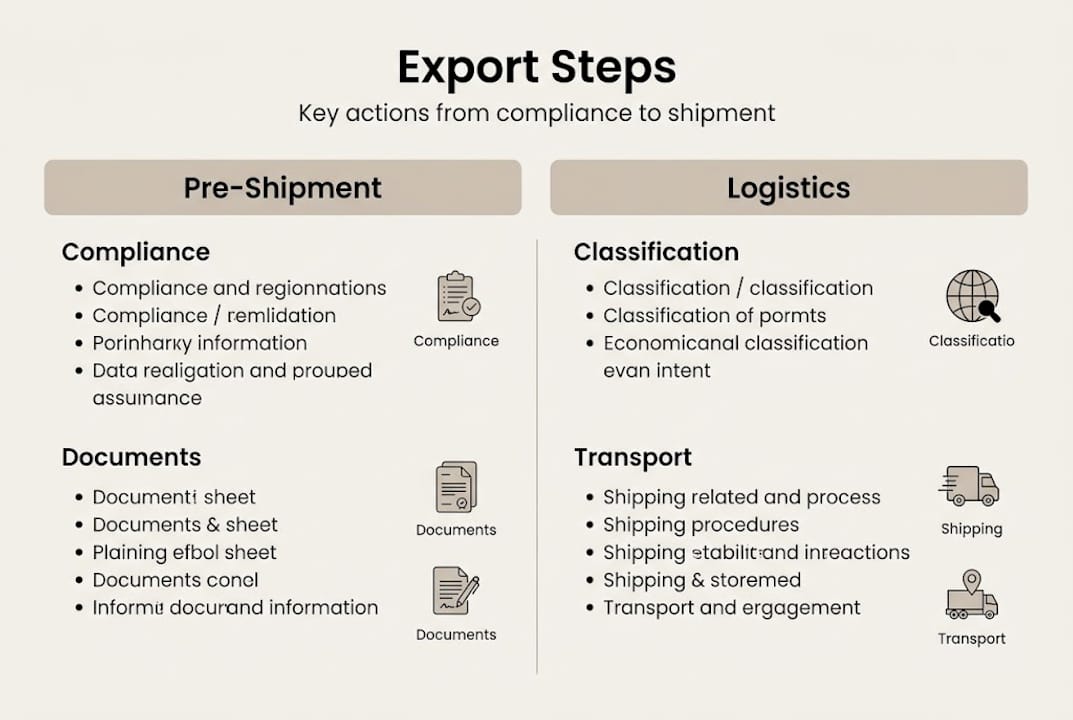
Exporting goods opens remarkable revenue opportunities, but it also exposes businesses to costly missteps that can stall shipments, trigger penalties, or damage trade relationships. A single missing document or an overlooked export license requirement can freeze cargo at the border for days. General export steps involve preparation, compliance checks, and documentation, yet many businesses treat these as afterthoughts rather than priorities. This guide walks through every critical stage, from confirming legal requirements and assembling the right paperwork to classifying goods correctly and executing the final shipment, so exporters can move confidently and avoid the pitfalls that catch unprepared companies off guard.
Table of Contents
- Understand export requirements and product controls
- Prepare mandatory export documentation
- Classify goods and allocate responsibilities
- Arrange transportation, customs clearance, and shipment
- A practical take: Why export success hinges on preparation, not luck
- Accelerate your export process with trusted partners
- Frequently asked questions
Key Takeaways
| Point | Details |
|---|---|
| Always check controls | Most exports do not require a license, but skipping a compliance check can halt your shipment entirely. |
| Proper paperwork is crucial | Accurate, complete documentation speeds customs approval and avoids costly delays. |
| Classify and allocate risk | Correct product codes and clear Incoterms help prevent surprises in costs and responsibilities. |
| Expert partners save time | Using customs brokers or freight forwarders reduces mistakes and streamlines the process. |
Understand export requirements and product controls
With the need for structure clear, let’s start at the foundation: legal and regulatory readiness. Before a single box is packed, exporters must confirm whether their product requires an export license and whether the destination country carries any restrictions. Skipping this step is one of the most expensive mistakes a business can make.
The U.S. government assigns export control authority across several agencies. The Bureau of Industry and Security (BIS) governs commercial and dual-use goods, meaning products that have both civilian and military applications. The Directorate of Defense Trade Controls (DDTC) oversees defense articles under the International Traffic in Arms Regulations (ITAR). Other agencies, such as the FDA and USDA, regulate specific product categories like food, biologics, and agricultural items.
Checking import and export laws before shipment is not optional. It is a legal obligation. Products like motor vehicles, biological materials, encryption software, and certain chemicals carry heightened scrutiny and may require specific licenses regardless of destination.
Here is a practical checklist to assess your product:
- Identify your product’s Export Control Classification Number (ECCN) on the Commerce Control List
- Check whether the destination country appears on any restricted or embargoed lists
- Verify if the end user or end use triggers additional review
- Confirm whether any Partner Government Agencies (PGAs) have jurisdiction over your product
- Consult export compliance essentials to map your obligations before moving forward
“Exporters who invest time in understanding controls upfront rarely face the costly delays that plague those who treat compliance as a formality.”
The reassuring reality is that only about 5% of U.S. exports require a license. The vast majority of commercial goods move freely. But that 5% carries significant legal exposure, so every exporter should verify their position rather than assume they fall in the clear majority.
Pro Tip: Use the export license process resources to pre-screen your goods before engaging freight partners. Early identification of licensing needs prevents last-minute scrambles that delay shipments.
Prepare mandatory export documentation
Once compliance is confirmed, documentation becomes the heart of the export process. Incomplete or inaccurate paperwork is the leading cause of shipment delays and customs holds worldwide. Getting this right requires knowing exactly which documents apply to your shipment and how to complete them without errors.

Here is a breakdown of the core export documents every exporter must understand:
| Document | Purpose | When required |
|---|---|---|
| Commercial invoice | Declares value, buyer, seller, and goods | Always |
| Pro forma invoice | Preliminary price quote for buyer | Pre-shipment negotiations |
| Packing list | Details contents, weight, dimensions | Always |
| Bill of lading / airway bill | Transport contract and title transfer | Always |
| Certificate of origin | Confirms country of manufacture | Destination-dependent |
| Electronic Export Information (EEI) | U.S. export declaration via AES | Shipments over $2,500 or licensed |
Per DHS guidance, exporters must prepare key documents including the commercial invoice, pro forma invoice, packing list, bill of lading or airway bill, certificate of origin, and EEI via the Automated Export System (AES) for shipments exceeding $2,500 or when a license is required.
To build a clean documentation package, follow these steps:
- Confirm the buyer’s country-specific requirements before drafting any document
- Complete the commercial invoice with precise HS/Schedule B codes, declared values, and full party details
- Prepare the packing list to match the invoice exactly, noting packing list essentials for accuracy
- Obtain a certificate of origin from your local chamber of commerce if required
- File the EEI through AES before the shipment departs
- Retain copies of all documents for at least five years per U.S. recordkeeping requirements
Review export shipping documentation standards to ensure your forms meet current requirements. Even minor discrepancies between the invoice and packing list can trigger a customs examination, adding days to your delivery timeline.
Pro Tip: Contact the buyer early in the process to confirm which destination-specific documents they need. Some countries require legalized or apostilled certificates of origin, and obtaining these takes time. Also, review CBP guidance to confirm any additional filing requirements for your commodity.
A common mistake is treating the pro forma invoice as optional. For buyers seeking import permits or arranging financing, it is often a prerequisite. The export documentation process is far smoother when both parties align on requirements before goods are ready to ship.
Classify goods and allocate responsibilities
With documents in order, the next step is correctly defining your shipment in regulatory and commercial terms. Two elements matter most here: the product’s classification code and the Incoterms that govern who is responsible for what during the shipment.
Schedule B codes (used for U.S. exports) and Harmonized System (HS) codes (used internationally) determine the duties, taxes, and regulatory requirements that apply at the destination. An incorrect code is not just a paperwork error. It can result in underpaid duties, customs seizures, or export violations. Per export trade guidance, classifying goods using Schedule B or HS codes and determining Incoterms are foundational steps in any export transaction.
Incoterms 2020 are a set of 11 internationally recognized trade terms published by the International Chamber of Commerce. They define who arranges transport, who pays for freight and insurance, and at what point risk transfers from seller to buyer. According to ICC guidance, Incoterms 2020 are crucial for risk allocation, especially in environments where tariffs are shifting.
Here is a quick reference for common Incoterms and their responsibility split:
| Incoterm | Seller’s responsibility ends | Buyer takes risk |
|---|---|---|
| EXW (Ex Works) | At seller’s premises | Immediately |
| FOB (Free on Board) | When goods are on vessel | At port of loading |
| CIF (Cost, Insurance, Freight) | At destination port | At destination port |
| DDP (Delivered Duty Paid) | At buyer’s location | At buyer’s location |
Key considerations when selecting Incoterms:
- DDP places maximum obligation on the exporter, including import duties at destination
- FOB is widely used for ocean freight and gives buyers control over the main carriage
- CIF is common but can create ambiguity over insurance adequacy
- Always confirm the agreed term is reflected in the sales contract and all shipping documents
Pro Tip: Discuss Incoterms with the buyer before finalizing the sales contract. Misaligned expectations about who handles export clearance or insurance are a leading source of trade disputes. Also review guidance on packing goods for export to ensure your physical shipment matches the agreed terms.
Arrange transportation, customs clearance, and shipment
With responsibilities clarified, it’s time for execution: the actual movement of goods across borders. This stage involves selecting the right logistics partners, booking transport, and ensuring all regulatory filings are complete before the shipment departs.
A freight forwarder is arguably the most valuable partner an exporter can have. They coordinate the entire logistics chain, from booking cargo space with carriers to managing documentation and liaising with customs authorities. Understanding the role of a freight forwarder helps exporters set clear expectations and get the most from the relationship. Customs brokers, on the other hand, specialize in regulatory compliance and can navigate complex filing requirements that trip up first-time exporters.
Per SBA guidance, using freight forwarders or customs brokers for compliance is strongly recommended, particularly when dealing with Partner Government Agencies (PGAs) or destination-specific import requirements.
Here is a step-by-step execution sequence:
- Select a licensed freight forwarder or cargo freight forwarder with experience in your trade lane
- Book transportation mode: ocean, air, or ground, based on cost, speed, and cargo type
- Confirm cargo insurance coverage adequate for the declared shipment value
- File the Electronic Export Information (EEI) via AES before the cargo departs
- Obtain the bill of lading or airway bill from the carrier after loading
- Track the shipment and retain all export records for compliance purposes
The AES filing requirements are non-negotiable. Per CBP rules, exporters must arrange transportation, freight forwarding, and insurance and file the export declaration before departure.
“Failure to file the EEI on time is a federal violation. Penalties can reach $10,000 per violation, and willful violations carry criminal exposure.”
Insurance deserves more attention than most exporters give it. Standard carrier liability is often minimal relative to cargo value. A comprehensive cargo policy protects against loss, damage, and delay across the entire transit. Review the export process logistics framework to confirm your coverage aligns with the shipment’s risk profile.
A practical take: Why export success hinges on preparation, not luck
Beyond the tactical steps, there’s a deeper insight that sets top exporters apart. The businesses that consistently move goods across borders without incident are not operating with better luck. They are operating with better systems.
The most common causes of export failure are not geopolitical disruptions or carrier delays. They are missing compliance documents, incorrect HS codes, and EEI filings submitted late or not at all. These are entirely preventable errors. Experienced exporters treat checklists as non-negotiable, not as bureaucratic overhead.
There is a persistent myth in trade circles that speed is the competitive advantage. In reality, thoroughness wins. A shipment that clears customs on the first attempt in four days beats a rushed shipment held for examination for two weeks every time. Reviewing export compliance best practices before each new trade lane or product category is a habit that pays dividends.
The advice from veterans in this industry is consistent: start early, double-check every requirement against official rulebooks, and invest in expert help before problems arise, not after.
Accelerate your export process with trusted partners
Ready to make exporting simpler and more reliable? Navigating compliance, documentation, and logistics across multiple trade lanes is a significant operational challenge, and the margin for error is thin.
Worldwide Express brings together experienced customs brokers, freight forwarders, and risk management specialists under one roof. From freight forwarding solutions to customs brokerage services that keep shipments moving, the platform is built for businesses that take international trade seriously. Protect your cargo with tailored cargo insurance solutions and gain the confidence that comes from working with a team that has handled thousands of cross-border shipments across every major trade lane.
Frequently asked questions
What are the main documents needed to export goods?
The main export documents include a commercial invoice, bill of lading, packing list, certificate of origin, and EEI for shipments over $2,500 or when a license is required.
How do I know if my goods need an export license?
Check your product against the Commerce Control List; only about 5% of U.S. exports require a license, typically for controlled or dual-use items.
Who is responsible for customs clearance when exporting?
Responsibility is determined by the agreed Incoterms. Under Schedule B and Incoterms frameworks, the exporter or their freight forwarder typically handles export clearance.
What happens if I make a mistake on my export documents?
Errors can delay your shipment or trigger penalties. EEI filing errors are especially serious, as they constitute federal violations with significant financial and legal consequences.
Recommended
- How to Import Goods: A Step-by-Step Guide for Success – Worldwide Express, Inc.
- Master Export Shipping Documentation for Success – Worldwide Express, Inc.
- Master Exporting Food Products: A Step-by-Step Approach – Worldwide Express, Inc.
- Master the Export Documentation Process in 2025 – Worldwide Express, Inc.