TL;DR:
- A forwarder bill, also known as an HBL, is a legally binding document issued by an FMC-licensed freight forwarder that serves as receipt, contract, and sometimes a document of title. It creates a direct relationship between the shipper and the forwarder and plays a crucial role in customs clearance and trade finance. Ensuring document accuracy, understanding its differences from the master bill, and verifying licensing are essential to preventing costly shipping and payment issues.
A forwarder bill is the industry term for a House Bill of Lading (HBL) or Freight Forwarder Bill of Lading (FBL), issued by an NVOCC or freight forwarder to the shipper as a receipt of goods, contract of carriage, and sometimes a document of title. For importers and exporters, this document defines the legal relationship between you and your freight forwarder, governs cargo release, and can determine whether a bank pays out under a letter of credit. Understanding what a forwarder bill is, how it differs from a master bill of lading, and where it can go wrong is not optional knowledge. It is the foundation of competent international shipping.
What is a forwarder bill and what does it legally do?
A forwarder bill, formally known as a House Bill of Lading, is a legally binding transport document that creates a direct contractual relationship between the shipper and the freight forwarder or NVOCC. The forwarder assumes the role of carrier in this relationship, taking on liability for the cargo from origin to destination as defined in the document’s terms. This is a critical distinction: the forwarder is not merely arranging transport. The forwarder is contractually responsible to you.

The forwarder bill serves three distinct legal functions simultaneously. As a receipt, it confirms the forwarder has taken possession of the goods in the described condition. As a contract of carriage, it sets the terms under which the goods will be transported. As a potential document of title, a negotiable forwarder bill allows the holder to claim the cargo at destination, which makes it a transferable financial instrument in trade transactions.
The negotiable versus non-negotiable distinction carries real consequences. A negotiable forwarder bill, made out “to order,” can be endorsed and transferred to a third party, enabling banks to use it as collateral in letter of credit transactions. A straight (non-negotiable) forwarder bill names a specific consignee and cannot be transferred. Choosing the wrong type for a financed shipment can block payment release entirely.
The Federal Maritime Commission draws a clear regulatory line between ocean freight forwarders, who arrange shipments, and NVOCCs, who issue forwarder bills and formally assume carrier status. Only FMC-licensed entities have legal authority to issue an enforceable forwarder bill. Shippers who work with unlicensed operators have no legal recourse in the event of cargo loss or damage. Verifying FMC licensing before engaging any forwarder is not a formality. It is a financial safeguard.
Pro Tip: Before signing any forwarding agreement, request the forwarder’s FMC license number and verify it directly on the FMC’s public database at fmc.gov. This takes under two minutes and protects you from unenforceable contracts.
Key legal functions of a forwarder bill include:
- Receipt of goods: Confirms cargo condition and quantity at pickup
- Contract of carriage: Establishes terms, liability, and routing obligations
- Document of title: Enables cargo ownership transfer when issued in negotiable form
- Letter of credit instrument: Serves as the primary shipping document banks require for payment release
How does a forwarder bill differ from a master bill of lading?
New shippers consistently confuse the House Bill of Lading with the Master Bill of Lading (MBL), and the confusion is understandable. Both documents look similar. Both cover the same physical cargo. But they are legally independent documents with entirely different parties, liabilities, and purposes.
The Master Bill of Lading is issued by the ocean carrier, such as Maersk, MSC, or CMA CGM, to the NVOCC or freight forwarder. The carrier recognizes only the forwarder as its customer on the MBL. The actual shipper does not appear on the master bill at all. The forwarder bill, by contrast, is issued by the forwarder to the actual shipper, covering the same cargo but within a separate contractual layer. You can learn more about bill of lading varieties to see how these documents fit into the broader documentation framework.
This layered structure exists for a practical reason. Freight forwarders often consolidate multiple smaller shipments from different shippers into a single container, a practice known as Less than Container Load (LCL) shipping. The carrier issues one MBL to the forwarder for the entire container. The forwarder then issues individual forwarder bills to each shipper for their portion of the cargo. The MBL and the HBL operate in parallel, not in sequence.
| Feature | Forwarder Bill (HBL) | Master Bill of Lading (MBL) |
|---|---|---|
| Issued by | Freight forwarder or NVOCC | Ocean carrier (Maersk, MSC, etc.) |
| Issued to | Actual shipper | NVOCC or freight forwarder |
| Governs | Forwarder-to-shipper relationship | Carrier-to-forwarder relationship |
| Shipper on document | Actual exporter | Freight forwarder |
| Used in LCL | Yes, one per shipper | No, one per container |
| Negotiable form available | Yes | Yes |
| Relevant for letter of credit | Yes, primary document | Rarely, unless direct shipment |
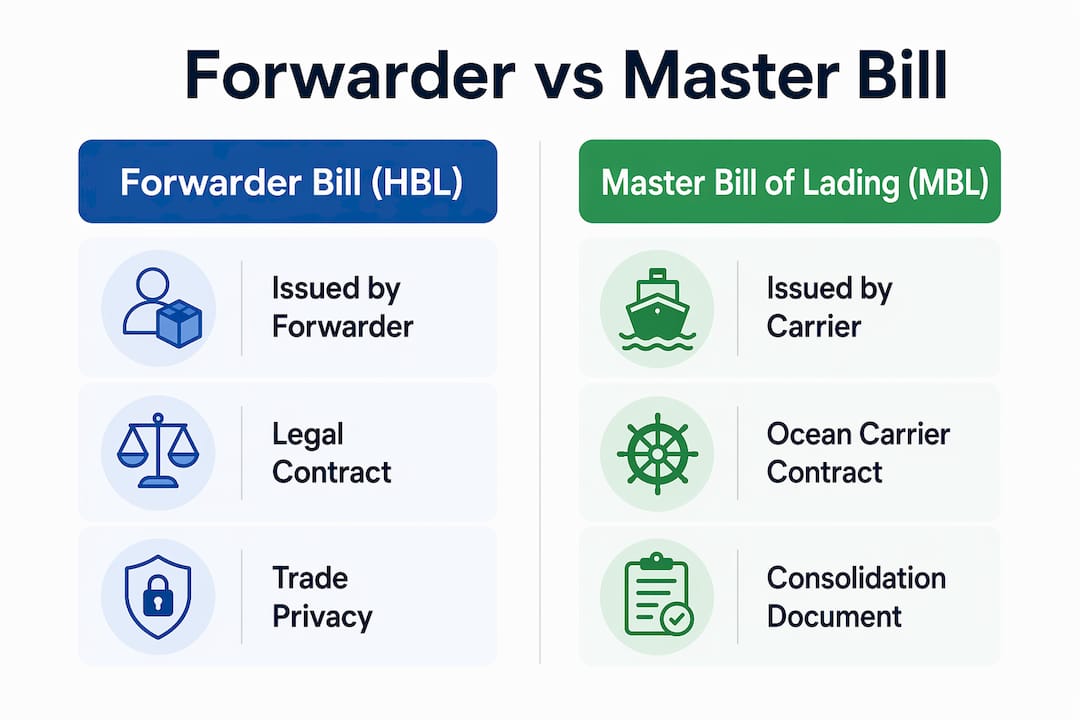
The legal independence of these two documents means that a dispute under the HBL does not automatically involve the ocean carrier, and vice versa. If a forwarder fails to deliver cargo, the shipper’s claim is against the forwarder under the HBL, not against Maersk or MSC under the MBL. This separation protects carriers from shipper disputes they have no visibility into, and it places the forwarder squarely in the middle as the accountable party.
What practical steps should importers and exporters take with forwarder bills?
Receiving a forwarder bill is not the end of the documentation process. It is the beginning of a verification sequence that determines whether your cargo clears customs without delay or sits at a terminal accumulating demurrage charges.
The most common operational failure is a mismatch between the forwarder bill and the master bill. Discrepancies between these documents cause customs delays, penalty fees, and extended cargo holds at terminals. A single transposed digit in a container seal number, a port name spelled differently across the two documents, or a weight discrepancy of even a few kilograms can trigger a customs examination. The cost of that examination, in time and fees, far exceeds the cost of a careful pre-shipment review.
Follow this verification sequence before any shipment departs:
- Confirm shipper and consignee details match exactly across the forwarder bill, commercial invoice, and packing list. Even minor variations in company name spelling create customs flags.
- Verify port of loading and port of discharge are identical on both the HBL and MBL. Routing changes made by the carrier after booking must be reflected in both documents.
- Check cargo description, HS codes, and weight against the packing list. Customs authorities cross-reference these figures, and discrepancies trigger inspections.
- Confirm the document type (negotiable or straight) matches your payment terms. If you are operating under a letter of credit, the bank’s requirements for the forwarder bill must be met precisely.
- Reconcile seal numbers and container numbers between the HBL and MBL before the vessel departs. Corrections after departure require amendments that delay cargo release.
Forwarder bills also provide a meaningful trade privacy advantage. The forwarder appears as shipper on the master bill, which prevents the ocean carrier from identifying your actual customers or suppliers. This matters for businesses that want to protect supplier relationships from competitors who might otherwise identify their source factories through carrier records.
Pro Tip: Request a draft forwarder bill from your freight forwarder at least 48 hours before the vessel’s cut-off time. This gives you a window to catch errors before they become expensive amendments or customs holds. Review it against your shipping documentation checklist every time.
What role does the forwarder bill play in trade finance?
The forwarder bill’s role in international trade finance is where its importance becomes most acute. Freight forwarders issue forwarder bills as part of managing the full documentation chain, from customs clearance to cargo consolidation, and the accuracy of those documents directly affects whether financial transactions complete.
In letter of credit transactions, the issuing bank specifies exactly which documents it requires for payment release, and the forwarder bill is typically the primary shipping document. Errors in the forwarder bill cause banks to refuse payment even when the cargo has arrived safely at destination. A discrepancy as minor as “Ltd.” versus “Limited” in a company name is sufficient grounds for a bank to declare a documentary discrepancy and withhold funds. This is not a theoretical risk. It is one of the most frequent causes of delayed payment in international trade.
The forwarder bill also enables ownership transfer during transit. When issued in negotiable form, the document can be endorsed and passed between parties, allowing a buyer to sell cargo while it is still at sea. This mechanism underpins commodity trading and back-to-back letter of credit structures used extensively in sectors like agricultural commodities, metals, and energy products.
Key roles of the forwarder bill in trade finance include:
- Letter of credit compliance: Banks require the forwarder bill to match LC terms exactly before releasing payment
- Cargo ownership transfer: Negotiable HBLs allow title to change hands during transit
- LCL consolidation documentation: One MBL covers multiple HBLs, enabling forwarders to offer competitive rates on smaller shipments
- Customs clearance trigger: The consignee presents the forwarder bill to claim cargo at destination
Understanding the bill of lading’s role in letters of credit is particularly valuable for exporters who rely on documentary credit as their primary payment security mechanism. The financial stakes attached to a correctly drafted forwarder bill are not abstract. They are the difference between getting paid and filing a dispute.
Key takeaways
A forwarder bill is a legally binding HBL issued by an FMC-licensed freight forwarder or NVOCC, and its accuracy directly determines customs clearance speed, cargo release rights, and payment outcomes in letter of credit transactions.
| Point | Details |
|---|---|
| Forwarder bill definition | An HBL issued by a forwarder or NVOCC serving as receipt, contract, and document of title. |
| Legal authority matters | Only FMC-licensed forwarders issue enforceable bills; unlicensed operators leave shippers unprotected. |
| HBL vs. MBL distinction | These are legally independent documents with separate parties, liabilities, and contractual purposes. |
| Document accuracy is critical | Discrepancies between HBL and MBL cause customs delays, terminal holds, and bank payment refusals. |
| Trade finance function | Negotiable forwarder bills enable ownership transfer and are required instruments in letter of credit transactions. |
Why most forwarder bill problems are entirely preventable
I have reviewed hundreds of shipping disputes over the years, and the pattern is almost always the same. The forwarder bill was not wrong because of some complex legal ambiguity. It was wrong because nobody checked it carefully before the vessel sailed.
The most damaging mistake I see importers and exporters make is treating the forwarder bill as a formality rather than a legal instrument. They receive the draft, glance at the cargo description, and approve it. Then they spend three weeks arguing with customs authorities over a weight discrepancy that was visible in the original document. The relationship between HBL and MBL is where most of these problems originate, and reconciling the two documents before departure eliminates the majority of them.
The trade privacy function of the forwarder bill is also underused. Businesses that have spent years building supplier relationships in Asia or Latin America often have no idea that their forwarder can shield those relationships from competitors by appearing as the shipper on the master bill. That is a structural advantage built into the documentation system, and it costs nothing to use.
My recommendation is straightforward: treat every forwarder bill review as a financial audit. Cross-reference it against your commercial invoice, packing list, and letter of credit terms before you approve it. If your forwarder cannot produce a draft 48 hours before cut-off, find one who can. The document is too important to rush.
— Ian
How Worldwideexpress supports your freight forwarding documentation
Worldwideexpress brings deep expertise in freight forwarding documentation, customs compliance, and international shipping to importers and exporters who need more than a booking platform. From verifying forwarder bill accuracy to managing the full documentation chain across air and ocean shipments, Worldwideexpress handles the details that protect your cargo and your payments.
Whether you are shipping LCL consolidations across the Pacific or managing time-sensitive air freight with letter of credit requirements, Worldwideexpress provides the documentation expertise and FMC-compliant processes your shipments require. Start with the 2026 freight forwarding guide to understand the full scope of services available, or explore the ocean freight forwarding steps to see exactly how forwarder bills fit into the end-to-end shipping process.
FAQ
What is the difference between a forwarder bill and a bill of lading?
A forwarder bill (HBL) is issued by a freight forwarder or NVOCC to the actual shipper, while a standard bill of lading is issued by the ocean carrier directly. The forwarder bill governs the forwarder-to-shipper relationship, whereas the carrier’s master bill governs the carrier-to-forwarder relationship.
Can a forwarder bill be used for customs clearance?
Yes. The consignee presents the forwarder bill to claim cargo and initiate customs clearance at the destination port. Accuracy between the forwarder bill and master bill is critical, as discrepancies trigger customs holds and penalty fees.
Who is legally authorized to issue a forwarder bill?
Only FMC-licensed freight forwarders and NVOCCs have legal authority to issue an enforceable forwarder bill. Shippers working with unlicensed entities have no legal recourse in the event of cargo loss or damage.
Is a forwarder bill accepted in letter of credit transactions?
Yes, provided it meets the exact terms specified by the issuing bank. Errors in the document cause banks to refuse payment even when cargo has arrived, making precise drafting a financial necessity.
What is the difference between a negotiable and a straight forwarder bill?
A negotiable forwarder bill is made out “to order” and can be endorsed and transferred to a third party, enabling ownership transfer during transit. A straight forwarder bill names a specific consignee and cannot be transferred, making it unsuitable for most letter of credit or trade finance arrangements.
Recommended
- Understanding freight forwarding: a 2026 guide – Worldwide Express, Inc.
- Carrier vs Forwarder: Key Differences for Smart Shipping – Worldwide Express, Inc.
- What is the Bill of Entry? Understanding Its Importance – Worldwide Express, Inc.
- Understanding the Role of a Freight Forwarder – Worldwide Express, Inc.